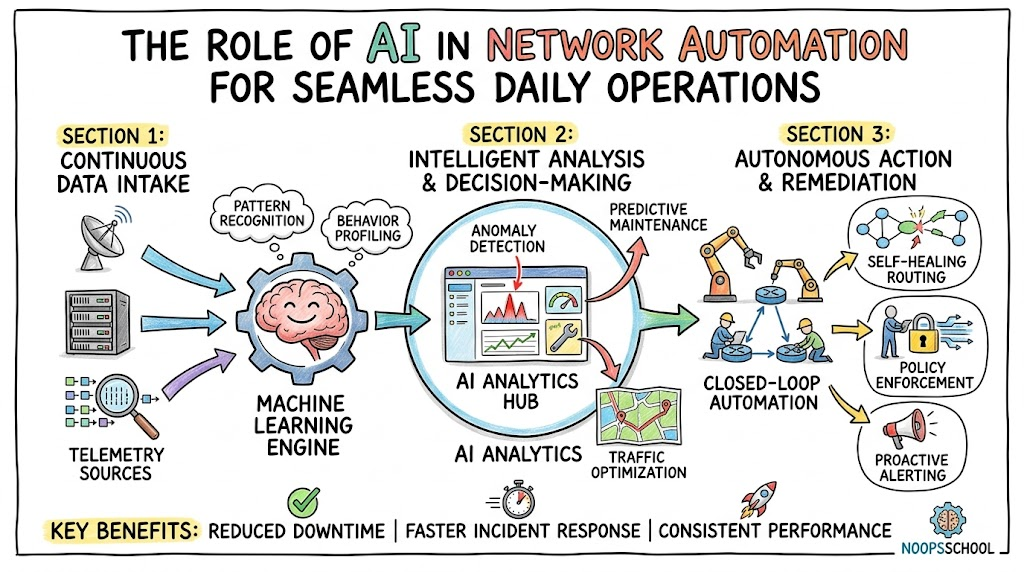
Modern digital infrastructure demands rapid adjustments, immense resilience, and uninterrupted uptime. As distributed computing environments grow increasingly intricate, manual administration struggles to keep pace with dynamic data flows. Consequently, enterprises now turn toward intelligent software systems to monitor, optimize, and protect their physical and virtual topologies. Artificial intelligence brings predictive decision-making and closed-loop control to infrastructure operations, allowing organizations to maintain consistent connectivity.
Traditional scripting handles static workloads effectively, but it lacks the contextual awareness required to solve unanticipated traffic spikes or intermittent link degradations. By integrating machine learning algorithms directly into routing and management fabrics, network architectures transition from reactive repair models to proactive self-healing environments. You can discover modern enterprise frameworks and practical platform engineering practices at Noopsschool to enhance your infrastructure capabilities. Implementing artificial intelligence in networking reduces operational overhead while delivering seamless experiences for end users.
Foundations of Machine Intelligence in Infrastructure Engineering
Modern telecommunication environments produce massive streams of telemetry that overwhelm traditional human analysis. When telemetry arrives from thousands of distributed switches and edge routers, operations teams cannot manually correlate events across disparate locations. Machine intelligence continuously ingests high-frequency telemetry data to uncover hidden patterns within complex traffic flows. As a result, network platforms detect subtle anomalies before they cascade into noticeable outages.
Beyond simple pattern recognition, intelligent software platforms classify varied application traffic according to business criticality. Algorithms evaluate packet parameters in real time, assigning dynamic prioritization based on latency tolerances and security policies. Furthermore, automated models establish reliable baseline metrics across peak and off-peak operating cycles. This continuous behavioral profiling provides engineering teams with accurate insights into baseline infrastructure health.
[ Telemetry Ingestion ] ➔ [ Real-Time AI Inference ] ➔ [ Closed-Loop Automation ] ➔ [ Network Optimization ]
Dynamic Telemetry Processing
Traditional Simple Network Management Protocol polling operates at fixed intervals, creating blind spots between collection cycles. Modern streaming telemetry pushes continuous state metrics from network interfaces directly to analytics pipelines. Intelligent ingestion engines process these telemetry streams immediately to evaluate link quality, interface errors, and memory utilization. Consequently, systems identify transient packet drops and queue congestion instantaneously.
Algorithmic Anomaly Detection
Static threshold alerting frequently triggers alert fatigue by notifying on-call engineers about harmless transient spikes. Machine learning algorithms apply time-series decomposition and statistical clustering to distinguish genuine system faults from normal usage variations. Therefore, operations engineers receive actionable notifications that point directly to root causes rather than secondary symptoms. This focused visibility accelerates incident response times dramatically.
Autonomous Closed-Loop Remediation
Closed-loop automation eliminates human latency from the incident resolution cycle. Once an algorithmic model identifies a failing optic or a saturated transoceanic link, the automation engine evaluates viable remediation steps. The platform then executes corrective actions autonomously, such as traffic rerouting or port throttling, without waiting for manual intervention. Afterward, the system verifies state compliance to confirm complete issue resolution.
Intent-Based Policy Orchestration
Intent-based networking translates high-level operational goals into granular device configurations automatically. Instead of writing custom CLI commands for individual switches, engineers declare overarching business requirements through a unified interface. The underlying intelligence then decomposes these intents into precise routing policies and firewall access control lists. Thus, policy enforcement remains perfectly consistent across diverse multi-vendor environments.
Key Operational Concepts You Must Know
Transitioning to intelligent network operations requires a clear grasp of modern networking telemetry and management paradigms. Systems rely on continuous telemetry, declarative configurations, and automated validation to maintain desired operational states. When these elements operate together, they create a robust framework capable of self-tuning under heavy production loads.
The table below outlines fundamental operational concepts that every network engineer must understand:
| Operational Concept | Core Function | Primary Operational Benefit |
|---|---|---|
| Streaming Telemetry | Pushes continuous performance data directly from hardware. | Eliminates polling delay and operational blind spots. |
| Declarative State | Defines desired configuration outcomes rather than execution steps. | Prevents configuration drift across heterogeneous clusters. |
| AIOps Correlation | Evaluates multivariate alerts to pinpoint actual root causes. | Drastically reduces alert fatigue for operations teams. |
| Closed-Loop Feedback | Automatically validates network state following remediation actions. | Ensures ongoing alignment with business-level policies. |
Understanding telemetry ingestion models allows architects to design scalable data processing pipelines. In addition, mastering declarative state models ensures that systems maintain identical configuration standards across hybrid clouds. When operators embrace these core concepts, they build predictable environments that scale effortlessly without increasing operational headcount.
Platform Implementation vs. Culture — What’s the Real Difference?
Achieving seamless operations requires a balanced combination of advanced automation platforms and a forward-thinking engineering culture. Platform implementation focuses on deploying the physical and virtual tools necessary to automate repetitive network workflows. These tools include orchestration engines, streaming collectors, and software-defined controllers. However, even the most sophisticated platform fails if the organizational culture resists automation and continuous learning.
Culture dictates how teams approach infrastructure reliability, error handling, and knowledge sharing. A strong operations culture encourages blameless post-incident reviews and values proactive monitoring over hero-driven incident response. When organizations foster psychological safety, engineers actively automate their manual tasks rather than guarding repetitive processes. The list below contrasts platform capabilities with cultural behaviors across key engineering roles:
- Site Reliability Engineers
- Platform: Deploying intent-based orchestration fabrics and automated rollback pipelines.
- Culture: Establishing realistic error budgets and enforcing continuous operational reviews.
- Network Infrastructure Architects
- Platform: Integrating streaming telemetry APIs with centralized machine learning clusters.
- Culture: Prioritizing modular, reproducible designs over bespoke manual configurations.
- Security and Compliance Officers
- Platform: Implementing automated access enforcement and real-time anomaly detection engines.
- Culture: Embedding security verification directly into daily development and deployment pipelines.
Ultimately, organizations must cultivate cultural evolution alongside technical adoption. If you install an intelligent orchestration platform into a siloed organization, teams will bypass automated systems in favor of familiar manual workflows. Conversely, a motivated team lacking appropriate platform tooling cannot scale modern infrastructure effectively. Sustainable network reliability requires technical tooling and organizational mindset to advance together.
Real-World Use Cases of Modern Operations
Global financial exchanges rely extensively on intelligent traffic steering to minimize microsecond-level delays during volatile trading sessions. These networks process millions of transactions per second, where localized packet congestion leads to substantial execution discrepancies. Algorithmic controllers analyze queue depths across core switches and instantly redirect traffic over the cleanest physical paths. As a result, financial institutions execute orders consistently without encountering unexpected transport latency.
Another prominent application occurs within large-scale hyperscale data center operations. These environments contain tens of thousands of optical links that experience physical degradation over time. By analyzing optical receiver power levels and cyclic redundancy check error trends, predictive models forecast transceiver failures days in advance. The automation platform then migrates active workloads away from degrading links before an outright connection break occurs.
[ Degraded Optic Detected ] ➔ [ Predictive Alert Triggered ] ➔ [ Traffic Shifted to Alternate Path ] ➔ [ Maintenance Scheduled ]
Healthcare facilities and remote surgical environments also utilize intelligent network automation to safeguard critical patient data. These environments require strict Quality of Service guarantees for surgical robotics and continuous life-support telemetry. When unexpected bandwidth spikes happen, intelligent controllers throttle non-essential guest traffic to preserve bandwidth for medical systems. Consequently, medical professionals maintain uninterrupted connectivity during life-critical operations.
Common Mistakes in Operations Engineering
A frequent error in network automation is deploying scripts without building robust validation mechanisms. Simple scripts often push configuration changes without checking downstream dependencies or verifying the pre-existing state of hardware. If a syntax error or configuration conflict exists, the script propagates errors across the entire topology instantly. Engineers must implement comprehensive pre-flight and post-flight validation checks to guarantee systemic safety.
Another common mistake involves ignoring telemetry data quality while training automated anomaly detection models. Machine learning algorithms rely heavily on clean, synchronized time-series data to make accurate predictive evaluations. When network switches operate with unsynchronized system clocks or drop telemetry packets internally, the analysis engine generates inaccurate predictions. Teams must ensure rigorous time synchronization and reliable data collection pipelines before activating autonomous remediation logic.
Finally, organizations often automate broken, manual processes directly without optimizing the underlying workflows first. Automating an inefficient, multi-layered approval process merely produces a faster version of an inefficient workflow. Before writing code or configuring orchestration platforms, teams should simplify their operational procedures. Streamlining standard operating procedures ensures that automated platforms operate cleanly without unnecessary operational friction.
How to Become an Operations Expert — Career Roadmap
Developing expertise in intelligent operations requires a progressive learning strategy that connects networking foundations with modern software engineering practices. You must start by mastering core routing, switching protocols, and Linux operating system internals. A solid understanding of packet flow, address resolution, and socket communication provides the baseline necessary for deep troubleshooting. The table below illustrates a structured roadmap for your operational journey:
| Progression Stage | Core Focus Area | Essential Tools & Protocols | Primary Competency |
|---|---|---|---|
| Stage 1: Fundamentals | Network Protocols & System Internals | TCP/IP, BGP, Linux Kernel, Wireshark | Deep packet and system-level diagnostics. |
| Stage 2: Automation | Infrastructure as Code & Scripting | Python, Ansible, Terraform, Git | Declarative infrastructure deployment. |
| Stage 3: Telemetry & AI | Streaming Data & Intelligent Operations | gNMI, Prometheus, Kafka, Python ML | Real-time predictive telemetry analysis. |
| Stage 4: Architecture | Distributed Systems & Closed-Loop Design | Kubernetes, SDN Controllers, OpenConfig | End-to-end autonomous network design. |
After mastering the foundational concepts, focus on developing infrastructure automation skills using structured data formats and APIs. Learn how to interact with network devices programmatically using structured models like OpenConfig rather than scraping unstructured command-line text. Furthermore, build small end-to-end projects that collect streaming telemetry and trigger automated configuration changes based on performance thresholds. This practical experience bridges the gap between theoretical knowledge and modern engineering realities.
FAQ Section
- How does artificial intelligence differ from standard network automation scripts?Standard automation scripts execute rigid, predefined instructions sequentially without understanding shifting operational contexts or unexpected environmental conditions. Artificial intelligence analyzes real-time telemetry continuously, recognizes abnormal patterns, and adapts its actions dynamically to maintain desired performance targets.
- Can intelligent network automation systems prevent distributed denial of service attacks?Yes, intelligent platforms detect distributed denial of service attacks by analyzing sudden deviations in global traffic patterns and flow records. The automation engine then dynamically updates edge filtering policies and diverts malicious traffic into scrubbing centers before services degrade.
- What role does intent-based networking play in reducing human operational error?Intent-based networking allows operators to declare desired business outcomes rather than configuring individual hardware parameters manually across hundreds of devices. The underlying software automatically compiles, validates, and deploys the required configurations, eliminating typical manual syntax and parameter mistakes.
- Why is time synchronization critical for predictive network maintenance models?Predictive models correlate events across geographically distributed network hardware to diagnose systemic faults and identify performance bottlenecks. Without precise microsecond-level time synchronization across all devices, the analytics engine cannot determine the exact sequence of operational events accurately.
- How does closed-loop remediation handle unexpected operational edge cases safely?Closed-loop systems utilize safety guardrails, including strict rate limits and automated rollbacks, to mitigate risks during configuration adjustments. If a remediation step fails to restore optimal performance, the system immediately reverts changes and escalates the issue to human engineers.
Final Summary
Intelligent automation represents the cornerstone of modern, high-availability digital network infrastructure. By pairing machine learning algorithms with streaming telemetry, organizations transform static networks into self-optimizing, adaptive environments. This technological shift resolves operational bottlenecks, eliminates mundane manual tasks, and ensures consistent uptime across complex hybrid landscapes.
Successfully adopting these modern capabilities requires balancing technical platforms with a progressive, blameless operational culture. As systems continue to expand in scale and complexity, mastering predictive analytics, intent-based policies, and closed-loop control becomes essential for operational resilience. By investing in continuous learning and robust telemetry frameworks, engineering teams ensure their networks remain agile, secure, and ready for future demands.