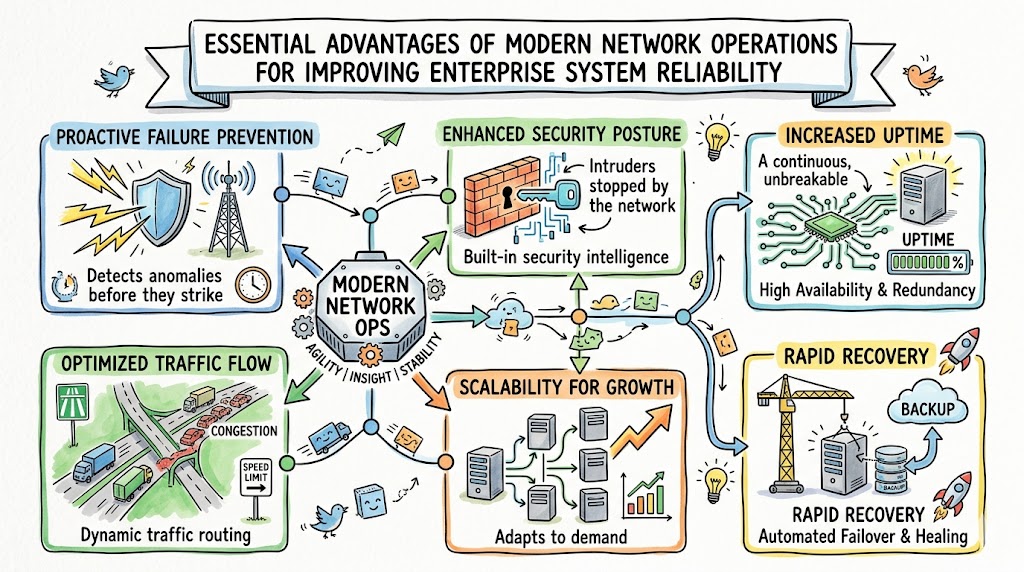
Imagine your primary enterprise system dropping offline unexpectedly during peak transactional hours, leaving thousands of customers stranded. This nightmare scenario highlights the immense vulnerability of modern digital infrastructure when left unmanaged. Fortunately, implementing robust network operations strategies effectively eliminates these catastrophic bottlenecks before they impact your end-users. Businesses require consistent uptime and rapid data delivery to survive in today’s fiercely competitive market.
Modern digital environments expand exponentially, creating intricate webs of microservices, cloud pipelines, and databases. Therefore, teams must adopt structured operational management methodologies to ensure seamless system availability at scale. This complete manual provides a deep-dive analysis of modern management practices, core platform engineering principles, and critical architectural metrics. You will discover practical ways to eliminate repetitive manual toil while maximizing your operational efficiency. To master these advanced architectural strategies and scale your digital infrastructure, explore the comprehensive educational pathways at Noopsschool.
The Origin of Systems Infrastructure
The Early Industrial Bottlenecks
Traditional corporate operations long suffered from fragmented structural isolation, where distinct engineering teams worked in strict silos. Software development professionals focused entirely on writing new application features, completely detached from deployment realities. Meanwhile, the dedicated systems infrastructure teams inherited the code, bearing total responsibility for production stability. Because these departments rarely shared insights, small software errors frequently caused major system failures during product launches. This counterproductive arrangement regularly sparked internal friction, prolonged troubleshooting times, and repeatedly stalled business growth.
Moving Toward Unified Workflow Automation
As online service demands surged globally, industry leaders realized that conventional siloed methodologies were completely unsustainable. Consequently, forward-thinking organizations began integrating development workflows directly with production maintenance processes. This collaborative transition introduced automated testing, continuous integration mechanisms, and real-time environment replication. By unifying these separated operations, companies successfully eliminated manual hand-offs and drastically reduced human configuration errors. This historical shift laid the technical foundation for modern automated infrastructure systems that drive today’s digital economies.
Global Expansion Across Commercial Ecosystems
The immense success of unified workflow automation quickly transformed software management practices across the entire global tech landscape. Major enterprise systems and digital platforms rapidly adopted these integrated models to handle millions of simultaneous user interactions. Over time, these practices expanded beyond massive tech companies into traditional sectors like banking, healthcare, and retail. Today, organizations worldwide leverage these standardized framework architectures to achieve resilient, continuous application delivery.
Defining Strategic Operations Management
The Core Operational Structure
Strategic operations management functions through a continuous loop of data collection, analysis, and proactive system adjustment. The baseline architecture establishes extensive monitoring agents across every layer of the corporate network infrastructure. These agents constantly feed real-time performance telemetry back to centralized analytical engines for review. Consequently, engineers gain immediate visibility into application behavior, resource utilization metrics, and potential network congestion points. The diagram below illustrates this continuous architectural flow.
This structural framework enables operations teams to intercept minor anomalies before they escalate into serious user-facing outages.
Daily Tasks of Systems Coordinators
Systems coordinators execute a wide array of technical tasks to maintain ideal infrastructure health every day. Specifically, these professionals review automated system alerts, investigate minor performance regressions, and update infrastructure configuration scripts. They also participate in architectural design reviews to ensure new features align with corporate availability targets. Additionally, these specialists dedicate significant time to developing custom automation scripts that eliminate repetitive administrative burdens.
Localized Control vs. Broad System Architecture
Managing modern enterprise infrastructure requires balancing granular, localized control with a comprehensive view of global system architecture. Localized control focuses heavily on individual server metrics, single container instances, and specific database query runtimes. Conversely, broad system architecture tracking evaluates total user journeys, cross-region data replication speeds, and complete network traffic patterns.
| Operational Dimension | Localized Control Focus Area | Broad System Architecture Focus |
| Primary Scope | Individual containers, specific servers, local database instances. | Entire cross-region networks, end-to-end user journeys. |
| Telemetry View | Single-component CPU utilization, localized memory metrics. | Global traffic distribution patterns, overall system latency. |
| Objective | Optimizing specific component performance thresholds. | Ensuring complete ecosystem resilience and high availability. |
Both perspectives remain absolutely vital; focusing exclusively on single components causes teams to miss overarching system degradation trends.
The Efficiency Mindset
Transitioning to advanced operations management demands a profound cultural shift that prioritizes long-term systemic stability over short-term fixes. Engineers must resist the temptation to apply quick, manual patches to recurring infrastructure problems. Instead, they embrace an efficiency mindset that treats every single operational failure as a software engineering challenge. This perspective encourages teams to write declarative code that automatically repairs infrastructure anomalies and optimizes performance.
The 7 Core Principles of Key Benefits of Network Operations for Your Business
1. Embracing Risk and Managing Variability
Modern operations engineering accepts the fundamental reality that complex digital systems will inevitably experience components failures. Trying to achieve absolute one hundred percent uptime is economically impractical and fundamentally stalls feature innovation. Therefore, teams focus on defining and managing acceptable levels of structural risk rather than pursuing impossible perfection. This approach enables businesses to release new software updates rapidly while keeping system disruption well within safe parameters.
2. Establishing Service Level Objectives (SLOs)
Organizations must establish precise, quantifiable performance targets to measure systemic success accurately. Service Level Objectives act as the definitive operational compass, aligning technical engineering goals directly with actual user expectations. By defining these metrics carefully, teams protect themselves from chasing unnecessary, over-engineered performance thresholds. These objectives provide clear data boundaries that guide daily deployment velocity and architectural investments.
3. Eliminating Toil and Manual Processes
Toil represents repetitive, manual, and administrative tasks that provide no long-term structural value to the corporate infrastructure. Left unchecked, excessive manual work drains engineering morale and severely throttles organizational agility. Advanced operations management actively mandates that teams identify, track, and systematically engineer away these manual tasks. By automating routine operations, businesses free up valuable engineering hours for creative system design and optimization.
4. Monitoring & Observability Across the Pipeline
Comprehensive visibility across the complete deployment pipeline remains essential for preventing critical operational blind spots. Modern observability strategies combine deep metric collection, structured log aggregation, and distributed request tracing. This multi-layered telemetry framework allows engineers to track data packets across complex microservices in real time. Consequently, when an unexpected failure occurs, teams can pinpoint the precise root cause within seconds.
5. Automation Over Manual Coordination
Scaling massive modern infrastructure requires replacing human coordination with programmatic software automation. Manual server configurations, manual scaling adjustments, and manual incident interventions simply fail to keep pace with dynamic cloud workloads. Teams utilize declarative infrastructure tools to deploy, configure, and scale network assets automatically based on live demand. This engineering strategy ensures that environments remain entirely consistent, predictable, and free from human error.
6. Release Engineering and Deployment Stability
Safe and predictable application delivery requires strict, automated release engineering practices. Operations specialists build robust deployment pipelines that incorporate automated testing, canary deployments, and instant rollback mechanisms. By shipping software changes in small, controlled increments, teams drastically minimize the blast radius of any hidden bugs. This disciplined framework allows organizations to maintain high deployment velocities without compromising baseline production stability.
7. Simplicity in Network Architecture
Intricate, overly complex infrastructure environments directly invite unexpected failures and significantly complicate troubleshooting efforts. Therefore, modern operations design strictly prioritizes architectural simplicity and minimal component sprawl. Engineers use clean, modular designs and eliminate redundant data pathways across the entire network layout. Keeping systems simple makes them far easier to observe, secure, and maintain over long commercial lifecycles.
Key Operational Concepts You Must Know
SLA vs. SLO vs. SLI — Explained Simply
Understanding operational performance requires mastering the distinct relationships between agreements, objectives, and indicators:
- Service Level Agreement (SLA): The overarching legal contract between a service provider and end-users specifying the promised uptime. It explicitly details the financial or legal penalties the provider faces if performance falls below the agreed standard.
- Service Level Objective (SLO): The internal target performance metric that engineering teams strive to maintain consistently. This objective is always set higher than the external agreement to provide a safe operational buffer.
- Service Level Indicator (SLI): The actual real-time measurement of system performance at any given moment. It calculates the exact percentage of successful requests versus total requests received over time.
Error Budgets — The Game Changer for Operational Risk
An error budget represents the exact amount of system downtime or performance degradation an organization tolerates over a specific timeframe. Calculated directly from the internal objective metric, this budget serves as a formal governance mechanism for product deployment. For instance, if your system objective requires ninety-nine percent uptime, you possess a one percent error budget for innovation. When the budget is full, development teams can aggressively launch complex new features into production. However, if unexpected outages completely exhaust this budget, all new feature releases pause instantly so engineers can focus exclusively on stabilization.
Toil — The Silent Productivity Killer in Infrastructure
Toil encompasses the tactical, repetitive tasks that scale linearly with infrastructure size, such as manually resetting server nodes. Unlike engineering work, which solves systemic problems permanently, toil merely keeps the system running temporarily. Organizations must constantly calculate their total hours spent on manual tasks to prevent operational stagnation. When toil exceeds a predefined threshold, management must immediately redirect engineering resources toward building permanent automation tools.
Incident Management & Postmortems
When critical system outages inevitably occur, teams must follow highly structured incident management protocols to restore service swiftly. Once the incident concludes, engineers conduct a comprehensive, completely blameless postmortem analysis. The core objective focuses entirely on uncovering deep architectural vulnerabilities rather than assigning personal blame to individuals. By documenting these operational lessons clearly, organizations transform stressful system failures into invaluable structural improvements.
Capacity Planning
Effective capacity planning ensures that corporate digital infrastructure scales efficiently ahead of major organic traffic surges. Engineers analyze historical utilization data, business growth forecasts, and seasonal promotional calendars to project future resource demands. This proactive strategy allows companies to procure necessary cloud infrastructure or adjust scaling limits well in advance. Consequently, systems maintain flawless performance even during unexpected, high-volume consumer events.
The Four Golden Signals of Pipeline Performance
To gain a clear, immediate understanding of system health, operations teams track four fundamental infrastructure metrics:
- Latency: The precise time it takes for a system to process a specific user request successfully.
- Traffic: The total volume of demand being placed on the network, measured in requests per second.
- Errors: The rate of incoming requests that fail to process successfully across the infrastructure.
- Saturation: The total percentage of system resources, such as memory or CPU, currently being utilized.
Platform Implementation vs. Culture — What’s the Real Difference?
The Philosophy Difference
Many organizations confuse high-level cultural frameworks with concrete, technical platform implementations. Cultural methodologies focus primarily on breaking down organizational walls, encouraging open communication, and sharing overall operational goals. Conversely, specific platform engineering practices apply these cultural ideals by building real automated tools and infrastructure frameworks. Culture establishes the collaborative mindset, while platform implementation provides the physical code and architecture to enforce it.
Roles & Responsibilities Compared
While both disciplines work together to maximize system reliability, their daily engineering focuses differ significantly:
- Cultural Operations Enablers: Focus intensely on improving cross-department communication pipelines and organizing blameless postmortems. They spend considerable time aligning development velocity with corporate business goals and managing overarching error budgets.
- Platform Systems Engineers: Dedicate their time to building automated CI/CD pipelines, managing container orchestration clusters, and writing infrastructure scripts. They construct the internal tools that other development teams use to deploy software safely.
Can You Have Both Disciplines?
Modern enterprise environments absolutely require both cultural frameworks and technical implementations to achieve long-term success. A team with great tools but a toxic, blame-heavy culture will consistently hide mistakes and suffer from severe burnout. Conversely, a highly collaborative team lacking automated platforms will struggle with slow manual processes and frequent configuration errors. Blending these two components creates a highly resilient engineering ecosystem that innovates rapidly.
Which One Should Your Team Adopt?
Choosing where to focus depends heavily on your current organizational size and technical maturity levels. Small, early-stage startups should prioritize establishing a collaborative, risk-aware culture before investing in complex platform setups. As the company scales and infrastructure complexity surges, the organization must transition toward formal platform implementation strategies.
| Organizational Stage | Primary Strategic Focus | Initial Action Steps |
| Early-Stage Startup | Establishing collaborative culture and basic shared workflows. | Implement basic monitoring and hold open team postmortems. |
| Growing Mid-Sized Enterprise | Standardizing platform deployment and automating manual work. | Build unified CI/CD pipelines and formalize internal SLOs. |
| Large Scale Corporation | Building advanced internal self-service developer platforms. | Automate infrastructure scaling and adopt chaos engineering. |
Evaluating these distinct organizational dimensions allows leadership to allocate engineering resources effectively.
Real-World Use Cases of Modern Operations
How Tech Leaders Use Operational Metrics
Major international software enterprises utilize real-time telemetry to manage massive, highly dynamic cloud environments. These organizations deploy sophisticated streaming dashboards that aggregate billions of metric data points from around the globe every second. By analyzing these complex telemetry flows, automated systems detect subtle anomalies and adjust traffic routes instantly. This continuous data evaluation ensures that global end-users experience consistent application speeds regardless of localized network congestion.
Chaos Engineering Approaches to Resilient Systems
Top-tier digital platforms do not simply wait for infrastructure failures to happen naturally. Instead, they practice chaos engineering by intentionally injecting controlled faults into production environments during business hours. For instance, automated utilities randomly disable critical server clusters or simulate severe network latency between data centers. This proactive experimentation allows engineers to verify that their automated self-healing systems respond correctly to real-world stress.
Handling Reliability at Massive Scale
Distributed microservice architectures require specialized management strategies to handle millions of simultaneous transactional requests. Enterprises employ advanced service meshes to manage communication, apply security policies, and enforce rate limits between individual services. If a specific microservice experiences an unexpected bottleneck, the system automatically redirects traffic to healthy instances. This dynamic isolation prevents localized code errors from cascading into widespread, multi-system outages.
High-Availability in Fintech Operations
Financial technology platforms operate under incredibly strict regulations and possess a total zero-tolerance policy for data loss or downtime. Therefore, fintech infrastructure utilizes multi-region active-active architectures where every transaction replicates across geographically isolated data centers instantly. If a major natural disaster takes an entire region offline, traffic shifts to the secondary facility seamlessly. This advanced design ensures continuous transaction processing and protects critical financial records from corruption.
Scaled-Down but Essential Systems for Startups
Early-stage companies can easily apply these core operational principles without incurring massive infrastructure costs or hiring huge teams. Startups leverage managed cloud offerings and open-source monitoring packages to establish basic visibility right from the start. By defining simple objectives and automating their primary deployment paths, small teams prevent early operational debt. This lean approach allows them to focus on product growth while ensuring their system remains stable for early adopters.
Common Mistakes in Operations Engineering
Mistake 1 — Confusing System Management with Just Being On-Call
Many companies mistakenly treat operations engineering as a reactionary, 24/7 on-call firefighting support service. When teams spend all their time manually responding to alerts, they accumulate massive amounts of technical debt. True operations engineering focuses primarily on proactive software design and building automation to prevent failures entirely. If an alert triggers repeatedly, engineers must fix the underlying architectural flaw rather than simply acknowledging the notification.
Mistake 2 — Setting Unrealistic SLOs
Business executives frequently demand one hundred percent system uptime without understanding the associated financial and operational costs. Demanding absolute perfection stalls software development because the error budget remains too small to tolerate any deployment risk. It also causes severe alert fatigue and developer burnout as engineers get woken up for minor, non-critical deviations. Organizations must set realistic objectives based on actual user satisfaction thresholds rather than abstract perfection.
Mistake 3 — Ignoring Toil Until It’s Too Late
Ignoring manual, repetitive infrastructure management tasks quickly throttles an organization’s long-term engineering velocity. As systems expand, the time required to manage manual configurations grows linearly, eventually consuming the team’s entire day. This neglect leaves engineers with zero time to build new automation or improve underlying system reliability. Smart leaders closely monitor their team’s workload and mandate that a significant portion of time goes toward eliminating manual toil.
Mistake 4 — Skipping Blameless Postmortems
When an unexpected outage occurs, a toxic culture focuses on finding an individual person to blame for the mistake. This counterproductive approach causes engineers to hide errors, cover up architectural flaws, and avoid taking innovative risks. Systems fail because the underlying guardrails and automated testing processes allowed a human error to reach production. Skipping open, blameless postmortems dooms an organization to repeat the exact same operational failures over and over.
Mistake 5 — Monitoring Without Actionable Alerts
Flooding engineering teams with hundreds of automated notifications for minor system fluctuations represents a severe operational danger. When alerts trigger for non-critical issues that require no real immediate intervention, engineers quickly learn to ignore them. Consequently, when a genuine, catastrophic infrastructure failure occurs, the critical notification gets lost in the noise. Every single alert hooked to an on-call pager must be completely actionable and indicate a clear, user-facing problem.
Mistake 6 — Not Involving Operational Engineers in the Design Phase
Software development teams frequently design complex application architectures without consulting operational infrastructure specialists. This isolation often results in features that are incredibly difficult to monitor, scale, or troubleshoot in production environments. Bringing operational expertise into the early design phase ensures that systems are built for long-term stability from day one. This collaborative planning prevents costly architectural redesigns after the software launches.
Essential Infrastructure Tools & Technologies
Monitoring & Observability
Maintaining complete control over modern digital infrastructure requires a robust suite of observability tools. Engineers utilize Prometheus to collect highly detailed time-series metrics from running applications and cluster nodes. They combine this data with Grafana to construct real-time operational dashboards that visually display system health. For complex, multi-cloud setups, enterprise platforms like Datadog and New Relic offer deep application performance monitoring and distributed tracing capabilities.
Incident Management
When critical infrastructure anomalies occur, teams use specialized platforms to coordinate their engineering response workflows. PagerDuty acts as a centralized routing engine, analyzing incoming system alerts and paging the correct on-call engineers instantly. These platforms help organize incident response communications, track resolution timelines, and bridge technical teams during major outages. Using structured response utilities ensures that troubleshooting proceeds calmly and efficiently under pressure.
CI/CD & Release Engineering
Automating the software delivery pipeline remains vital for maintaining high deployment velocity and production stability. Jenkins serves as a foundational automation server, running continuous integration tests whenever developers update code. For modern, containerized environments, Spinnaker and Argo CD provide powerful GitOps-driven continuous deployment capabilities. These engines automate the safe rollout of infrastructure changes and handle rollbacks instantly if performance indicators drop.
Chaos Engineering
To actively validate system resilience, teams leverage specialized testing tools to inject controlled faults directly into production. Chaos Monkey automatically terminates random server instances within cloud environments to ensure the surrounding infrastructure heals itself. Other advanced fault-injection frameworks allow engineers to simulate localized network partitions, resource exhaustion, and data center dropouts safely. Running these controlled experiments uncovers hidden architectural vulnerabilities before they cause real user-facing outages.
SLO Management
Tracking service level metrics against agreed consumer thresholds requires dedicated monitoring solutions. Platforms like Nobl9 integrate directly with existing data sources to calculate error budgets and performance objectives continuously. These utilities provide early warning notifications when a system consumes its error budget too rapidly. Having clear visibility into budget consumption helps leadership make data-driven decisions regarding feature release speeds.
How to Become an Operations Expert — Career Roadmap
Skills Every Specialist Must Have
Breaking into this highly technical field requires mastering a core set of foundational infrastructure skills. Aspirants must become fully proficient with Linux terminal commands, system administration principles, and shell scripting utilities. Additionally, learning programming languages like Python or Go is absolutely essential for building robust automation tools. Professionals must also master cloud infrastructure concepts, network protocols, and containerization technologies like Docker.
The Professional Learning Path
The educational journey begins by mastering basic systems administration and local environment configurations thoroughly. Next, professionals learn to manage container orchestration systems and write declarative infrastructure-as-code scripts. From there, the path advances toward building unified deployment pipelines and designing complex distributed architectures. Senior experts focus on high-level organizational strategies, advanced error budget governance, and multi-region disaster recovery systems.
Certifications Worth Pursuing
Earning industry-recognized certifications helps validate your specialized infrastructure expertise to prospective employers. Aspiring engineers should consider pursuing foundational cloud credentials from major providers like AWS, Google Cloud, or Microsoft Azure. The Certified Kubernetes Administrator (CKA) designation provides immense professional value for container management roles. Additionally, dedicated certificates focused explicitly on site reliability engineering and operational management offer substantial career advantages.
Educational Resources with Noopsschool
Navigating this vast technical landscape requires structured, hands-on guidance from industry mentors who understand modern production realities. Aspiring professionals can access deep-dive courses, live lab environments, and comprehensive infrastructure training materials directly through Noopsschool. These specialized educational programs focus heavily on real-world scenarios, teaching you how to automate complex pipelines and manage massive system scalability. Investing in structured learning prepares you to handle the toughest operational challenges in the enterprise ecosystem.
The Future of Systems Management
AI and Automation in System Optimization
Artificial intelligence and machine learning algorithms are rapidly transforming how enterprises manage complex digital infrastructure. Modern predictive models analyze vast streams of telemetry data to identify subtle anomaly patterns long before humans can detect them. These smart systems can automatically adjust network routing, scale cloud resources, and execute automated incident remediation playbooks. This evolution shifts operational management from a reactive troubleshooting model to a completely predictive framework.
Platform Engineering — The Evolution of Infrastructure
Platform engineering represents the next major evolutionary step in modern cloud infrastructure management. Instead of configuring environments manually for developers, operations specialists build centralized, self-service internal developer platforms. These custom platforms allow software developers to provision secure, compliant infrastructure assets independently with a few simple clicks. This strategy drastically reduces internal organizational friction, eliminates deployment bottlenecks, and ensures consistent architectural standards across the enterprise.
Management in Cloud-Native & Kubernetes Environments
As organizations migrate toward microservices, managing large-scale Kubernetes clusters presents unique architectural challenges. Future operations strategies must handle highly dynamic, short-lived container environments that scale up and down continuously. Engineers rely on advanced service meshes and declarative configuration models to maintain security, visibility, and control. Mastering these complex orchestration layers remains absolutely critical for keeping cloud-native infrastructure stable and cost-efficient.
Operational Skills That Will Matter Most
The ideal profile for an infrastructure professional continues to evolve alongside shifting technology landscapes. Moving forward, companies will place immense value on financial cloud optimization skills to control rising infrastructure expenses. Deep data observability expertise and the ability to design secure-by-default automation pipelines will also become primary requirements. Professionals who combine strong software engineering capabilities with a deep understanding of system architecture will lead the industry.
FAQ Section
- What is the standard career path for an operational systems specialist?
The typical career journey begins as a junior systems administrator or cloud support engineer focusing on basic monitoring and troubleshooting. Over time, professionals advance into dedicated operational engineering roles where they build automation and manage core infrastructure platforms. Senior specialists eventually transition into architectural leadership positions, designing global systems, guiding corporate reliability strategies, and mentoring engineering departments.
- How do these modern practices differ from traditional IT operations?
Traditional IT operations rely heavily on manual system configurations, reactive firefighting support, and strict organizational silos between developers and operators. In contrast, modern operations treat infrastructure management as a software engineering problem, emphasizing proactive automation, shared responsibility, and continuous visibility. This methodology leverages precise metrics like error budgets to balance rapid feature deployment with baseline system stability.
- What are the average salary trends for infrastructure engineering experts?
Due to the critical role they play in preventing multi-million dollar system outages, these specialized professionals command excellent compensation packages globally. Entry-level engineers typically earn highly competitive salaries that surpass standard IT helpdesk roles significantly. Senior experts, platform architects, and reliability directors frequently rank among the highest-paid engineering professionals within the modern technology sector.
- Why is an error budget considered a game changer for businesses?
An error budget provides a clear, data-driven framework that eliminates the natural tension between fast feature innovation and system stability. It shifts the conversation from emotional arguments to objective, quantifiable data that both business executives and engineers respect. This mechanism ensures that development velocity remains high when systems are stable, while automatically prioritizing reliability when the budget depletes.
- Which programming languages are most valuable for automation engineering?
Python remains an incredibly popular and accessible language for writing infrastructure automation scripts, managing data, and interacting with cloud APIs. However, Go has quickly become the absolute industry standard for building modern cloud-native tools, container utilities, and high-performance microservices. Mastering both languages gives infrastructure professionals an immense competitive advantage when designing scalable automation frameworks.
- Can small startups benefit from implementing these complex methodologies?
Absolutely, because applying the core principles early prevents the accumulation of crippling operational debt that crushes growing companies later. Startups do not need to build massive, expensive platform architectures right away to see real benefits. By simply adopting a collaborative culture, setting basic performance objectives, and automating core deployment paths, small teams scale efficiently.
Final Summary
Maintaining flawless system health requires a continuous commitment to observability, automation, and a progressive operational culture. By embracing calculated risks, eliminating manual toil, and establishing clear performance objectives, organizations protect their digital infrastructure from catastrophic disruptions. As cloud systems become increasingly complex, prioritizing structural reliability serves as a primary foundation for sustainable business growth. Embracing these advanced performance frameworks ensures that your enterprise architecture remains resilient, efficient, and fully prepared for future technological transformations. Take control of your infrastructure journey today by exploring the comprehensive engineering career programs available at Noopsschool.