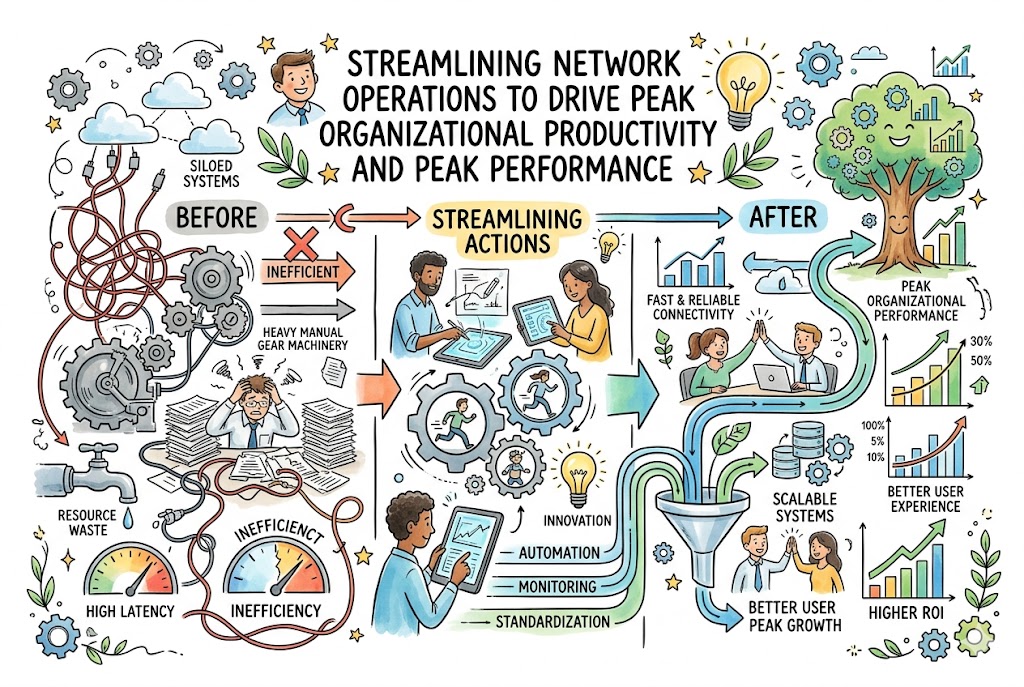
Imagine a critical production environment freezing during a peak traffic surge while isolated engineering units scramble through fragmented logs. This familiar nightmare highlights the costly bottlenecks that occur when modern infrastructure lacks cohesive orchestration. Consequently, organizations lose precious velocity because they treat infrastructure management as a reactive firefighting exercise.
Streamlining network operations for increased productivity represents a deliberate engineering methodology focused on standardizing, automating, and optimizing complex infrastructure pathways. This holistic approach eliminates structural friction, unifies disparate team workflows, and introduces data-driven telemetry to maximize daily output. By removing repetitive manual steps, engineering teams can shift their energy toward strategic development.
This exhaustive guide provides a blueprint for transforming chaotic infrastructure into a highly reliable asset. We will examine foundational architectural principles, concrete operational metrics, and specific strategies to eliminate systemic waste. Furthermore, you will discover how modern automation engines and cultural frameworks work together to protect baseline system health.
Ultimately, achieving this operational maturity requires access to structured knowledge and enterprise-grade learning tracks. To build these foundational competencies, forward-thinking professionals frequently utilize the comprehensive curriculum provided by Noopsschool to master infrastructure optimization. Embracing these methodologies enables teams to scale systems predictably while maintaining high delivery speeds.
Decoding Network Optimization Strategy
To fully optimize modern corporate systems, engineers must dismantle traditional, rigid management layers. This targeted strategy replaces unpredictable human interventions with resilient software patterns, creating predictable operational environments. Consequently, teams can scale up their services without experiencing a matching spike in manual maintenance tasks.
Implementing these practices transforms how an entire organization approaches technological risk. Instead of aiming for an unrealistic goal of zero downtime, teams deploy proactive monitoring systems to manage acceptable risk levels. Therefore, this strategic approach ensures that daily productivity gains directly support long-term system reliability.
The Origin of Systems Infrastructure
The Early Industrial Bottlenecks
During the early phases of corporate IT deployment, organizations managed physical hardware configurations using localized, manual processes. This approach created severe operational silos because development and operations units worked in isolation. Consequently, teams frequently misunderstood system dependencies, leading to prolonged troubleshooting cycles and unstable deployments.
Because these early systems lacked centralized control, small changes often caused unexpected, widespread failures. Individual administrators manually configured physical servers, which naturally resulted in configuration drift across environments. As a result, operations teams spent most of their working hours resolving routine environmental mismatches.
Moving Toward Unified Workflow Automation
As software environments grew more complex, enterprise organizations realized that traditional manual management could no longer scale. This realization drove the development of unified workflow automation, a practice that treats infrastructure as code. By codifying environmental setups, companies successfully bridge the gap between separate engineering teams.
[Traditional Silos] ──> [Infrastructure as Code] ──> [Unified Automated Workflows]
This evolutionary shift introduced automated testing frameworks directly into the infrastructure deployment pipeline. Teams rapidly discovered that programmatic verification minimized human error while speeding up delivery loops. Consequently, organizations replaced unpredictable manual steps with standardized, repeatable deployment pathways.
Global Expansion Across Commercial Ecosystems
The rapid expansion of global cloud environments required these automated workflows to adapt quickly across large-scale commercial industries. Modern enterprises now operate across multiple cloud zones, which demands absolute consistency in network configurations. Therefore, these advanced frameworks became essential for businesses looking to maintain a global digital presence.
Today, large-scale commercial organizations leverage these unified architectures to remain competitive in fast-moving global markets. Standardized operational practices enable multi-regional systems to deploy software updates continuously with minimal manual support. As a result, this global standardization serves as the foundational architecture for modern corporate computing.
Defining Strategic Operations Management
The Core Operational Structure
The underlying structure of modern systems management relies on a continuous feedback loop connecting system telemetries to automated orchestration tools. This configuration gives engineers real-time visibility into complex data pathways across distributed cloud networks. Because the system continuously streams data, automated triggers can resolve common errors before they impact end users.
┌────────────────────────────────────────┐
│      Continuous Telemetry Stream       │
└───────────────────┬────────────────────┘
                    ▼
┌────────────────────────────────────────┐
│     Automated Orchestration Engine     │
└───────────────────┬────────────────────┘
                    ▼
┌────────────────────────────────────────┐
│      Proactive System Adjustment       │
└────────────────────────────────────────┘
This structural architecture ensures that every infrastructure component remains transparent and easy to track. Centralized policy engines actively enforce security boundaries and resource allocations across all active environments. Consequently, this cohesive structure helps prevent unexpected downtime while keeping operational resource consumption efficient.
Daily Tasks of Systems Coordinators
Systems coordinators handle diverse technical responsibilities aimed at preserving infrastructure equilibrium. They write declarative configuration scripts, configure automated alert thresholds, and audit continuous integration pipelines. Furthermore, these specialists actively identify repetitive operational bottlenecks to eliminate them through targeted engineering solutions.
- Developing and maintaining declarative infrastructure-as-code scripts.
- Configuring intelligent alerting logic to prevent alert fatigue.
- Auditing system telemetry to identify hidden resource bottlenecks.
- Conducting blameless postmortems to improve systemic resilience.
- Optimizing CI/CD pipelines to ensure safe application delivery.
Localized Control vs. Broad System Architecture
Managing local application components requires a deep understanding of individual software behaviors and specific runtime environments. However, broad system architecture demands a wider view that encompasses multi-region routing, global load balancing, and cross-cluster storage synchronization. Operations engineers must carefully balance these two perspectives to ensure local modifications do not disrupt the wider infrastructure.
+-------------------------------------------------------------+
| BROAD SYSTEM ARCHITECTURE                                   |
| (Global Load Balancing, Multi-Region Routing, Clusters)     |
|                                                             |
|   +-----------------------------------------------------+   |
|   | LOCALIZED CONTROL                                   |   |
|   | (Application Mismatches, Local Storage, Pods)       |   |
|   +-----------------------------------------------------+   |
+-------------------------------------------------------------+
When teams focus too much on localized control, they often lose sight of overarching system dependencies. Conversely, focusing exclusively on broad architecture can cause teams to overlook micro-level errors that cause performance issues. Maintaining balanced coordination across both levels ensures the entire network remains resilient against sudden failures.
The Efficiency Mindset
Transitioning to an efficiency-focused operational model requires a major shift in engineering culture. Teams must resist the urge to deploy quick, temporary fixes when resolving production errors. Instead, they need to view every incident as an opportunity to engineer long-term, automated solutions that permanently fix root vulnerabilities.
This specialized mindset prioritizes structural durability over short-term feature delivery. Engineers deliberately dedicate time to removing systemic waste, standardizing documentation, and improving observability tools. As a result, this cultural focus creates a highly stable infrastructure capable of supporting rapid business growth.
The 7 Core Principles of Streamlining Network Operations for Increased Productivity
1. Embracing Risk and Managing Variability
Modern engineering principles show that pursuing 100% reliability is counterproductive and overly expensive. Since complex distributed systems naturally experience minor failures, teams must focus on managing acceptable risk levels. By establishing clear risk tolerances, organizations can confidently ship features without hurting system stability.
[System Inefficiencies] ──> [Quantified Risk Tolerance] ──> [Uninhibited Innovation]
Accepting and managing this variability allows development teams to innovate quickly without being blocked by overly rigid uptime targets. Engineers leverage data-driven insights to determine exactly when to prioritize stability over speed. Consequently, this balanced approach to risk keeps production environments reliable while encouraging business agility.
2. Establishing Service Level Objectives (SLOs)
Service Level Objectives serve as the primary targets for keeping systems reliable and performant. These metrics translate technical data points into meaningful objectives aligned with actual user expectations. By tracking performance against these goals, engineering teams can make objective, data-backed decisions about resource allocation.
Teams use these defined targets to maintain a healthy balance between new features and system stability. When a system violates an SLO, engineers immediately pause feature updates to focus on stabilizing the underlying infrastructure. This framework removes emotion from operations, ensuring everyone agrees on operational priorities.
3. Eliminating Toil and Manual Processes
Toil represents repetitive, manual tasks that lack long-term strategic value and scale linearly with system growth. Examples include manually provisioning servers or restarting stuck services on a daily basis. Left unchecked, this manual workload drains engineering resources and blocks innovation.
[Manual Task Identification] ──> [Automation Scripting] ──> [Toil Eradication]
To break this cycle, modern operations teams explicitly limit the time spent on manual administrative tasks. Engineers build programmatic solutions to automate these repetitive workloads, converting manual steps into self-healing code blocks. This ongoing optimization allows teams to support growing infrastructures without needing to increase headcount.
4. Monitoring & Observability Across the Pipeline
Comprehensive observability gives engineers deep visibility into the internal states of a network based on its external outputs. Traditional monitoring merely alerts teams when a failure occurs, but modern observability helps engineers discover why it happened. This deep visibility relies on collecting logs, metrics, and distributed traces across the entire delivery chain.
                      ┌───────────────┐
                      │    Metrics    │
                      └───────┬───────┘
                              ▼
┌───────────────┐     ┌───────────────┐     ┌───────────────┐
│     Logs      │───> │ Observability │ <───│    Traces     │
└───────────────┘     └───────────────┘     └───────────────┘
Maintaining this detailed visibility ensures that engineers notice hidden performance drops before they trigger major outages. Teams utilize real-time dashboards to analyze complex traffic patterns and spot unusual behaviors across microservices. As a result, this deep insight significantly reduces troubleshooting times when responding to complex live incidents.
5. Automation Over Manual Coordination
Relying on manual human coordination during a critical incident often introduces errors and delays recovery times. Modern engineering strategies solve this by replacing human operational steps with predictable software engines. These automation platforms automatically detect performance variations and safely scale resources up or down in response.
Automated systems execute complex remediation playbooks consistently, day or night, without human fatigue. This strategy protects infrastructure integrity by eliminating the risk of typos or overlooked steps during high-pressure incidents. Consequently, the organization moves away from manual interventions toward an automated, self-healing architecture.
6. Release Engineering and Deployment Stability
Release engineering focuses on building secure, automated pipelines to package and deploy application code. By standardizing these deployment stages, organizations ensure that every update undergoes identical security tests and validation steps. This consistent approach significantly lowers the risk of environmental errors reaching production.
┌──────────────┐     ┌──────────────┐     ┌──────────────┐
│ Standardized │────>│ Automated    │────>│ Controlled   │
│ Code Package │     │ Testing Loop │     │ Canary Roll  │
└──────────────┘     └──────────────┘     └──────────────┘
Using advanced strategies like canary rollouts or blue-green deployments helps teams limit the impact of bad updates. If an update introduces an error, the deployment pipeline automatically rolls back to the last stable state. This safety loop allows teams to deploy updates frequently while protecting the end-user experience.
7. Simplicity in Network Architecture
Complex network designs naturally create more hidden vulnerabilities and make troubleshooting difficult. In contrast, minimal layouts reduce unexpected side effects and simplify root-cause analysis during outages. Therefore, keeping systems straightforward remains a core requirement for scaling infrastructure safely.
[Complex Architecture] ──> [Remove Unused Components] ──> [Clean, Standardized Design]
Engineers maintain simplicity by removing unused components, avoiding custom configurations, and standardizing infrastructure modules. This clean approach ensures that new team members can quickly understand system layouts without navigating confusing documentation. Ultimately, simple systems are far easier to monitor, secure, and maintain over long lifecycles.
Key Operational Concepts You Must Know
SLA vs. SLO vs. SLI — Explained Simply
Understanding the differences between Service Level Agreements, Objectives, and Indicators is essential for managing infrastructure effectively. These three metrics establish the boundaries for acceptable performance, legal commitments, and objective measurement.
- Service Level Indicator (SLI): A specific, real-time metric that measures a system’s behavior, such as the latency of an API call.
- Service Level Objective (SLO): A target performance level defined for an SLI, such as achieving under 200ms latency for 99.9% of requests.
- Service Level Agreement (SLA): A legal contract spelling out the business penalties or refunds if the system fails to meet its SLO targets.
Error Budgets — The Game Changer for Operational Risk
An error budget represents the total acceptable downtime a system can experience over a set period before users get frustrated. Calculated directly as $1 – \text{SLO}$, this framework gives product and operations teams a clear metric to balance innovation with stability. For example, a 99.9% uptime target leaves a 0.1% error budget for experimental deployments and updates.
┌────────────────────────────────────────────────────────┐
│ Total Operational Budget (100%)                       │
├────────────────────────────────────────────┬───────────┤
│ Target Service Availability (99.9% SLO)    │ 0.1% Err  │
└────────────────────────────────────────────┴───────────┘
When this budget runs out, the team changes its focus to infrastructure stabilization and delays new feature releases. This mechanism ensures the system stays reliable while providing a clear framework to manage deployment risks. Consequently, error budgets prevent feature development from outpacing foundational system stability.
Toil — The Silent Productivity Killer in Infrastructure
Toil encompasses manual administrative tasks that provide no long-term business value and increase directly as your system grows. If engineers spend their days manually running scripts or resetting servers, they cannot build automated solutions to permanently fix root issues. Left unchecked, this manual workload burns out staff and blocks engineering progress.
[Identify Repetitive Tasks] ──> [Track Manual Hours] ──> [Develop Automation]
To eliminate this overhead, organizations track how many hours engineers spend on manual operations each week. Teams then design software tools to automate those specific tasks, shifting from manual processes to scalable workflows. This ongoing cleanup ensures that engineering capacity remains focused on strategic platform upgrades.
Incident Management & Postmortems
Effective incident management requires a clear response framework that prioritizes fast service restoration over placing blame. When an outage happens, responders follow strict roles to isolate the error, fix the service, and notify stakeholders. Afterward, the team holds a blameless postmortem to understand the system flaws that led to the issue.
┌──────────────────┐     ┌──────────────────┐     ┌──────────────────┐
│  Service Outage  │────>│ Fast Restoration │────>│    Blameless     │
│    Detection     │     │   & Isolation    │     │    Postmortem    │
└──────────────────┘     └──────────────────┘     └──────────────────┘
Blameless postmortems focus entirely on mechanical and process failures rather than pointing fingers at individuals. This open approach encourages engineers to share mistakes honestly, helping the team find the true root causes. Consequently, the lessons learned from these reviews turn operational failures into permanent system upgrades.
Capacity Planning
Capacity planning involves analyzing usage trends and system performance data to forecast future infrastructure needs. This practice ensures your systems can handle unexpected traffic spikes or steady business growth without dropping performance. By tracking these trends early, engineers can purchase resources or optimize configurations well ahead of demand spikes.
[Historical Telemetry] ──> [Trend Analysis] ──> [Proactive Resource Scaling]
Modern infrastructure teams leverage historical monitoring data to build predictive models for resource consumption. These models help companies plan their technology budgets accurately and avoid emergency over-provisioning during peak events. As a result, proactive planning keeps system performance stable while avoiding wasted cloud spend.
The Four Golden Signals of Pipeline Performance
To monitor distributed applications effectively, engineers focus on tracking four essential infrastructure metrics. These foundational data points provide a clear, real-time picture of overall system health.
            ┌──────────────────────────────────────────┐
            │         THE FOUR GOLDEN SIGNALS          │
            └────────────────────┬─────────────────────┘
       ┌───────────────┬─────────┴─────────┬───────────────┐
       ▼               ▼                   ▼               ▼
┌─────────────┐ ┌─────────────┐     ┌─────────────┐ ┌─────────────┐
│   Latency   │ │   Traffic   │     │   Errors    │ │ Saturation  │
└─────────────┘ └─────────────┘     └─────────────┘ └─────────────┘
- Latency: The total time it takes to complete a specific request, separating successful responses from failures.
- Traffic: A measure of total demand on the system, tracking metrics like HTTP requests per second or network bandwidth.
- Errors: The rate of requests that fail completely, return unexpected status codes, or violate system protocols.
- Saturation: A measure of total resource usage, showing how close your system is to its maximum memory, CPU, or network limits.
Platform Implementation vs. Culture — What’s the Real Difference?
The Philosophy Difference
Platform implementation focuses on deploying specific technical tools, automating configurations, and building infrastructure pipelines. In contrast, operational culture defines how teams collaborate, handle failures, and balance delivery speed with stability. Tools are essential for execution, but they can only succeed if supported by an open, collaborative engineering culture.
+--------------------------------------------------------+
|                 OPERATIONAL SUCCESS                    |
+-------------------------------------------+------------+
| Technical Tooling & Pipelines (50%)       | Culture    |
+-------------------------------------------+------------+
When organizations buy advanced monitoring platforms without changing their internal silos, their operational issues usually remain. This happens because tools simply highlight system issues; fixing them requires a team culture that prioritizes continuous engineering upgrades. Therefore, balancing technical tools with cultural practices is key to long-term system health.
Roles & Responsibilities Compared
To understand how these different areas function, it helps to compare their primary day-to-day focuses and operational duties. The following breakdown illustrates how technical execution aligns with cultural goals.
- Technical Implementation Focus:
- Deploying and maintaining observability infrastructure.
- Building automated CI/CD deployment pipelines.
- Writing infrastructure-as-code scripts to manage environments.
- Setting up automated failover policies across clusters.
- Cultural Practices Focus:
- Facilitating blameless postmortems after system outages.
- Aligning engineering goals with agreed user experience metrics.
- Reducing manual toil through open cross-team collaboration.
- Managing error budgets to balance innovation and stability.
Can You Have Both Disciplines?
Modern tech organizations do not treat technical platforms and cultural frameworks as opposing paths. Instead, they leverage both disciplines together to build highly resilient, scalable systems. Automated platforms provide the telemetry data needed to make the objective operational decisions required by a blameless engineering culture.
┌─────────────────────────┐               ┌─────────────────────────┐
│  Automated Platforms    │──────────────>│    Cultural Frameworks  │
│  (Provide Telemetry)    │<──────────────│    (Guide Priorities)   │
└─────────────────────────┘               └─────────────────────────┘
This combination helps businesses ship software updates quickly while maintaining high reliability targets. An engineering team backed by automated tools can safely take measured risks, knowing their platforms will catch issues early. This mutual support turns infrastructure from a common business bottleneck into a driver of growth.
Which One Should Your Team Adopt?
Choosing where to focus first depends largely on your company’s current engineering maturity and team size. Early-stage startups usually focus on adopting flexible technical tools to automate basic deployments quickly with minimal overhead. As the infrastructure grows and more engineering teams join, establishing a strong, collaborative culture becomes essential to prevent silos.
[Small Team: Ad-Hoc Tools] ──> [Growing Infrastructure] ──> [Mature: Unified Culture & Platform]
Mid-sized organizations often struggle if they deploy complex software platforms before establishing clear internal ownership rules. For the best results, teams should grow their tooling and culture together, using every outage to refine both their workflows and automated guardrails. This step-by-step approach ensures your engineering practices scale naturally alongside your business infrastructure.
Real-World Use Cases of Modern Operations
How Tech Leaders Use Operational Metrics
Major software enterprises rely on real-time data tracking to manage global application clusters serving millions of users. These tech leaders use advanced data pipelines to collect billions of individual log entries and traces every single day. This data stream feeds automated systems that can dynamically adjust routing paths before users ever notice a slowdown.
┌─────────────────────┐     ┌─────────────────────┐     ┌─────────────────────┐
│  Billions of Logs   │────>│ Automated Analytics │────>│ Dynamic Traffic     │
│  & Traces Collected │     │   Engine Filters    │     │ Routing Adjustments │
└─────────────────────┘     └─────────────────────┘     └─────────────────────┘
By connecting real-time metrics directly to automated orchestration platforms, these companies remove human delay from basic infrastructure scaling. This data-driven strategy allows engineering teams to maintain high system availability during massive global events or sudden traffic surges. Consequently, continuous telemetry forms the backbone of modern, enterprise-scale software management.
Chaos Engineering Approaches to Resilient Systems
Top technology companies regularly inject controlled failures into their production systems to find hidden weaknesses before they cause real outages. This practice, known as chaos engineering, involves intentionally shutting down server nodes or introducing network latency under safe conditions. By simulating these failures, teams can verify that their automated self-healing mechanisms work correctly.
[Inject Controlled Failure] ──> [Monitor Automated Recovery] ──> [Harden System Flaws]
These experiments help engineers catch hidden dependencies and flawed alert logic that standard testing passes over. Instead of waiting for a real emergency, teams proactively test and harden their infrastructure during normal business hours. This ongoing testing builds deep confidence in the system’s ability to withstand major, unexpected real-world outages.
Handling Reliability at Massive Scale
Managing distributed microservices that process massive transaction volumes requires moving completely away from static server setups. Leading cloud platforms run thousands of independent containers that scale automatically based on immediate processing demand. To keep these dynamic environments stable, companies use automated service meshes to handle traffic balancing and secure internal communications.
┌────────────────────────────────────────────────────────┐
│             AUTOMATED SERVICE MESH ARCHITECTURE        │
├────────────────────────────────────────────────────────┤
│ Container 1 <───> Dynamic Traffic Balancing <───> Cont. 2│
├────────────────────────────────────────────────────────┤
│ Container 3 <───> Secure Internal Routing   <───> Cont. 4│
└────────────────────────────────────────────────────────┘
These decoupled architectures ensure that a failure in one microservice won’t bring down the entire application stack. If a specific processing node slows down, automated routing engines immediately direct traffic to healthy containers. This approach enables large cloud networks to maintain steady performance while running continuous updates.
High-Availability in Fintech Operations
Financial technology platforms operate under strict regulatory standards that demand near-zero tolerance for system downtime or data loss. To meet these high availability requirements, fintech companies run active-active architectures that mirror transactions across isolated cloud regions in real time. If a whole data center loses power, traffic shifts instantly to another zone without losing a single transaction record.
┌──────────────────────────┐               ┌──────────────────────────┐
│   Cloud Data Region A    │ <───────────> │   Cloud Data Region B    │
│   (Active Transaction)   │  Sync Mirror  │   (Active Transaction)   │
└──────────────────────────┘               └──────────────────────────┘
These teams use automated testing pipelines to verify their emergency failover systems every week without disrupting daily services. They also configure precise monitoring alerts to catch small validation errors before they impact customer accounts. This strict focus on reliability protects both user transactions and corporate compliance around the clock.
Scaled-Down but Essential Systems for Startups
Early-stage startups do not need the massive, multi-region setups used by giant enterprises, but they still benefit from core operational principles. Small engineering teams leverage managed cloud services and lightweight automation to keep workflows clean without high maintenance costs. By starting with basic infrastructure-as-code modules, a small team can avoid configuration mess from day one.
[Managed Cloud Framework] ──> [Lightweight CI/CD Setup] ──> [Clean, Scalable Footprint]
Adopting these clean habits early saves startups from accumulating massive technical debt as their product scales up. Small teams set simple uptime targets and use basic monitoring dashboards to watch their core application paths. This practical setup lets early-stage companies iterate quickly on new features while maintaining a stable foundation for early users.
Common Mistakes in Operations Engineering
Mistake 1 — Confusing System Management with Just Being On-Call
A frequent mistake in growing companies is treating operations engineering as an exclusive, round-the-clock on-call shift. When teams spend all their time manually responding to alert pages, they cannot build long-term automation to fix root flaws. This reactive firefighting approach results in high staff burnout and leaves infrastructure fragile.
[Firefighting Mentality] ──> [Continuous Manual Patches] ──> [System Fragility Increases]
True operational engineering means applying software development practices to solve infrastructure problems permanently. Teams must protect their engineers’ time, ensuring they spend a large part of each week writing automation code rather than just clearing alerts. Moving away from manual fixes helps companies build a resilient, self-healing architecture.
Mistake 2 — Setting Unrealistic SLOs
Many engineering teams mistakenly set perfect 100% uptime goals, believing that higher targets always mean better service. However, demanding perfect uptime blocks new feature deployments, because every update introduces some technical risk. It also forces engineers to build overly complex, expensive redundancies that add little real value for users.
[Unrealistic 100% Target] ──> [Frozen Feature Delivery] ──> [Engineering Stagnation]
Smart organizations set realistic uptime goals based on actual user satisfaction and business needs. This practical approach leaves a clear error budget that development teams can use to ship features quickly and safely. Balancing stability with speed keeps your product moving forward without risking system health.
Mistake 3 — Ignoring Toil Until It’s Too Late
Ignoring repetitive manual tasks can slowly build up severe operational debt that blocks your development speed. When engineers are stuck manually updating keys, resetting environments, or cleaning disks every week, strategic platform upgrades stall. This manual burden naturally grows heavier as you add more servers and scale your infrastructure.
[Accumulated Manual Toil] ──> [Engineering Speed Drops] ──> [Deployment Bottlenecks]
To avoid this, teams should treat manual toil as a technical vulnerability that needs immediate engineering attention. Organizations should explicitly track time spent on manual operations and assign automation tasks to eliminate those repetitive steps. Keeping manual overhead low ensures your engineering team stays fast and efficient.
Mistake 4 — Skipping Blameless Postmortems
When a company culture blames individuals for production outages, engineers naturally hide mistakes and avoid taking risks. This defensive attitude makes it difficult to discover the true systemic gaps that allowed the human error to cause an outage. Consequently, the same root failures tend to happen over and over again.
[Blame-Heavy Culture] ──> [Hidden Technical Errors] ──> [Repeated Systemic Failures]
Holding open, blameless postmortems helps teams focus on fixing flawed processes and missing guardrails instead of pointing fingers. This transparent approach encourages engineers to share insights honestly, leading to stronger, more reliable system updates. Turning incidents into shared lessons is the best way to build a resilient engineering organization.
Mistake 5 — Monitoring Without Actionable Alerts
Setting up vague alerts for every minor metric variation quickly causes alert fatigue across your engineering team. When paged constantly for non-critical issues that require no immediate action, responders start ignoring notifications altogether. This noise can cause teams to miss real, critical infrastructure failures until they turn into major outages.
[Vague Metric Pages] ──> [Widespread Alert Fatigue] ──> [Missed System Outages]
Every operational alert should point to a clear, actionable issue that requires immediate human intervention to prevent service disruption. If a notification doesn’t require a fast response, it should be logged quietly to a dashboard rather than paging an engineer. Clean alerting logic keeps on-call teams focused and responsive when real emergencies happen.
Mistake 6 — Not Involving Operational Engineers in the Design Phase
Treating infrastructure management as an afterthought means bringing in operations engineers only after an application is fully built. This separation often leads to major deployment issues, as software architectures may not match modern scaling, monitoring, or security frameworks. Fixing these compatibility issues late in development causes long delays and drives up costs.
┌─────────────────────────┐               ┌─────────────────────────┐
│ Isolated Software Build │──────────────>│ High-Cost Retrofitting  │
│ (No Infrastructure In)  │               │ (Delayed Project Launch)│
└─────────────────────────┘               └─────────────────────────┘
Including operations experts from day one ensures that system architectures are inherently scalable and easy to monitor. This early collaboration helps teams design automated deployment paths and smart scaling rules straight into the core software design. As a result, product launches move much faster and run more reliably in production environments.
Essential Infrastructure Tools & Technologies
Monitoring & Observability
Building a dependable observability stack requires a thoughtful mix of time-series databases, log aggregators, and distributed tracing platforms. Teams use tools like Prometheus to gather real-time metric statistics, which are then displayed on centralized Grafana dashboards. Enterprise suites like Datadog and New Relic combine these separate data sources into a single dashboard for easier system tracking.
┌────────────────────────────────────────────────────────┐
│             MODERN OBSERVABILITY ECOSYSTEM             │
├───────────────────────────┬────────────────────────────┤
│ Metrics: Prometheus       │ Visual Dashboards: Grafana │
├───────────────────────────┼────────────────────────────┤
│ Full Suite: Datadog       │ Analytics: New Relic       │
└───────────────────────────┴────────────────────────────┘
These platforms collect and organize performance data across every layer of your cloud infrastructure. This deep visibility helps engineers spot micro-level errors before they cascade into widespread system outages. Investing in high-quality observability tools is the first step toward building a data-driven operations model.
Incident Management
When an unexpected outage happens, teams need organized communication platforms to coordinate their engineering response quickly. Services like PagerDuty route critical telemetry alerts directly to the correct on-call engineers based on custom team schedules. Once notified, responders use these platforms to open shared incident channels, track progress, and update status pages for users.
[Telemetry Alert] ──> [PagerDuty Smart Routing] ──> [Active Incident Room]
These incident tools help teams follow standard resolution playbooks, reducing chaos during high-pressure situations. They also document structural timelines automatically, giving engineers clean data histories for later postmortem reviews. Using dedicated incident software helps organizations lower their average time to resolve production issues.
CI/CD & Release Engineering
Modern release engineering relies on secure, automated deployment pipelines to test, package, and ship application code consistently. Automation servers like Jenkins handle the core testing and building stages, ensuring every update meets quality standards. For cloud-native environments, teams use gitops systems like Argo CD and Spinnaker to safely sync declarative configurations directly into active server clusters.
┌───────────────┐     ┌───────────────┐     ┌───────────────┐
│ Build Phase   │────>│ GitOps Sync   │────>│ Cluster State │
│ (via Jenkins) │     │ (via Argo CD) │     │ (via Spinnaker)│
└───────────────┘     └───────────────┘     └───────────────┘
These automated delivery pathways significantly reduce human error risks by removing manual steps from production rollouts. They also feature automated safety checks that can freeze deployments or roll back updates if performance drops. Standardizing code delivery through automated pipelines keeps your deployment speed fast and your runtime safe.
Chaos Engineering
To proactively test infrastructure resilience, organizations use automated fault injection software to simulate real-world system failures. Tools like Chaos Monkey automatically shut down virtual machine instances in production, testing whether the system self-heals without impacting users. This proactive testing helps engineers find hidden single points of failure, unrecorded dependencies, and weak alerting logic.
[Chaos Monkey Trigger] ──> [Live Node Shutdown] ──> [Self-Healing Validation]
Running these controlled experiments during standard working hours gives teams a safe way to harden their infrastructure. It shifts operational focus from guessing how systems fail to proving exactly how they recover. Embracing chaos engineering tools helps companies build deep confidence in their platform’s baseline stability.
SLO Management
Tracking service availability targets requires dedicated software to measure real-time metrics against customer performance agreements. Platforms like Nobl9 connect straight to your monitoring data to calculate error budgets and project reliability trends. These dashboards provide early warnings if resource consumption or error rates threaten to exhaust your operational budgets too quickly.
[Telemetry Sources] ──> [Nobl9 Calculation Engine] ──> [Error Budget Runrate]
Centralizing this data helps business managers and engineering teams stay aligned on deployment risks and operational stability. It removes guesswork from product decisions by providing clear, data-backed metrics on whether to ship features or focus on cleanup. Using dedicated SLO management software keeps your technical execution aligned with actual user expectations.
Technical Comparison of Core Operational Frameworks
To help your organization select the right approach, the table below highlights how different infrastructure methodologies handle automation, risk, and team collaboration.
| Operational Category | Traditional Infrastructure Management | Automated Site Reliability Engineering | Platform Engineering Systems |
| Primary Automation Strategy | Manual scripting and ad-hoc local configurations | Declarative infrastructure as code and self-healing pipelines | Internal developer platforms with self-service templates |
| Risk & Reliability Focus | Reactive troubleshooting and zero-downtime targets | Data-driven error budgets and quantifiable SLO bounds | Standardized infrastructure blueprints with built-in guardrails |
| Team Collaboration Model | Isolated silos with manual handoffs between units | Shared operational duties via software engineering principles | Dedicated platform teams supporting internal developers |
The second table outlines how these operational choices impact key business metrics like deployment frequency and typical recovery timelines.
| Operational Metric | Traditional Infrastructure Management | Automated Site Reliability Engineering | Platform Engineering Systems |
| Deployment Frequency | Infrequent, manual batch releases (monthly or quarterly) | Continuous, automated updates (multiple times daily) | Standardized, automated self-service product rollouts |
| Mean Time to Resolution | Slow recovery due to manual tracking and triage | Fast, automated rollback and intelligent alerting | Programmatic self-healing and standardized environments |
| Toil Allocation Target | Uncapped manual tasks that grow with infrastructure | Explicitly restricted to under half of total engineering time | Eliminated through automated self-service platforms |
How to Become an Operations Expert — Career Roadmap
Skills Every Specialist Must Have
Entering this competitive technical field requires mastering foundational operating system architectures, network protocols, and coding languages. You must be comfortable navigating Linux terminal environments, managing file permissions, and auditing system processes. Additionally, scripting languages like Python or Go are essential for building automation tools and infrastructure pipelines.
            ┌──────────────────────────────────────────┐
            │          CORE FOUNDATIONAL SKILLS        │
            └────────────────────┬─────────────────────┘
       ┌───────────────┬─────────┴─────────┬───────────────┐
       ▼               ▼                   ▼               ▼
┌─────────────┐ ┌─────────────┐     ┌─────────────┐ ┌─────────────┐
│ Linux Shell │ │ Python / Go │     │ TCP/IP and  │ │ Cloud Specs │
│ Proficiency │ │ Scripting   │     │ DNS Networks│ │ (AWS/Azure) │
└─────────────┘ └─────────────┘     └─────────────┘ └─────────────┘
Engineers also need a deep understanding of core networking principles, including TCP/IP routing, DNS configuration, and security controls. You should couple these skills with experience managing cloud resources on platforms like AWS, Azure, or Google Cloud. Mastering these technical skills provides the foundation needed to design scalable, modern computing platforms.
The Professional Learning Path
Your educational progression begins with mastering local system administration and simple software development workflows. From there, you should learn to package applications using container platforms like Docker and manage clusters with Kubernetes. Next, study infrastructure-as-code principles by writing declarative configuration modules using tools like Terraform.
┌──────────────┐     ┌──────────────┐     ┌──────────────┐
│  Linux & OS  │────>│ Containers & │────>│ Declarative  │
│ Foundations  │     │ Orchestration│     │ IaC Modules  │
└──────────────┘     └──────────────┘     └──────────────┘
The final phase of your learning track focuses on mastering advanced architecture topics like distributed systems design and automated telemetry pipelines. Learn to build unified monitoring environments and manage error budget policies across enterprise clouds. Following this step-by-step path ensures you develop both the practical skills and theoretical knowledge needed for senior roles.
Certifications Worth Pursuing
Earning respected industry certifications validates your technical expertise and opens up senior engineering opportunities. Start with foundational cloud credentials like AWS Certified Cloud Practitioner or Microsoft Azure Fundamentals (AZ-900) to confirm your basic cloud knowledge. Next, focus on cloud-native skills by earning the Certified Kubernetes Administrator (CKA) designation.
For advanced operations roles, pursue specialized credentials like the SRE Foundation or DevOps Leader certifications. These tracks test your practical ability to design resilient pipelines, reduce manual toil, and foster healthy engineering cultures. Earning these industry certifications demonstrates your commitment to modern infrastructure management.
Educational Resources with Noopsschool
Building these advanced operational skills requires access to high-quality, practical learning tracks designed by industry professionals. Aspiring systems specialists can leverage the thorough training bootcamps and hands-on laboratory exercises offered by Noopsschool. This curriculum covers everything from basic Linux admin workflows to advanced cloud-native infrastructure automation.
These expert-led programs focus heavily on real-world scenarios, helping you master the tools used daily by enterprise tech teams. Students gain practical experience configuring real monitoring pipelines, managing simulated incidents, and writing automated deployment scripts. Partnering with a structured educational academy accelerates your transformation into a proficient operations engineer.
The Future of Systems Management
AI and Automation in System Optimization
The integration of machine intelligence is redefining how enterprise companies monitor and protect their cloud networks. Modern analytics engines scan massive streams of telemetry data to catch unusual performance anomalies before they impact users. These smart systems can trace root infrastructure failures automatically, giving on-call responders immediate fixes during unexpected outages.
[Telemetry Stream] ──> [Machine Intelligence Engine] ──> [Automated Root Cause Fix]
As these automated tools mature, they will shift system optimization from a reactive cleanup process to a fully proactive model. Machine learning models can analyze long-term demand trends to optimize resource allocations across globally distributed clusters. Embracing intelligent automation allows organizations to run highly efficient networks while reducing manual maintenance workloads.
Platform Engineering — The Evolution of Infrastructure
Platform engineering is rapidly changing infrastructure delivery by building automated, internal self-service portals for software developers. Instead of filing manual requests for every server resource, developers use these portals to provision secure environments instantly. This self-service approach removes deployment bottlenecks and keeps development teams moving fast.
┌─────────────────────────┐               ┌─────────────────────────┐
│ Manual Resource Tickets │──────────────>│ Internal Developer Port │
│ (Slow Legacy Bottlenecks)│               │ (Instant Cloud Tooling) │
└─────────────────────────┘               └─────────────────────────┘
Platform teams focus on embedding security guardrails, cost controls, and compliance rules straight into these automated templates. This strategy protects infrastructure health while giving product teams the freedom to iterate quickly without manual oversight. Consequently, platform ecosystems are becoming the standard architecture for modern enterprise development.
Management in Cloud-Native & Kubernetes Environments
The widespread adoption of dynamic, containerized applications introduces unique monitoring challenges for modern operations teams. Because these microservice clusters scale and move resources constantly, traditional static monitoring tools can no longer keep up. Engineers use automated service meshes and sidecar proxies to track performance across changing network paths.
[Dynamic Container Sprawl] ──> [Automated Service Mesh] ──> [Real-Time Path Tracking]
Managing these elastic environments requires writing declarative configuration policies that adapt automatically to cluster changes. Teams leverage automated controllers to audit security boundaries and optimize resource allocations inside active clusters. Mastering cloud-native orchestration ensures your systems remain highly available as data demands grow.
Operational Skills That Will Matter Most
The changing technology landscape means systems experts must continuously expand their skills beyond basic server configuration. Future engineering priorities will focus heavily on cloud financial optimization (FinOps), helping companies reduce wasted cloud spend across global networks. Professionals must also master green computing concepts to minimize carbon footprints and resource use across data centers.
- Cloud Financial Optimization (FinOps): Programmatically tracking and reducing wasted cloud resources.
- Green Computing Architectures: Optimizing configurations to lower data center energy consumption.
- Advanced Data Mesh Observability: Tracking performance across decentralized data pipelines.
- Automated Security Guardrails: Building zero-trust compliance directly into self-service templates.
FAQ Section
- What is the typical career path for an infrastructure operations specialist?Most professionals begin their careers in foundational technical support, system administration, or junior software development positions. Over time, they build skills in container orchestration, infrastructure automation, and telemetry design, stepping up into dedicated systems engineering roles. Senior engineers frequently advance into enterprise platform architecture design or technology leadership positions, managing large-scale cloud delivery frameworks.
- How do organizations calculate the real cost of manual toil?Teams calculate the cost of toil by tracking how many hours engineers spend on manual, repetitive administrative tasks each week. Multiply these total hours by the average engineering labor rate to find the direct financial cost of manual operations. Companies also measure the indirect costs of delayed product releases and staff burnout caused by excessive manual workloads.
- What is the average salary trend for automated network operations engineers?Global market data shows strong salary compensation for engineers skilled in cloud infrastructure automation and site reliability engineering. Entry-level specialists command competitive base salaries, while senior architects earn top compensation packages at major tech firms. This strong demand reflects how critical reliable, automated cloud delivery has become to modern digital businesses.
- Can smaller startups implement these advanced operational principles effectively?Yes, early-stage companies can apply core reliability concepts by using managed cloud services and lightweight automation pathways. Startups should focus on setting simple uptime targets and writing basic infrastructure-as-code configurations from day one. This proactive foundation prevents technical debt from building up, allowing small teams to scale cleanly as their user base grows.
- How do error budgets help balance feature development with system stability?An error budget defines the total acceptable downtime a system can experience before users notice a dip in service quality. If the system stays stable and maintains a healthy budget, product teams can ship features rapidly despite the technical risk. However, if a service exhausts its budget, the team pauses new releases to focus exclusively on infrastructure stabilization.
- What is the difference between automated site reliability engineering and traditional DevOps?DevOps represents a broad cultural movement focused on breaking down traditional silos between software development and operations teams. Site reliability engineering acts as a specific implementation of DevOps, applying software development principles to solve infrastructure problems. SRE relies on clear, data-driven frameworks like SLOs and error budgets to manage system health objectively.
Final Summary
Protecting system longevity requires moving entirely away from old-school, reactive firefighting habits. True operational efficiency comes from treating infrastructure as a software engineering challenge, using automation to systematically eliminate repetitive manual tasks. Setting clear availability targets and managing error budgets helps companies maintain a healthy balance between rapid innovation and baseline platform stability. As cloud architectures become more complex, combining automated platforms with a collaborative, blameless engineering culture is essential for healthy scaling.
Looking ahead, the evolution of corporate technology will continue to favor organizations that build highly automated, self-healing platforms. Investing in comprehensive engineering training tracks enables modern teams to turn complex networks into smooth drivers of business growth. To build the deep technical expertise needed for this transition, explore the professional courses and hands-on bootcamps available at Noopsschool to master next-generation infrastructure management.