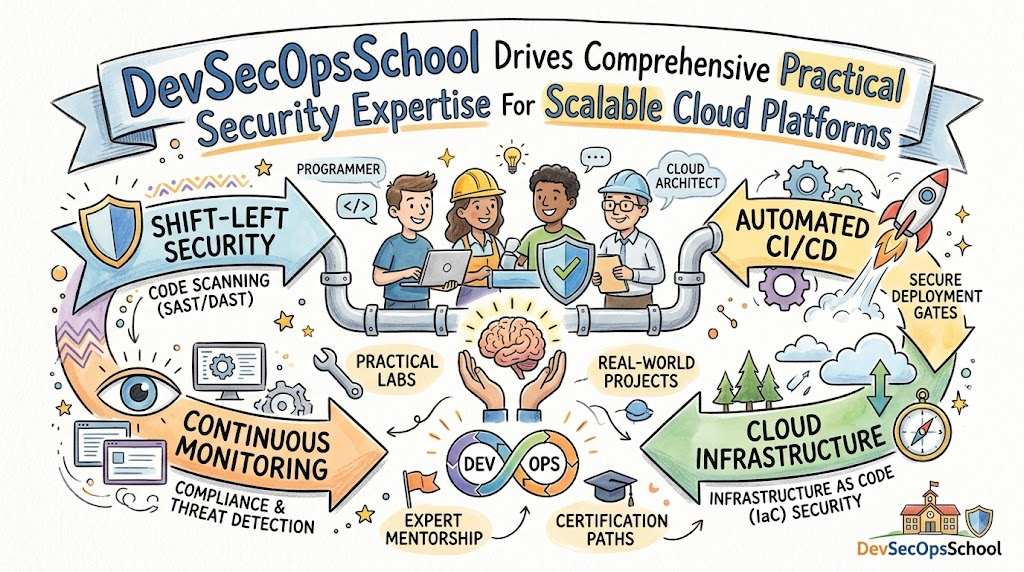
Building secure software at high velocity requires cross-functional teams to eliminate traditional operational handoffs. When companies treat security reviews as a disconnected audit stage, deployment queues grow and dangerous vulnerabilities inevitably reach production environments. Consequently, enterprises face high remediation expenses, brand erosion, and severe regulatory penalties.
DevSecOps directly resolves these bottlenecks by embedding automated security checkpoints into everyday engineering routines. Furthermore, gaining proficiency in these practices requires immersive laboratory work using enterprise-grade tooling. Enrolling in a structured DevSecOps Course provides software engineers, system administrators, and security specialists with the practical skills to protect containerized systems throughout the entire software lifecycle.
Understanding The Shift-Left Security Architecture
Engineering secure software requires developers, operations staff, and security teams to share mutual accountability across every project phase. Historically, security teams analyzed completed applications manually right before release, stalling continuous delivery. In contrast, DevSecOps relies on shift-left principles that run automated code, dependency, and configuration scans continuously.
+-------------------------------------------------------------------------------+
|                       PROACTIVE SECURITY ARCHITECTURE                         |
|                                                                               |
|  [ Plan & Code ]  -->  [ Build & Package ]  -->  [ Test & Stage ]  --> [ Run ]|
|         |                     |                       |                 |     |
|   Threat Modeling      SAST & SCA Scans        IaC & Secret Scans    Runtime  |
+-------------------------------------------------------------------------------+
For instance, programmers catch security flaws directly in their code editors instead of waiting weeks for external audit spreadsheets. Moreover, early flaw detection drastically cuts development overhead because resolving defects during initial coding costs far less than fixing active production vulnerabilities.
| Project Stage | Cost Multiplier | Primary Engineering Action |
|---|---|---|
| Code Creation | 1x (Baseline) | Instant inline code corrections in local IDE |
| Continuous Integration | 5x | Automated scanner remediation and dependency patches |
| Live Production | 30x+ | Emergency patching, system rollbacks, and downtime |
Core Pillars Supporting Automated Software Defense
A mature security automation pipeline integrates diverse validation engines across development milestones to detect threats early.
- Static Application Security Testing (SAST): Analyzes source code files to uncover insecure code constructs, logic errors, and injection vulnerabilities.
- Software Composition Analysis (SCA): Catalogs third-party packages and verifies dependencies against recognized vulnerability databases.
- Secret Detection Scanners: Flags unencrypted tokens, private certificates, and credentials before developers commit files to shared branches.
- Dynamic Application Security Testing (DAST): Tests running applications to identify authentication weaknesses and dynamic server configuration errors.
- Infrastructure as Code (IaC) Validation: Audits Terraform and CloudFormation definitions to eliminate public storage buckets and overly permissive network rules.
+-------------------------------------------------------------------------------+
|                        MULTI-TIER SCANNING TOPOLOGY                           |
|                                                                               |
|  Source Repository  -->  SAST (Semgrep) + SCA (Snyk)                          |
|  Pipeline Artifact  -->  Secret Scans (TruffleHog) + Image Scans (Trivy)      |
|  Cloud Provisioning -->  IaC Auditing (Checkov) + Policy Checks (OPA)         |
|  Staging Cluster    -->  DAST (OWASP ZAP) + Behavioral Audits (Falco)         |
+-------------------------------------------------------------------------------+
Therefore, deploying these automated verification layers provides clear visibility across all software deployment stages.
Integrating Automated Quality Gates Into CI/CD Pipelines
Configuring security tools inside CI/CD pipelines guarantees that every code change satisfies strict quality baselines before reaching cloud servers. Developers trigger automated static analyzers and container scanners whenever they open a pull request.
+-------------------------------------------------------------------------------+
|                     AUTOMATED PIPELINE VALIDATION GATES                       |
|                                                                               |
|  [ Open Pull Request ]                                                        |
|           |                                                                   |
|           v                                                                   |
|  [ Trigger Security Scanners ] --> Runs SAST, SCA, and Secret Detection       |
|           |                                                                   |
|           v                                                                   |
|  [ Quality Gate Decision ]    --> Critical Flaw Found? -> Break Pipeline      |
|           |                                               (Alert Developer)   |
|       (Passed)                                                                |
|           v                                                                   |
|  [ Build & Scan Container ]   --> Runs Trivy Image Vulnerability Scan         |
|           |                                                                   |
|           v                                                                   |
|  [ Automated Deployment ]     --> Ship to Hardened Kubernetes Cluster         |
+-------------------------------------------------------------------------------+
Additionally, automated quality gates stop builds that include unpatched severe vulnerabilities or plain-text secrets. Therefore, developers address security defects during their regular engineering routines, removing manual approval roadblocks and maintaining release speed.
Automating Governance With Policy As Code
Policy as Code enables cloud architects to express compliance standards and access boundaries as executable configuration files. Instead of inspecting infrastructure manually, automated validation tools test environment templates against defined organizational rules.
Specifically, engines like Open Policy Agent (OPA) enforce consistent security controls across cloud resources and Kubernetes admission controllers. Consequently, developers cannot provision non-compliant infrastructure, such as unencrypted database volumes or containers running with root privileges.
Hardening Container Environments And Cloud Workloads
Microservice architectures introduce distinct operational demands because traditional operating system controls cannot protect container runtime environments. Engineering teams must implement pod security standards, manage cluster permissions, and inspect container images continuously.
+-------------------------------------------------------------------------------+
|                     KUBERNETES LAYERED DEFENSE TOPOLOGY                       |
|                                                                               |
|  Layer 1: Network Ingress     --> Strict NetworkPolicies and Ingress Routing  |
|  Layer 2: Admission Control   --> OPA Gatekeeper Policy Validation            |
|  Layer 3: Identity & Access   --> Granular Role-Based Access Control (RBAC)   |
|  Layer 4: Secret Management   --> HashiCorp Vault Dynamic Secret Injection    |
|  Layer 5: Runtime Auditing    --> Falco System Call Behavioral Monitoring     |
+-------------------------------------------------------------------------------+
Completing targeted Kubernetes Security Training gives engineers the practical skills to configure granular Role-Based Access Control, define network policies, and run behavioral threat monitoring. Furthermore, combining these practices with Cloud Security Posture Management (CSPM) safeguards multi-cloud assets against unauthorized access.
Prioritizing Vulnerabilities And Streamlining Compliance
Efficient vulnerability management prioritizes flaws according to real-world exploitability and business importance rather than alert quantity. Standard scanners frequently bombard developers with hundreds of low-impact warnings, creating fatigue and delay.
+-------------------------------------------------------------------------------+
|                      CONTEXTUAL VULNERABILITY TRIAGE                          |
|                                                                               |
|  Scanner Detections  --> Reachability Analysis --> Business Asset Evaluation  |
|                                                          |                    |
|                                                          v                    |
|  Patched Codebase  <-- Actionable Ticket Generated <-- High-Risk Flaw Confirmed|
+-------------------------------------------------------------------------------+
To prevent this problem, forward-thinking teams use contextual risk scoring that checks code reachability and data criticality. Moreover, compliance automation tools continuously audit cloud infrastructure against SOC 2, ISO 27001, and PCI-DSS standards, creating accurate audit records without manual spreadsheets.
Cultivating Security Champions And Cross-Team Alignment
Achieving real security transformation requires strong communication and shared ownership across all technical units. Historically, developers considered security guidelines restrictive, while security analysts struggled to inspect thousands of code commits manually.
+-------------------------------------------------------------------------------+
|                         SECURITY CHAMPION NETWORK                             |
|                                                                               |
|                    [ Central Security Governance ]                            |
|                                  |                                            |
|                 +----------------+----------------+                           |
|                 |                                 |                           |
|                 v                                 v                           |
|      [ Security Champion ]             [ Security Champion ]                  |
|      Backend Platform Team             Cloud Services Team                    |
|                 |                                 |                           |
|                 v                                 v                           |
|     (Runs Threat Modeling)            (Tunes Pipeline Quality Gates)          |
+-------------------------------------------------------------------------------+
To eliminate this cultural gap, forward-thinking companies establish Security Champions within each software team. These champions lead threat modeling sessions, assist teammates with vulnerability fixes, and adjust automated scanning rules. Consequently, security becomes a standard engineering practice rather than an external obstacle.
Identifying And Mitigating Implementation Traps
Organizations often face costly delays when rolling out automated security programs without a clear operational roadmap.
- Scanner Alert Fatigue: Running numerous aggressive scanners simultaneously floods developers with false alarms and slows progress.
- Overly Strict Quality Rules: Halting builds on minor warnings frustrates engineers and encourages them to bypass checks.
- Tooling Without Instruction: Purchasing expensive software without training internal staff leads to unused tools and unmanaged risk.
- Ignoring Culture: Focusing solely on automation tools while neglecting cross-team collaboration impedes successful adoption.
Therefore, engineering leaders must introduce automated gates progressively, tuning detection parameters to match team maturity.
Professional Career Paths And Certification Programs
Earning a verified DevSecOps Engineer Certification proves your ability to build and secure complex cloud release workflows to potential employers. Technical hiring managers specifically seek engineers who showcase hands-on mastery of pipeline automation.
| Certification Level | Core Technical Capabilities | Primary Target Roles |
|---|---|---|
| Security Associate | SAST/SCA scanning, secret detection, basic CI/CD gates | Junior Pipeline Security Engineer |
| Senior DevSecOps Specialist | IaC validation, Policy as Code, container hardening | Senior DevSecOps / SRE Lead |
| Certified DevSecOps Professional | Multi-cloud CSPM, Kubernetes runtime defense, compliance automation | Principal Cloud Security Architect |
Undergoing thorough DevSecOps Certification Training prepares candidates to pass practical assessments, construct robust release pipelines, and secure senior engineering roles.
Enterprise Training Formats And Global Education Programs
Technical practitioners and enterprise organizations need versatile educational options that match practical business demands.
+-------------------------------------------------------------------------------+
|                       ROLE-BASED SKILL DEVELOPMENT                            |
|                                                                               |
|  Developers         --> Secure Coding + Dependency Patching                   |
|  DevOps Engineers   --> CI/CD Quality Gates + Secrets Management + IaC Scans  |
|  Security Analysts  --> Policy as Code + Dynamic DAST Automation + Audits     |
|  Cloud Architects   --> Kubernetes Defense-in-Depth + Multi-Cloud Governance  |
+-------------------------------------------------------------------------------+
- Interactive Hands-On Instruction: Practical DevSecOps Training offers cloud sandbox labs where engineers remediate real-world vulnerabilities.
- Tailored Corporate Programs: Enterprise leaders utilize customized Corporate DevSecOps Training to upskill distributed engineering units on their specific toolchains.
- Flexible Global Access: Distributed teams use DevSecOps Online Training to join live interactive masterclasses from any location worldwide.
- Regional Engineering Excellence: Technology professionals build deep technical competencies through specialized DevSecOps Training in India, qualifying for key roles across global tech firms.
DevSecOpsSchool Lab-Driven Education Methodology
DevSecOpsSchool delivers a lab-intensive learning framework focused on production-grade architectures. Instead of relying on passive slide decks, learners configure actual release pipelines and cloud environments directly.
- Source Code & Artifact Security: Master SonarQube, Semgrep, Snyk, and Trivy to inspect source code and container images.
- Pipeline Orchestration: Build secure CI/CD workflows using Jenkins, GitHub Actions, and GitLab CI.
- Dynamic Testing & Secrets Management: Deploy OWASP ZAP and HashiCorp Vault across distributed cloud environments.
- Infrastructure & Policy as Code: Enforce enterprise governance using Terraform, Checkov, and Open Policy Agent.
Consequently, learners graduate with the practical experience, real project work, and technical confidence needed to lead enterprise security initiatives.
Frequently Asked Questions About DevSecOpsSchool
1. Which core concepts should learners understand before joining this course?
Familiarity with basic Linux system commands, Git version control workflows, and general software development or systems administration concepts provides an ideal starting point.
2. Which security automation tools do students configure during practical labs?
Students gain direct experience with SonarQube, Semgrep, Snyk, OWASP ZAP, Trivy, Docker, Kubernetes, Terraform, Checkov, HashiCorp Vault, and Open Policy Agent.
3. How do participants access the cloud laboratory environments?
Learners connect to cloud-hosted sandbox environments directly via their web browsers to build pipelines, scan infrastructure templates, and secure container clusters.
4. Can working professionals complete this curriculum alongside full-time jobs?
Yes, interactive instructor-led classes take place during convenient weekend and evening schedules, supported by complete session recordings and round-the-clock lab access.
5. How does DevSecOps differ from traditional DevOps methodologies?
Traditional DevOps focuses primarily on deployment speed and workflow automation, whereas DevSecOps embeds automated security checks and compliance validation directly into every delivery stage.
6. Does the curriculum include dedicated container security training modules?
Yes, the course includes dedicated labs covering container image scanning, admission controllers, Kubernetes network policies, RBAC configurations, and runtime monitoring.
7. How does earning a professional certification advance an engineering career?
Obtaining a verified credential proves practical technical competence to recruiters and hiring managers, significantly boosting career opportunities for senior cloud security roles.
8. Can companies tailor the corporate training syllabus to their internal tech stacks?
Yes, enterprise training modules adapt directly to match an organization’s specific cloud providers, CI/CD tools, container platforms, and internal security policies.
9. How do students resolve vulnerabilities during the hands-on project assignments?
Participants analyze scanner outputs, patch vulnerable dependencies, adjust infrastructure templates, update policy rules, and verify that pipelines clear all automated quality gates.
10. What long-term educational resources do graduates receive after course completion?
Graduates retain ongoing access to lab documentation, reference architecture guides, active peer discussion communities, and career mentorship support from experienced industry instructors.
Advancing Engineering Reliability Through Continuous Security
Adopting a comprehensive DevSecOps model allows engineering teams to ship reliable software rapidly without compromising security or regulatory compliance. When developers, operations engineers, and security specialists collaborate using automated scanning pipelines, declarative policy engines, and hardened container platforms, they protect enterprise assets against modern cyber threats.
Investing in structured hands-on education builds the verified practical capabilities necessary to defend complex cloud environments effectively. Begin your educational journey with DevSecOpsSchool today to master automated pipeline security, earn recognized industry credentials, and advance your engineering career.