Introduction
The landscape of modern infrastructure is shifting toward automated intelligence, making the Certified AIOps Engineer designation a critical milestone for tech professionals. Consequently, this guide serves engineers and managers who aim to navigate the complexities of machine learning integration within DevOps and platform engineering. By pursuing this path, individuals gain the necessary expertise to manage self-healing systems and predictive maintenance at scale. This comprehensive overview clarifies how AIOpsSchool provides the framework for making informed career decisions in an increasingly algorithmic world.
What is the Certified AIOps Engineer?
The Certified AIOps Engineer program represents a fundamental shift from reactive manual monitoring to proactive, AI-driven operations. It exists to bridge the gap between traditional systems administration and advanced data science applications within IT environments. Furthermore, the curriculum prioritizes production-focused learning over abstract theory to ensure that engineers can implement real-world solutions immediately. This alignment with modern engineering workflows allows enterprises to reduce mean time to resolution and improve overall system reliability through intelligent automation.
Who Should Pursue Certified AIOps Engineer?
System Reliability Engineers and DevOps professionals benefit most from this certification as it enhances their ability to manage high-velocity environments. Additionally, cloud architects and data professionals find immense value in learning how to apply machine learning models to infrastructure telemetry. Engineering managers who oversee digital transformation initiatives also gain the strategic context needed to lead technical teams effectively. This program holds significant global relevance, particularly in India’s booming tech hubs, where companies are rapidly adopting automated scaling and intelligent observability.
Why Certified AIOps Engineer is Valuable and Beyond
The demand for intelligent operations continues to grow as enterprise environments become too complex for human intervention alone. Therefore, obtaining this certification ensures long-term career longevity by providing skills that remain relevant even as specific software tools change. It fosters a deep understanding of data patterns and anomaly detection, which are essential for maintaining modern cloud-native applications. Ultimately, professionals who invest time in this training see a substantial return on investment through higher-tier roles and increased technical authority.
Certified AIOps Engineer Certification Overview
The program is delivered via the official course portal and hosted on the primary website to ensure a seamless learning experience for all candidates. It utilizes a multi-level assessment approach that evaluates both theoretical knowledge and practical implementation capabilities. Ownership of the certification resides with industry experts who update the structure regularly to reflect the latest shifts in artificial intelligence and IT operations. This practical framework ensures that every certified professional possesses a verified ability to handle complex automated environments.
Certified AIOps Engineer Certification Tracks & Levels
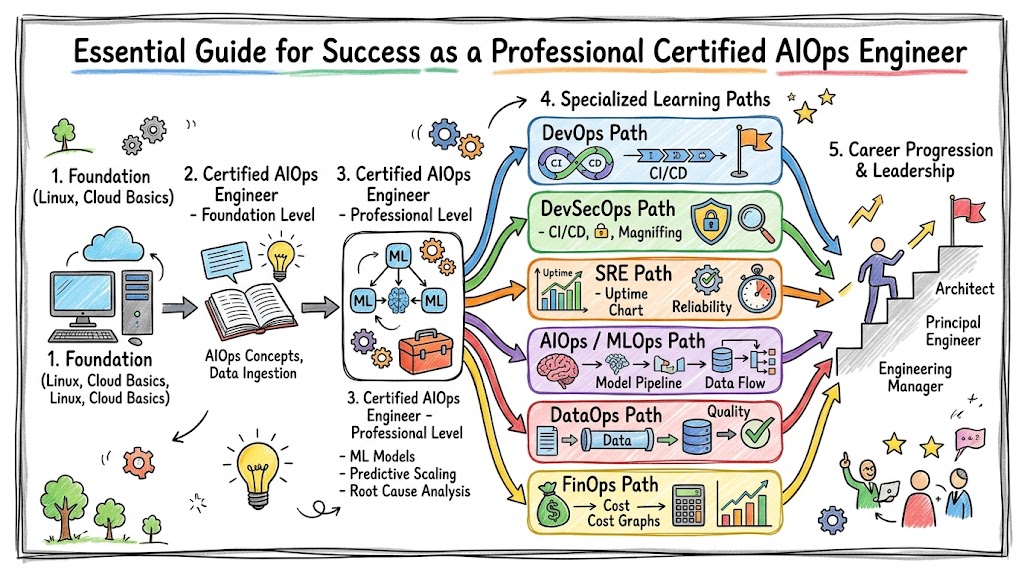
Professionals can start at the foundation level to grasp the core concepts of data ingestion and basic automation patterns. Subsequently, the professional level introduces advanced specialization tracks focused on specific domains like SRE or FinOps. The advanced levels target architects who design entire AIOps ecosystems and lead organizational change. This structured progression allows engineers to align their learning journey with their current career stage while preparing for future leadership responsibilities.
Complete Certified AIOps Engineer Certification Table
| Track | Level | Who it’s for | Prerequisites | Skills Covered | Recommended Order |
| Core AIOps | Foundation | Associate Engineers | Basic Linux & Networking | Data Ingestion, Alerting | 1 |
| SRE-AIOps | Professional | Senior SREs | Foundation Level | Error Budgets, Self-healing | 2 |
| Data-AIOps | Professional | Data Engineers | Python & SQL | Telemetry Pipelines, ML Models | 2 |
| Enterprise | Advanced | Architects | 5+ Years Experience | Governance, AI Strategy | 3 |
Detailed Guide for Each Certified AIOps Engineer Certification
Certified AIOps Engineer – Foundation Level
What it is
This certification validates a candidate’s grasp of basic AIOps principles and their ability to differentiate between traditional monitoring and intelligent observability. It serves as the baseline for all subsequent tracks.
Who should take it
Junior DevOps engineers, recent graduates, and IT administrators who want to enter the field of automated operations should start here.
Skills you’ll gain
- Understanding telemetry data types.
- Configuring basic threshold-based alerts.
- Utilizing automation scripts for repetitive tasks.
Real-world projects you should be able to do
- Setting up a centralized logging dashboard.
- Automating basic server health checks using Python.
Preparation plan
- 7–14 days: Review official documentation and core terminology.
- 30 days: Complete all lab exercises and practice exams.
- 60 days: Not required for this level unless coming from a non-technical background.
Common mistakes
Candidates often underestimate the importance of understanding standard DevOps metrics before moving into AI concepts.
Best next certification after this
- Same-track option: Professional AIOps Engineer.
- Cross-track option: Certified SRE.
- Leadership option: IT Operations Manager.
Certified AIOps Engineer – Professional Level
What it is
The professional level confirms that an engineer can deploy and manage machine learning models specifically designed for infrastructure anomaly detection. It emphasizes practical integration within existing CI/CD pipelines.
Who should take it
Mid-level DevOps and SRE professionals with at least two years of experience in cloud environments should pursue this.
Skills you’ll gain
- Implementing root cause analysis (RCA) engines.
- Managing noise reduction in large-scale alerting systems.
- Deploying predictive scaling policies.
Real-world projects you should be able to do
- Building an automated incident response workflow.
- Integrating a noise-reduction filter on top of Prometheus.
Preparation plan
- 7–14 days: Focus on advanced ML integration patterns.
- 30 days: Hands-on lab work with real-world datasets.
- 60 days: Full project implementation and peer review sessions.
Common mistakes
Focusing too much on the math of machine learning rather than the operational application of the results.
Best next certification after this
- Same-track option: Advanced AIOps Architect.
- Cross-track option: Certified MLOps Professional.
- Leadership option: Principal Systems Engineer.
Choose Your Learning Path
DevOps Path
Engineers following this path focus on integrating AI into the software delivery lifecycle to speed up deployments. They learn how to use predictive analytics to identify potential deployment failures before they occur in production. This path emphasizes the reduction of manual intervention in the build and release process. By mastering these skills, DevOps professionals ensure higher stability and faster feedback loops for development teams.
DevSecOps Path
This journey prioritizes the marriage of security intelligence with operational automation to create a robust defense mechanism. Professionals learn to use AI for real-time threat detection and automated vulnerability remediation across the cloud stack. They focus on identifying anomalous behavior that signifies a security breach rather than just a performance glitch. Consequently, this path is essential for those protecting sensitive enterprise data in high-risk environments.
SRE Path
The SRE path focuses heavily on maintaining service level objectives through intelligent monitoring and automated incident response. Engineers learn to build self-healing systems that can resolve common issues without human pagers being triggered. They utilize AIOps to refine error budgets and provide deeper insights into system performance under stress. This track is ideal for those who prioritize reliability and uptime above all else.
AIOps Path
This specific track dives deep into the core mechanics of artificial intelligence applied strictly to IT operations data. Candidates study various algorithms for pattern recognition and time-series forecasting to predict future system states. It provides the technical foundation needed to build custom AIOps platforms from the ground up for large enterprises. Professionals here act as the bridge between pure data science and infrastructure management.
MLOps Path
Focusing on the lifecycle of machine learning models, this path ensures that AI systems themselves are reliable and scalable. Engineers learn how to automate the training, testing, and deployment of models used within the AIOps framework. They address challenges like model drift and data quality to maintain the accuracy of automated insights. This is a critical path for ensuring that the AI in AIOps remains functional and effective over time.
DataOps Path
The DataOps path emphasizes the quality and flow of telemetry data that fuels AIOps engines. Professionals learn to build resilient data pipelines that can handle massive volumes of logs, metrics, and traces in real-time. They focus on data cleansing and normalization to ensure that downstream AI models receive high-quality input. Without this path, the intelligence of any AIOps implementation remains limited by poor data foundation.
FinOps Path
This path applies intelligent automation to cloud financial management to optimize spending and reduce waste. Engineers learn to use AI to predict cloud costs and automatically adjust resources based on budget constraints. They focus on identifying orphaned resources and underutilized instances through pattern recognition. This track is increasingly vital for organizations looking to maximize their cloud investment while maintaining performance.
Role → Recommended Certified AIOps Engineer Certifications
| Role | Recommended Certifications |
| DevOps Engineer | Foundation + Professional (DevOps Track) |
| SRE | Professional (SRE Track) |
| Platform Engineer | Advanced AIOps Architect |
| Cloud Engineer | Foundation + Professional (Cloud Track) |
| Security Engineer | Professional (DevSecOps Track) |
| Data Engineer | Professional (DataOps Track) |
| FinOps Practitioner | Professional (FinOps Track) |
| Engineering Manager | Foundation + Enterprise Advanced |
Next Certifications to Take After Certified AIOps Engineer
Same Track Progression
Once an engineer masters the professional level, they should move toward the Advanced Architect designation. This progression involves designing large-scale distributed systems that rely entirely on intelligent automation for governance. It requires a shift from managing tools to designing ecosystems that think and act independently. Deep specialization in a specific domain like Predictive SRE allows professionals to become the go-to experts for high-stakes environments.
Cross-Track Expansion
Broadening skills across different tracks like DevSecOps or FinOps creates a more versatile professional profile. For instance, an AIOps expert who understands cloud financial management can prove the direct monetary value of their technical improvements. This expansion prevents siloed thinking and allows engineers to solve problems that span multiple departments. It is the best way to prepare for Staff Engineer or Principal Engineer roles that require a holistic view of the company.
Leadership & Management Track
Transitioning into leadership requires shifting focus from technical implementation to strategic alignment and team growth. Certified professionals can move into roles like Head of Infrastructure or VP of Engineering by leveraging their technical authority. They use their knowledge of AIOps to drive organizational efficiency and justify technical investments to stakeholders. This track is about empowering others to use AI-driven tools to achieve business goals effectively.
Training & Certification Support Providers for Certified AIOps Engineer
DevOpsSchool
This provider offers extensive bootcamps and hands-on labs that cover the entire DevOps spectrum, including specialized AIOps modules. Their instructors bring decades of industry experience to help students understand the practical application of automation tools in production environments.
Cotocus
Cotocus focuses on boutique consulting and specialized technical training for enterprise teams looking to modernize their infrastructure. They provide tailored learning paths that align with specific corporate goals, ensuring that teams can implement AIOps strategies immediately after certification.
Scmgalaxy
As a long-standing community and training platform, this provider offers a wealth of resources for configuration management and continuous integration. Their AIOps curriculum emphasizes the evolution of traditional SCM into intelligent, automated delivery pipelines for modern software.
BestDevOps
This organization provides high-quality training materials and certification prep courses designed for working professionals. They focus on clear, concise lessons that fit into a busy schedule, making it easier for engineers to upskill without pausing their careers.
devsecopsschool.com
Specializing in the intersection of security and operations, this site provides the specific training needed to master automated threat detection. Their courses are essential for anyone following the DevSecOps path within the AIOps ecosystem.
sreschool.com
This platform focuses exclusively on site reliability engineering principles and how AI can be used to maintain system health. Their labs simulate high-pressure production failures to test an engineer’s ability to respond using intelligent automation.
aiopsschool.com
The primary authority on this certification, this site hosts the official curriculum and exam portal. It serves as the central hub for all learning materials, community discussions, and technical updates related to the AIOps engineering field.
dataopsschool.com
This provider focuses on the data engineering side of the house, teaching professionals how to manage the telemetry pipelines required for AI. Their training ensures that the data feeding into your AIOps engine is clean, reliable, and timely.
finopsschool.com
This site offers specialized training in cloud financial management and how to use intelligent automation to control infrastructure costs. It is the go-to resource for engineers who want to specialize in the financial optimization track.
Frequently Asked Questions (General)
- How difficult is the certification exam for a beginner?
The foundation level is accessible for those with basic IT knowledge, but the professional levels require significant hands-on experience with cloud systems.
- How much time should I dedicate to studying each week?
Most successful candidates spend approximately five to ten hours per week over a period of two months to fully grasp the material.
- Are there any specific prerequisites before I can start?
A basic understanding of Linux, networking, and at least one scripting language like Python is highly recommended for all participants.
- What is the return on investment for this specific program?
Professionals often report significant salary increases and access to higher-level roles in platform engineering and SRE departments after completion.
- Is it better to take the SRE track or the DevOps track first?
If your goal is system uptime and reliability, choose SRE; if you want to speed up software delivery, start with the DevOps track.
- How long does the certification remain valid after passing?
The certification generally remains valid for two years, after which you may need to pass an update exam to stay current with technology.
- Does the program include hands-on lab environments?
Yes, the curriculum includes several virtual labs where you can practice implementing AIOps tools on real-world infrastructure scenarios.
- Can I skip the foundation level if I have experience?
While possible, it is recommended to complete the foundation level to ensure you are familiar with the specific terminology used in the advanced exams.
- What tools are covered in the training curriculum?
The program covers a wide range of tools including Prometheus, ELK Stack, various machine learning frameworks, and automated remediation platforms.
- Is there a community or forum for certified professionals?
Yes, graduates gain access to a private community where they can network with other experts and share best practices for intelligent operations.
- Are the exams proctored online or at a center?
Exams are typically proctored online, allowing you to take them from the comfort of your home or office at a scheduled time.
- How does this certification differ from a standard AI degree?
This program focuses strictly on the operational application of AI in IT environments rather than the theoretical mathematical foundations of general AI.
FAQs on Certified AIOps Engineer
- What exactly does an AIOps engineer do on a daily basis?
An engineer in this role spends their time building and maintaining the automated systems that monitor infrastructure and respond to incidents. They analyze data patterns to prevent outages before they happen and refine the algorithms used for noise reduction in alerts.
- How does AIOps integrate with existing DevOps tools?
AIOps acts as an intelligence layer on top of your existing CI/CD and monitoring stack. It ingests data from tools like Jenkins, GitHub, and Datadog to provide a unified, intelligent view of the entire software lifecycle.
- Is coding a major part of the certification process?
Yes, you will need to be comfortable with scripting, particularly in Python or Go. The certification requires you to write automation scripts that interact with APIs and handle data processing tasks.
- What is the most challenging part of the curriculum?
Most students find the transition from simple threshold alerts to algorithmic anomaly detection the most difficult. It requires a mental shift from if-this-then-that logic to understanding statistical probabilities and data trends.
- Does this certification help with cloud-specific roles like AWS or Azure?
Absolutely, as most AIOps tools are cloud-agnostic but are frequently deployed within AWS, Azure, or GCP environments to manage their complex services efficiently.
- Can a manager benefit from this technical certification?
Yes, a manager gains the technical vocabulary and strategic understanding needed to hire the right talent and choose the correct tools for their organization’s needs.
- How does AIOps help in reducing alert fatigue?
AIOps uses clustering algorithms to group related alerts into a single incident. This prevents engineers from being overwhelmed by hundreds of individual notifications for the same root cause.
- Are there real-world case studies included in the course?
The training includes several case studies from large enterprises that have successfully reduced downtime and operational costs using the techniques taught in the program.
Final Thoughts: Is Certified AIOps Engineer Worth It?
Investing in this certification is a strategic move for any serious engineer who wants to stay ahead of the automation curve. As systems grow larger and more complex, the ability to apply artificial intelligence to operations is no longer just a luxury—it is a necessity. This path provides the practical skills needed to transform from a manual troubleshooter into an architect of intelligent, self-sustaining systems. If you are looking to elevate your career and secure your place in the future of IT, this program offers the most direct and effective route. Success in this field requires continuous learning, but this certification provides the solid foundation you need to build a lasting and impactful career.