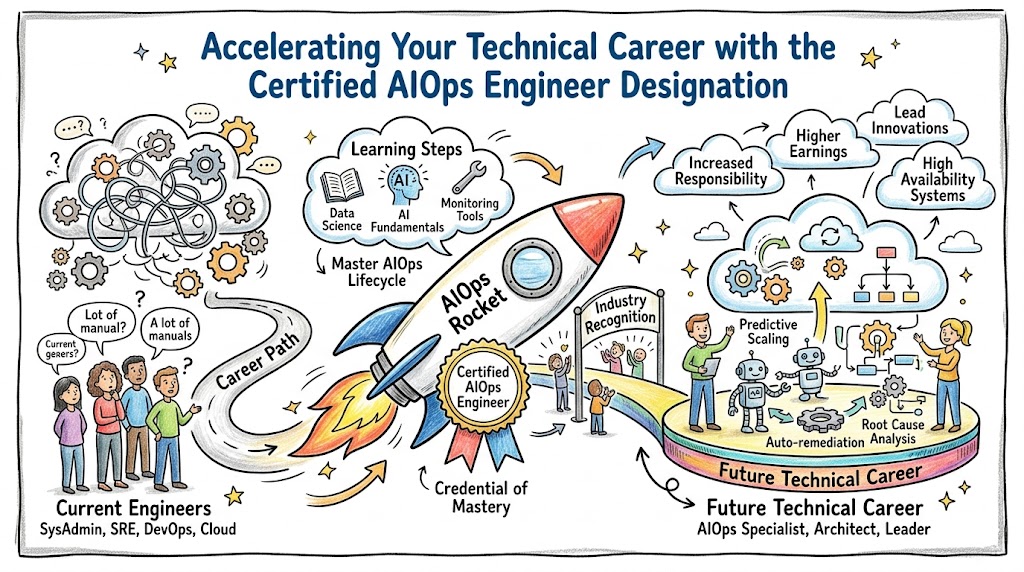
Introduction
Professional growth in the cloud-native era requires a deep understanding of automated intelligence, and achieving the Certified AIOps Engineer status provides the perfect catalyst for this advancement. This guide assists site reliability engineers, developers, and data professionals in navigating the shift toward proactive system management. As environments scale beyond human capacity, AIOpsSchool delivers the practical expertise needed to maintain high availability through machine learning. By following this roadmap, engineers transform from reactive troubleshooters into architects of self-healing infrastructure.
What is the Certified AIOps Engineer?
The Certified AIOps Engineer program establishes a high standard for professionals who manage modern IT operations through artificial intelligence and big data analytics. It replaces traditional, manual monitoring techniques with automated workflows that process massive telemetry streams in real-time. Practitioners learn to build systems that correlate events, reduce alert noise, and pinpoint root causes without human intervention. This certification ensures that engineers can meet the rigorous demands of production-grade environments by focusing on actionable intelligence rather than static rules.
Who Should Pursue Certified AIOps Engineer?
Cloud architects, SREs, and DevOps specialists find this certification essential for managing distributed microservices at scale. It offers a clear path for technical staff who want to master the intersection of data science and infrastructure management. Engineering leaders also utilize this knowledge to build more resilient teams that focus on innovation rather than repetitive maintenance tasks. This credential holds significant value across global markets and India’s rapidly expanding tech landscape, where companies prioritize efficiency and automated reliability.
Why Certified AIOps Engineer is Valuable and Beyond
Earning this certification secures your position in a future where autonomous operations define the industry standard for enterprise technology. It empowers you to handle the increasing volume and variety of data generated by modern cloud-native stacks. Organizations actively seek experts who can lower operational costs and improve system uptime through predictive analytics. By mastering these skills now, you ensure a high return on investment for your career and remain competitive as the role of the traditional administrator disappears.
Certified AIOps Engineer Certification Overview
Students access the comprehensive curriculum through the official training portal, while the Website name platform hosts the integrated lab environments. The program utilizes a rigorous practical assessment model to ensure candidates can execute real-world AIOps strategies effectively. Industry veterans maintain the certification content, ensuring it reflects the latest shifts in observability and machine learning patterns. Unlike theoretical courses, this program emphasizes hands-on mastery of the entire AIOps lifecycle, from initial data collection to automated remediation.
Certified AIOps Engineer Certification Tracks & Levels
The certification structure follows a logical progression through foundation, professional, and advanced tiers to support lifelong learning. The foundation level introduces the core concepts of pattern recognition and operational data flows for entry-level practitioners. Moving to the professional level, engineers dive into complex integrations for SRE and DevOps workflows, including automated incident management. Finally, the advanced track prepares senior engineers to design and lead large-scale digital transformation initiatives across the entire enterprise.
Complete Certified AIOps Engineer Certification Table
| Track | Level | Who it’s for | Prerequisites | Skills Covered | Recommended Order |
| Operations | Foundation | Junior Staff | Basic IT Knowledge | Log Analysis, AI Logic | 1 |
| Engineering | Professional | SREs/DevOps | Professional Exp | RCA, Anomaly Detection | 2 |
| Strategy | Advanced | Lead Architects | Professional Cert | Auto-remediation Design | 3 |
| Leadership | Expert | Managers/CTOs | Senior Leadership | AI ROI, Strategy | 4 |
Detailed Guide for Each Certified AIOps Engineer Certification
Certified AIOps Engineer – Foundation
What it is
This certification confirms your understanding of the basic principles of artificial intelligence as they apply to IT infrastructure. It serves as a validation of your ability to interpret operational data and understand the AIOps framework.
Who should take it
Aspiring cloud engineers and recent graduates should take this as their first step into intelligent operations. It also benefits IT support staff who wish to modernize their skill set for the automated workplace.
Skills you’ll gain
- Mastery of the core pillars of the AIOps lifecycle.
- Ability to identify and categorize various types of telemetry data.
- Basic understanding of how machine learning reduces operational noise.
Real-world projects you should be able to do
- Create a data ingestion pipeline that aggregates logs from multiple servers.
- Develop a dashboard that highlights trends in system performance metrics.
Preparation plan
- 14 Days: Review the fundamental definitions and use cases for AIOps.
- 30 Days: Complete the introductory hands-on labs for data visualization.
- 60 Days: Practice identifying patterns in sample operational datasets.
Common mistakes
- Ignoring the data cleaning process before attempting analysis.
- Focusing solely on the tools rather than the underlying architectural logic.
Best next certification after this
- Same-track option: Professional AIOps Level.
- Cross-track option: Cloud Infrastructure Associate.
- Leadership option: Operations Team Lead.
Certified AIOps Engineer – Professional
What it is
The professional level validates your capability to deploy and manage AI models within complex, production-grade cloud environments. It proves you can integrate AIOps logic into existing DevOps and SRE toolchains for improved reliability.
Who should take it
Middle-level engineers with at least two years of experience in system administration or DevOps should pursue this credential. It is designed for those who manage critical infrastructure and high-availability applications.
Skills you’ll gain
- Implementing automated root cause analysis for faster incident resolution.
- Configuring and tuning predictive alerts based on behavioral anomalies.
- Orchestrating AI insights across Slack, Jira, and other collaboration tools.
Real-world projects you should be able to do
- Build a self-healing workflow that automatically fixes common server errors.
- Optimize an observability stack to eliminate redundant and low-priority alerts.
Preparation plan
- 14 Days: Study advanced API integrations and data correlation rules.
- 30 Days: Set up a comprehensive AIOps lab in a sandbox environment.
- 60 Days: Implement a pilot automation project in a non-critical system.
Common mistakes
- Setting alert thresholds too low, which creates new types of noise.
- Failing to update the AI models as the underlying infrastructure changes.
Best next certification after this
- Same-track option: Advanced AIOps Architect.
- Cross-track option: DevSecOps Professional.
- Leadership option: Infrastructure Manager.
Choose Your Learning Path
DevOps Path
Practitioners on this path integrate AI directly into the continuous delivery pipeline to increase deployment speed and safety. They use AIOps to analyze build logs and predict potential failures before they reach the user. This approach creates a faster feedback loop between developers and operations, ensuring high code quality. By automating these checks, DevOps teams maintain rapid release cycles without sacrificing the stability of the environment.
DevSecOps Path
This track focuses on using artificial intelligence to bolster security within the automation framework. Engineers learn to identify subtle security threats by analyzing access patterns and system logs for anomalous behavior. They automate the response to standard security vulnerabilities, allowing the team to focus on more complex threat hunting. This ensures that security keeps pace with the speed of cloud-native development.
SRE Path
Site Reliability Engineers use AIOps to maintain strict availability targets through intelligent monitoring and predictive maintenance. This path teaches you how to build systems that forecast resource exhaustion and prevent outages before they occur. You will focus on creating autonomous recovery scripts that resolve incidents without manual intervention. It empowers SREs to manage massive global infrastructures with a high degree of precision.
AIOps Path
Specialists on this dedicated path manage the actual machine learning models and data pipelines that drive automation. They focus on selecting the right algorithms for specific operational tasks and ensuring the data remains clean and relevant. This role requires a deep dive into data science for IT, focusing on high-fidelity insights and noise reduction. They serve as the technical backbone for the entire automated operations strategy.
MLOps Path
The MLOps path targets engineers who oversee the lifecycle of the AI models used in operations. They ensure that these models undergo proper testing, versioning, and deployment just like any other software code. This path emphasizes the monitoring of model performance and retraining to prevent accuracy loss over time. It is essential for maintaining the long-term reliability of any AI-driven operational system.
DataOps Path
DataOps professionals focus on the flow and quality of the telemetry data that feeds the AIOps engine. They build resilient pipelines that aggregate information from logs, traces, and metrics across diverse environments. This path emphasizes data governance, real-time processing, and scalability as core success factors. Without their expertise, the AI models would lack the high-quality data needed to make accurate decisions.
FinOps Path
This path applies intelligent data analysis to the challenge of cloud cost management and resource optimization. Engineers learn to use AI to identify wasteful spending and forecast future cloud budgets based on usage trends. This role bridges the gap between engineering performance and financial responsibility for the enterprise. It ensures that the organization extracts the maximum value from its cloud investments.
Role → Recommended Certified AIOps Engineer Certifications
| Role | Recommended Certifications |
| DevOps Engineer | Certified AIOps Professional, DevOps Master |
| SRE | Certified AIOps Professional, SRE Specialist |
| Platform Engineer | Advanced AIOps Architect, Cloud Expert |
| Cloud Engineer | AIOps Foundation, Cloud Architect |
| Security Engineer | AIOps for Security, DevSecOps Pro |
| Data Engineer | DataOps Specialist, AIOps Foundation |
| FinOps Practitioner | FinOps Certified, AIOps for FinOps |
| Engineering Manager | AIOps for Managers, Tech Strategy |
Next Certifications to Take After Certified AIOps Engineer
Same Track Progression
Mastering the Advanced AIOps Architect level represents the ultimate goal for those seeking deep technical specialization. This track allows you to lead the design of complex, self-managing systems for the world’s largest enterprises. It keeps you at the absolute forefront of operational technology, focusing on the future of autonomous clouds. Continuous progression on this track ensures your skills never become obsolete in a rapidly changing market.
Cross-Track Expansion
Gaining certifications in MLOps or DevSecOps broadens your perspective and makes you a much more valuable team member. These additional skills allow you to understand the security implications of your automation and how to manage the models themselves. This versatility is highly prized by modern tech companies that value cross-functional expertise. It prepares you to handle a wider variety of challenges as you move into senior roles.
Leadership & Management Track
Transitioning into management requires you to move from technical execution to strategic planning and team leadership. Pursuing management-focused certifications helps you understand how to align technical projects with business goals and budgets. You will learn to manage stakeholder expectations and communicate the complex value of AIOps to non-technical executives. This path is perfect for those who want to shape the direction of entire engineering departments.
Training & Certification Support Providers for Certified AIOps Engineer
DevOpsSchool
This provider offers extensive training programs that blend DevOps theory with hands-on AIOps implementation. They focus on giving students the tools they need to solve actual production problems immediately after completing their course.
Cotocus
This organization specializes in helping professionals master the intricacies of modern cloud-native environments. Their curriculum features input from industry experts who provide real-world context for every technical lesson.
Scmgalaxy
As a community-led resource, this platform provides deep-dive tutorials and workshops on automation and configuration management. They help engineers stay updated on the latest shifts in intelligent operational practices.
BestDevOps
This portal delivers high-quality education for engineers who want to excel in high-scale tech environments. Their structured courses help candidates prepare for certifications while gaining practical, resume-building skills.
devsecopsschool.com
This dedicated site focuses on the crucial intersection of security and automated IT operations. They teach engineers how to use AI to detect threats faster and more accurately within a DevOps framework.
sreschool.com
This institution focuses on the core principles of Site Reliability Engineering and how AIOps supports them. Their training helps students build the skills needed to maintain massive systems with high reliability.
aiopsschool.com
As the primary destination for AIOps education, this site provides a complete learning path for all experience levels. They offer specialized courses that cover everything from foundational data logic to advanced AI architecture.
dataopsschool.com
This provider focuses on the essential task of managing the data pipelines that power intelligent automation. They show engineers how to handle massive data scales while maintaining the integrity and speed of the information.
finopsschool.com
This school teaches the art of cloud cost optimization through the lens of data science and automation. They help practitioners reduce waste and improve the financial predictability of their cloud environments.
Frequently Asked Questions
- Does this certification help me advance to a senior role?
Yes, it provides the specialized knowledge in automation and data science that modern enterprises look for when hiring senior engineers.
- How much coding do I need to know for the professional level?
You should have a working knowledge of Python or similar languages to handle the automated remediation and API integration tasks.
- Is the exam recognized by global technology companies?
Yes, major firms worldwide recognize this credential as a standard for proficiency in intelligent IT operations and automation.
- Can I complete the training while working a full-time job?
Most providers offer flexible, self-paced learning options that allow you to balance your studies with your current professional responsibilities.
- What is the main difference between AIOps and standard monitoring?
Standard monitoring only reports current states, while AIOps uses data analytics to predict future issues and automate the response.
- Are there any hands-on labs included in the foundation level?
While the foundation level focuses more on concepts, it typically includes basic labs to help you visualize operational data flows.
- How do I keep my certification active over time?
You may need to participate in continuing education or pass a renewal exam every few years to stay current with technology.
- Is this certification valuable for engineers based in India?
Absolutely, as India’s tech sector moves toward high-scale cloud services, the demand for AIOps-certified professionals is growing rapidly.
- Does the course cover the use of AI in capacity planning?
Yes, the professional and advanced levels cover how to use historical data to forecast future resource needs automatically.
- Can I take the classes in a physical classroom setting?
Some providers offer hybrid models, but most students find the online proctored exams and digital labs to be the most convenient.
- How does this certification address alert fatigue?
It teaches you how to use AI correlation and suppression rules to ensure engineers only see the most critical and relevant alerts.
- Is there a prerequisite for the foundation level exam?
No formal prerequisites exist for the foundation level, though a basic understanding of IT infrastructure and cloud concepts is very helpful.
FAQs on Certified AIOps Engineer
- Which specific AIOps tools will I learn to use?
The curriculum focuses on the logic behind AIOps, though you will gain experience with popular logging, monitoring, and correlation platforms in the labs.
- How does AIOps improve the software release cycle?
It provides real-time feedback on how new code affects system performance, allowing for faster rollbacks or fixes if the AI detects an anomaly.
- Can I apply these skills to hybrid cloud environments?
Yes, the principles of AIOps work effectively across on-premise, public cloud, and hybrid setups to provide a unified view of system health.
- What kind of mathematical background do I need?
You don’t need to be a mathematician; the course focuses on applying existing AI models to IT problems rather than building them from scratch.
- Does the program include training on incident management?
Yes, a significant portion of the professional track covers how AI transforms the incident lifecycle from detection to automated resolution.
- Are the labs conducted in real cloud environments?
Most providers use simulated or actual cloud sandboxes to give you a safe place to practice implementing AIOps strategies.
- How do I register for the certification exam?
You can register through the official website of the training provider, where you will select an exam date and time that fits your schedule.
- Is there a community forum for students and alumni?
Yes, most certification programs grant access to a private network where you can discuss technical challenges and find job opportunities.
Final Thoughts: Is Certified AIOps Engineer Worth It?
Selecting the path to become a Certified AIOps Engineer signifies a forward-thinking approach to your technical career. It moves you past the limitations of traditional administration and equips you with the skills to manage the next generation of intelligent systems. The effort you invest in mastering these data-driven techniques will return substantial value through improved job prospects and more efficient daily operations. By embracing this change, you become a vital contributor to your organization’s digital stability and future growth.