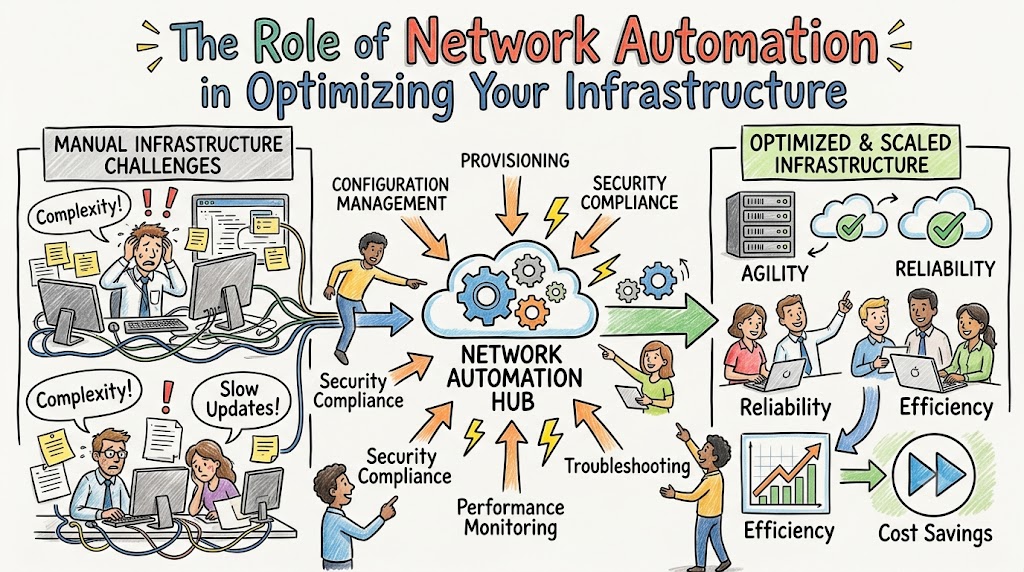
Network automation is the fundamental shift from manually configuring routers, switches, and firewalls to using software and code to manage your entire network ecosystem. Historically, network engineers relied on command-line interfaces and tedious, repetitive tasks to keep connectivity alive. Today, this traditional approach simply cannot keep pace with the speed, scale, and complexity demanded by modern digital environments. By integrating automation, organizations can drastically reduce human error, accelerate service delivery, and maintain a consistently stable infrastructure.
At its core, network automation involves utilizing specialized software tools, scripts, and frameworks to automate the provisioning, configuration, management, and testing of network devices. Instead of logging into fifty different switches to apply a single security patch, an engineer writes a script or uses a platform to push that change simultaneously across the entire fleet. Consequently, this frees up valuable human resources to focus on strategic, high-level architecture rather than getting bogged down in operational minutiae.
Furthermore, the true power of network automation lies in its ability to transform a rigid, hardware-centric setup into a dynamic, software-driven infrastructure. It bridges the gap between development teams and network teams, enabling a seamless flow of services from inception to production. Ultimately, understanding and leveraging this technological shift is absolutely essential for any organization looking to optimize its infrastructure, reduce operational overhead, and remain competitive in a rapidly evolving technological landscape. If you want to master these essential skills, Noopsschool provides the exact training needed to get started.
Defining the Core Mechanics of Network Automation
To truly grasp how automation optimizes infrastructure, we must first break down its core mechanics. Network automation is not a single tool or a magic button; rather, it is a layered approach combining intent-based networking, software-defined infrastructure, and continuous integration pipelines. Intent-based networking allows administrators to declare what they want the network to achieve, such as prioritizing video traffic, while the automation engine figures out how to implement it. This shifts the focus from managing individual device configurations to managing the overall business intent.
Additionally, software-defined networking separates the control plane from the data plane, centralizing the intelligence of the network. This centralization is what makes large-scale automation possible. When the network brain is decoupled from the individual hardware limbs, you can program the entire infrastructure holistically. Therefore, changes that once took weeks of planning and careful execution can now be rolled out in minutes with mathematical precision, fundamentally altering how infrastructure is consumed and maintained.
The Shift from Manual CLI to Code-Driven Workflows
The transition from manual Command Line Interface workflows to code-driven methodologies represents a massive paradigm shift in engineering. For decades, the CLI was the undisputed king of network management, requiring engineers to memorize proprietary syntax for every single vendor. However, this method is inherently unscalable and prone to typos, which can cause catastrophic outages. By moving to code-driven workflows, networks are treated as immutable infrastructure, where the desired state is defined in code and applied consistently.
Consequently, this shift introduces the concept of Infrastructure as Code, where every configuration change goes through version control, peer review, and automated testing before it ever touches a live device. If a change causes an issue, the network can be instantly rolled back to the previous known-good state. Ultimately, this code-driven approach removes the anxiety traditionally associated with network changes, replacing fear with confidence and predictability across the entire organizational infrastructure.
Why Infrastructure Optimization Demands Automation Now
Modern infrastructure is incredibly complex, blending on-premises data centers, cloud environments, and edge computing into a single, sprawling mesh. Attempting to optimize this hybrid ecosystem manually is a futile effort that inevitably leads to bottlenecks and visibility gaps. Automation is demanded now because the velocity of business requirements has vastly outpaced the velocity of manual human operations. When a new application requires specific network policies across multiple cloud providers, only an automated system can provision those paths swiftly and accurately.
Moreover, security threats are becoming more sophisticated, requiring immediate network responses that human operators simply cannot execute fast enough. Automation enables dynamic micro-segmentation and instant policy enforcement, isolating threats before they can proliferate. Therefore, infrastructure optimization is no longer just about making things faster; it is about making them resilient, secure, and adaptable to sudden changes in demand or threat landscapes.
Key Operational Concepts You Must Know
To effectively navigate the world of modern network operations, you must internalize several foundational concepts that serve as the bedrock of automation. These concepts move beyond simple scripting and delve into how automated systems actually function at scale. Understanding these principles will allow you to design architectures that are inherently automatable, rather than trying to bolt automation onto legacy, fragile systems. These concepts form the universal language of operations engineering today.
First and foremost is the concept of “State Management.” In an automated environment, you must understand the difference between the actual state of your network and the desired state defined in your code. The automation platform’s primary job is to constantly reconcile these two states. If a user makes an unauthorized manual change, the system detects the drift and automatically corrects it. Consequently, mastering state management ensures your infrastructure remains perfectly aligned with your design specifications at all times.
Another crucial concept is “Idempotency.” An idempotent operation is one that can be applied multiple times without changing the result beyond the initial application. For example, if an automation script instructs a switch to ensure a specific VLAN exists, running that script ten times will not create ten VLANs; it will simply verify the VLAN is there and do nothing else. This property is absolutely vital for building reliable, repeatable automation workflows that do not cause unintended side effects when executed repeatedly.
Understanding Declarative vs. Imperative Models
When building automation, you generally choose between declarative and imperative programming models. The imperative model focuses on the “how,” giving the device a strict set of step-by-step instructions to achieve a goal. For instance, you might write a script that says: log in, enter configuration mode, create a VLAN, assign a port, and save. While powerful, imperative scripts are brittle because they assume the starting state of the device is exactly as expected.
Conversely, the declarative model focuses entirely on the “what.” You simply tell the system, “Ensure this port is assigned to this VLAN,” and the underlying automation engine figures out the necessary steps to make it happen. Therefore, declarative models are highly favored in modern operations because they are inherently idempotent and much more resilient to unexpected device states. Ultimately, relying on declarative models drastically reduces the complexity of your automation code.
The Importance of Abstraction in Network Operations
Abstraction is the process of hiding the complex, underlying details of the network while exposing a simplified interface for the operator. In traditional networking, engineers had to know the exact CLI syntax for Cisco, Juniper, and Arista devices. Abstraction layers, such as network intent models or vendor-agnostic automation frameworks, translate a single universal command into the specific syntax required by each vendor. This means you write one piece of automation logic, and the abstraction layer handles the translation.
As a result, abstraction drastically reduces the operational overhead of managing a multi-vendor environment. It allows operations teams to focus on the logical topology and business policies rather than getting entangled in proprietary syntax. Furthermore, if you ever swap out a vendor’s hardware, your automation code remains entirely unchanged because the abstraction layer absorbs the impact. Ultimately, abstraction future-proofs your automation investments and simplifies your daily operations.
Continuous Integration and Continuous Deployment for Networks
Borrowing heavily from software development, Continuous Integration and Continuous Deployment (CI/CD) is a concept that has revolutionized network operations. In a CI/CD pipeline, every configuration change is committed to a version control system like Git. Automatically, this commit triggers a series of checks, including syntax validation, security scans, and even simulated network tests. Only if the change passes all these automated gates is it considered for deployment.
Consequently, this methodology completely eliminates the “big bang” network changes that traditionally happened at midnight and caused endless outages. Instead, networks receive small, incremental, and thoroughly tested updates exactly like software applications. Therefore, embracing CI/CD for networks ensures that your infrastructure is always in a deployable state, drastically reducing downtime and increasing the overall reliability of the network.
Platform Implementation vs. Culture — What’s the Real Difference?
A common trap organizations fall into is believing that purchasing an expensive network automation platform will instantly solve their operational woes. However, the technology itself is only half the battle; the other, arguably more difficult half, is the organizational culture. Platform implementation involves installing software, configuring APIs, and writing initial scripts. It is a tangible, check-the-box project that can be completed in a few months. Unfortunately, without a cultural shift, these platforms often become shelf-ware.
Culture, on the other hand, is about how people think, collaborate, and approach problem-solving. An automation-friendly culture embraces failure as a learning opportunity, demands peer review of all code, and breaks down the silos between development and operations teams. You can have the most advanced automation platform in the world, but if your engineers are terrified of making changes or refuse to share their knowledge, the platform will remain utterly useless. Therefore, the real difference lies in human behavior, not software capabilities.
Furthermore, platform implementation is a technical skill, whereas cultural transformation is a leadership challenge. Leaders must actively reward collaborative behaviors and create safe environments for engineers to experiment with new automation tools. When an organization focuses solely on the platform, they end up with a highly automated version of their existing broken processes. Conversely, when they focus on culture, the platform naturally becomes an enabler of a new, highly efficient way of working.
Why Tools Fail Without Cultural Buy-In
Tools fail without cultural buy-in because automation inherently disrupts existing power dynamics and comfort zones. In many traditional environments, seniority is tied to knowing arcane command-line syntax. When automation makes that knowledge obsolete, engineers may feel threatened and passively resist using the new system. They might continue doing things manually and simply use the automation platform to generate reports after the fact, completely negating its value.
Additionally, if management uses automation purely as a cost-cutting measure to eliminate jobs, the remaining staff will view the platform with suspicion rather than enthusiasm. To succeed, cultural buy-in must be rooted in the idea that automation eliminates tedious toil, allowing engineers to elevate their careers into architecture and design. Ultimately, people will only champion a tool if they believe it makes their working lives better, not just cheaper for the company.
Transitioning from Siloed Teams to Collaborative Workflows
Traditional IT organizations operate in strict silos: server teams, network teams, security teams, and application teams. This siloed structure is the natural enemy of automation, as deploying a new application requires manual handoffs and ticketing between each group. Transitioning to collaborative workflows means forming cross-functional teams that own an application from top to bottom, including its underlying network infrastructure. This structure is often referred to as a DevOps or NetDevOps approach.
Consequently, when a network engineer sits side-by-side with a software developer, they begin to understand each other’s constraints and requirements. The developer learns that networks are not just dumb pipes, and the network engineer learns the agility demands of continuous software delivery. Therefore, breaking down these silos is a cultural achievement that unlocks the true speed and efficiency that automation platforms promise to deliver.
Measuring Success Beyond Just Tool Deployment
If you only measure success by whether the automation platform is installed and running, you are missing the bigger picture. True success in operations engineering must be measured by business outcomes. Are you deploying network changes ten times faster than before? Has the number of configuration-related outages dropped significantly? Are your engineers reporting higher job satisfaction because they no longer have to do mindless, repetitive tasks? These are the metrics that matter.
Additionally, measuring success involves tracking the reduction in “mean time to repair” (MTTR) when an outage does occur. An automated network can pinpoint faults and potentially reroute traffic in seconds, whereas a manual approach might take hours of troubleshooting. Therefore, organizations must shift their key performance indicators away from technical deployment milestones and focus entirely on agility, reliability, and employee retention to truly gauge their operational maturity.
Real-World Use Cases of Modern Operations
Understanding the theory behind network automation is important, but seeing how it is applied in real-world scenarios truly highlights its transformative power. Modern operations span a wide variety of disciplines, from Zero Touch Provisioning in massive data centers to automated security responses. These use cases demonstrate that automation is not a futuristic concept; it is a present-day necessity that solves immediate, painful problems for enterprises globally. Let us explore some of the most impactful applications.
One of the most prevalent use cases is Zero Touch Provisioning (ZTP). Imagine a logistics company opening a new warehouse and needing to deploy fifty network switches. In the past, an engineer would have to unbox each switch, console into it, manually load the operating system, and apply a baseline configuration. With ZTP, the engineer simply plugs the switch into power and the network. The switch reaches out to a central controller, authenticates itself, downloads its specific configuration, and becomes fully operational without a single human keystroke.
Another critical use case is automated compliance and security auditing. Regulatory frameworks require organizations to maintain strict network configurations, such as ensuring no default passwords exist or that specific access control lists are applied everywhere. Manually auditing thousands of devices is impossible. Automation platforms can run daily checks against these compliance baselines, automatically generating reports and even remediating non-compliant devices instantly. Consequently, this drastically reduces the risk of costly regulatory fines.
Zero Touch Provisioning in Data Centers
In hyperscale data centers, Zero Touch Provisioning is an absolute requirement, not a luxury. These environments contain tens of thousands of servers and switches that are constantly being decommissioned and replaced. Human intervention at the rack level would bottleneck the entire supply chain. By leveraging ZTP, data center operators can treat network hardware exactly like servers in a cloud environment—completely disposable and instantly replaceable.
When a new switch is installed, it uses protocols like DHCP and TFTP to locate the automation controller. The controller then identifies the switch by its serial number or MAC address and pushes the exact configuration tailored for that specific rack and slot. Therefore, if a switch fails, a junior technician can simply swap the physical hardware, and the automation handles the entire logical restoration. Ultimately, this reduces hardware replacement times from hours to mere minutes.
Automated Compliance and Security Posture Management
Maintaining a strong security posture across a sprawling network is a never-ending battle. Attackers continuously probe for weak configurations, such as open management ports or outdated encryption protocols. Automated compliance tools continuously scan the network against a defined golden baseline. If an engineer accidentally leaves an SSH session open or misconfigures a routing protocol, the automation system immediately flags it and can automatically revert the change.
Furthermore, when a new critical vulnerability is announced, automation allows organizations to quickly assess their exposure. Instead of manually logging into every router to check the firmware version, a script can query the entire infrastructure in seconds and provide a definitive list of affected devices. Consequently, security teams can patch the vulnerability in a targeted, rapid manner, significantly shrinking the window of opportunity for potential attackers.
Dynamic Traffic Engineering and Load Balancing
Traditional networks rely on static routing protocols that often lead to inefficient path selection and congested links. Modern operations leverage automated, dynamic traffic engineering to optimize how data flows across the infrastructure. Using technologies like segment routing, automation platforms can constantly monitor bandwidth utilization and latency across all available paths. If a primary link becomes congested, the system dynamically shifts traffic to underutilized paths in real-time.
Additionally, this dynamic approach is incredibly valuable for multi-cloud environments where traffic must traverse expensive public internet links or dedicated interconnects. Automation can intelligently route traffic based on application sensitivity, sending bulk data transfers over cheaper paths while prioritizing interactive user traffic over premium links. Therefore, dynamic traffic engineering ensures that organizations maximize the return on their infrastructure investments while providing an optimal experience for end-users.
Incident Response and Automated Remediation
When a network outage occurs, every second of downtime costs money and damages reputation. Modern operations utilize automated incident response to dramatically reduce mean time to repair. Instead of waking up an engineer to troubleshoot, the automation platform detects the anomaly, such as a sudden spike in packet loss, and immediately begins executing a predefined remediation playbook. This might involve isolating a faulty link or restarting a degraded process.
Moreover, advanced automation systems can integrate with artificial intelligence to predict failures before they happen. By analyzing telemetry data over time, the system can identify subtle trends that precede a hardware failure, such as gradually increasing error rates on an optical interface. The system can then proactively reroute traffic away from the failing component and automatically generate a hardware replacement ticket. Ultimately, automated remediation transforms network operations from reactive firefighting to proactive stability management.
Common Mistakes in Operations Engineering
While the benefits of network automation are undeniable, the path to achieving them is littered with potential pitfalls. Many organizations stumble not because the technology is flawed, but because they make preventable mistakes during their transition. Recognizing these common errors is the first step toward avoiding them. By understanding what not to do, you can steer your automation initiatives toward sustainable, long-term success rather than frustrating failures.
The single most common mistake is attempting to automate a broken process. If your manual workflow is chaotic, poorly documented, and inefficient, automating it will simply produce chaotic, poorly documented, and inefficient results at a much faster rate. Before writing a single line of code, operations teams must ruthlessly streamline and optimize their manual processes. You must define exactly what success looks like before you ask a machine to replicate it.
Another frequent error is the “snowflake” anti-pattern, where engineers write highly specific, one-off scripts to solve immediate problems without considering broader applicability. Over time, this leads to a massive, unmanageable graveyard of custom scripts that only the original author understands. When that author leaves the company, the automation breaks. Therefore, organizations must enforce coding standards, modular design, and peer review to prevent their automation efforts from devolving into “spaghetti code.”
Automating Broken Processes Instead of Fixing Them
It is incredibly tempting to look at a tedious manual task and immediately write a script to handle it. However, this is a dangerous reflex. For example, if your manual process for onboarding a new customer involves six different ticketing systems and manual data entry, simply writing a script to move the data between those systems is a missed opportunity. You are automating the friction, not solving the underlying architectural flaw.
Instead, you should first question why six systems are required in the first place. Can they be consolidated? Can APIs be integrated to eliminate the manual data entry completely? Therefore, the rule of thumb is to simplify and optimize the process manually first, and only introduce automation once the process is as lean and logical as possible. Ultimately, automating a broken process merely accelerates your inefficiency.
Neglecting Version Control and Peer Reviews
In software engineering, the idea of making changes without version control and peer review is completely unthinkable. Yet, in network engineering, it is still alarmingly common for someone to write a script, run it directly against production devices, and hope for the best. This completely bypasses the safety nets that make automation reliable. Without version control, there is no history of what changed, who changed it, or how to roll it back if things go wrong.
Furthermore, skipping peer reviews means that bugs, logic errors, and potentially catastrophic typos go unnoticed until they impact the live network. Every piece of network automation code must be treated with the same rigor as production software. It must be committed to a Git repository, reviewed by a fellow engineer, and merged through a controlled pipeline. Consequently, enforcing these software engineering best practices is non-negotiable for a mature operations team.
Over-Engineering Solutions for Simple Tasks
There is a certain allure to building complex, elegant automation frameworks that can handle every conceivable edge case. However, over-engineering is a massive trap. If a simple task, like updating a single DNS record, takes three days to automate because you are building a robust, microservices-based architecture to handle it, you have lost the plot. The goal of automation is to save time and reduce errors, not to create endless engineering projects for basic operational needs.
Therefore, operations engineers must carefully balance robustness with pragmatism. Sometimes, a simple, well-documented shell script is vastly superior to a complex, distributed application. The key is to choose the simplest tool that reliably solves the problem at hand. As the complexity of the problem grows, you can iteratively introduce more sophisticated tools. Ultimately, avoiding over-engineering ensures that your team remains agile and delivers immediate value.
Ignoring Failure Modes and Rollback Strategies
Every automated system will eventually fail, whether due to a bug, an API outage, or unexpected network conditions. A critical mistake is building automation that only knows how to move forward but has no concept of how to move backward. If an automated configuration push fails halfway through, does it leave the network in a fractured, half-configured state? If so, the automation has made things worse than if you had done it manually.
Consequently, every automation workflow must include explicit failure modes and rollback strategies. Before pushing a change, the system should automatically back up the current configuration. If the post-change validation checks fail, the system must immediately abort and restore the backup without human intervention. Therefore, planning for failure is not pessimistic; it is the hallmark of a resilient, production-ready automation architecture.
How to Become an Operations Expert — Career Roadmap
Transitioning from a traditional network engineer to a modern operations expert is a highly rewarding career move, but it requires a deliberate and structured approach. You are essentially adding software engineering skills to your existing infrastructure knowledge, making you a rare and highly valuable hybrid professional. This roadmap outlines the critical steps you need to take to navigate this transition successfully and position yourself at the forefront of the industry.
The journey begins with a mindset shift. You must stop thinking of yourself as someone who configures boxes and start thinking of yourself as a developer who builds systems to manage networks. This means accepting that code is the new CLI and that testing is just as important as implementation. Once your mindset is aligned, you can begin systematically acquiring the technical skills that define the modern operations expert.
Furthermore, this career path is not about abandoning your hard-earned networking knowledge. On the contrary, your deep understanding of routing protocols, spanning tree, and network architecture is exactly what gives your automation context. A pure software developer might write beautiful code that violates fundamental network design principles. As a network operations expert, you bring the domain expertise that ensures the automation is not just technically sound, but architecturally correct.
Stage 1: Mastering Fundamental Scripting Languages
The absolute first technical step on this roadmap is learning to code, and there is no better starting point than Python. Python has become the lingua franca of network automation due to its readability, massive ecosystem of libraries, and broad industry adoption. Do not try to learn computer science theory; focus strictly on practical, task-oriented programming. Learn how to manipulate strings, parse JSON data, read and write files, and interact with APIs.
Once you are comfortable with basic Python syntax, start applying it to network tasks. Write a script that logs into a router via SSH and pulls the running configuration. Then, modify that script to parse the configuration and extract specific information, like interface statuses or OSPF neighbors. Consequently, by solving real network problems with code, you will build both your skills and your confidence simultaneously, proving to yourself that automation is highly attainable.
Stage 2: Learning Infrastructure as Code Tools
After mastering basic scripting, you must graduate to dedicated Infrastructure as Code (IaC) tools like Ansible. While Python is general-purpose, Ansible is purpose-built for configuration management and automation. It operates using a declarative model, meaning you define the desired state of your network, and Ansible handles the heavy lifting of figuring out how to get there. Learning Ansible teaches you critical concepts like idempotency, inventory management, and playbook design.
Dive deep into Ansible modules specific to networking vendors. Learn how to structure playbooks that are modular, reusable, and easily readable by your peers. Furthermore, explore how to integrate Ansible with version control systems to start building your first basic CI/CD pipelines. Therefore, mastering IaC tools bridges the gap between writing simple scripts and building enterprise-grade, automated network architectures.
Stage 3: Understanding APIs and Data Formats
Modern networks are managed not through CLIs, but through Application Programming Interfaces (APIs). To interact with these APIs, you must deeply understand data serialization formats, primarily JSON and YAML. You need to know how to construct a JSON payload to create a virtual network in a cloud provider or how to parse a YAML response from a network controller. This data literacy is fundamental to every automation task you will perform.
Additionally, you must understand the different types of APIs, particularly RESTful APIs. Learn how HTTP methods like GET, POST, PUT, and DELETE map to standard network operations like reading, creating, updating, and deleting configurations. Spend time using tools like Postman to manually interact with network device APIs before trying to automate them with code. Consequently, a solid grasp of APIs and data formats unlocks the entire modern infrastructure ecosystem.
Stage 4: Developing CI/CD and Testing Proficiency
The final stage of becoming an expert is mastering the deployment and testing of your automation code. You must learn how to use tools like Git for version control and become proficient with branching and merging strategies. More importantly, you need to learn how to set up automated pipelines using tools like Jenkins or GitLab CI. These pipelines will automatically test your code every time you make a change.
Testing in network automation involves both static analysis, like checking for syntax errors, and dynamic testing, like spinning up virtual network nodes in a container and verifying that your configuration actually works as intended. Embracing a “test-first” mentality is what separates amateur scripters from professional operations engineers. Therefore, by mastering CI/CD, you guarantee that your automation is reliable, scalable, and safe to deploy into production environments.
FAQ Section
What exactly is network automation?
Network automation is the use of software and code to manage, configure, test, and operate network devices, replacing manual command-line processes with scalable, programmable workflows.
Is coding strictly required to automate networks?
While basic tasks can be done with visual tools, a deep understanding of coding, particularly in Python, is essential for solving complex problems and advancing in a modern operations career.
Can small businesses benefit from network automation?
Absolutely, small businesses benefit greatly by reducing manual errors, saving time on repetitive tasks, and ensuring their limited IT staff can focus on strategic initiatives rather than mundane configuration chores.
What is the biggest challenge in adopting network automation?
The biggest challenge is usually cultural, as it requires shifting from traditional siloed, manual mindsets to collaborative, code-driven workflows, which often meets resistance from existing staff.
How does automation impact network security?
Automation vastly improves security by enabling continuous compliance checks, rapid vulnerability patching, and dynamic micro-segmentation, all of which reduce the attack surface and human error.
Do I need to abandon my current network knowledge to learn automation?
No, your existing network knowledge is crucial because automation is simply a new way to implement that knowledge; understanding protocols and architecture ensures your code actually works correctly.
What is Infrastructure as Code?
Infrastructure as Code is the practice of managing and provisioning computer networks and servers through machine-readable definition files, rather than physical hardware configuration or interactive configuration tools.
How long does it take to become proficient in network automation?
It typically takes several months of consistent, hands-on practice to become comfortable with the basics, and years of real-world experience to master advanced architectural concepts and CI/CD integration.
Final Summary
Network automation is no longer an emerging trend; it is the definitive standard for managing and optimizing modern infrastructure. Throughout this guide, we have explored how moving from manual, command-line operations to code-driven workflows fundamentally transforms the reliability, speed, and agility of networks. By treating infrastructure as code, organizations can eliminate human error, enforce strict compliance, and adapt to changing business demands with unprecedented speed. The era of configuring networks box-by-box has permanently ended.
We also delved into the critical operational concepts that underpin this transformation, such as state management, idempotency, and the vital difference between imperative and declarative models. Understanding these principles is essential for building automation that is resilient and scalable. Furthermore, we emphasized that technology alone is insufficient. The most advanced automation platforms will fail if they are not accompanied by a cultural shift that breaks down silos, embraces peer review, and focuses on continuous improvement rather than just tool deployment.
The real-world use cases, from Zero Touch Provisioning to automated incident response, clearly demonstrate the tangible business value of these practices. However, success requires navigating common pitfalls, such as automating broken processes or neglecting version control. Finally, for those looking to thrive in this new landscape, the career roadmap provides a clear, actionable path from traditional networking to modern operations expertise. By mastering scripting, APIs, and CI/CD pipelines, you can secure your place at the forefront of the industry. Ultimately, optimizing your infrastructure through automation is a continuous journey that yields immense rewards for those willing to embrace it.