Introduction
Network security protects computer networks, devices, applications, and data from unauthorized access, cyberattacks, malware, and other digital threats. As organizations continue to rely on digital systems for daily operations, protecting network infrastructure has become a critical business requirement rather than a technical option.
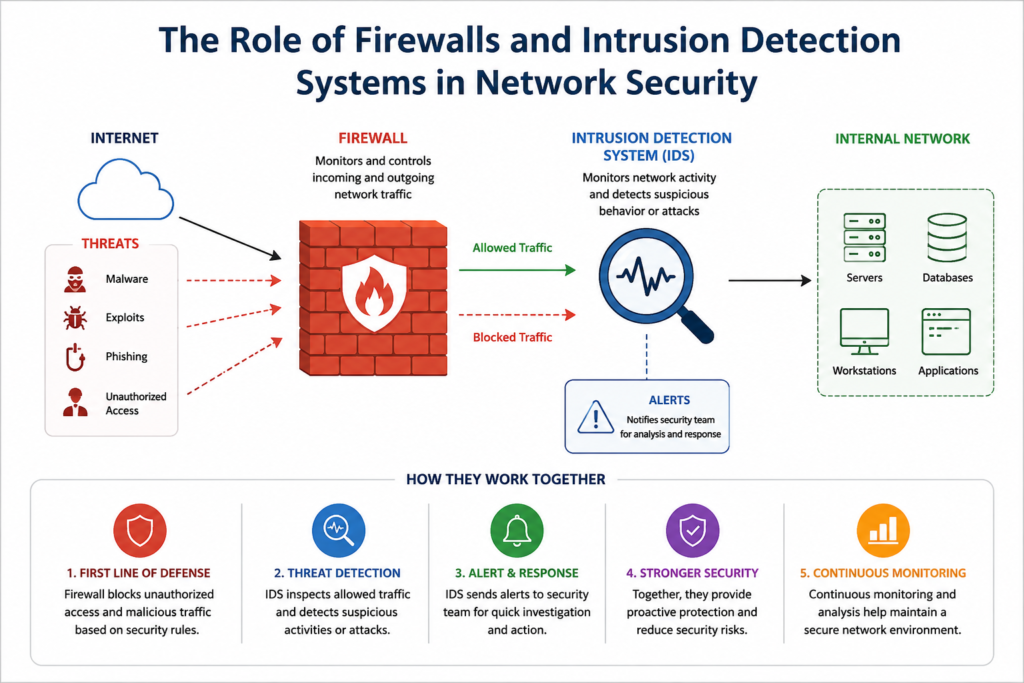
Among the most important security technologies used in modern networks are firewalls and Intrusion Detection Systems (IDS). These tools work together to monitor, control, and secure network traffic. While firewalls act as gatekeepers that regulate incoming and outgoing traffic, IDS solutions continuously analyze network activities to identify suspicious behavior and potential attacks.
Organizations of all sizes use these technologies to reduce risks, maintain compliance, protect sensitive information, and ensure business continuity. Security teams often combine multiple layers of protection to create a strong defense strategy. In this approach, firewalls and IDS solutions serve as foundational components.
For businesses seeking professional training and expertise in cybersecurity and network operations, Noopsschool provides educational resources and learning opportunities that help professionals develop practical security skills.
Understanding Network Security Fundamentals
Network security consists of policies, technologies, processes, and practices designed to protect digital infrastructure from cyber threats. It focuses on ensuring the confidentiality, integrity, and availability of data and systems.
Organizations face numerous threats every day. Attackers constantly search for vulnerabilities in servers, applications, cloud environments, wireless networks, and user devices. Without adequate protection, businesses may experience data breaches, service disruptions, financial losses, and reputational damage.
Network security relies on multiple layers of defense. Instead of depending on a single security solution, organizations deploy various security controls that work together. This layered approach reduces the likelihood of successful attacks.
Common security controls include:
- Firewalls
- Intrusion Detection Systems
- Intrusion Prevention Systems
- Antivirus software
- Endpoint security solutions
- Access control systems
- Network segmentation
- Encryption technologies
- Security monitoring platforms
Each security control performs a specific function. Firewalls regulate traffic, while IDS solutions identify suspicious activities. Together, they create stronger protection against evolving cyber threats.
What Is a Firewall?
A firewall is a security device or software application that monitors and controls network traffic based on predefined security rules. It acts as a barrier between trusted internal networks and untrusted external networks.
The primary purpose of a firewall is to prevent unauthorized access while allowing legitimate communication. Every piece of traffic entering or leaving a network passes through firewall inspection.
Firewalls evaluate traffic according to configured policies. If traffic matches approved rules, the firewall permits access. If traffic violates security policies, the firewall blocks the connection.
Organizations use firewalls to:
- Protect internal systems
- Restrict unauthorized access
- Control internet usage
- Prevent malware communication
- Enforce security policies
- Monitor network activities
Without firewalls, networks become significantly more vulnerable to external attacks and unauthorized access attempts.
Types of Firewalls
Packet Filtering Firewalls
Packet filtering firewalls examine individual packets and make decisions based on source addresses, destination addresses, protocols, and ports.
These firewalls provide basic protection and operate quickly because they inspect limited information. However, they may not detect sophisticated threats that require deeper analysis.
Stateful Inspection Firewalls
Stateful firewalls track active connections and maintain information about ongoing sessions.
Instead of evaluating packets independently, they analyze the context of communications. This approach improves security while maintaining efficient performance.
Many enterprise environments use stateful firewalls because they balance protection and speed effectively.
Proxy Firewalls
Proxy firewalls act as intermediaries between users and external systems.
Rather than allowing direct communication, the firewall receives requests and forwards them on behalf of users. This method hides internal network details and provides additional security inspection.
Organizations handling sensitive information often use proxy firewalls to strengthen security controls.
Next-Generation Firewalls
Next-Generation Firewalls combine traditional firewall functions with advanced security features.
Capabilities typically include:
- Deep packet inspection
- Application awareness
- User identification
- Malware detection
- Threat intelligence integration
- SSL traffic inspection
These firewalls provide more comprehensive protection against modern cyber threats.
Cloud Firewalls
Cloud firewalls protect cloud-based applications and infrastructure.
As organizations migrate workloads to cloud platforms, cloud-native security solutions help maintain visibility and control across distributed environments.
Cloud firewalls support scalability and centralized management, making them attractive for modern enterprises.
What Is an Intrusion Detection System?
An Intrusion Detection System is a security technology that monitors network or system activities to identify suspicious behavior, policy violations, and potential cyberattacks.
Unlike firewalls, which primarily control access, IDS solutions focus on detection and alerting.
The system continuously analyzes traffic patterns, user behavior, and system activities. When unusual events occur, it generates alerts that security teams can investigate.
IDS solutions help organizations identify threats that may bypass traditional security controls.
Examples include:
- Malware infections
- Unauthorized access attempts
- Insider threats
- Denial-of-service attacks
- Data exfiltration attempts
- Exploitation activities
IDS technologies provide valuable visibility into network activities and support proactive threat detection.
Types of Intrusion Detection Systems
Network-Based IDS
Network-Based IDS monitors traffic across network segments.
Sensors analyze packets traveling through the network and compare activities against known attack signatures or behavioral patterns.
These systems provide broad visibility into network communications.
Host-Based IDS
Host-Based IDS operates directly on servers, workstations, or endpoints.
The system monitors:
- File modifications
- System logs
- User activities
- Application behavior
- Configuration changes
Host-based monitoring provides detailed insight into individual systems.
Signature-Based IDS
Signature-based systems compare activities against a database of known attack patterns.
When a match occurs, the IDS generates an alert.
This approach effectively detects known threats but may miss previously unseen attacks.
Anomaly-Based IDS
Anomaly-based systems establish baseline behavior and identify deviations from normal activities.
Because they focus on unusual behavior, they can detect new threats that do not match existing signatures.
However, anomaly detection may generate more false positives than signature-based methods.
How Firewalls and IDS Work Together
Firewalls and IDS solutions complement each other.
A firewall acts as the first line of defense by controlling traffic flow. Meanwhile, IDS continuously monitors activities to detect suspicious behavior.
Consider a scenario where an attacker attempts to exploit a web application.
The firewall may allow legitimate web traffic because the traffic appears normal. However, the IDS may identify malicious payloads, unusual requests, or attack signatures embedded within the traffic.
This layered approach provides stronger security than relying on a single technology.
Benefits include:
- Improved visibility
- Faster threat detection
- Better incident response
- Reduced attack success rates
- Enhanced compliance support
Organizations achieve greater protection when both technologies operate together.
Why Firewalls Are Essential in Network Security
Firewalls remain one of the most important security controls because they regulate network communication.
Access Control
Firewalls enforce policies that determine who can access specific systems and services.
This control reduces opportunities for unauthorized users.
Traffic Monitoring
Firewalls provide visibility into network traffic patterns.
Administrators can identify unusual activity and investigate potential threats.
Segmentation
Organizations often divide networks into separate zones.
Firewalls control communication between these zones and reduce lateral movement opportunities for attackers.
Threat Reduction
Blocking unnecessary services and ports reduces the attack surface.
As a result, attackers have fewer opportunities to exploit vulnerabilities.
Compliance Support
Many regulations require organizations to implement network access controls.
Firewalls help satisfy these requirements and support audit readiness.
Why IDS Is Critical for Modern Security Operations
Threats constantly evolve. Attackers frequently develop new techniques to bypass traditional defenses.
IDS solutions improve visibility and help organizations identify suspicious activities before significant damage occurs.
Early Detection
Security teams receive alerts when unusual activities appear.
Early detection enables faster investigation and containment.
Incident Response Support
IDS logs provide valuable evidence during investigations.
Security analysts can understand attack timelines and determine affected systems.
Threat Hunting
Organizations use IDS data to proactively search for hidden threats.
This approach improves overall security maturity.
Continuous Monitoring
Unlike periodic assessments, IDS systems operate continuously.
Around-the-clock monitoring helps organizations detect threats regardless of when they occur.
Key Operational Concepts You Must Know
Effective network security depends on understanding several operational concepts.
Defense in Depth
Defense in depth involves deploying multiple security layers rather than relying on one control.
If one security mechanism fails, additional protections remain available.
Least Privilege
Users should receive only the access necessary to perform their responsibilities.
This principle limits potential damage from compromised accounts.
Network Segmentation
Segmentation divides networks into smaller zones.
Even if attackers gain access to one segment, movement across the network becomes more difficult.
Continuous Monitoring
Security requires ongoing observation rather than one-time implementation.
Organizations must continuously monitor systems, traffic, and user behavior.
Incident Response
Detection alone is not enough.
Teams must establish processes for containment, investigation, recovery, and improvement.
Threat Intelligence
Security teams use external threat information to understand emerging attack techniques and strengthen defenses.
These operational concepts significantly improve firewall and IDS effectiveness.
Platform Implementation vs. Culture — What’s the Real Difference?
Many organizations focus heavily on security tools while overlooking security culture.
This imbalance often creates security gaps.
Platform Implementation
Platform implementation refers to technical deployment activities.
Examples include:
- Installing firewalls
- Configuring IDS sensors
- Creating security rules
- Monitoring alerts
- Updating software
These tasks establish the technical foundation of security.
Security Culture
Security culture refers to how people think about and practice security.
It includes:
- Employee awareness
- Security accountability
- Leadership commitment
- Collaboration
- Risk management habits
A strong culture encourages employees to recognize threats and follow security practices.
Why Culture Matters
Even advanced security platforms cannot fully protect organizations when employees ignore security guidelines.
For example, a user may accidentally share credentials despite having multiple security technologies in place.
Strong culture reduces human-related risks.
Achieving Balance
Organizations achieve the best results when technology and culture work together.
Technical controls provide protection, while security-conscious employees support those controls through responsible behavior.
Real-World Use Cases of Modern Operations
Modern organizations use firewalls and IDS solutions in many practical scenarios.
Financial Services Protection
Banks process highly sensitive customer information.
Firewalls restrict access to financial systems, while IDS solutions monitor suspicious activities and fraud attempts.
Healthcare Security
Healthcare organizations manage confidential patient records.
Security teams use firewalls and IDS technologies to protect medical systems and maintain privacy.
E-Commerce Platforms
Online stores process customer transactions around the clock.
Security solutions help detect payment fraud, malicious bots, and unauthorized access attempts.
Government Networks
Government agencies maintain critical infrastructure and sensitive information.
Advanced monitoring helps identify nation-state threats and targeted attacks.
Manufacturing Environments
Industrial systems increasingly connect to digital networks.
Firewalls and IDS technologies help protect production systems from operational disruptions.
Educational Institutions
Universities support large numbers of users and devices.
Security monitoring helps identify malware outbreaks and unauthorized activities across campus networks.
Common Firewall Configuration Mistakes
Even powerful firewalls can become ineffective when misconfigured.
Overly Permissive Rules
Allowing unnecessary traffic creates security risks.
Organizations should regularly review and tighten firewall policies.
Poor Documentation
Undocumented configurations create confusion and increase troubleshooting complexity.
Clear documentation improves consistency and accountability.
Ignoring Rule Reviews
Firewall policies often accumulate outdated rules over time.
Regular audits help eliminate unnecessary access permissions.
Lack of Monitoring
Organizations sometimes deploy firewalls but fail to monitor logs.
Monitoring provides visibility into attacks and policy violations.
Inadequate Testing
Changes should be tested before deployment.
Testing reduces the likelihood of security gaps and service disruptions.
Common IDS Implementation Mistakes
IDS deployments also face challenges.
Excessive False Positives
Poor tuning can generate overwhelming alert volumes.
Analysts may eventually ignore important warnings.
Insufficient Coverage
Monitoring only a portion of the network creates blind spots.
Organizations should strategically place sensors throughout critical environments.
Delayed Response
Detection has limited value without timely investigation.
Security teams need clearly defined response procedures.
Outdated Signatures
Signature-based systems require regular updates.
Outdated signatures reduce detection effectiveness.
Lack of Skilled Personnel
Security tools require knowledgeable analysts.
Without proper expertise, organizations may struggle to interpret alerts accurately.
Common Mistakes in Operations Engineering
Operations engineering involves maintaining reliable, secure, and efficient systems. Many professionals encounter similar challenges during their careers.
Ignoring Automation Opportunities
Manual processes consume time and increase error rates.
Automation improves consistency and operational efficiency.
Reactive Instead of Proactive Management
Waiting for failures before taking action creates unnecessary risks.
Proactive monitoring identifies issues before they affect users.
Weak Change Management
Uncontrolled changes often introduce instability.
Structured change processes improve reliability and accountability.
Limited Documentation
Knowledge trapped within individuals creates operational dependencies.
Comprehensive documentation supports collaboration and continuity.
Inadequate Monitoring
Organizations cannot manage what they cannot observe.
Monitoring should provide visibility into performance, security, and availability.
Poor Communication
Operations teams must collaborate with developers, security teams, management, and business stakeholders.
Strong communication improves decision-making and problem resolution.
Best Practices for Firewall and IDS Management
Organizations should follow proven practices to maximize effectiveness.
Establish Clear Security Policies
Policies provide guidance for implementation and decision-making.
Review Configurations Regularly
Security environments evolve continuously.
Regular reviews help maintain effectiveness.
Use Layered Security
Multiple controls provide stronger protection than a single solution.
Monitor Continuously
Security monitoring should operate around the clock.
Train Personnel
Technology alone cannot provide complete protection.
Skilled professionals improve security outcomes.
Conduct Security Assessments
Regular testing identifies weaknesses before attackers exploit them.
Future Trends in Network Security
Network security continues to evolve as threats become more sophisticated.
Artificial Intelligence
AI helps security teams analyze large volumes of data and identify threats faster.
Behavioral Analytics
Organizations increasingly focus on user and entity behavior analysis.
This approach helps detect insider threats and compromised accounts.
Cloud-Native Security
Cloud adoption continues to increase.
Security solutions are adapting to support distributed environments.
Zero Trust Architecture
Zero Trust assumes no user or system should receive automatic trust.
Every request requires verification.
Integrated Security Platforms
Organizations increasingly consolidate security tools to improve visibility and operational efficiency.
How to Become an Operations Expert — Career Roadmap
Operations expertise requires a combination of technical knowledge, practical experience, and continuous learning.
Step 1: Learn Networking Fundamentals
Build a strong foundation in:
- TCP/IP
- Routing
- Switching
- DNS
- Network protocols
Networking knowledge forms the basis of security operations.
Step 2: Understand Operating Systems
Learn both Linux and Windows administration.
Operations professionals regularly interact with servers and infrastructure.
Step 3: Study Security Fundamentals
Focus on:
- Firewalls
- IDS and IPS
- Access control
- Encryption
- Vulnerability management
Security knowledge strengthens operational capabilities.
Step 4: Learn Monitoring and Logging
Understand how monitoring systems collect and analyze operational data.
Visibility is essential for effective operations.
Step 5: Develop Automation Skills
Automation improves scalability and efficiency.
Popular areas include:
- Scripting
- Configuration management
- Infrastructure automation
Step 6: Gain Hands-On Experience
Practical experience accelerates learning.
Build labs, participate in projects, and solve real operational challenges.
Step 7: Learn Incident Management
Operations experts frequently respond to outages and security incidents.
Understanding structured response processes is critical.
Step 8: Strengthen Communication Skills
Technical expertise alone is insufficient.
Professionals must explain issues clearly to different audiences.
Step 9: Stay Updated
Technology evolves continuously.
Successful professionals invest in ongoing learning and skill development.
Step 10: Specialize
After gaining foundational experience, consider focusing on:
- Network security
- Cloud operations
- Site reliability engineering
- Security operations
- Infrastructure engineering
Specialization helps build advanced expertise and career growth opportunities.
FAQ Section
What is the main purpose of a firewall?
A firewall controls network traffic and prevents unauthorized access based on predefined security rules.
What does an Intrusion Detection System do?
An IDS monitors network or system activities and alerts security teams when suspicious behavior is detected.
Can an IDS replace a firewall?
No. Firewalls and IDS solutions perform different functions and work best when used together.
What is the difference between IDS and IPS?
An IDS detects and alerts, while an Intrusion Prevention System can automatically block malicious activities.
Why is network segmentation important?
Segmentation limits attacker movement and reduces the impact of security incidents.
Do small businesses need firewalls and IDS solutions?
Yes. Organizations of all sizes face cyber threats and benefit from layered security controls.
How often should firewall rules be reviewed?
Organizations should review rules regularly and whenever significant infrastructure changes occur.
What causes false positives in IDS systems?
Improper tuning, unusual but legitimate activities, and overly broad detection rules can generate false positives.
Is cloud security different from traditional network security?
Cloud environments require many of the same principles, but they introduce additional considerations related to shared responsibility and distributed infrastructure.
What skills are required for operations engineering?
Networking, operating systems, security, monitoring, automation, troubleshooting, and communication skills are all important.
Final Summary
Firewalls and Intrusion Detection Systems play a central role in modern network security. Firewalls regulate traffic and enforce access controls, while IDS solutions monitor activities and identify suspicious behavior. Together, they create a powerful security foundation that helps organizations detect threats, reduce risks, and maintain operational resilience.
Successful security programs go beyond technology. Organizations must combine strong security platforms with effective operational practices, skilled personnel, continuous monitoring, and a security-focused culture. Concepts such as defense in depth, least privilege, segmentation, and incident response strengthen overall protection and improve organizational readiness.
As cyber threats continue to evolve, businesses must continuously refine their security strategies. Regular reviews, ongoing training, proactive monitoring, and layered defenses help organizations stay ahead of attackers. Professionals who develop expertise in networking, security operations, automation, and incident management can build rewarding careers while helping organizations protect critical systems and data.