Introduction
Cyber attacks have become one of the biggest threats to organizations of every size. Businesses depend on digital systems for communication, operations, customer management, and data storage. As a result, attackers constantly search for weaknesses that can be exploited to steal information, disrupt services, or gain unauthorized access to critical resources.
Network security plays a central role in protecting organizations from these risks. It involves the policies, technologies, processes, and practices used to safeguard networks, systems, and data from unauthorized access and malicious activities. When implemented correctly, network security creates multiple layers of protection that make it significantly harder for attackers to succeed.
Organizations that invest in strong security practices are better prepared to identify threats, minimize vulnerabilities, and respond quickly when incidents occur. Effective security is not only about deploying tools. It also requires employee awareness, operational discipline, and continuous improvement.
For individuals looking to strengthen their knowledge of cybersecurity and modern operational practices, Noopsschool provides learning opportunities designed to help professionals develop practical skills and industry-relevant expertise.
In this comprehensive guide, we will explore how organizations can prevent cyber attacks using network security best practices, understand critical operational concepts, examine real-world examples, avoid common mistakes, and build a successful career in operations and security.
Understanding Cyber Attacks and Network Security
Before discussing prevention strategies, it is important to understand what cyber attacks are and why network security matters.
A cyber attack is any attempt to gain unauthorized access to systems, networks, applications, or data. Attackers may be motivated by financial gain, espionage, disruption, revenge, or competitive advantage.
Common forms of cyber attacks include:
- Malware infections
- Ransomware attacks
- Phishing campaigns
- Distributed Denial-of-Service (DDoS) attacks
- Insider threats
- Credential theft
- Man-in-the-middle attacks
- Network intrusion attempts
- Data breaches
- Social engineering attacks
Network security acts as a protective barrier between valuable digital assets and potential attackers. It combines technology, people, and processes to reduce risk and improve resilience.
A strong security posture focuses on prevention, detection, response, and recovery. Each component is equally important because no environment can be guaranteed to be completely attack-proof.
Why Cyber Attack Prevention Matters
Many organizations focus heavily on recovery after a security incident. However, prevention is far more cost-effective than responding to a major breach.
Successful cyber attacks can lead to:
- Financial losses
- Operational downtime
- Loss of customer trust
- Legal consequences
- Regulatory penalties
- Intellectual property theft
- Brand reputation damage
When organizations implement strong network security controls, they reduce the likelihood of successful attacks and limit potential damage when incidents occur.
Prevention also allows security teams to spend more time improving systems rather than constantly responding to emergencies.
Core Network Security Best Practices
Establish a Strong Security Policy
Every successful security program begins with clear policies.
A security policy defines acceptable behavior, access controls, password requirements, data handling procedures, and incident response expectations.
Without documented policies, employees often make inconsistent decisions that create security gaps.
Effective policies should include:
- Access management standards
- Device usage rules
- Data protection guidelines
- Password requirements
- Remote work security procedures
- Incident reporting processes
Policies must also be reviewed regularly to remain aligned with changing technologies and threats.
Implement Multi-Layered Defense
Relying on a single security solution creates unnecessary risk.
A layered security strategy ensures that if one defense fails, additional controls remain available.
Multiple layers may include:
- Firewalls
- Endpoint protection
- Intrusion detection systems
- Network segmentation
- Security monitoring
- Identity management controls
- Data encryption
This approach significantly reduces the likelihood of successful compromise.
Use Strong Authentication Controls
Weak passwords remain one of the most common causes of security breaches.
Organizations should enforce:
- Complex password requirements
- Password managers
- Multi-factor authentication
- Account lockout policies
- Regular credential reviews
Multi-factor authentication provides an additional layer of security by requiring users to verify their identity through multiple methods.
Even if credentials are stolen, attackers face additional barriers before gaining access.
Apply the Principle of Least Privilege
Users should only have access to resources necessary for their responsibilities.
Excessive permissions increase the potential impact of compromised accounts.
Least privilege reduces risk by:
- Limiting unauthorized access
- Reducing insider threats
- Restricting lateral movement
- Improving accountability
Access reviews should be conducted regularly to ensure permissions remain appropriate.
Keep Systems Updated
Outdated software frequently contains vulnerabilities that attackers exploit.
Organizations should establish a structured patch management process.
This process should include:
- Vulnerability identification
- Patch testing
- Deployment scheduling
- Verification procedures
Timely updates help eliminate known security weaknesses before attackers can exploit them.
Encrypt Sensitive Data
Encryption protects information by converting it into unreadable data that requires authorized keys for access.
Organizations should encrypt:
- Stored data
- Backup files
- Email communications
- Data transfers
- Cloud storage resources
Encryption minimizes exposure even if attackers obtain access to systems or files.
Segment the Network
Network segmentation divides infrastructure into smaller controlled sections.
Instead of allowing unrestricted communication across the environment, segmentation limits access between different systems.
Benefits include:
- Reduced attack surface
- Better access control
- Improved monitoring
- Containment of security incidents
If one segment becomes compromised, attackers have greater difficulty reaching critical assets.
Monitor Network Activity Continuously
Security monitoring allows organizations to detect suspicious behavior quickly.
Monitoring solutions can identify:
- Unusual login attempts
- Unauthorized access
- Data exfiltration
- Malware activity
- Network anomalies
Continuous monitoring improves visibility and shortens response times.
Train Employees Regularly
Technology alone cannot prevent every attack.
Employees are often targeted through phishing emails, social engineering, and fraudulent communications.
Security awareness training should cover:
- Recognizing phishing attempts
- Safe browsing habits
- Password management
- Reporting suspicious activity
- Data protection responsibilities
An informed workforce becomes a valuable security asset.
Develop an Incident Response Plan
Preparation is essential when security incidents occur.
An incident response plan outlines:
- Roles and responsibilities
- Escalation procedures
- Communication strategies
- Investigation processes
- Recovery steps
Organizations that practice response procedures recover faster and experience less disruption.
Building a Security-First Culture
Security should not be viewed as solely the responsibility of the IT department.
Organizations achieve stronger protection when security becomes part of everyday operations.
A security-first culture encourages:
- Accountability
- Awareness
- Continuous learning
- Risk identification
- Collaboration
Employees who understand the importance of security are more likely to follow policies and report concerns promptly.
Leadership also plays a critical role by supporting security initiatives and promoting responsible behavior.
Key Operational Concepts You Must Know
Modern network security depends heavily on operational excellence. Understanding key operational concepts helps organizations maintain reliable and secure environments.
Availability
Systems must remain accessible when users need them.
Availability focuses on:
- Redundancy
- High availability architecture
- Disaster recovery
- Backup strategies
Security controls should protect systems without unnecessarily reducing availability.
Reliability
Reliable systems perform consistently under expected conditions.
Reliability is achieved through:
- Proper design
- Preventive maintenance
- Monitoring
- Performance optimization
Reliable systems reduce operational disruptions and security risks.
Observability
Observability refers to the ability to understand system behavior through collected data.
This includes:
- Metrics
- Logs
- Traces
- Alerts
Observability improves troubleshooting and threat detection.
Automation
Automation reduces manual effort and minimizes human error.
Common automation activities include:
- Patch deployment
- Configuration management
- User provisioning
- Threat detection workflows
Automation increases efficiency while strengthening consistency.
Scalability
Organizations must prepare for growth.
Scalable systems can handle increasing workloads without sacrificing performance or security.
Planning for scalability prevents future operational bottlenecks.
Resilience
Resilience measures how effectively systems recover from disruptions.
Resilient environments include:
- Backup infrastructure
- Failover mechanisms
- Recovery procedures
- Business continuity planning
Resilience ensures operations continue even during adverse events.
Platform Implementation vs. Culture — What’s the Real Difference?
Organizations often focus heavily on technology while overlooking culture. However, both elements play critical roles in operational success.
| Platform Implementation | Culture |
|---|---|
| Focuses on tools and technology | Focuses on people and behaviors |
| Provides technical capabilities | Encourages responsible actions |
| Can be deployed quickly | Develops over time |
| Supports automation and efficiency | Supports collaboration and accountability |
| Depends on architecture and processes | Depends on leadership and mindset |
Why Platform Implementation Matters
Platform implementation provides the technical foundation needed for secure operations.
Examples include:
- Monitoring platforms
- Identity management systems
- Security analytics solutions
- Configuration management tools
Without strong platforms, security teams struggle to maintain visibility and control.
Why Culture Matters
Even the best tools cannot compensate for poor security behavior.
Culture influences:
- Decision-making
- Policy compliance
- Incident reporting
- Risk awareness
Organizations with strong security cultures often experience fewer successful attacks because employees actively participate in protection efforts.
Achieving Balance
The most successful organizations combine strong platforms with strong culture.
Technology provides capabilities.
Culture ensures those capabilities are used effectively.
Together they create a sustainable security environment.
Real-World Use Cases of Modern Operations
Modern operations extend beyond maintaining servers and networks. They support business continuity, security, performance, and innovation.
Security Monitoring Centers
Security operations centers continuously monitor networks for suspicious activity.
Teams analyze alerts, investigate incidents, and coordinate response efforts.
This approach improves visibility and accelerates threat detection.
Cloud Infrastructure Management
Organizations increasingly rely on cloud environments.
Operations teams manage:
- Cloud security
- Resource allocation
- Identity management
- Cost optimization
- Compliance requirements
Effective cloud operations reduce risk while supporting business growth.
Automated Patch Management
Large organizations may operate thousands of devices.
Automation allows teams to:
- Identify vulnerabilities
- Deploy updates
- Verify installations
- Generate compliance reports
This significantly improves security efficiency.
Threat Intelligence Integration
Modern operations teams use threat intelligence to identify emerging risks.
Threat intelligence helps organizations:
- Recognize attacker techniques
- Prioritize vulnerabilities
- Improve defenses
- Strengthen incident response
This proactive approach enhances preparedness.
Disaster Recovery Operations
Disaster recovery planning ensures critical services remain available during disruptions.
Operations teams prepare for:
- Hardware failures
- Natural disasters
- Cyber attacks
- Data corruption
Recovery readiness minimizes downtime and business impact.
Zero Trust Implementation
Many organizations adopt Zero Trust strategies.
Zero Trust assumes no user or device should be automatically trusted.
Operations teams support this model through:
- Identity verification
- Device validation
- Continuous monitoring
- Access controls
This reduces opportunities for unauthorized access.
Common Mistakes in Operations Engineering
Even experienced organizations can make mistakes that weaken security and operational effectiveness.
Ignoring Documentation
Poor documentation creates confusion during incidents.
Teams may struggle to:
- Understand system configurations
- Follow recovery procedures
- Troubleshoot problems
Comprehensive documentation improves consistency and efficiency.
Overlooking Access Reviews
Permissions often accumulate over time.
Without regular reviews:
- Former employees may retain access
- Users may receive unnecessary privileges
- Insider risks increase
Periodic audits help maintain appropriate access levels.
Relying Too Much on Manual Processes
Manual activities increase the likelihood of mistakes.
Common risks include:
- Configuration errors
- Missed updates
- Delayed responses
Automation helps reduce these vulnerabilities.
Neglecting Monitoring
Organizations cannot protect what they cannot see.
Insufficient monitoring often delays threat detection and increases damage.
Comprehensive visibility remains essential for modern operations.
Failing to Test Recovery Plans
Many organizations create recovery plans but never test them.
Untested plans may fail when needed most.
Regular exercises help identify weaknesses before real incidents occur.
Ignoring Employee Education
Technical controls are important, but employee awareness remains critical.
Untrained personnel may unknowingly:
- Click malicious links
- Share sensitive information
- Circumvent security controls
Ongoing education strengthens organizational defenses.
Treating Security as a One-Time Project
Security is an ongoing process.
Threats evolve continuously, and defenses must evolve as well.
Organizations should regularly review:
- Policies
- Technologies
- Procedures
- Risk assessments
Continuous improvement is essential.
How to Become an Operations Expert — Career Roadmap
Operations professionals play a vital role in maintaining secure, reliable, and efficient environments.
The journey to expertise requires technical knowledge, practical experience, and continuous learning.
Step 1: Build a Strong Foundation
Start by learning core concepts such as:
- Networking fundamentals
- Operating systems
- Security principles
- System administration
- Cloud computing basics
A solid foundation makes advanced topics easier to understand.
Step 2: Learn Infrastructure Technologies
Operations experts must understand how infrastructure components interact.
Focus on:
- Servers
- Virtualization
- Storage systems
- Network architecture
- Cloud platforms
Hands-on experience is especially valuable.
Step 3: Develop Automation Skills
Automation is a key component of modern operations.
Important areas include:
- Scripting
- Configuration management
- Infrastructure automation
- Workflow automation
Automation skills improve efficiency and scalability.
Step 4: Master Monitoring and Observability
Learn how to collect and analyze operational data.
Key topics include:
- Logging
- Metrics collection
- Alert management
- Performance analysis
Strong observability skills improve troubleshooting and security detection.
Step 5: Gain Security Knowledge
Operations and security increasingly overlap.
Important security areas include:
- Access management
- Vulnerability management
- Incident response
- Threat detection
- Compliance frameworks
Security expertise enhances career opportunities.
Step 6: Work on Real Projects
Practical experience accelerates learning.
Seek opportunities to:
- Manage systems
- Build automation workflows
- Support infrastructure deployments
- Participate in incident response
Real-world exposure develops confidence and problem-solving abilities.
Step 7: Strengthen Communication Skills
Technical expertise alone is not enough.
Operations professionals regularly communicate with:
- Executives
- Developers
- Security teams
- Customers
Clear communication improves collaboration and leadership potential.
Step 8: Embrace Continuous Learning
Technology evolves rapidly.
Successful professionals stay current through:
- Reading industry publications
- Participating in communities
- Attending training programs
- Practicing new technologies
Continuous learning supports long-term career growth.
FAQ Section
What is network security?
Network security is the practice of protecting networks, systems, and data from unauthorized access, cyber attacks, and other security threats.
Why is network segmentation important?
Network segmentation limits communication between systems, reducing the spread of attacks and improving access control.
How does multi-factor authentication improve security?
Multi-factor authentication requires additional identity verification, making unauthorized access more difficult even if passwords are compromised.
What is the principle of least privilege?
The principle of least privilege ensures users receive only the permissions necessary to perform their responsibilities.
Why is employee training important for cybersecurity?
Employees are frequently targeted by attackers. Training helps them recognize threats and respond appropriately.
What role does monitoring play in security?
Monitoring provides visibility into system activity, enabling organizations to detect suspicious behavior and respond quickly.
Can small businesses benefit from network security best practices?
Yes. Organizations of all sizes face cyber threats and can significantly reduce risk through effective security practices.
What is a Zero Trust approach?
Zero Trust is a security model that continuously verifies users and devices instead of assuming trust by default.
Why is automation important in operations?
Automation reduces human error, improves consistency, and enables teams to manage large environments more efficiently.
How long does it take to become an operations expert?
The timeline varies depending on experience, learning commitment, and practical exposure. Consistent hands-on practice significantly accelerates progress.
Final Summary
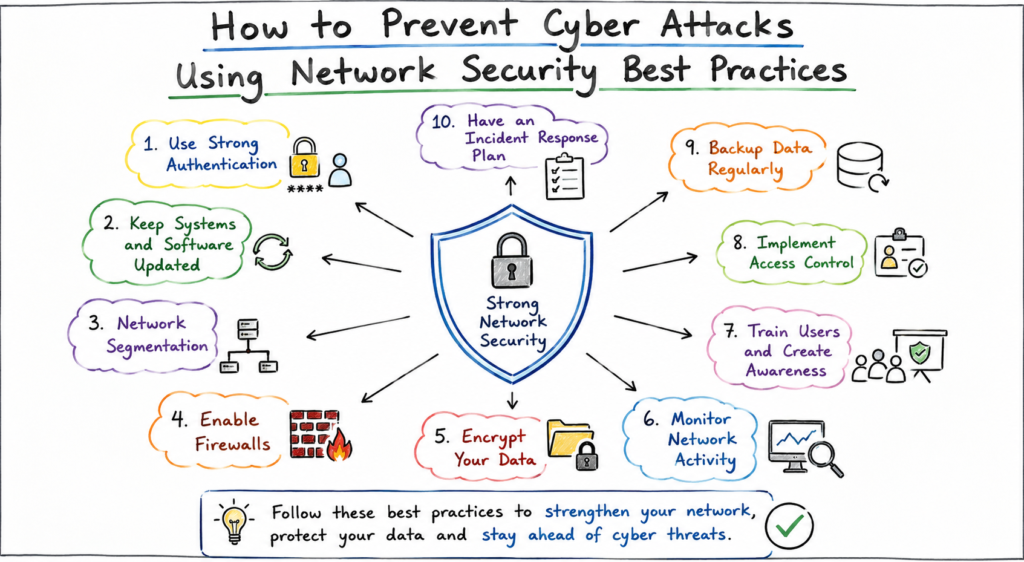
Preventing cyber attacks requires more than installing security software. Organizations must adopt a comprehensive network security strategy that combines technology, processes, and people. Strong authentication, network segmentation, encryption, monitoring, employee training, and incident response planning all contribute to a more secure environment.
At the same time, operational excellence plays a major role in maintaining security. Concepts such as automation, observability, resilience, reliability, and scalability help organizations build systems that are both secure and efficient.
Successful organizations understand that technology alone is not enough. Platform implementation provides the necessary tools, while culture ensures those tools are used responsibly and effectively. Together, they create a strong foundation for long-term security success.
As cyber threats continue to evolve, continuous improvement remains essential. Organizations that regularly assess risks, update defenses, educate employees, and strengthen operations are better positioned to prevent attacks and maintain trust.
For professionals pursuing careers in operations and cybersecurity, developing expertise in networking, infrastructure, automation, monitoring, and security creates valuable opportunities and prepares them to protect modern digital environments effectively.