Introduction
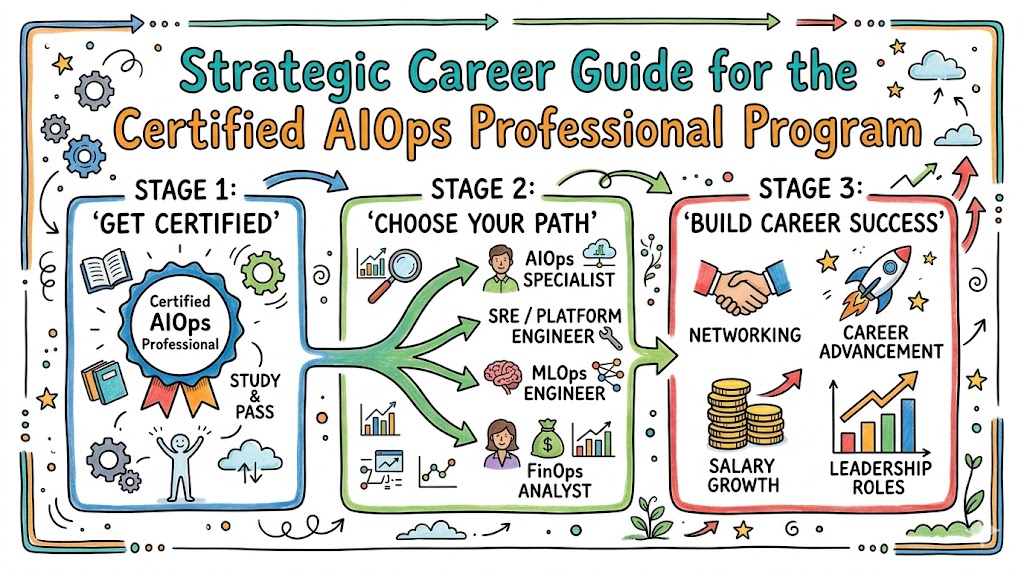
As infrastructure complexity grows beyond human scale, the Certified AIOps Professional designation has become a critical milestone for modern engineers. This guide serves as a comprehensive roadmap for SREs, DevOps specialists, and platform leaders who intend to integrate artificial intelligence with operational excellence. By focusing on practical application rather than just theoretical models, this resource helps AIOpsSchool students navigate the shift from reactive troubleshooting to proactive, data-driven automation. Professionals will gain a clear understanding of how this path accelerates career growth within cloud-native environments and enterprise-scale platforms.
What is the Certified AIOps Professional?
The Certified AIOps Professional program represents the convergence of machine learning and traditional system administration. It exists to bridge the gap between massive telemetry data and actionable operational insights in production-grade environments. Unlike generic data science courses, this certification focuses strictly on the engineering workflows required to maintain high availability and performance. It aligns perfectly with modern enterprise practices by teaching engineers how to deploy algorithmic solutions that reduce “noise” and automate root cause analysis effectively.
Who Should Pursue Certified AIOps Professional?
This certification is designed for Site Reliability Engineers (SREs), Cloud Architects, and Platform Engineers who manage distributed systems at scale. Security professionals and data engineers also benefit significantly by learning how to apply anomaly detection to their respective domains. While experienced seniors find immediate value in optimizing large-scale clusters, beginners can use this track to differentiate themselves in a competitive job market. Managers and technical leaders should pursue this to understand the ROI and resource requirements of AI-driven operations within global organizations.
Why Certified AIOps Professional is Valuable and Beyond
The demand for intelligent automation is permanent because manual monitoring cannot keep up with microservices and serverless architectures. This certification ensures longevity by teaching fundamental concepts that remain relevant even as specific monitoring tools evolve or change. Enterprises are rapidly adopting AIOps to reduce Mean Time to Repair (MTTR) and operational costs, making certified professionals highly sought after. Investing time in this program provides a significant return through increased architectural influence and access to high-impact leadership roles in tech-forward companies.
Certified AIOps Professional Certification Overview
The program is delivered via the official portal and hosted on the AIOpsSchool platform, ensuring a standardized learning experience. It utilizes a multi-level assessment approach that combines rigorous technical exams with practical scenarios to validate real-world readiness. The structure is owned and maintained by industry veterans who prioritize operational stability and the practical integration of AI tools. Professionals can expect a clear progression from foundational concepts to advanced algorithmic implementation, all managed through a streamlined digital dashboard.
Certified AIOps Professional Certification Tracks & Levels
The certification is structured into foundation, professional, and advanced levels to accommodate various stages of a career. The foundation level introduces core concepts of telemetry and data science for operations, while the professional level dives into model deployment and integration. Advanced tracks focus on architectural design and building custom AIOps frameworks for specific enterprise needs. These levels align with career progression, moving a candidate from an individual contributor to a strategic architect or technical lead.
Complete Certified AIOps Professional Certification Table
| Track | Level | Who it’s for | Prerequisites | Skills Covered | Recommended Order |
| Operations | Foundation | Junior Engineers | Basic Linux/Cloud | Log Analysis, Monitoring | First |
| Engineering | Professional | Mid-level SREs | Python, Statistics | Anomaly Detection, NLP | Second |
| Architecture | Advanced | Senior Leads | Professional Cert | Predictive Scaling, ML Ops | Third |
Detailed Guide for Each Certified AIOps Professional Certification
Certified AIOps Professional – Foundation
What it is
This certification validates a fundamental understanding of how artificial intelligence enhances traditional IT operations and monitoring. It covers the basics of data collection and the role of machine learning in noise reduction.
Who should take it
It is suitable for entry-level DevOps engineers and system administrators who want to understand the future of monitoring. It serves as an excellent starting point for those new to data-driven operations.
Skills you’ll gain
- Understanding telemetry data types (Metrics, Logs, Traces).
- Identifying common AIOps use cases in production.
- Navigating basic dashboarding and alerting logic.
Real-world projects you should be able to do
- Configure a basic monitoring stack with automated alerting thresholds.
- Perform initial log clustering to identify recurring system errors.
Preparation plan
- 7–14 days: Review official documentation and terminology.
- 30 days: Complete all lab exercises and practice quizzes.
- 60 days: Implement a basic monitoring project in a lab environment.
Common mistakes
- Ignoring the difference between supervised and unsupervised learning.
- Focusing too much on specific tools rather than general concepts.
Best next certification after this
- Same-track: Professional AIOps Level.
- Cross-track: SRE Foundation.
- Leadership: ITIL Specialist.
Choose Your Learning Path
DevOps Path
The DevOps path focuses on integrating AI into the Continuous Integration and Continuous Deployment (CI/CD) pipeline. Engineers learn to use predictive analytics to determine the risk of a code deployment before it reaches production. This path emphasizes automated testing and feedback loops that learn from previous release failures. It is ideal for those who want to build self-healing delivery pipelines.
DevSecOps Path
In the DevSecOps path, the focus shifts toward automated threat detection and security response using AI models. Professionals learn to distinguish between normal user behavior and potential security breaches through pattern recognition. This track covers the automation of compliance checks and the use of AI to patch vulnerabilities at scale. It is a critical path for protecting cloud-native environments.
SRE Path
The SRE path is heavily centered on maintaining reliability and meeting Service Level Objectives (SLOs) through intelligent automation. Engineers apply AIOps to perform root cause analysis and reduce the time spent on repetitive manual tasks, known as toil. This track emphasizes the creation of sophisticated error budgets that adjust based on predictive system health. It is the most common path for those managing high-traffic web applications.
AIOps Path
The dedicated AIOps path dives deep into the algorithmic side of operations, focusing on the development of custom machine learning models. Professionals spend time on data engineering, feature selection, and model training specifically for system telemetry. This path is for those who want to build the internal platforms that other engineering teams will use. It bridges the gap between pure data science and systems engineering.
MLOps Path
The MLOps path addresses the operational challenges of deploying and maintaining machine learning models in production. It focuses on model versioning, monitoring for data drift, and ensuring the scalability of AI infrastructure. This path is essential for organizations that rely on AI as a core part of their product offering. It ensures that the AI itself is reliable and performant.
DataOps Path
DataOps focuses on the orchestration of people, processes, and technology to deliver high-quality data to AIOps engines. This path teaches how to build resilient data pipelines that feed the monitoring and analysis tools. Professionals learn about data governance, quality control, and the automation of data delivery. It is the foundation upon which all successful AI operations are built.
FinOps Path
The FinOps path applies AI to cloud financial management, helping organizations optimize their cloud spend automatically. Engineers learn to use predictive models to forecast future costs and identify anomalies in billing data. This track focuses on automated rightsizing and the implementation of cost-saving policies through intelligent insights. It is highly valued by management for its direct impact on the bottom line.
Role → Recommended Certified AIOps Professional Certifications
| Role | Recommended Certifications |
| DevOps Engineer | AIOps Professional, CI/CD Automation |
| SRE | AIOps Advanced, Reliability Architect |
| Platform Engineer | Foundation AIOps, Cloud Native Expert |
| Cloud Engineer | FinOps Practitioner, AIOps Professional |
| Security Engineer | DevSecOps AIOps, Threat Hunter |
| Data Engineer | DataOps Professional, ML Pipeline Spec |
| FinOps Practitioner | Cloud Cost Optimizer, AIOps Foundation |
| Engineering Manager | AIOps Strategy, Technical Leadership |
Next Certifications to Take After Certified AIOps Professional
Same Track Progression
Deep specialization involves moving into the Advanced AIOps Architect level, where the focus is on designing custom enterprise solutions. This involves mastering complex neural networks for predictive maintenance and high-level strategy for global infrastructure. Professionals at this level often lead the digital transformation initiatives within their organizations.
Cross-Track Expansion
Skill broadening allows an AIOps professional to branch into MLOps or DevSecOps to become a more versatile engineer. Understanding how to secure the AI pipeline or how to manage the lifecycle of a model adds immense value to a resume. This makes the individual a “T-shaped” professional with both deep and broad expertise.
Leadership & Management Track
Transitioning to leadership involves moving toward certifications focused on engineering management and technical strategy. At this stage, the focus shifts from writing code to managing teams that implement AIOps frameworks. This path is ideal for those who want to influence the long-term technical direction of a company.
Training & Certification Support Providers for Certified AIOps Professional
DevOpsSchool
This provider offers extensive hands-on labs and expert-led sessions for various engineering certifications. They focus on practical skills that translate directly to the workplace.
Cotocus
A specialized training firm that provides tailored corporate programs for cloud and AI integration. They are known for high-quality content and flexible learning schedules.
Scmgalaxy
A community-driven platform that provides deep technical insights into configuration management and automation. They offer a wealth of resources for candidates preparing for professional exams.
BestDevOps
Focuses on delivering the best-in-class curriculum for DevOps and SRE professionals. Their training is designed to be concise and highly effective for busy engineers.
devsecopsschool.com
This site specializes in the security aspect of the development lifecycle. They provide specialized tracks for those looking to integrate AI with security operations.
sreschool.com
A dedicated portal for everything related to Site Reliability Engineering. They offer focused training on maintaining system uptime using advanced monitoring techniques.
aiopsschool.com
The primary authority for AIOps certification and education. They provide the official curriculum and assessment for the professional designation discussed in this guide.
dataopsschool.com
Focuses on the critical data management skills required to support modern AI systems. Their courses cover pipeline automation and data quality.
finopsschool.com
A specialized provider for cloud financial management training. They help professionals master the art of cloud cost optimization through data-driven insights.
Frequently Asked Questions (General)
- How difficult is the Certified AIOps Professional exam?
The difficulty is moderate to high, as it requires both operational knowledge and a basic understanding of statistics and machine learning. - How much time does it take to prepare for this certification?
Most professionals spend between 30 to 60 days depending on their existing background in DevOps and data science. - Are there any specific prerequisites for the professional level?
Yes, it is recommended to have at least two years of experience in a DevOps or SRE role and basic Python knowledge. - What is the ROI of getting this certification?
Professionals often see a significant increase in salary and are frequently recruited for high-level architect and lead positions. - Should I take the foundation level first?
If you are new to AI and machine learning concepts, the foundation level provides the necessary vocabulary and context. - Does this certification expire?
Most professional certifications require renewal every two to three years to ensure your skills stay current with evolving technology. - Is there a lab component in the exam?
Yes, the professional and advanced levels typically include performance-based tasks that test your ability to configure systems. - Can I take the exam online?
The program usually offers proctored online exams for global accessibility, allowing you to take it from home or office. - How does this differ from a standard Data Science certificate?
This is focused specifically on IT operations, logs, and telemetry, whereas data science is much broader and less system-oriented. - Will this help me move into a Management role?
Yes, it demonstrates a strategic understanding of how to scale operations efficiently, which is a key requirement for technical leadership. - Are the study materials provided with the course?
The official portal typically provides a full set of study guides, videos, and practice labs upon enrollment. - Is this certification recognized globally?
Yes, it is designed for an international audience and is respected by major tech enterprises and consulting firms worldwide.
FAQs on Certified AIOps Professional
- What specific tools are covered in this program?
The program focuses on conceptual mastery but utilizes popular tools like Prometheus, ELK stack, and various Python-based ML libraries for practical exercises. - How much coding is required for the exam?
A working knowledge of Python and Shell scripting is essential for completing the automated portions of the assessment. - Does the course cover generative AI for operations?
Yes, the curriculum includes modern modules on how Large Language Models can assist in incident documentation and script generation. - Is there a focus on multi-cloud environments?
The principles taught apply across AWS, Azure, and Google Cloud, focusing on vendor-neutral AIOps strategies and architectural patterns. - How are the practical labs structured?
Labs provide access to real-world datasets where you must identify anomalies and set up automated remediation workflows. - Can this certification help with FinOps?
Absolutely, one of the core tracks focuses on using AI to analyze billing data and automate cost-saving measures across the cloud. - What is the pass mark for the final assessment?
Candidates generally need to achieve a score of 70% or higher to demonstrate professional competency in the subject matter. - Are there community forums for students?
Students get access to a private community where they can discuss labs and share real-world implementation challenges with peers.
Final Thoughts: Is Certified AIOps Professional Worth It?
Investing in this path is a strategic move for any engineer who sees the writing on the wall regarding manual operations. The reality of modern technology is that systems are becoming too large and fast for human-only management. This certification provides the mental framework and technical skills to stay ahead of that curve. It moves you from being a person who fixes things to a person who builds systems that fix themselves. While it requires a commitment of time and study, the professional credibility and architectural insight gained are invaluable in a market that increasingly rewards those who can master the intersection of AI and infrastructure.