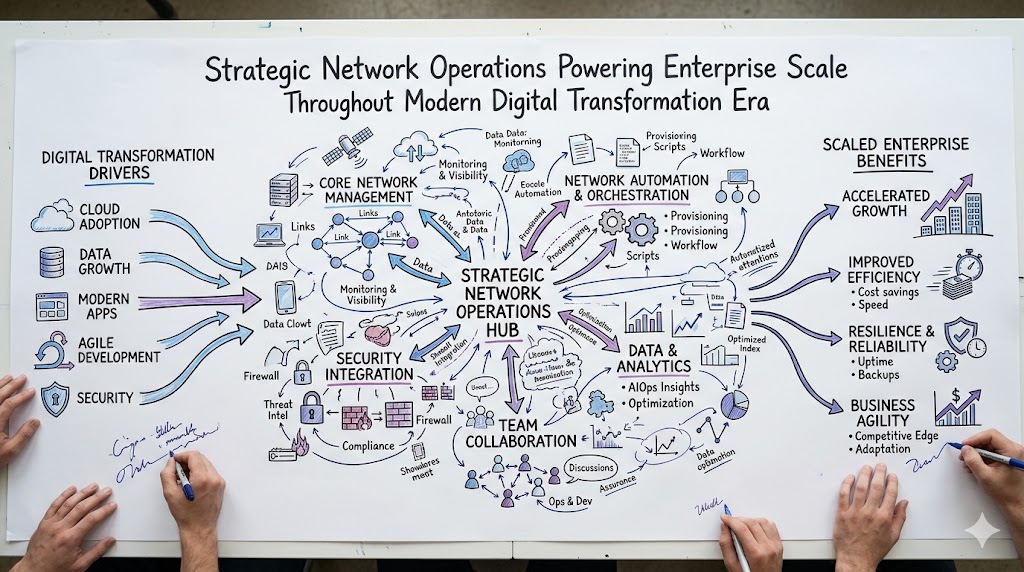
Imagine a sudden operational bottleneck dropping your primary payment gateway during peak traffic hours, costing thousands of dollars every single minute. Traditional operations infrastructure immediately fractures under this intense pressure, leaving isolated engineering teams pointing fingers at each other while customers abandon their shopping carts. This exact scenario illustrates why shifting toward modern network operations remains critical for any business attempting to survive a complex software migration. Modern enterprises cannot rely on old reactive paradigms anymore because distributed systems require continuous visibility, high adaptability, and automated architectural resilience.
Network operations in digital transformation means embedding software engineering principles directly into infrastructure management to keep systems highly available. Modern teams need this structured discipline because applications now scale dynamically across multiple cloud environments, rendering manual oversight completely obsolete. By treating infrastructure as software, companies eliminate fragile setups and build predictable deployment pathways that scale fluidly alongside user growth. Consequently, this deep guide explores the historical evolution, core pillars, strategic operational mechanics, and actionable frameworks necessary to master modern infrastructure management.
Throughout the following sections, we will dissect the foundational principles that keep global platforms online around the clock. You will discover the practical differences between competing operational methodologies, learn to eliminate manual overhead, and master performance metrics like latency and saturation. Additionally, we will map out a comprehensive career pathway, highlighting the specific technical skills and modern observability platforms required to lead enterprise-level transitions.
Transitioning your enterprise architecture requires premium educational resources, structured guidance, and hands-on professional development. You can accelerate your entire engineering journey by exploring the industry-aligned resources available at Noopsschool, where specialized masterclasses empower teams to dominate modern cloud ecosystems. Embracing these advanced engineering frameworks ensures your organization maintains an elite competitive advantage while building bulletproof infrastructure for long-term commercial success.
The Origin of Systems Infrastructure
The Early Industrial Bottlenecks
Historically, organizations isolated development teams from operations departments, creating massive friction points that delayed critical software updates for months. Developers focused entirely on shipping new features quickly, while operations engineers prioritized maintaining environmental stability at all costs. Because these two groups operated with opposing incentives, deployments frequently failed, leading to lengthy debugging cycles and severe finger-pointing.
Manual server provisioning and undocumented custom scripts dominated this early era, making environment replication virtually impossible. When an infrastructure component failed, finding the root cause required parsing through disconnected logs across dozens of separate machines. This fragmented approach slowed down organizational velocity and introduced significant human errors into production environments, threatening corporate stability.
Moving Toward Unified Workflow Automation
As enterprise applications grew more complex, leading technology firms realized that manual system administration could not match rapid consumer demand. This realization triggered a major industry shift toward unified workflow automation, treating infrastructure configurations with the same rigor as application code. Engineers started utilizing version control systems to store environment templates, allowing teams to replicate entire data centers automatically within minutes.
Breaking down these long-standing operational silos allowed developers and systems specialists to share delivery responsibilities equally. Automated testing pipelines began validating environment safety parameters long before code reached live production servers, significantly reducing critical deployment failures. Consequently, organizations achieved much faster release cycles while simultaneously improving the baseline reliability of their customer-facing digital platforms.
Global Expansion Across Commercial Ecosystems
This automated operational framework quickly spread beyond specialized web startups, transforming traditional banking, healthcare, and retail enterprises worldwide. Large companies discovered that automating infrastructure delivery directly reduced operational overhead while accelerating their time-to-market. As a result, businesses reorganized their engineering departments around continuous delivery models, embedding operations experts directly into product development teams.
Today, global commercial ecosystems run entirely on interconnected microservices that require unified, highly automated architectural oversight. Modern network operations serve as the central backbone for these massive deployments, ensuring constant platform availability across diverse geographical regions. This global expansion has turned operational engineering into a core strategic capability for any enterprise seeking digital dominance.
Defining Strategic Operations Management
The Core Operational Structure
The foundational architecture of modern operations relies on continuous data feedback loops that bridge software development and active runtime environments. Telemetry data constantly flows from distributed software containers into centralized aggregation hubs, allowing engineers to view real-time performance characteristics. This structured framework treats infrastructure as an evolving software application, ensuring every configuration change passes through continuous integration pipelines.
[Software Code] ──> [CI/CD Automation] ──> [Live Environment] ──> [Telemetry Gathering]
       ▲                                                                 │
       └───────────────────────── Automated Feedback ────────────────────┘
By enforcing strict infrastructure-as-code principles, organizations eliminate configurations that drift over time, which avoids unexpected system behaviors. The operational structure prioritizes automated self-healing mechanisms, allowing systems to detect faults and replace failing instances without human intervention. This proactive design philosophy transforms operations from a reactive firefighting department into a predictable, software-driven engineering discipline.
Daily Tasks of Systems Coordinators
Systems coordinators execute complex software engineering tasks daily to optimize infrastructure performance, reliability, and security parameters across the enterprise. Instead of manually patching servers, these specialists write automated scripts to eliminate repetitive maintenance tasks and streamline resource allocation. They spend considerable time refining continuous deployment pipelines, ensuring applications move smoothly from staging areas to live clusters.
Additionally, coordinators review system telemetry data to identify hidden performance degradations before they escalate into major user-facing incidents. They collaborate closely with application developers, defining architectural patterns that withstand sudden traffic spikes or regional cloud availability failures. When production anomalies occur, they lead targeted technical investigations, analyzing log streams to build sustainable, long-term system fixes.
Localized Control vs. Broad System Architecture
Managing modern infrastructure requires balancing localized control over micro-components with the strategic oversight of broad, interconnected system architectures. Granular tracking focuses on individual application containers, specific database queries, and localized cache hit ratios to optimize immediate processing efficiency. While this microscopic view remains valuable, optimizing individual nodes without looking at the wider system can create unexpected downstream blockages.
Conversely, broad system architecture oversight focuses on data flows across multiple cloud zones, global traffic patterns, and cross-application dependencies. Engineers must understand how changing a single microservice configuration impacts the performance profiles of adjacent platforms down the line. This balanced approach ensures that local optimizations actively support the resilience, scalability, and performance of the entire enterprise ecosystem.
The Efficiency Mindset
Embracing modern operations requires a profound cultural shift that rejects short-term manual fixes in favor of permanent architectural stability. This unique mindset compels engineers to treat every operational failure as a design flaw that requires a systematic software solution. Rather than celebrating heroics during outages, teams celebrate building resilient systems that handle failures quietly without human paging.
Furthermore, this efficiency mindset prioritizes long-term platform reliability over rapid, reckless feature deployment schedules. Teams explicitly acknowledge that system downtime harms brand reputation and reduces user trust, making platform stability a core feature. By prioritizing automation, continuous documentation, and architectural simplicity, enterprises build sustainable technical environments that thrive amidst constant market changes.
The 7 Core Principles of Network Operations
1. Embracing Risk and Managing Variability
Perfection in distributed software networks remains an impossible standard because hardware components, network lines, and cloud systems fail randomly. Modern operations embrace this reality by defining acceptable levels of architectural risk instead of striving for unrealistic perfect uptime. By acknowledging that things fail, teams can design robust systems that degrade gracefully when underlying components experience unexpected disruptions.
Managing variability requires engineers to build deep fault tolerance directly into application deployment pipelines from the very beginning. Teams run continuous architectural experiments to determine exactly how their platforms behave when critical dependencies unexpectedly disappear. This realistic approach allows businesses to allocate engineering resources efficiently, balancing feature creation with targeted system reliability investments.
2. Establishing Service Level Objectives (SLOs)
Service Level Objectives serve as the primary foundational compass for modern engineering teams, defining clear, measurable performance targets. These objective metrics align business expectations with everyday engineering reality, ensuring everyone agrees on what acceptable system performance looks like. By establishing clear SLOs, teams protect themselves from arbitrary performance demands that add unnecessary architectural complexity.
┌──────────────────────────────────────────────────────────┐
│              Enterprise Metrics Framework                │
├──────────────────────────────────────────────────────────┤
│  SLA (Business Contract) ──> Legal Agreement             │
│    └─> SLO (Internal Target) ──> Reliability Goal        │
│          └─> SLI (Real-time Metric) ──> Current Status   │
└──────────────────────────────────────────────────────────┘
Maintaining reliable objectives requires choosing specific indicators that match actual customer happiness, such as API response success rates. Engineers use these metrics to manage development speed, slowing down feature releases whenever an objective target faces imminent violation. This data-driven approach removes emotion from operational discussions, keeping development velocity directly tied to measurable system stability.
3. Eliminating Toil and Manual Processes
Toil represents repetitive, manual, operational work that scales linearly with system growth and provides no long-term organizational value. Tasks like manually restarting servers or running routine database scripts drain engineering focus and introduce significant human error risk. Modern operations systematically identify these manual bottlenecks and prioritize engineering solutions to eliminate them permanently from workflows.
Traditional Operations:   [More Servers] ──> [Linear Toil Growth] ──> [More Engineers Needed]
Modern Operations:        [More Servers] ──> [Automated Tooling]  ──> [Scalable System Efficiency]
Reducing manual tasks frees up engineers to focus on proactive architecture design, scalability improvements, and security enhancements. Teams measure their operational toil hours strictly, ensuring that manual maintenance never consumes more than half of their weekly capacity. This disciplined focus on continuous automation ensures that infrastructure scale remains untethered from growing engineering headcount.
4. Monitoring & Observability Across the Pipeline
Comprehensive observability provides deep visibility into the entire software delivery pipeline, eliminating dangerous operational blind spots before they impact users. Traditional monitoring only alerts teams when a component breaks, whereas observability lets engineers understand why a system behaves oddly. By collecting logs, metrics, and distributed traces, teams track complex request paths across hundreds of microservices.
       [Request Entry]
              │
      ┌───────┴───────┐
      ▼               ▼
 [Service A]     [Service B]
      │               │
      ▼               ▼
 [Database]      [External API]
  (Traces)        (Logs & Metrics)
This holistic pipeline visibility allows infrastructure teams to detect subtle performance trends, like progressive memory leaks or slow database connections. Observability ensures that every deployment generates clean data streams, making it easier to pinpoint root causes during multi-system outages. Consequently, teams resolve complex performance regressions much faster, protecting end-user experiences from extended disruptions.
5. Automation Over Manual Coordination
Modern infrastructure environments grow far too large and dynamic for teams to coordinate deployments or scale resources using manual checklists. Engineering organizations prioritize building automated systems that handle resource scheduling, application scaling, and network routing configurations independently based on live data. This approach shifts the engineer’s role from manual system coordinator to designer of smart, automated automation systems.
Automated pipelines run comprehensive security scans, execute unit tests, and provision production resources without requiring manual verification steps. If an application update triggers an error, the automated infrastructure identifies the problem and rolls back the change immediately. This reliance on programmatic automation reduces operational risk, ensures environment consistency, and lets organizations scale systems with minimal human friction.
6. Release Engineering and Deployment Stability
Release engineering focuses on delivering software updates to production environments in a safe, repeatable, and completely predictable manner. Elite teams utilize advanced deployment strategies, such as canary releases and greenfield testing, to minimize the blast radius of new code. By steering small slices of live user traffic to updated containers, engineers validate software safety under real production conditions.
[All Users] ──> [Traffic Router] ─┬─> (95% Traffic) ──> [Stable Production V1]
                                  └─> (5% Traffic)  ──> [Canary Instance V2]
Stable release engineering also depends on maintaining uniform artifacts that move unchanged through development, staging, and production environments. This consistency guarantees that behavior seen during testing matches exactly how the application runs when exposed to global user traffic. By mastering deployment stability, enterprises ship innovative features continuously without undermining the foundational reliability of their production applications.
7. Simplicity in Network Architecture
Complex network configurations invite operational disasters because intricate, intertwined systems hide underlying failure vectors from engineering visibility. Modern operations intentionally champion minimal architectural designs, reducing unnecessary dependencies, custom plugins, and non-standard protocol layers. Keeping environments clean and uniform makes it significantly easier for engineering teams to reason about system behavior during high-stress outages.
Complex (Fragile):   [Service] <───> [Custom Proxy] <───> [Legacy Bridge] <───> [Database]
Simple (Resilient):  [Service] ───────────────────────────────────────────────> [Database]
Minimal infrastructure design simplifies automated service discovery, accelerates troubleshooting, and dramatically speeds up onboarding times for new engineers. Teams systematically deprecate legacy architecture components and reject convoluted networking workarounds that solve short-term problems while introducing long-term technical debt. Ultimately, maintaining a highly clean, simple environment represents the ultimate form of sophisticated operational engineering.
Key Operational Concepts You Must Know
SLA vs. SLO vs. SLI — Explained Simply
Navigating modern operations requires understanding the distinct definitions and relationships between SLAs, SLOs, and Service Level Indicators (SLIs). These three elements form the structural foundation of reliability engineering, translating abstract business goals into specific technical metrics.
- Service Level Agreement (SLA): This represents the formal, legally binding commitment made directly to external end-users regarding overall platform availability. It includes real financial or contractual penalties, such as service credits, that trigger if platform performance falls below the agreed threshold.
- Service Level Objective (SLO): This serves as the target reliability goal for internal engineering teams, designed to be stricter than the external SLA. It functions as an early warning system, helping teams catch performance problems before contractual violations occur.
- Service Level Indicator (SLI): This is the specific, quantifiable measurement tracking the real-time performance of a live production service. A standard example includes calculating the exact percentage of incoming HTTP requests that return successful status codes within 200 milliseconds.
Error Budgets — The Game Changer for Operational Risk
An error budget represents the exact amount of acceptable downtime an enterprise platform can tolerate over a specific timeframe. Calculated directly from your established internal SLO, this budget serves as a dynamic meter balancing development speed against system stability. For example, a 99.9% availability objective grants an engineering team an error budget of exactly 0.1% allowable failure risk.
┌────────────────────────────────────────────────────────┐
│                   Monthly Error Budget                 │
├───────────────────────────────┬────────────────────────┤
│   Used Budget (0.07%)         │ Remaining Budget (0.03%)│
│   [■■■■■■■■■■■■■■■■■■■■■■■]   │ [■■■■■■■■■]            │
├───────────────────────────────┴────────────────────────┤
│ Action: Remaining budget allows for new feature launch │
└────────────────────────────────────────────────────────┘
When an application burns through its assigned error budget due to outages, development priorities shift immediately from features to stability fixes. Conversely, a large remaining error budget signals that the team can safely launch innovative code changes and accept higher deployment risks. This automated policy removes emotional friction between product developers and infrastructure engineers, anchoring deployment decisions to empirical reliability data.
Toil — The Silent Productivity Killer in Infrastructure
Toil acts as an insidious tax on engineering velocity, slowly consuming valuable time that teams should spend building scalable infrastructure solutions. To identify toil, look for manual, repetitive tasks triggered by administrative demands rather than structural improvements. If a recurring operational task can be solved permanently with an automated script, it is toil, not engineering.
Toil Identification Checklist:
✔ Manual?             (Requires manual typing or clicking)
✔ Repetitive?         (Executed multiple times per week)
✔ Automatable?        (Could be handled by a software script)
✔ Tactical?           (Solves an immediate symptom, not the root cause)
Systematically eliminating toil requires organizations to track manual tasks using clear ticketing metrics and dedicate engineering sprint time to automation. Teams can build self-service internal developer portals that let software developers provision staging resources or run schema migrations independently. Over time, eliminating these manual bottlenecks lowers operational costs and keeps engineers engaged in high-value system design work.
Incident Management & Postmortems
Effective incident management requires structured coordination protocols that minimize service disruption when critical system components fail unexpectedly. Teams designate specific roles during outages, separating technical incident commanders from communication leads to streamline decision-making. Once an issue is mitigated, the organization conducts a blameless postmortem to understand the systemic weaknesses that allowed the failure.
Blameless postmortems focus entirely on identifying flawed processes, broken automation, and architectural blind spots rather than punishing human mistakes. If an engineer executes a bad command, the postmortem asks why the system allowed a single keystroke to cause an outage. Documenting these lessons publicly and implementing concrete safety fixes prevents similar failure patterns from recurring, making the system stronger.
Capacity Planning
Capacity planning ensures that enterprise infrastructure scales smoothly ahead of organic traffic growth and predictable seasonal business demands. Engineers analyze historical resource metrics to forecast future needs for compute clusters, storage volumes, and network database connections. This practice prevents sudden resource exhaustion events that cause catastrophic, widespread platform slow-downs.
Modern capacity planning blends traditional data modeling with cloud-native dynamic scaling configurations to handle unexpected traffic spikes. Teams run stress tests against infrastructure, pushing simulated traffic loads to extremes to find hidden system tipping points. Proactively discovering these boundaries allows businesses to manage infrastructure budgets efficiently while maintaining optimal performance margins for end-users.
The Four Golden Signals of Pipeline Performance
To maintain complete infrastructure visibility, engineers focus deeply on tracking the Four Golden Signals of system performance. These metrics provide a clear, real-time picture of platform health, helping teams diagnose complex system issues rapidly.
┌────────────────────────────────────────────────────────┐
│               The Four Golden Signals                  │
├───────────────────────────┬────────────────────────────┤
│ ⏱ Latency                 │ 📊 Traffic                 │
│ Time taken to service a   │ Demand placed on the       │
│ request (e.g., 120ms).    │ system (e.g., HTTP req/sec)│
├───────────────────────────┼────────────────────────────┤
│ ❌ Errors                 │ 📈 Saturation              │
│ Rate of requests that     │ How full the system re-     │
│ fail (e.g., 500 internal).│ sources are (e.g., 85% CPU)│
└───────────────────────────┴────────────────────────────┘
- Latency: The exact time it takes to process a request, separating successful responses from failures to avoid skewing data.
- Traffic: A measurement of overall demand on the system, such as incoming HTTP requests per second or network bandwidth consumption.
- Errors: The rate of requests that fail explicitly, return improper response codes, or timeout before completion.
- Saturation: A metric tracking resource utilization, indicating how close a system component is to reaching its maximum design capacity.
Platform Implementation vs. Culture — What’s the Real Difference?
The Philosophy Difference
Understanding infrastructure transformation requires recognizing the key distinctions between concrete technical implementations and high-level organizational culture frameworks. Implementation focuses on technical mechanisms, such as configuring container orchestration networks, deploying monitoring daemons, and setting up automated backup workflows. These technical tools provide the raw capabilities needed to execute operational strategies, but tools alone cannot fix broken organizational structures.
Conversely, cultural frameworks focus on human alignment, engineering mindsets, shared responsibilities, and eliminating organizational friction points. A healthy engineering culture values blameless learning, prioritizes data-driven decisions, and embraces automation as a core principle. Without this underlying cultural shift, teams simply use modern tools to execute old, inefficient habits, failing to achieve true agility.
Roles & Responsibilities Compared
While platform engineering and operations culture share common reliability goals, their day-to-day duties diverge across several key operational areas.
- Platform Implementation Specialists:
- Design and maintain unified developer platforms that simplify resource provisioning workflows across the enterprise.
- Configure global monitoring systems, manage shared logging infrastructure, and maintain core CI/CD deployment nodes.
- Build automated infrastructure templates using configuration-as-code tools to ensure cross-environment consistency.
- Cultural Operations Champions:
- Facilitate collaborative architectural reviews between independent application developers and core infrastructure teams.
- Define internal SLO targets, establish blameless incident practices, and manage organization-wide error budgets.
- Educate engineering product teams on reliability principles, systems thinking, and sustainable deployment patterns.
Can You Have Both Disciplines?
Elite enterprise organizations do not choose between technical implementations and progressive engineering cultures; they deliberately combine both disciplines. Technical platforms provide the automated tools that make cultural principles, like reducing manual toil and accelerating releases, possible. Simultaneously, a progressive engineering culture ensures that tools are adopted effectively rather than bypassed by frustrated development groups.
When these two disciplines coexist, the internal platform functions as a physical manifestation of the team’s shared cultural values. For example, a cultural commitment to deployment stability leads directly to building automated canary deployment capabilities into the core developer portal. This integration creates a self-reinforcing ecosystem where software platforms empower humans, and humans continuously optimize the platforms.
Which One Should Your Team Adopt?
Choosing where to focus your engineering resources depends heavily on your current team size, technical maturity, and immediate business challenges. Small startups should prioritize building a collaborative, shared operational culture long before investing in massive internal software platforms. Early-stage teams need cultural flexibility to iterate rapidly, making heavy custom platform investments an expensive distraction.
┌────────────────────────────────────────────────────────┐
│              Organizational Roadmap                    │
├───────────────────────────┬────────────────────────────┤
│ Small Startup             │ Large Enterprise           │
│ Focus: Shared Culture     │ Focus: Internal Platforms  │
│ Goals: Flex, Speed, Trust │ Goals: Scale, Governance   │
└───────────────────────────┴────────────────────────────┘
Conversely, large enterprises with hundreds of developers must build structured, automated platforms to maintain consistency and compliance. Handing every team custom control over infrastructure creates chaotic, unmanageable environments that resist security updates. By establishing a central platform group, large organizations provide guardrails that keep developer workflows safe, compliant, and highly efficient at scale.
Real-World Use Cases of Modern Operations
How Tech Leaders Use Operational Metrics
Global streaming platforms and e-commerce leaders leverage real-time operational metrics to maintain flawless user experiences for millions of concurrent viewers. These enterprises collect billions of telemetry points every second, utilizing advanced algorithmic filters to isolate meaningful performance trends from background noise. By analyzing latency spikes across specific regions, traffic routers shift user sessions to healthy cloud zones automatically.
These technical organizations tie engineering metrics directly to business outcomes, mapping latency changes to customer engagement rates. For instance, a 50-millisecond increase in search query response times can cause a measurable dip in user interactions. This tight feedback loop allows product leaders to justify pause times for feature development to focus on critical infrastructure performance tuning.
Chaos Engineering Approaches to Resilient Systems
Prominent cloud enterprises utilize chaos engineering to proactively uncover subtle infrastructure defects before they trigger widespread production outages. Engineers inject controlled failures into live networks, such as randomly terminating server clusters or introducing artificial network latency. These experiments validate that self-healing systems detect anomalies and reroute traffic without harming end-user workflows.
Practicing chaos engineering requires deep maturity, clear safety boundaries, and automated rollback triggers to protect core user traffic. Teams start by running small failure simulations in staging environments before introducing random disruptions to live production clusters. This proactive discipline builds deep organizational confidence, ensuring systems withstand unpredictable real-world issues.
Handling Reliability at Massive Scale
Modern hyperscale platforms utilize decoupled microservice architectures to process hundreds of thousands of concurrent API requests without experiencing system failure. These distributed applications depend on service discovery layers, dynamic load balancers, and intelligent caching structures to optimize data paths. By breaking monolithic platforms into independent services, teams isolate failures, preventing single bugs from crashing entire ecosystems.
At this massive scale, infrastructure groups implement automated rate-limiting policies and circuit-breaker patterns to protect backend data warehouses. If a specific microservice experiences a traffic spike, circuit breakers trip to block downstream calls, preserving baseline functionality. This defensive architectural approach ensures the core application remains operational even when minor sub-systems experience intense pressure.
High-Availability in Fintech Operations
Financial technology platforms operate under zero-tolerance mandates for data loss, transaction delays, and infrastructure downtime. Payment processing networks utilize multi-region active-active architectures, replicating transactional data across separate geographical data centers in real-time. This configuration ensures that if an entire cloud region experiences an outage, adjacent zones handle transaction volumes instantly.
Fintech operations engineers enforce rigorous encryption, continuous compliance auditing, and strict change-management automation across every deployment layer. They leverage immutable infrastructure pipelines to ensure every server update matches audited security baselines precisely. By combining high-availability clustering with automated validation, financial platforms achieve continuous compliance while delivering reliable payment services.
Scaled-Down but Essential Systems for Startups
Early-stage startups do not need the massive multi-region setups used by tech giants, but they still benefit from core operational principles. Small teams leverage managed cloud services, serverless computing layers, and lightweight container tools to minimize infrastructure overhead. This strategy allows startups to build automated deployment lines and gain basic system visibility without hiring a large operations team.
Startups prioritize setting up basic alerts for critical failure metrics, like high database CPU saturation or rising HTTP error rates. Automating these basic guardrails protects small teams from exhausting manual firefighting, keeping their energy focused on finding product-market fit. Establishing these clean architectural habits early builds a rock-solid foundation that supports rapid corporate scaling down the road.
Common Mistakes in Operations Engineering
Mistake 1 — Confusing System Management with Just Being On-Call
A common misstep involves treating modern operations as a traditional IT help desk that merely responds to system alerts. When engineers spend all their time reacting to infrastructure pages, they cannot build the automation needed to fix underlying bugs. This reactive cycle keeps teams trapped in operational debt, where infrastructure stability depends entirely on constant human intervention.
Modern operations is an engineering discipline focused on proactive software development, not manual system firefighting. Leadership must afford teams the time to analyze incident trends, rebuild fragile components, and write automated remediation scripts. Shifting from reactive firefighting to proactive engineering breaks the on-call cycle, improving system reliability and team morale.
Mistake 2 — Setting Unrealistic SLOs
Product owners frequently demand 100% platform availability, assuming that targeting anything less signals poor engineering quality. However, chasing absolute perfection stalls feature velocity, introduces bloated infrastructure costs, and requires unnecessary architectural complexity. Because every additional decimal point of uptime requires exponential effort, unrealistic objectives burn through engineering budgets rapidly.
Availability Target vs. Allowable Downtime:
  • 99% Uptime    ──> ~7.3 hours allowable monthly downtime
  • 99.9% Uptime  ──> ~43.8 minutes allowable monthly downtime
  • 99.99% Uptime ──> ~4.38 minutes allowable monthly downtime
Engineers must educate business stakeholders on the practical trade-offs associated with aggressive, multi-nine reliability targets. Organizations should base internal objectives on actual user satisfaction thresholds rather than arbitrary perfection. Setting realistic targets keeps development moving fast while ensuring infrastructure costs remain aligned with business needs.
Mistake 3 — Ignoring Toil Until It’s Too Late
Organizations often overlook minor manual tasks, assuming that spending a few minutes daily on manual server restarts is harmless. However, as infrastructure scales from ten servers to hundreds, these small tasks expand into major blockages. Left unaddressed, manual work completely consumes your engineering capacity, leaving teams no time for strategic architecture design.
Ignoring this operational debt causes severe project delays, high human error rates, and widespread team burnout. Organizations must treat manual tasks as systemic defects, tracking manual hours closely within engineering workflows. Prioritizing continuous automation keeps operational overhead low, allowing engineering velocity to remain high as systems scale.
Mistake 4 — Skipping Blameless Postmortems
When an outage triggers corporate finger-pointing, engineers naturally hide mistakes, obscure root causes, and avoid proposing innovative system fixes. Punishing a team member for a typo ignores the systemic gaps that allowed a single mistake to disrupt production. This culture leaves organizations vulnerable to experiencing the exact same failure patterns repeatedly.
Enterprises must build a blameless postmortem culture that views operational failures as valuable opportunities for system optimization. Focus discussions entirely on improving automated guardrails, updating testing suites, and refining deployment validation pipelines. Embracing these lessons openly transforms human mistakes into structural enhancements, protecting infrastructure over the long haul.
Mistake 5 — Monitoring Without Actionable Alerts
Many monitoring setups route every single system warning directly to on-call engineer phones, creating massive alert noise. When engineers receive dozens of non-critical pages every night, they quickly experience alert fatigue and ignore notifications. Consequently, when a catastrophic platform failure occurs, the critical alert gets lost in the noise, delaying mitigation.
Alert Routing Optimization:
  [System Anomaly Detected]
             │
     Is it user facing?
       ├──> YES ──> [Page On-Call Engineer Immediately]
       └──> NO  ──> [Log to Dashboard / Jira Ticket]
Every paging alert must indicate a real, user-facing issue that requires immediate human intervention to resolve. If an alert does not require urgent action, route it to an internal dashboard or ticket queue instead of paging someone. Streamlining notifications ensures on-call engineers stay alert, focused, and ready to handle critical incidents rapidly.
Mistake 6 — Not Involving Operational Engineers in the Design Phase
Software development teams often build complex application features without consulting infrastructure specialists during the early planning stages. Consequently, developers ship applications that require non-standard network configurations, introduce storage bottlenecks, or resist horizontal scaling. This separation forces operations teams to scramble to build complex workarounds right before major launches.
Siloed Design (High Failure Risk):
  [App Design] ──> [Code Completed] ──> [Handed to Ops] ──> [Production Failure]

Integrated Design (High Success Rate):
  [Joint Design: Dev + Ops] ──> [Automated CI/CD] ──> [Safe Stable Deployment]
Integrating infrastructure engineers into early architectural discussions ensures applications are built for production reliability from day one. Operational specialists offer critical insights on data replication, service interactions, and monitoring requirements before code gets written. This proactive collaboration eliminates late-stage deployment delays, paving the way for smooth feature launches.
Essential Infrastructure Tools & Technologies
Monitoring & Observability
Maintaining complete control over a distributed infrastructure stack requires specialized software tools to collect and analyze telemetry data streams. For time-series metric tracking and real-time alerting, modern engineering groups rely heavily on Prometheus integrated with Grafana visualization dashboards. These open-source systems allow operators to build comprehensive views of cluster performance, resource utilization, and application trends.
When managing complex multi-cloud deployments, enterprises often implement enterprise observability suites like Datadog or New Relic for deep visibility. These commercial platforms provide distributed tracing capabilities, helping engineers follow individual API requests across complex microservice boundaries. Utilizing these tools allows infrastructure teams to locate performance drops and pinpoint the root causes of systemic anomalies rapidly.
Incident Management
When critical systems fail, organizations need structured incident response software to coordinate engineering teams and manage stakeholder updates. Platforms like PagerDuty function as the primary orchestration hub, routing high-priority alerts to on-call engineers based on automated rotation schedules. These tools integrate directly with monitoring systems, ensuring critical events trigger immediate human response sequences.
[System Monitor] ──> [PagerDuty Router] ──> [On-Call Engineer] ──> [Slack War Room]
During active outages, teams utilize dedicated chat ops integrations and incident tracking workspaces to log mitigation steps in real time. These communication hubs archive timeline details automatically, creating a clean record for subsequent postmortem reviews. Using structured incident tools helps enterprises reduce their mean time to resolution (MTTR) and handle high-stress situations smoothly.
CI/CD & Release Engineering
Automating the movement of code from developer workstations to live production clusters requires reliable continuous integration and delivery engines. Jenkins remains a widely utilized workhorse for complex, custom build automation pipelines across traditional enterprise software environments. However, cloud-native deployments frequently leverage GitOps delivery tools like Argo CD or Spinnaker to manage containerized applications.
[Git Commit] ──> [Jenkins Build] ──> [Argo CD Reconciliation] ──> [Kubernetes Cluster]
These modern release controllers constantly sync live cluster states with configurations stored in version control systems. If an unauthorized manual change occurs in production, the delivery engine automatically restores the approved configuration. This automation eliminates human intervention during deployments, ensuring environment consistency and protecting system uptime.
Chaos Engineering
Building truly resilient infrastructure requires specialized tools designed to inject controlled failures into production environments safely. Chaos Monkey, originally developed by Netflix, serves as a prominent tool for randomly disabling container instances within live clusters. This automated disruption forces engineering teams to build self-healing, redundant application layers that handle unexpected server deaths gracefully.
Modern chaos suites provide fine-grained control over failure experiments, allowing engineers to simulate network latencies or API failures easily. These tools include automated safety checks that halt experiments instantly if core platform performance drops below safe boundaries. Practicing controlled disruptions allows enterprises to validate their system resilience and fix hidden weaknesses before real outages strike.
SLO Management
As modern operations shifts toward metric-driven management, tracking reliability targets requires dedicated software platforms rather than manual spreadsheets. Tools like Nobl9 allow enterprises to aggregate data streams from multiple monitoring sources to calculate error budgets continuously. These platforms provide clear visibility into budget consumption rates, alerting teams when accelerated burn rates threaten SLO targets.
[Prometheus / Datadog] ──> [Nobl9 Engine] ──> [Error Budget Dashboard] ──> [Alerts]
Centralizing your reliability objectives helps product managers and infrastructure engineers collaborate effectively on deployment decisions. The software automatically generates historical compliance reports, showing business leaders exactly how infrastructure performance tracks against user expectations. Utilizing these specialized platforms allows organizations to scale their reliability practices systematically across dozens of independent product teams.
Core Tooling Comparison
The following table provides a concise overview of the core tooling ecosystem, highlighting the classification and primary use case for each platform.
| Tool Name | Tool Classification | Primary Operational Use Case |
| Prometheus | Monitoring & Observability | Time-series metric collection and real-time alerting |
| Grafana | Monitoring & Observability | Multi-source dashboard visualization and performance tracking |
| Datadog | Monitoring & Observability | Enterprise full-stack observability and distributed tracing |
| New Relic | Monitoring & Observability | Application performance monitoring and telemetry analytics |
| PagerDuty | Incident Management | On-call rotation management and automated alert routing |
| Spinnaker | CI/CD & Release Engineering | Multi-cloud continuous delivery and advanced deployment orchestrations |
| Argo CD | CI/CD & Release Engineering | Declarative GitOps deployment for Kubernetes clusters |
| Jenkins | CI/CD & Release Engineering | Extensible automation server for continuous integration pipelines |
| Chaos Monkey | Chaos Engineering | Automated instance termination to test infrastructure resilience |
| Nobl9 | SLO Management | Centralized error budget tracking and objective calculation |
How to Become an Operations Expert — Career Roadmap
Skills Every Specialist Must Have
Entering the operations engineering field requires mastering a deep mix of system administration, software development, and cloud networking skills. Aspiring specialists must feel completely comfortable navigating Linux terminal environments, managing file permissions, and optimizing system processes. You must master scripting languages like Python or Go to write clean automation tools and eliminate manual workflows.
         [Advanced Systems Architecture]
                        ▲
                        │
     [Infrastructure as Code & Cloud Platforms]
                        ▲
                        │
 [Linux Internals & Scripting (Python / Go / Bash)]
Additionally, engineers need a solid understanding of core networking protocols, including TCP/IP configurations, DNS management, and HTTP routing. You must master infrastructure-as-code tools like Terraform and container orchestration networks using Kubernetes. These core technical competencies allow you to design, deploy, and manage distributed systems reliably at enterprise scale.
The Professional Learning Path
Your educational progression begins with mastering single-server setups, local database configurations, and basic shell script creation. Once comfortable with basic systems, progress to cloud architecture, learning to provision networks and load balancers programmatically. At this stage, focus on configuration management tools to automate environment setup and maintain consistency.
Next, dive deep into container ecosystems and microservices architecture, learning to orchestrate distributed apps across dynamic compute clusters. Master the art of telemetry collection, configuring monitoring systems to track latency, errors, and resource saturation. Finally, step into senior system design, focusing on global multi-region architectures, error budget policies, and long-term capacity planning.
Certifications Worth Pursuing
Industry-recognized credentials validate your technical skills and open doors to senior engineering roles within top tech companies. The Certified Kubernetes Administrator (CKA) designation remains a highly valued benchmark, proving your hands-on ability to manage container clusters. Additionally, obtaining advanced cloud architecture certs from AWS, Google Cloud, or Azure demonstrates deep expertise in modern cloud infrastructure.
Top Infrastructure Certifications:
🏅 Certified Kubernetes Administrator (CKA)
🏅 AWS Certified DevOps Engineer - Professional
🏅 Google Cloud Professional Cloud DevOps Engineer
Pursuing these targeted certifications forces you to study advanced architectural patterns, high-availability setups, and disaster recovery strategies systematically. While real-world experience remains irreplaceable, these credentials provide a structured learning framework that accelerates your professional development. Holding these verified credentials signals to enterprises that you possess the skills needed to lead complex digital transformations.
Educational Resources with Noopsschool
Acquiring these advanced architectural skills requires structured, hands-on training built by experienced industry professionals. Noopsschool provides comprehensive masterclasses designed to bridge the gap between theoretical software engineering and practical systems infrastructure management. Their specialized curriculum focuses on real-world tools, cloud-native automation, and enterprise reliability strategies.
Students engage in immersive lab exercises, building automated deployment lines, configuring observability suites, and managing live container networks. This practical, mentor-led guidance ensures you develop the problem-solving mindsets required to navigate high-pressure production incidents confidently. Investing in these structured resources empowers engineers to advance their careers and help organizations build highly resilient infrastructure.
Professional Learning Milestones
The following table outlines the structured educational progression, mapping out clear professional milestones across various career stages.
| Career Stage | Focus Area | Key Technical Milestone | Expected Outcomes |
| Entry-Level | Linux & Scripting | Master command-line utilities and automated bash tools | Ability to manage individual server instances independently |
| Intermediate | Cloud & Containers | Orchestrate applications using container systems and IaC | Build automated deployment lines and manage environments |
| Advanced | Observability & SLOs | Build comprehensive telemetry dashboards and track budgets | Detect performance trends and protect platform stability |
| Expert | Systems Architecture | Design multi-region global failovers and scale policies | Lead enterprise cloud migrations and architectural design |
The Future of Systems Management
AI and Automation in System Optimization
The next evolution of infrastructure management centers on embedding machine intelligence directly into automated observability pipelines. Algorithmic engines analyze massive streams of telemetry data, learning baseline performance trends to detect subtle anomalies early. This predictive capability allows systems to spot memory leaks or database slow-downs long before they trigger critical alerts.
Furthermore, automated systems accelerate root cause analysis by compiling log trails and tracing paths instantly during active incidents. This intelligent automation assists human operators, presenting clear remediation options and speeding up incident mitigation. As these technologies mature, systems will optimize resource allocations independently, lowering cloud costs while safeguarding platform uptime.
Platform Engineering — The Evolution of Infrastructure
Platform engineering is rapidly reshaping modern enterprise deployments by replacing custom infrastructure workarounds with unified internal developer platforms. These internal portals provide self-service templates, allowing software developers to provision resources and deploy code independently within safe boundaries. This shift eliminates ticketing bottlenecks, freeing infrastructure teams to focus on core architecture security and scalability.
Traditional: [Developer] ──> [Submit Ticket] ──> [Ops Team Provisions] ──> [Weeks Delayed]
Modern:      [Developer] ──> [Self-Service Portal] ──> [Automated Guardrails] ──> [Minutes Live]
By packaging complex infrastructure configurations into simple, internal tools, organizations maintain high consistency while accelerating feature delivery. Platform engineering treats internal developers as customers, continuously optimizing workflows to reduce friction. This modern paradigm ensures that as engineering departments grow, development velocity remains high without compromising security compliance.
Management in Cloud-Native & Kubernetes Environments
As companies migrate toward large, distributed container systems, managing dynamic environments introduces unique orchestration challenges. Kubernetes has become the standard engine for container deployment, but its high complexity requires continuous automated management. Engineers utilize advanced service meshes to manage communication, secure endpoints, and gain visibility across microservice networks.
Dynamic scaling policies require smart resource management to prevent cluster nodes from running out of capacity during sudden traffic spikes. Teams implement declarative configurations, managing their entire container infrastructure through version-controlled Git branches. This cloud-native discipline ensures environments stay perfectly synchronized, allowing companies to scale services reliably across multiple clouds.
Operational Skills That Will Matter Most
As automation replaces routine maintenance, the value of traditional system administration is shifting toward strategic engineering capabilities. Future systems experts must master advanced data analytics to interpret massive streams of telemetry information effectively. Understanding how to query distributed databases and trace network paths across cloud boundaries will distinguish elite engineers from their peers.
Future Skill Priorities:
1. Telemetry Data Analytics (Querying traces, metrics, and logs)
2. Cloud Financial Management (FinOps resource cost optimization)
3. Cross-Platform Architecture Design (Multi-cloud mesh environments)
Additionally, cloud financial management, or FinOps, is becoming a critical skill as organizations work to optimize cloud infrastructure spend. Engineers must learn to balance system reliability targets with resource efficiency, avoiding over-provisioning to minimize waste. Cultivating this blend of data analysis, financial awareness, and systems thinking ensures professionals remain indispensable assets to enterprise engineering organizations.
FAQ Section
- What is the typical career path for someone entering the operations engineering field?Most specialists start as junior system administrators or software engineers, focusing on basic script creation and local environment setups. Over time, they progress to cloud deployment automation, container orchestration, and full-stack observability management. Senior professionals move into enterprise systems architecture or platform engineering leadership roles, where they design large-scale, multi-cloud environments.
- How do salary trends for operations specialists compare to traditional software developers?Operations specialists command premium compensation packages that frequently match or exceed standard software engineering salaries due to their rare blend of skills. Companies value professionals who combine software programming expertise with deep systems networking and infrastructure security knowledge. As organizations scale their cloud footprints, the high demand for these specialized architects continues to drive compensation upward.
- What is the fundamental difference between modern operations and traditional DevOps practices?DevOps represents a high-level cultural philosophy that champions shared responsibility, automated workflows, and breaking down engineering silos. Modern operations serves as a concrete, highly prescriptive implementation of those DevOps ideals, applying software engineering techniques directly to infrastructure management. Essentially, DevOps defines the cultural goals, while operations provides the specific engineering frameworks to achieve them.
- How do error budgets help balance rapid feature development with platform stability?An error budget provides a clear, data-driven framework that guides release decisions based on live system performance. If an application maintains a healthy error budget, developers can launch innovative features and accept higher deployment risks. However, when an outage exhausts the budget, priorities immediately switch to stability enhancements, removing emotional debates between product and operations teams.
- Why is a blameless postmortem culture critical for long-term corporate reliability?A blameless postmortem culture ensures that engineering teams document failures honestly without fear of punishment or finger-pointing. This transparency allows teams to uncover the true systemic gaps, broken processes, and missing guardrails that caused an incident. Fixing these root organizational issues prevents similar failure patterns from recurring, making the enterprise infrastructure stronger over time.
- Can small startups benefit from these principles, or are they only for tech giants?Startups gain massive advantages by adopting these core principles early, even when using small, simplified infrastructure setups. Implementing basic automated testing pipelines, lightweight container templates, and clean metric tracking prevents teams from getting buried in manual work. Building these reliable habits early creates a flexible technical foundation that scales smoothly as the business grows.
Final Summary
Modern enterprise networks require high architectural adaptability, proactive system automation, and comprehensive visibility to thrive amidst continuous digital transformations. Moving away from legacy, reactive workflows allows organizations to eliminate manual bottlenecks, balance release risks, and safeguard user-facing application stability. Implementing rigorous metric frameworks guarantees that code delivery speeds remain aligned with foundational infrastructure resilience. Ultimately, mastering these software-driven disciplines turns infrastructure from a costly operational bottleneck into a scalable competitive engine. Discover how your engineering team can lead this transformation and dominate complex cloud ecosystems by exploring the professional training masterclasses at Noopsschool.