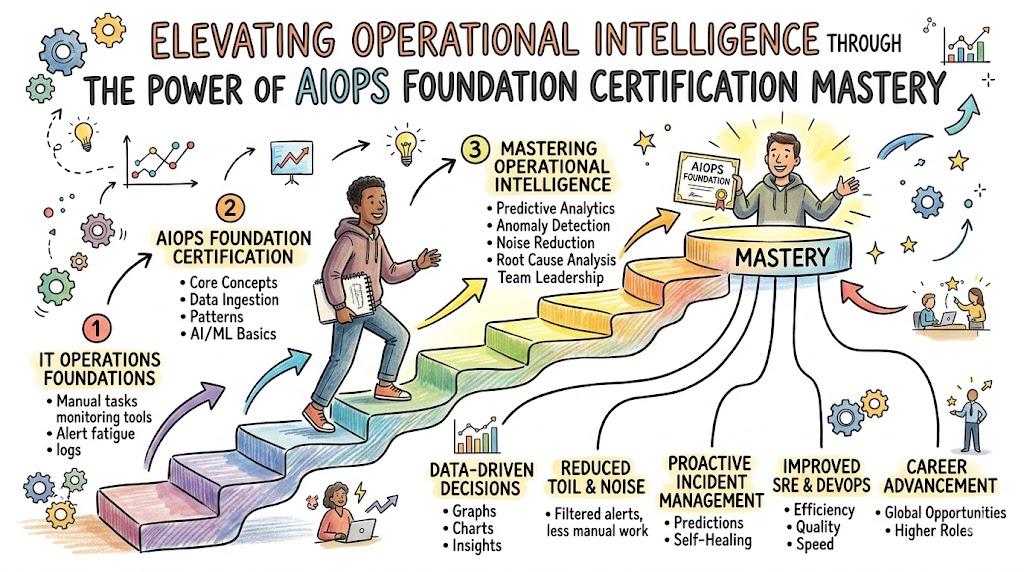
The modern technical landscape shifts rapidly toward automated intelligence, making the AIOps Foundation Certification a vital asset for forward-thinking engineers. This guide serves professionals in DevOps, SRE, and platform engineering who need to transition from manual monitoring to AI-driven operations. By earning this credential from AIOpsSchool, you position yourself at the forefront of the next operational revolution. We provide this roadmap to help you navigate the complexity of machine learning in production environments and make informed career decisions.
What is the AIOps Foundation Certification?
The AIOps Foundation Certification represents a bridge between traditional IT operations and the world of artificial intelligence and machine learning. It exists to standardize the knowledge required to implement automated remediation and predictive analytics in complex, distributed systems. This program emphasizes real-world applications, ensuring that engineers learn how to manage production-grade noise reduction and anomaly detection rather than just studying abstract theories. It aligns perfectly with modern enterprise practices where data-driven decision-making is no longer optional but a core requirement for maintaining high availability.
Who Should Pursue AIOps Foundation Certification?
Systems engineers, SREs, and cloud architects find the most immediate value in this certification as they grapple with overwhelming telemetry data. It equally benefits security professionals looking to automate threat detection and data engineers who want to understand the operational side of ML pipelines. Beginners use it to build a strong conceptual base, while experienced managers leverage it to lead digital transformation initiatives within their organizations. The relevance spans globally, as enterprises in India and across the world aggressively seek talent capable of scaling operations through intelligent automation.
Why AIOps Foundation Certification is Valuable and Beyond
The demand for AIOps expertise grows because the volume of data generated by cloud-native microservices surpasses human capacity for manual analysis. This certification ensures longevity in your career by teaching you how to build resilient systems that self-heal using algorithmic patterns. Enterprise adoption of AI in operations accelerates, meaning those with certified skills see a significant return on their time investment. Staying relevant in the industry requires moving beyond static scripts and embracing the dynamic, predictive capabilities that this certification validates.
AIOps Foundation Certification Overview
This comprehensive program delivers lessons and resides on the AIOpsSchool platform. The certification utilizes a practical assessment approach that tests your understanding of the AIOps lifecycle, from data ingestion to automated action. Designers built it to be accessible yet rigorous, ensuring that ownership of the certificate reflects a genuine ability to handle modern operational challenges. The structure focuses on providing a vendor-neutral foundation that applies to any cloud environment or toolset you encounter in the field.
AIOps Foundation Certification Tracks & Levels
The certification hierarchy begins with the foundation level, which establishes the core vocabulary and architectural concepts of AI-driven operations. Following this, professional and advanced levels allow engineers to dive deeper into algorithmic tuning, data science for Ops, and complex automation workflows. Specialization tracks cater to those focusing on specific domains like FinOps for cost prediction or DevSecOps for automated security responses. These levels align strategically with career progression, moving from individual contributor roles to senior architectural and leadership positions.
Complete AIOps Foundation Certification Table
| Track | Level | Who it’s for | Prerequisites | Skills Covered | Recommended Order |
| Core Operations | Foundation | Aspiring AIOps Engineers | Basic IT Ops Knowledge | Data Ingestion, Pattern Discovery | 1st |
| Advanced SRE | Professional | Senior SREs | Foundation Cert | Predictive Scaling, Incident Noise Reduction | 2nd |
| ML Engineering | Professional | Data & DevOps Engineers | Python/Basic ML | Model Deployment, Drift Detection | 2nd |
| Strategic Lead | Advanced | Engineering Managers | Professional Cert | AIOps Strategy, ROI Mapping | 3rd |
Detailed Guide for Each AIOps Foundation Certification
AIOps Foundation Certification – Foundation Level
What it is
This certification validates a professional’s understanding of the fundamental principles of artificial intelligence applied to IT operations. It confirms you know how to move from reactive to proactive monitoring.
Who should take it
It suits junior to mid-level DevOps engineers, SREs, and IT managers who are new to machine learning concepts. No prior data science experience is required to start.
Skills you’ll gain
- Understanding the AIOps conceptual framework and lifecycle.
- Identifying data sources for operational intelligence.
- Knowledge of event correlation and noise reduction techniques.
- Grasping the basics of predictive analytics in cloud environments.
Real-world projects you should be able to do
- Designing a basic telemetry pipeline for high-volume logs.
- Configuring automated alerts based on statistical anomalies rather than static thresholds.
- Creating a roadmap for integrating AI tools into an existing NOC.
Preparation plan
The 7-14 day strategy involves intensive review of the official study guide and terminology. A 30-day plan allows for exploring case studies and taking practice exams to identify knowledge gaps. The 60-day approach works best for those wanting to experiment with open-source AIOps tools alongside their theoretical studies.
Common mistakes
- Overlooking the importance of data quality before applying AI models.
- Assuming AIOps replaces all traditional monitoring tools immediately.
- Neglecting the cultural shift required for automated remediation.
Best next certification after this
- Same-track option: AIOps Professional Specialist
- Cross-track option: Kubernetes Security Specialist
- Leadership option: Digital Transformation Manager
Choose Your Learning Path
DevOps Path
The DevOps path integrates AI into the Continuous Integration and Continuous Deployment pipelines to predict deployment failures. Engineers learn to use machine learning to analyze code quality and performance metrics in real-time. This path bridges the gap between development speed and operational stability. It remains essential for those looking to build “No-Ops” environments where software handles its own lifecycle.
DevSecOps Path
In this path, the focus shifts to using AI for automated threat hunting and vulnerability management. Professionals learn how to identify patterns of malicious behavior that traditional signature-based security tools might miss. By applying AIOps to security, you reduce the mean time to detect and respond to breaches. This critical track serves engineers working in highly regulated industries or high-risk environments.
SRE Path
The SRE path emphasizes reliability and the reduction of toil through intelligent automation and error budget management. You learn how to use predictive analytics to forecast capacity needs and prevent outages before they occur. This track focuses heavily on service level objectives and using AI to maintain them. It represents the gold standard for those managing massive-scale distributed systems.
AIOps Path
This dedicated track dives deep into the algorithmic side of operations, focusing on model selection and data engineering. You master the art of turning raw telemetry into actionable insights using various machine learning techniques. It covers the end-to-end lifecycle of an AIOps platform, from data collection to automated remediation. This path fits specialists who want to be the primary architects of intelligent operations.
MLOps Path
The MLOps path serves those who manage the lifecycle of machine learning models in production. It covers versioning, monitoring, and scaling ML models just like traditional software. You learn how to handle data drift and model decay to ensure consistent performance. This path is vital as more companies move AI models from the lab to the real world.
DataOps Path
This path focuses on the orchestration and quality of data pipelines that feed into both business and operational systems. You learn how to apply DevOps principles to data management to ensure reliability and speed. It covers data governance, privacy, and the automation of data delivery. This path benefits professionals sitting at the intersection of big data and system operations.
FinOps Path
The FinOps path uses AI to predict cloud spending patterns and identify opportunities for cost optimization. You learn how to use machine learning to correlate cloud usage with business value. This path grows increasingly important as cloud bills become more complex and difficult to manage manually. It empowers engineers to take accountability for the financial impact of their technical decisions.
Role → Recommended AIOps Foundation Certification Certifications
| Role | Recommended Certifications |
| DevOps Engineer | AIOps Foundation, Jenkins Engineer |
| SRE | AIOps Foundation, SRE Professional |
| Platform Engineer | AIOps Foundation, CKA |
| Cloud Engineer | AIOps Foundation, AWS Architect |
| Security Engineer | AIOps Foundation, CKS |
| Data Engineer | AIOps Foundation, Big Data Specialty |
| FinOps Practitioner | AIOps Foundation, FinOps Certified |
| Engineering Manager | AIOps Foundation, Agile Leader |
Next Certifications to Take After AIOps Foundation Certification
Same Track Progression
After completing the foundation, you should pursue professional-level certifications that focus on specific AIOps tools and advanced algorithmic tuning. This allows you to become a subject matter expert in automated operations. Deepening your knowledge in this track ensures you can design complex, self-healing architectures for global enterprises.
Cross-Track Expansion
Broadening your skills into areas like Kubernetes security or cloud-native architecture provides a more holistic view of the ecosystem. Understanding how AIOps interacts with container orchestration or security protocols makes you a more versatile engineer. This expansion is key for those who want to move into high-level platform engineering roles.
Leadership & Management Track
For those looking to move into management, certifications in strategic leadership and digital transformation provide the logical next steps. These credentials help you translate technical AIOps capabilities into business value and ROI. It prepares you to lead large-scale organizational changes and manage diverse technical teams.
Training & Certification Support Providers for AIOps Foundation Certification
DevOpsSchool
This organization provides extensive hands-on training and a robust curriculum designed for working professionals seeking AIOps mastery. They offer interactive sessions led by industry experts who bring real-world scenarios into the virtual classroom environment. Their focus ensures students apply what they learn immediately to their current projects and roles.
Cotocus
This provider specializes in tailored consulting and training services that bridge the gap between theoretical knowledge and practical implementation. They focus on modernizing IT infrastructure through advanced automation and AI integration techniques for global teams. Their trainers are seasoned practitioners who understand the nuances of enterprise-scale digital transformation and cloud-native adoption.
Scmgalaxy
As a long-standing community and training hub, they offer a wealth of resources, including blogs, tutorials, and certification bootcamps. They emphasize the integration of configuration management and CI/CD with emerging AI technologies to streamline the entire software delivery lifecycle. Their approach is community-driven, providing a platform for continuous learning and networking among DevOps professionals.
BestDevOps
This platform focuses on curated learning paths that highlight the most effective tools and practices in the current market. They provide deep dives into AIOps and SRE methodologies, helping engineers stay ahead of the technical curve with high-quality content. Their goal simplifies complex technical topics into digestible, actionable modules for career advancement.
devsecopsschool.com
This institution focuses heavily on the intersection of security and automated operations, ensuring that AI implementations remain secure by design. They offer specialized courses that teach how to use machine learning for automated threat detection and compliance monitoring. Their curriculum is essential for any professional looking to master the security aspects of modern IT environments.
sreschool.com
Dedicated to the principles of site reliability engineering, this provider teaches how to use AI to maintain system uptime and performance. Their training covers everything from error budgets to predictive incident management using advanced AIOps frameworks. They empower students to build more resilient systems that require less manual intervention over time.
aiopsschool.com
As a primary authority on the subject, this site provides the official certification and comprehensive training modules for the AIOps ecosystem. They focus exclusively on the transition from traditional operations to AI-driven environments with vendor-neutral methodologies. Their certifications represent a global standard for excellence in the field of intelligent operations.
dataopsschool.com
This provider focuses on the crucial data layer, teaching how to manage the lifecycle of data used by AI and operational tools. They emphasize the importance of data quality, pipeline automation, and collaborative workflows between data and operations teams. Their courses are vital for anyone responsible for the integrity of an organization’s operational intelligence data.
finopsschool.com
Focused on the financial management of cloud resources, this site teaches how to use AI for cost forecasting and optimization. They provide the tools and knowledge necessary to align cloud spending with business objectives through data-driven insights. Their training is essential for organizations looking to gain better control over their expanding cloud infrastructure costs.
Frequently Asked Questions (General)
- How difficult is the foundation exam for an experienced engineer?
The exam maintains moderate difficulty; while it requires a solid grasp of IT operations, it focuses more on conceptual understanding than deep coding.
- What is the typical time commitment required for preparation?
Most working professionals find that 30 days of consistent study, about 5-10 hours per week, suffices to pass comfortably.
- Are there any mandatory prerequisites before I can take the test?
No strict formal prerequisites exist, but a basic understanding of Linux, networking, and the DevOps lifecycle helps significantly.
- Will this certification help me get a salary increase or promotion?
While not guaranteed, AIOps is a high-demand skill; many engineers report better job prospects and higher salary brackets after becoming certified.
- Is the certification exam conducted online or at a testing center?
The exam is typically available online through proctored platforms, allowing you to take it from the comfort of your home or office.
- How long does the certification remain valid after I pass?
The certification generally remains valid for two to three years, after which you may need to renew or progress to a higher level.
- Does the program cover specific tools like Splunk or ELK?
The foundation level remains vendor-neutral, focusing on the underlying principles and logic that apply to all major AIOps and monitoring tools.
- Is there a community or forum for certified professionals?
Yes, most providers offer access to exclusive alumni groups and forums where you network and share knowledge with other experts.
- Can I retake the exam if I do not pass on my first attempt?
Most providers allow retakes, though a waiting period and a nominal fee usually apply to the second attempt.
- How does this differ from a standard DevOps certification?
While DevOps focuses on the lifecycle and culture of delivery, this specifically addresses using AI to manage and scale operations.
- Are there hands-on labs included in the training materials?
Yes, high-quality training providers include lab environments where you practice data ingestion and anomaly detection on real datasets.
- Is this certification recognized by major cloud providers like AWS or Azure?
Yes, major cloud and enterprise employers widely recognize it as a valuable complementary credential to platform-specific certifications.
FAQs on AIOps Foundation Certification
- What is the main focus of this foundation program?
The primary focus teaches engineers how to apply machine learning and data science principles to automate and optimize IT operational tasks.
- Does it require advanced mathematics or statistics knowledge?
No, the foundation level explains the necessary statistical concepts in a simplified, practical way relevant to system monitoring.
- How does this certification help with incident management?
It teaches how to use AI to correlate multiple alerts into a single incident, significantly reducing the noise and fatigue for on-call engineers.
- Can managers benefit from this technical certification?
Absolutely, it provides managers with the technical vocabulary and strategic understanding needed to oversee AIOps projects and tool selection.
- What kind of data sources are covered in the curriculum?
The course covers a wide range of telemetry, including logs, metrics, traces, and events from cloud-native and legacy infrastructure.
- Is the exam focused on multiple-choice questions or practical tasks?
The foundation exam usually consists of multiple-choice questions designed to test your understanding of core AIOps concepts and workflows.
- How does AIOps relate to the Site Reliability Engineering role?
AIOps serves as a powerful tool for SREs, providing the automation needed to manage complex systems and meet strict service level objectives.
- Are the study materials updated frequently for new trends?
Yes, the curriculum regularly changes to reflect the latest advancements in AI and the evolving landscape of cloud-native operations.
Final Thoughts: Is AIOps Foundation Certification Worth It?
Securing this certification represents a strategic move for any engineer who wants to stay competitive in an increasingly automated world. It provides the clarity needed to navigate the hype surrounding AI and offers practical tools for improving system reliability. As a mentor, I see this as a necessary evolution for operations professionals who currently feel overwhelmed by the complexity of modern cloud environments. It is not just about a certificate; it is about adopting a data-driven mindset that defines the next decade of engineering excellence. Take the step to modernize your skills now, and you will find yourself better equipped to lead the teams of the future.