Introduction
Scaling cloud operations in a competitive market requires engineers to abandon manual configurations in favor of automated, programmable workflows. This Hashicorp Terraform training provides the technical foundation you need to define, deploy, and manage complex environments using a single, unified language. By mastering these high-demand skills, you align your career with the latest DevOpsschool standards, ensuring that you can handle the architectural demands of any modern enterprise. This guide helps you navigate the various certification tracks so you can make informed decisions that drive your professional growth in the global technology sector.
What is the Hashicorp Terraform training?
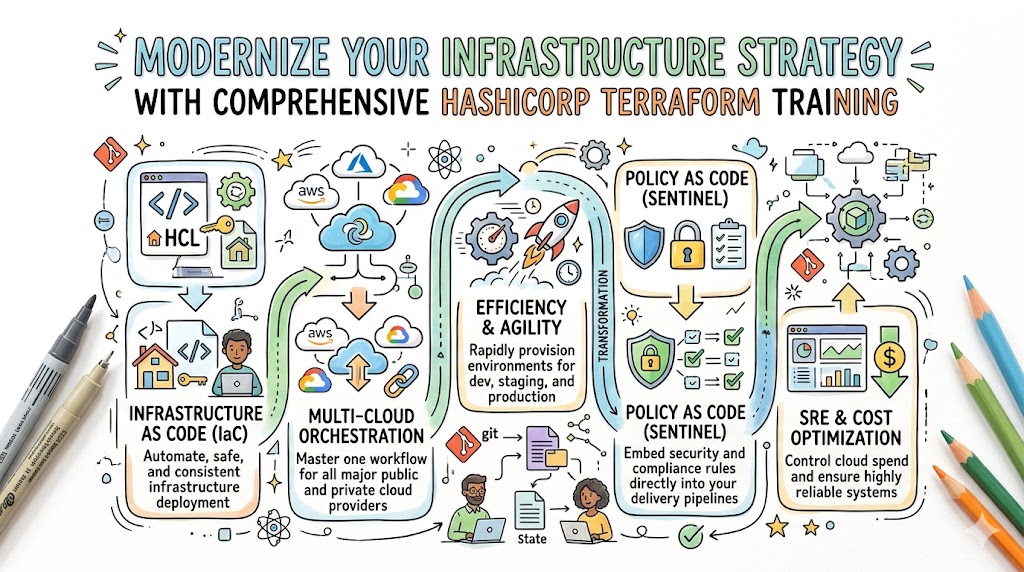
This educational program establishes the industry benchmark for Infrastructure as Code (IaC) proficiency. It teaches you how to use a declarative configuration language to describe your desired cloud state, allowing the tool to handle the underlying API calls automatically. Rather than focusing on a single vendor, the training emphasizes a provider-agnostic approach that works across AWS, Azure, Google Cloud, and on-premises environments. You gain the ability to version your infrastructure just like application code, which drastically improves the reliability and speed of your deployment cycles.
Who Should Pursue Hashicorp Terraform training?
Cloud engineers, site reliability specialists, and system administrators find this curriculum essential for managing modern, large-scale systems. The program also offers significant value to security professionals who want to automate compliance checks and data engineers who need to provision elastic processing clusters. Even technical leaders benefit from the training by gaining a deeper understanding of how automation reduces operational risk and costs. Whether you are an aspiring engineer in India or a seasoned architect at a global firm, these skills provide a universal language for infrastructure excellence.
Why Hashicorp Terraform training is Valuable and Beyond
The shift toward multi-cloud architectures has created an unprecedented demand for engineers who can manage diverse environments without vendor lock-in. Because this tool acts as a bridge between different service providers, your expertise remains portable and highly valuable even if your company changes its primary cloud vendor. You invest your time in a skill set that emphasizes logical orchestration and state management, which are core pillars of modern platform engineering. This training ensures your long-term relevance in an industry that continues to move away from manual server management.
Hashicorp Terraform training Certification Overview
The certification framework measures your hands-on technical ability through a structured assessment delivered via the official training path and hosted on DevOpsschool. It tests your knowledge of the core workflow—write, plan, and apply—while ensuring you understand the critical importance of state consistency and modular design. The program balances the use of the open-source CLI with an introduction to enterprise features like private registries and team-based workspaces. Earning this credential proves to the market that you possess the practical skills required to build and maintain production-grade automated systems.
Hashicorp Terraform training Certification Tracks & Levels
The curriculum offers a clear roadmap that takes you from basic automation tasks to complex, enterprise-wide orchestration. You begin with the Associate level to master the fundamentals of syntax and resource management before moving toward professional and expert specializations. These advanced tracks cover topics like policy-as-code, secrets management integration, and multi-region scaling. By following these levels, you build a comprehensive portfolio of skills that allow you to grow from a junior practitioner into a principal architect who sets the technical strategy for an entire organization.
Complete Hashicorp Terraform training Certification Table
| Track | Level | Who it’s for | Prerequisites | Skills Covered | Recommended Order |
| Automation Core | Associate | Junior DevOps/Devs | Cloud Basics | CLI, HCL, State | 1 |
| Team Governance | Professional | Senior SREs | Associate | Sentinel, Workspaces | 2 |
| Security Operations | Specialist | SecOps Engineers | Professional | Vault, Compliance | 3 |
| Enterprise Architect | Expert | Principal Architects | 5+ Years Exp | Scaling, Modules | 4 |
Detailed Guide for Each Hashicorp Terraform training Certification
Hashicorp Terraform training – Associate Certification
What it is
This entry-level certification validates your fundamental grasp of infrastructure automation concepts using the industry’s leading tool. It confirms that you can successfully initialize directories, preview changes, and deploy resources to a cloud provider without manual intervention.
Who should take it
Developers, junior operations staff, and cloud enthusiasts who want to formalize their automation skills should target this credential. It requires no prior certifications, making it the most accessible starting point for anyone looking to enter the world of infrastructure as code.
Skills you’ll gain
- Mastering HashiCorp Configuration Language (HCL) to define resources.
- Understanding how the State file acts as the source of truth for your environment.
- Creating dynamic configurations using input variables, locals, and output values.
- Executing core commands like init, plan, apply, and destroy with precision.
Real-world projects you should be able to do
- Deploy a multi-tier application stack including compute, storage, and networking.
- Build a reusable module for standardizing security group rules across teams.
- Configure a remote backend with state locking to enable safe team collaboration.
Preparation plan
- 7–14 days: Study the basic HCL syntax and practice deploying simple resources to a free-tier cloud account.
- 30 days: Explore more complex scenarios involving loops, conditionals, and multi-cloud providers.
- 60 days: Focus on advanced state management and troubleshooting techniques while taking simulated exams.
Common mistakes
- Forgetting to exclude the state file or sensitive variables from version control systems.
- Skipping the ‘plan’ phase and applying changes directly to production environments.
- Building large, monolithic configuration files instead of using small, manageable modules.
Best next certification after this
- Same-track option: Terraform Professional.
- Cross-track option: Certified Kubernetes Administrator (CKA).
- Leadership option: HashiCorp Certified Vault Associate.
Choose Your Learning Path
DevOps Path
You focus on weaving infrastructure automation into the fabric of the software development lifecycle. This path teaches you to build CI/CD pipelines that provision the necessary hardware as soon as a developer pushes new code. By synchronizing your infrastructure and application deployments, you eliminate the “it works on my machine” problem entirely.
DevSecOps Path
The security track emphasizes the creation of automated guardrails that protect your cloud environment. You learn to write code-based policies that scan every proposed infrastructure change for security vulnerabilities or compliance violations. This ensures that your organization stays safe and compliant without slowing down the engineering team.
SRE Path
Site Reliability Engineers prioritize the resilience and performance of the platforms they manage. On this path, you master high-level state management and disaster recovery strategies to ensure maximum system uptime. You learn how to use code to recreate entire global infrastructures in minutes during a critical outage.
AIOps Path
This track explores the intersection of artificial intelligence and automated operations. You learn how to feed infrastructure data into AI models to predict when you need to scale resources. By building self-healing systems, you allow your infrastructure to respond to changing traffic patterns without human intervention.
MLOps Path
Machine learning workflows require specialized environments that can handle massive data processing and model training. This path teaches you how to provision the complex GPU clusters and storage systems needed for AI projects. You ensure that your data science teams have consistent, repeatable environments for every experiment.
DataOps Path
Data professionals use this path to automate the setup of massive data warehouses and processing engines. You learn to manage services like Snowflake or Databricks via code, ensuring that your data platform remains stable and version-controlled. This allows your team to focus on extracting insights rather than managing servers.
FinOps Path
The financial operations path focuses on using automation to drive down cloud costs. You learn how to integrate cost-estimation tools into your deployment workflow so engineers see the financial impact of their code before they deploy it. This transparency helps the entire organization maintain a lean and efficient budget.
Role → Recommended Hashicorp Terraform training Certifications
| Role | Recommended Certifications |
| DevOps Engineer | Associate, Professional |
| SRE | Associate, SRE Path |
| Platform Engineer | Professional, Expert |
| Cloud Engineer | Associate |
| Security Engineer | DevSecOps Specialty |
| Data Engineer | DataOps Path |
| FinOps Practitioner | FinOps Path |
| Engineering Manager | Associate (Overview) |
Next Certifications to Take After Hashicorp Terraform training
Same Track Progression
Deepen your expertise by pursuing advanced certifications that focus on enterprise governance and scaling. You will learn how to manage complex organizations with hundreds of workspaces while enforcing global security standards. Staying on this track allows you to become the primary subject matter expert for automation within your company.
Cross-Track Expansion
Broaden your horizons by earning certifications in container orchestration or secrets management. Pairing your automation skills with Kubernetes or Vault makes you a versatile “full-stack” operator. This combination allows you to manage everything from the virtual machine layer up to the sensitive application data layer.
Leadership & Management Track
Transition into leadership by focusing on architectural strategy and organizational culture. These certifications help you understand how to build a “Cloud Center of Excellence” that empowers other teams. You learn how to set the high-level standards that drive innovation while maintaining operational control.
Training & Certification Support Providers for Hashicorp Terraform training
DevOpsSchool
This provider offers a comprehensive curriculum that balances theoretical concepts with intensive hands-on lab work. Their instructors bring real-world production experience to every session, ensuring that students learn how to solve actual crises rather than just memorizing exam questions. They offer personalized mentorship that helps you navigate your entire career journey.
Cotocus
Cotocus focuses on enterprise-level training for teams undergoing digital transformation and cloud migration. They specialize in teaching you how to integrate automation tools into existing, complex legacy systems with minimal risk. Their programs are designed to maximize the efficiency of your internal engineering teams immediately.
Scmgalaxy
Scmgalaxy acts as a massive community hub where you can find endless tutorials, guides, and free learning resources. It is an excellent resource for self-paced learners who want to see how other engineers solve common automation challenges. Their community forums provide a space for real-time troubleshooting and collaboration.
BestDevOps
This platform offers highly curated learning paths that align perfectly with current job market requirements. They focus on giving you the templates and best practices that you can apply on your first day at a new job. Their training modules are streamlined to help you achieve certification with maximum efficiency.
devsecopsschool.com
This organization leads the way in teaching the security side of the automation lifecycle. You will learn how to build “unbreakable” systems by integrating automated vulnerability scanning and policy-as-code. It is the gold standard for engineers working in finance, healthcare, or government sectors.
sreschool.com
Sreschool focuses on the reliability and performance metrics that keep systems running smoothly under pressure. Their courses teach you how to use automation to monitor system health and respond to incidents automatically. This is a vital resource for anyone responsible for maintaining high availability.
aiopsschool.com
This provider sits at the cutting edge of the industry, teaching you how to apply machine learning to your operations. You will learn how to build “intelligent” infrastructure that can self-heal and optimize its own performance. It is a must for anyone looking to lead the next wave of IT innovation.
dataopsschool.com
DataOpsSchool bridges the gap between big data engineering and automated operations. They teach you how to apply DevOps principles to ensure your data pipelines remain consistent and high-quality. This training is essential for modern data teams that demand both speed and accuracy.
finopsschool.com
This platform focuses on the intersection of cloud engineering and corporate finance. You learn how to use automation to track every penny spent in the cloud and how to optimize your resources for maximum value. It is a vital resource for anyone tasked with managing large cloud budgets.
Frequently Asked Questions (General)
- How much prior coding knowledge should I have?You only need a basic understanding of logic and command-line interfaces, as the language uses a very readable and simple format.
- Can I use this tool to manage multiple cloud providers?Yes, the primary advantage of this training is that you learn to orchestrate resources across AWS, Azure, and Google Cloud using one tool.
- How long does the study process typically take?Most professionals spend four to eight weeks preparing, depending on how often they practice with the actual software.
- Is the exam based on multiple-choice questions?The exam primarily uses multiple-choice and multiple-response questions, but they are designed to test your practical, real-world logic.
- Do I need to pay for a cloud account to practice?You can complete almost all the laboratory exercises using the “free tier” accounts provided by major cloud vendors.
- What is the most important topic to master for the exam?State management is widely considered the most critical topic, as it is the foundation for how the tool tracks your infrastructure.
- How does this tool compare to provider-specific options?Unlike vendor-locked tools, this training teaches you a universal approach that works across your entire technology stack.
- Will this certification help me get a job in India?Yes, the Indian tech market has a massive demand for automation experts, and recruiters recognize this credential as a benchmark for excellence.
- Is there a practical coding part in the exam?While there is no live coding environment, you must read and troubleshoot code snippets to answer the questions accurately.
- Does the certification expire?Yes, the credential is valid for two years, ensuring that practitioners stay up to date with the latest features.
- Can I take the training online?Yes, most providers offer flexible online options, including self-paced modules and instructor-led virtual classrooms.
- Is it useful for a developer who doesn’t do “Ops”?Absolutely, as modern developers are increasingly expected to manage their own testing and staging environments through code.
FAQs on Hashicorp Terraform training
- What is the difference between a “Plan” and an “Apply”?The plan command shows you exactly what will happen, while apply actually executes the changes in your cloud account.
- How do I keep my passwords out of the code?The training teaches you to use input variables and external secrets managers to keep sensitive data secure and separate.
- Can I use this for local servers?Yes, there are providers for local virtualization platforms like VMware and VirtualBox, making it useful for hybrid setups.
- What is a “Module” used for?Modules act like templates, allowing you to package and reuse groups of resources across different projects or environments.
- Is the state file dangerous?The state file contains a map of your infrastructure; if you lose or corrupt it, the tool loses track of what it has built.
- What does “idempotent” mean in this context?It means that running the same code multiple times will always result in the same environment, without creating duplicate resources.
- How does it handle existing infrastructure?You can use the “import” feature to bring existing cloud resources under the management of your automated workflow.
- Is it possible to share code with a team?Yes, by using version control systems and remote state locking, entire teams can collaborate on the same infrastructure safely.
Final Thoughts: Is Hashicorp Terraform training Worth It?
Investing your energy into mastering infrastructure automation marks a significant turning point in your professional journey. I have seen many engineers move from manual administration to high-level architectural roles by embracing these exact principles. The ability to manage global systems through a few lines of code is not just a job skill; it is a fundamental requirement for the modern digital economy. While the learning curve requires dedication, the rewards in terms of career longevity, salary, and professional respect are truly immense. If you want to build the future of technology rather than just maintain its past, this certification is your essential first step.