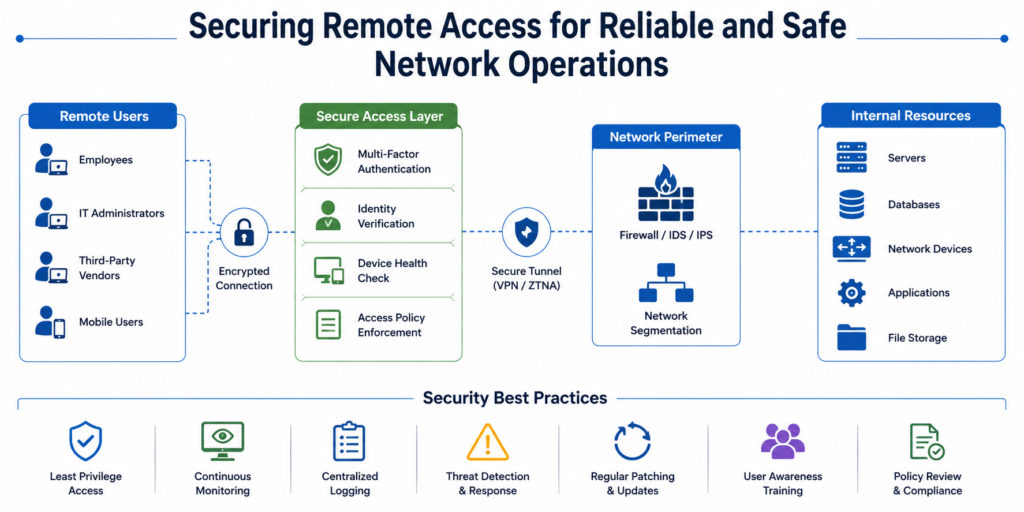
Remote access has become a critical part of modern network operations. Organizations rely on distributed teams, remote administrators, third-party vendors, cloud platforms, and managed service providers to maintain infrastructure from different locations. While remote connectivity improves flexibility and operational efficiency, it also introduces significant security risks. Attackers often target remote access systems because they provide direct entry points into critical networks.
As organizations expand their digital environments, securing remote access becomes a foundational requirement rather than an optional security measure. Network engineers, operations teams, and security professionals must implement layered controls that protect users, devices, applications, and data without slowing operational workflows. This is where Noopsschool helps professionals understand modern network operations, security frameworks, infrastructure management, and operational best practices required to protect enterprise environments.
Remote access security is not limited to deploying a VPN. It involves identity verification, device security, network segmentation, access governance, continuous monitoring, threat detection, and operational discipline. Organizations that understand these principles can maintain productivity while significantly reducing cyber risks. This comprehensive guide explores every major aspect of securing remote access in network operations and explains how modern teams can create secure and scalable remote access architectures.
Understanding Remote Access in Network Operations
Remote access allows users to connect to organizational resources from locations outside the primary network perimeter. Network administrators may need access to routers, switches, firewalls, servers, cloud platforms, monitoring systems, and management consoles while working remotely or supporting distributed infrastructure.
Traditionally, organizations relied on physical access to data centers and network facilities. However, digital transformation has changed operational requirements. Teams now manage hybrid environments that include on-premises infrastructure, cloud services, branch offices, remote workers, and outsourced support providers. Consequently, secure remote connectivity has become an operational necessity.
Remote access environments often include multiple technologies working together. VPN solutions create encrypted communication channels. Identity systems verify user credentials. Multi-factor authentication adds another verification layer. Endpoint security protects user devices. Monitoring platforms observe activity. Access control systems determine authorization levels. Together, these technologies create a security framework that balances operational efficiency and protection.
Without proper controls, remote access can become a major attack vector. Weak passwords, unsecured devices, exposed management ports, and excessive privileges frequently contribute to breaches. Therefore, organizations must adopt a strategic approach that combines technology, governance, and operational best practices.
Why Remote Access Security Matters More Than Ever
Cybercriminals actively target remote access infrastructure because it often provides direct access to critical systems. A compromised remote connection can allow attackers to move laterally across networks, steal sensitive information, deploy ransomware, disrupt operations, or gain persistent access to valuable resources.
The increasing adoption of cloud computing, remote work, and distributed operations has expanded the attack surface significantly. Employees frequently access corporate resources from home networks, public internet connections, and personal devices. Meanwhile, contractors and vendors often require temporary access to internal systems. Every connection introduces potential risk.
Operational teams must also consider regulatory requirements. Many industries require strict controls over access management, authentication, logging, and data protection. Failure to secure remote access can result in compliance violations, financial penalties, operational downtime, and reputational damage.
Strong remote access security supports business continuity. During emergencies, infrastructure incidents, maintenance activities, and disaster recovery events, operations teams depend on secure remote access to maintain service availability. Consequently, security and operational resilience are closely connected.
Core Components of Secure Remote Access
Effective remote access security depends on multiple layers of protection working together. No single technology can provide complete security. Instead, organizations must implement a defense-in-depth strategy that addresses users, devices, networks, applications, and operational processes.
Strong Authentication
Authentication verifies user identity before granting access. Password-only authentication is no longer sufficient because attackers can obtain credentials through phishing, credential stuffing, brute-force attacks, or social engineering.
Organizations should implement:
- Multi-factor authentication
- Hardware security tokens
- Mobile authentication applications
- Biometric verification
- Risk-based authentication
By requiring additional verification factors, organizations significantly reduce the likelihood of unauthorized access even when passwords are compromised.
Secure Communication Channels
All remote communications should use encrypted connections. Encryption protects data from interception while traveling across public networks.
Common secure communication technologies include:
- Virtual Private Networks
- Secure Shell (SSH)
- Transport Layer Security
- IPsec tunnels
- Zero Trust Network Access platforms
Encryption ensures confidentiality and integrity while reducing exposure to man-in-the-middle attacks.
Endpoint Security
Remote access security depends heavily on the security posture of connecting devices. Even strong authentication mechanisms can fail if an endpoint is compromised.
Organizations should enforce:
- Antivirus protection
- Endpoint Detection and Response solutions
- Device encryption
- Security patching
- Application control
- Device compliance verification
Secure endpoints help prevent attackers from using compromised systems to access enterprise resources.
Access Control Policies
Access controls determine what users can access after authentication. Effective authorization follows the principle of least privilege.
Users should receive only the permissions necessary to perform assigned responsibilities. Excessive privileges increase risk because compromised accounts can cause greater damage.
Role-based access control enables organizations to manage permissions efficiently while reducing administrative complexity and security exposure.
Key Operational Concepts You Must Know
Remote access security becomes significantly more effective when teams understand the operational principles behind secure network management. These concepts influence how organizations design, deploy, monitor, and improve access controls.
Principle of Least Privilege
Least privilege ensures users receive only the minimum permissions required for their responsibilities. Administrators should avoid granting broad access rights simply for convenience.
When privileges remain tightly controlled, organizations limit the impact of compromised accounts. Attackers who gain access to a restricted account face greater difficulty moving laterally across the environment. Consequently, least privilege remains one of the most effective operational security practices.
Zero Trust Security
Zero Trust assumes no user, device, or connection should be trusted automatically. Every access request requires verification regardless of location.
Instead of trusting users inside a network perimeter, Zero Trust continuously validates identity, device health, behavioral indicators, and contextual information. This model significantly improves security in remote access environments where traditional network boundaries no longer exist.
Network Segmentation
Network segmentation divides infrastructure into smaller security zones. Sensitive systems remain isolated from less critical resources.
Segmentation prevents attackers from freely moving across environments after gaining access. Even if a remote connection becomes compromised, segmentation limits the potential impact and reduces exposure to critical assets.
Continuous Monitoring
Security monitoring provides visibility into remote access activity. Organizations must track login attempts, authentication failures, privilege escalations, configuration changes, and unusual behavior patterns.
Continuous monitoring enables faster detection of threats and supports rapid incident response. Visibility remains essential because organizations cannot protect assets they cannot observe effectively.
Identity-Centric Security
Modern security strategies increasingly focus on identity rather than network location. Identity has become the new security perimeter.
Identity-centric security integrates authentication, authorization, device verification, behavioral analysis, and policy enforcement. This approach supports secure operations across cloud environments, remote locations, and hybrid infrastructures.
Building a Secure Remote Access Architecture
A secure remote access architecture combines multiple security layers into a cohesive framework. Each layer protects against different attack methods while supporting operational efficiency.
Organizations should begin by identifying critical systems that require remote administration. Risk assessments help determine security requirements for each resource. Highly sensitive systems often require stronger authentication, stricter monitoring, and additional approval processes.
Network engineers should eliminate direct internet exposure for management interfaces whenever possible. Instead, administrators should connect through secure gateways, bastion hosts, or access brokers that enforce authentication and logging requirements.
Access pathways should remain simple and controlled. Excessive complexity often creates operational challenges and increases configuration errors. Clear architecture designs support both security and maintainability.
Organizations should also document remote access workflows thoroughly. Standardized procedures help teams maintain consistency while reducing the likelihood of security gaps during operational changes.
Multi-Factor Authentication as a Critical Defense Layer
Multi-factor authentication remains one of the most effective controls for protecting remote access systems. Password compromise continues to drive many successful cyberattacks, making additional verification essential.
A strong MFA implementation combines something users know, something users possess, or something users inherently are. Examples include passwords, security tokens, smartphone authentication applications, and biometric identifiers.
Operational teams should require MFA for:
- VPN access
- Administrative accounts
- Cloud platforms
- Network management systems
- Monitoring platforms
- Remote desktop services
Organizations that consistently enforce MFA significantly reduce the effectiveness of credential theft attacks. Consequently, MFA has become a foundational security requirement across modern network operations.
Securing VPN Infrastructure
Virtual Private Networks remain widely used for remote connectivity. However, improperly configured VPN environments can become attractive attack targets.
Administrators should implement strong encryption standards and regularly review VPN configurations. Outdated protocols should be replaced with modern alternatives that provide stronger protection.
VPN security best practices include:
- Enforcing MFA
- Restricting administrative access
- Monitoring login activity
- Applying security patches promptly
- Limiting access permissions
- Conducting regular audits
Organizations should also evaluate VPN scalability. Security controls must continue functioning effectively during periods of increased remote connectivity without creating operational bottlenecks.
The Growing Role of Zero Trust Network Access
Zero Trust Network Access solutions represent an evolution beyond traditional VPN models. Rather than granting broad network connectivity, these platforms provide access only to specific authorized resources.
ZTNA solutions evaluate multiple factors before approving access requests. Identity verification, device compliance, location data, behavioral analysis, and risk scoring contribute to access decisions.
This approach reduces attack surfaces significantly because users receive access only to required applications instead of entire network segments. As organizations continue adopting cloud services and remote work models, ZTNA increasingly becomes a preferred remote access strategy.
Platform Implementation vs. Culture — What’s the Real Difference?
Technology alone cannot secure remote access environments. Organizations often invest heavily in platforms while overlooking the cultural and operational behaviors that determine long-term success.
Platform Implementation
Platform implementation focuses on technical capabilities. Teams deploy VPNs, authentication systems, monitoring tools, endpoint protection platforms, and access management solutions.
Technical implementations provide essential security controls. Without proper technologies, organizations cannot establish secure remote access foundations. However, technology only addresses part of the challenge.
Implementation activities typically include:
- Security architecture design
- Access control deployment
- Authentication configuration
- Monitoring integration
- Infrastructure hardening
- Compliance validation
These activities create the technical framework required for secure operations.
Security Culture
Culture influences how people use technology. Employees, administrators, managers, and contractors all affect security outcomes through daily decisions and behaviors.
Organizations with strong security cultures encourage:
- Responsible access management
- Security awareness
- Policy adherence
- Incident reporting
- Continuous improvement
- Operational accountability
Even advanced security platforms become ineffective when users bypass controls, share credentials, ignore policies, or neglect security responsibilities.
Achieving Balance
The most successful organizations combine strong technology platforms with disciplined operational cultures. Security tools provide protection, while organizational culture ensures consistent and responsible usage.
This balance creates sustainable security improvements that adapt to changing threats and operational requirements.
Real-World Use Cases of Modern Operations
Remote access security supports a wide range of operational activities across industries. Understanding practical use cases helps organizations design controls that align with real-world requirements.
Global Network Management
Large enterprises often operate infrastructure across multiple regions. Network engineers require remote access to routers, switches, firewalls, and monitoring systems located in different facilities.
Secure remote access enables centralized management while maintaining strong authentication, authorization, and auditing controls. This approach improves operational efficiency without sacrificing security.
Cloud Infrastructure Administration
Cloud platforms host critical applications, databases, and business services. Administrators need secure access to management consoles and operational resources.
Identity-driven access controls, MFA, and Zero Trust principles help protect cloud environments from unauthorized access and privilege abuse.
Managed Service Providers
Service providers frequently support customer environments remotely. Secure access frameworks ensure technicians can perform maintenance activities while limiting exposure to customer systems.
Strong logging and session monitoring provide accountability and transparency for remote support operations.
Incident Response Operations
Security teams often investigate threats from remote locations. During incidents, rapid access to logs, systems, and management interfaces becomes essential.
Secure remote access allows responders to contain threats, analyze activity, and restore services while maintaining security controls throughout the response process.
Industrial Infrastructure Management
Critical infrastructure operators increasingly manage operational technology systems remotely. Secure access controls protect sensitive environments while supporting maintenance, monitoring, and troubleshooting activities.
These environments require particularly strong safeguards because operational disruptions can affect essential services and public safety.
Common Mistakes in Operations Engineering
Many organizations invest in security technologies but still experience incidents because of operational mistakes. Understanding common errors helps teams strengthen their defenses.
Relying Only on Passwords
Password-only authentication remains one of the most common weaknesses. Attackers frequently exploit stolen credentials to gain unauthorized access.
Organizations should consistently enforce MFA across all remote access systems.
Excessive User Privileges
Granting broad administrative permissions increases risk substantially. Users often retain unnecessary privileges long after operational requirements change.
Regular access reviews help ensure permissions remain appropriate and aligned with current responsibilities.
Ignoring Endpoint Security
Remote access security extends beyond authentication systems. Compromised devices can undermine otherwise strong security architectures.
Endpoint security programs should include patch management, malware protection, compliance monitoring, and device encryption.
Poor Visibility and Monitoring
Organizations sometimes deploy remote access technologies without implementing sufficient monitoring capabilities.
Without visibility, suspicious activity may remain undetected for extended periods. Comprehensive logging and security analytics improve threat detection capabilities significantly.
Delayed Patch Management
Unpatched vulnerabilities frequently contribute to successful attacks. Attackers actively target outdated software components exposed through remote access infrastructure.
Timely patch management remains essential for reducing exposure to known security weaknesses.
How to Become an Operations Expert — Career Roadmap
Operations professionals play a critical role in maintaining secure, reliable, and efficient technology environments. Building expertise requires technical knowledge, operational experience, and continuous learning.
Step 1: Learn Networking Fundamentals
Begin with foundational networking concepts including:
- TCP/IP
- Routing
- Switching
- DNS
- VPN technologies
- Firewalls
Strong networking knowledge supports every aspect of operations engineering.
Step 2: Develop Security Skills
Security expertise has become essential for modern operations professionals. Focus on:
- Access management
- Authentication technologies
- Threat detection
- Vulnerability management
- Security monitoring
Understanding security principles improves operational decision-making significantly.
Step 3: Master Operating Systems
Operations teams frequently manage Linux and Windows environments. Learn system administration, automation, troubleshooting, and performance optimization techniques.
Hands-on experience strengthens technical confidence and problem-solving abilities.
Step 4: Learn Automation Technologies
Automation reduces manual effort and improves consistency. Operations experts should understand:
- Scripting languages
- Infrastructure automation
- Configuration management
- Monitoring automation
- Workflow orchestration
Automation skills remain highly valuable across modern IT environments.
Step 5: Gain Cloud Experience
Cloud platforms continue transforming infrastructure management. Learn cloud networking, identity management, security controls, and operational best practices.
Cloud expertise expands career opportunities significantly.
Step 6: Build Real-World Experience
Practical experience remains one of the most important learning methods. Participate in infrastructure projects, troubleshooting exercises, incident response activities, and operational improvements.
Hands-on exposure helps professionals understand how technology functions within real business environments.
Step 7: Pursue Continuous Learning
Technology evolves rapidly. Successful operations professionals continually update their skills through training, certifications, labs, industry research, and practical experimentation.
Lifelong learning supports long-term career growth and professional relevance.
Advanced Monitoring and Auditing Strategies
Monitoring and auditing strengthen remote access security by providing visibility into user activities and system behavior. Organizations should collect detailed logs from authentication systems, VPN platforms, access gateways, endpoint devices, and management consoles.
Behavioral analytics can identify unusual access patterns that may indicate compromised accounts or insider threats. Examples include unexpected login locations, unusual access times, privilege escalation attempts, and abnormal resource usage.
Regular audit reviews help organizations verify compliance with internal policies and regulatory requirements. Auditing also supports forensic investigations by providing historical records of user activity and system events.
Effective monitoring transforms remote access security from a reactive process into a proactive operational capability.
FAQ Section
What is remote access security?
Remote access security refers to the policies, technologies, and controls used to protect users and systems when accessing organizational resources from external locations.
Why is multi-factor authentication important?
Multi-factor authentication reduces the risk of unauthorized access by requiring additional verification beyond passwords.
Is a VPN enough to secure remote access?
No. VPNs provide encrypted communication, but organizations also need strong authentication, endpoint security, access controls, monitoring, and governance processes.
What is Zero Trust Network Access?
Zero Trust Network Access provides secure access to specific resources after verifying user identity, device health, and contextual risk factors.
How does least privilege improve security?
Least privilege limits user permissions to necessary tasks, reducing the impact of compromised accounts and insider threats.
What role does endpoint security play?
Endpoint security protects devices connecting remotely by preventing malware infections, enforcing compliance policies, and reducing attack opportunities.
Why should organizations monitor remote access activity?
Monitoring helps detect suspicious behavior, identify threats quickly, support investigations, and improve overall security visibility.
What skills are required for operations engineering careers?
Networking, security, operating systems, automation, cloud computing, monitoring, troubleshooting, and communication skills are essential for operations professionals.
Final Summary
Securing remote access in network operations requires a comprehensive strategy that combines technology, governance, monitoring, and operational discipline. Organizations must move beyond simple password-based access and implement layered security controls that include multi-factor authentication, endpoint protection, encryption, access governance, continuous monitoring, network segmentation, and Zero Trust principles.
Successful remote access security programs balance operational efficiency with risk reduction. While platforms provide technical protection, organizational culture ensures that users and administrators follow secure practices consistently. Together, these elements create resilient environments capable of supporting modern distributed operations.
As remote connectivity continues to expand across enterprise networks, cloud platforms, and critical infrastructure environments, organizations that prioritize secure remote access will strengthen operational reliability, improve regulatory compliance, reduce cyber risk, and maintain business continuity. For operations professionals, mastering these concepts provides a strong foundation for building secure, scalable, and future-ready network environments.