Introduction
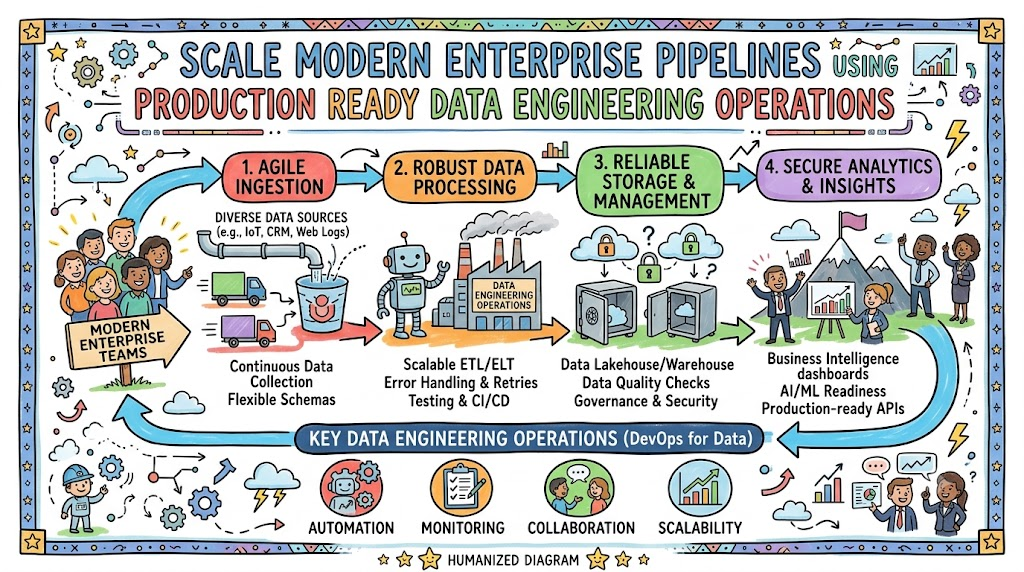
Broken ingestion scripts, unexpected schema mutations, and delayed business analytics constantly plague analytics teams. Modern business leaders demand accurate real-time metrics, so engineering teams manage analytical pipelines with the same discipline as core software applications.
Bridging the divide between reactive pipeline fixes and automated delivery, this education platform delivers production-tested blueprints, technical training, and enterprise consulting. Consequently, data practitioners, platform engineers, and cloud architects eliminate system downtime, establish end-to-end automation, and deploy high-trust analytics rapidly.
What is DataOps?
Understanding What is DataOps means treating pipeline development as a continuous manufacturing line for business insights. This operational philosophy unites agile sprints, continuous integration pipelines, automated schema testing, and statistical quality control across analytical architectures.
+-------------------------------------------------------------------------------+
|                       AUTOMATED DATA DELIVERY ENGINE                          |
|                                                                               |
|  [ Ingestion Layer ] ──► [ Automated CI Tests ] ──► [ Model Transformation ]  |
|          ▲                                                    │               |
|          │                                                    ▼               |
|  [ Proactive Telemetry ] ◄── [ Monitored Release ] ◄── [ DAG Orchestration ]  |
+-------------------------------------------------------------------------------+
Rather than pushing unverified SQL scripts straight into production warehouses, engineers implement automated validation steps for every pull request. Hence, organizations shorten development cycles, intercept data anomalies early, and deliver rock-solid datasets to analytics consumers.
Why DataOps Matters for Modern Data Teams
Unmonitored pipeline failures waste valuable development hours as engineers manually trace errors across upstream tables. Furthermore, undocumented column modifications quietly distort machine learning features and corrupt boardroom intelligence dashboards.
By deploying automated integration tests alongside continuous statistical monitoring, platform developers catch bad payloads before data warehouses update. Thus, technical teams ship analytical models in minutes instead of losing whole sprints to emergency database rollbacks.
Core Components of a DataOps Environment
Assembling an enterprise-grade platform requires integrated automation tooling, modular pipeline design, and strict quality gates across every environment.
- Continuous Integration & Delivery Pipelines: Validates transformation models, triggers regression tests, and provisions staging environments automatically.
- Declarative Cloud Sandboxes: Uses Infrastructure as Code (IaC) to spin up isolated environments that mirror live production configurations.
- Automated Data Quality Guards: Evaluates null constraints, column data types, and row volume freshness before tables commit to production.
- Comprehensive Pipeline Telemetry: Tracks transformation lineage and emits real-time alerts when ingestion jobs exceed standard runtime limits.
Understanding DataOps Tools
Selecting the right platform stack determines whether your pipelines scale gracefully or collapse under heavy analytical workloads. Therefore, engineers must organize their tooling choices around core operational requirements.
| Platform Layer | Operational Responsibility | Leading Industry Technologies |
|---|---|---|
| Workflow Scheduling | Resolves task dependencies and DAG runtimes | Apache Airflow, Dagster, Prefect |
| Transformation Engines | Builds modular, version-controlled analytical models | dbt Core, SQLMesh, GitHub Actions |
| Assertion & Quality | Catches schema drift and validates payload values | Great Expectations, Soda Core, Monte Carlo |
| Modern Cloud Storage | Delivers elastic compute and unified storage | Snowflake, Databricks, Google BigQuery |
Mastering these integrated DataOps Tools allows teams to design modular pipelines that gracefully tolerate upstream API updates and schema shifts.
How DataOps Changes the Data Engineering Workflow
Conventional engineering teams struggle with manual script launches, unchecked database edits, and frantic morning hotfixes. In direct contrast, modern methodology mandates Git branch isolation, peer reviews, and automated integration checks for every single code change.
In addition, continuous integration runners validate transformation logic against realistic test data before merging pull requests. As a direct result, unexpected production incidents plummet, allowing data engineers to build high-impact business features without interruption.
DataOps Training: What Should You Learn?
Enrolling in structured DataOps Training enables developers to replace fragile manual workflows with resilient, automated data systems. Because scalable lakehouses require disciplined operational procedures, candidates must master several essential technical domains.
- Enterprise Version Control: Learn branch isolation techniques, semantic versioning standards, and automated deployment triggers tailored for database transformations.
- Dynamic Workflow Orchestration: Build modular directed acyclic graphs, configure intelligent task retries, and automate error mitigation procedures.
- Automated Assertion Design: Program explicit testing constraints to verify primary keys, payload volume distributions, and schema boundaries.
- Cloud Infrastructure Automation: Provision repeatable analytical environments, audit user permissions, and optimize warehouse compute spend.
Using a DataOps Tutorial to Build Practical Skills
Working through a practical DataOps Tutorial provides engineers with direct experience constructing robust, automated data platforms. For example, learners build an automated pipeline where each Git push triggers data assertions inside an isolated testing environment.
[ Developer Git Branch ]
           │
           ▼
[ CI Automation Runner ] ──► Compiles dbt models & spins up isolated test schema
           │
           ▼
[ Assertion Framework ]  ──► Validates row freshness, foreign keys & column rules
           │
     (Tests Succeed)
           │
           ▼
[ Production Deployment ] ──► Orchestrator executes scheduled ingestion run
Through this project, engineers witness how pre-deployment test suites stop corrupted data from polluting analytics dashboards.
DataOps Certification and Professional Development
Earning a credible DataOps Certification proves your architectural mastery and distinguishes your resume in a competitive tech job market. Forward-thinking companies prioritize certified professionals who know how to enforce data reliability while controlling cloud compute costs.
Completing an industry-tested DataOps Course helps candidates master automated testing pipelines, data governance architectures, and modern cloud design principles. Ultimately, verifiable industry credentials demonstrate your practical readiness to guide high-stakes platform modernizations.
Becoming a Certified DataOps Engineer
The Certified DataOps Engineer credential demonstrates your mastery of automated pipeline mechanics, continuous integration testing, and production telemetry monitoring. Practitioners holding this certification deploy automated build runners, maintain container runtimes, and construct robust testing suites every day.
Moreover, certified engineers eliminate data delivery bottlenecks, establish targeted alerting rules, and enforce schema contracts at system ingestion boundaries. Their daily engineering efforts keep analytical data pipelines moving without interruption.
Becoming a Certified DataOps Architect
Securing the Certified DataOps Architect credential proves your strategic infrastructure vision, platform governance expertise, and technical leadership ability. Architects evaluate emerging technologies, design scalable cloud data lakehouses, and implement enterprise-wide data observability frameworks.
Furthermore, these senior leaders draft data security baselines, establish strict delivery SLAs, and eliminate cloud waste. Their foundational blueprints enable decentralized engineering pods to ship trustworthy data products while respecting platform policies.
DataOps Consulting for Organizations
Enterprises routinely face mounting technical debt, siloed reporting workflows, and unmonitored legacy pipelines that lack testing automation. Dedicated DataOps Consulting resolves these organizational roadblocks by providing architectural audits, custom migration blueprints, and practical operational playbooks.
Seasoned platform consultants inspect existing data architectures, pinpoint release bottlenecks, and install automated deployment pipelines directly into company workflows. Consequently, organizations accelerate release frequency, reduce system outages, and lower their cloud infrastructure bills.
DataOps Services for Growing Teams
Scaling startups and mid-market companies often need enterprise-grade platform capabilities without hiring an entire operations department immediately. Flexible DataOps Services solve this staffing challenge by managing modern data stacks, configuring automated testing, and optimizing warehouse performance.
Dedicated operational engineers oversee cloud lakehouses, monitor pipeline execution schedules, and resolve transient infrastructure issues immediately. Therefore, internal analytics teams focus solely on deriving business intelligence rather than debugging compute clusters.
Who Can Benefit From Learning DataOps?
Transitioning to automated operational workflows provides clear benefits for various technical specialists seeking to advance their careers and scale platform architectures.
- Data Engineers: Remove repetitive firefighting by building automated pipeline assertions, modular transformations, and dynamic DAG workflows.
- Platform & DevOps Engineers: Apply mature CI/CD practices, Infrastructure as Code, and containerization concepts to modern cloud data warehouses.
- Analytics Engineers: Build production-grade transformation models using strict Git branching rules, automated testing suites, and modular SQL frameworks.
- Cloud Enterprise Architects: Design fault-tolerant, fully compliant analytical platforms that deliver dependable data for machine learning and operational dashboards.
A Practical DataOps Learning Roadmap
Acquiring operational mastery requires progressing through distinct developmental phases, advancing from development fundamentals to complex platform design.
+-------------------------------------------------------------------------------+
|                      STEP-BY-STEP DATAOPS ROADMAP                             |
|                                                                               |
|  [ Step 1: Development Fundamentals ]                                         |
|    • Shell Automation, Git Workflows, Advanced SQL, Python Programming        |
|                                                                               |
|  [ Step 2: Orchestration & Modeling ]                                         |
|    • Containerized Applications, Airflow Orchestration, Modular dbt Models    |
|                                                                               |
|  [ Step 3: CI/CD & Automated Quality ]                                        |
|    • GitHub Actions Runners, Great Expectations Assertions, Data Contracts    |
|                                                                               |
|  [ Step 4: Enterprise Observability & FinOps ]                                |
|    • End-to-End Metadata Lineage, Statistical Anomaly Tracing, Cost Control   |
+-------------------------------------------------------------------------------+
Advancing systematically through these milestones equips engineers with hands-on coding proficiency alongside comprehensive architectural expertise.
Common DataOps Mistakes to Avoid
Many technical leaders buy high-priced commercial monitoring software while ignoring basic development best practices. For instance, purchasing an observability platform produces few tangible benefits if engineers skip Git version control and automated pull request gates.
Similarly, relying on downstream analysts to catch bad records creates operational friction and damages leadership trust in reports. Instead, engineering teams must shift testing left by placing schema contracts directly at data collection boundaries.
How DataOpsSchool Can Support Your Learning Journey
Featuring comprehensive educational courses, hands-on lab environments, and direct mentorship, this dedicated learning portal speeds up your mastery of operational principles. Students conquer interactive challenges, follow curated roadmaps, and build enterprise-grade pipeline architectures that reflect actual production requirements.
Whether you need practical tutorials, recognized professional credentials, or strategic implementation guidance, these specialized programs deliver immediate technical results. By applying professional software engineering standards to data operations, engineers create resilient data pipelines that power strategic business expansion.
Frequently Asked Questions About DataOpsSchool
- Which technical professionals get the most value from these courses?
Data engineers, platform developers, analytics specialists, and cloud architects seeking automated, scalable pipelines gain the greatest benefits.
- Where do DataOps practices depart from classic DevOps engineering?
Classic DevOps handles static application code and server uptime, while DataOps coordinates software releases alongside dynamic, constantly changing data payloads.
- Can practitioners prepare for verified professional certifications on the platform?
The platform offers complete preparatory tracks for both hands-on pipeline engineers and senior enterprise architects.
- Which technologies receive the primary focus across the coursework?
Students master essential tools including Apache Airflow, dbt Core, Docker, Great Expectations, Snowflake, and automated GitHub Actions runners.
- Should prospective learners have coding experience before joining?
Basic working knowledge of SQL queries and standard Python scripts helps students successfully complete the advanced technical labs.
- Can enterprise clients request private consulting engagements?
Experienced platform specialists deliver custom architectural assessments, pipeline modernizations, and team training for corporate clients.
- How does automated testing stop analytics failures?
Automated suites inspect data types, enforce unique keys, and block anomalous payloads before downstream reporting dashboards ingest new records.
- What core tasks define the Certified DataOps Engineer role?
These professionals build deployment pipelines, write automated test cases, and monitor cloud transformation runtimes every business day.
- Do students build projects inside live cloud sandboxes?
Learners design and deploy production-grade pipelines inside realistic cloud sandbox environments that accurately simulate enterprise architectures.
- Will finishing this coursework improve my career prospects?
Mastering automated delivery and platform reliability prepares engineers for high-paying leadership positions across top data-driven companies.
Final Thoughts
Adopting automated delivery principles completely transforms enterprise data engineering operations. Replacing manual database interventions with continuous integration, automated assertions, and comprehensive telemetry helps teams ship trusted analytics without delay.
Mastering these operational disciplines provides the tools, confidence, and authority needed to engineer robust platforms that scale effortlessly alongside evolving business demands.