Introduction
Accelerating digital product development requires unwavering infrastructure stability and continuous deployment execution. Modern engineering organizations demand automated release pipelines, instant anomaly mitigation, and relentless performance tuning. When software creators divide their energy between building application features and handling unexpected infrastructure outages, innovation stalls while engineer burnout surges. Engaging specialized operational assistance resolves pressing cloud challenges while empowering internal engineering teams to focus on core product goals.
DevOpsSupport equips technology leaders, SaaS companies, and global enterprises with proactive infrastructure management. Our dedicated operational coverage removes pipeline friction, accelerates software delivery, and guards production platforms against unplanned downtime. By integrating structured operational practices, software organizations transform fragile architectures into resilient, self-repairing digital systems. Collaborating with experienced operations professionals guarantees continuous platform availability and long-term business agility.
Understanding DevOps Support Services And Their Core Capabilities
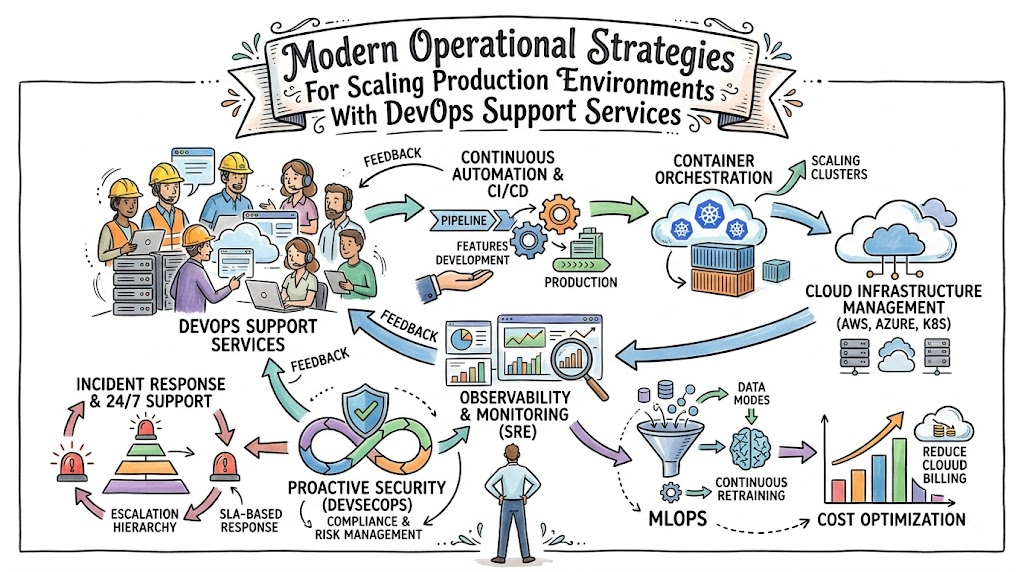
DevOps Support Services deliver targeted management across cloud platforms, deployment pipelines, system observability, and real-time incident resolution. Senior operations specialists maintain continuous integration and continuous delivery (CI/CD) workflows to ensure predictable, error-free software releases. Consequently, development organizations prevent release delays and bounce back swiftly from technical disruptions.
Additionally, these services encompass infrastructure as code (IaC), performance optimization, and multi-cloud governance across complex platform ecosystems. Product teams gain superior uptime, clear release schedules, and proactive security monitoring. Continuous technical maintenance ensures every infrastructure component remains updated, fully compliant, and cost-efficient across its operational lifecycle.
The Critical Need For Continuous Infrastructure Oversight
Unplanned platform downtime erodes customer confidence, disrupts revenue streams, and damages enterprise reputation. Complex cloud environments require frequent security patches, resource scaling, and system configuration checks. Implementing structured support prevents minor software bugs from expanding into major service outages.
Maintaining continuous operational coverage eliminates single points of failure within engineering departments. Real-time observability tools surface system bottlenecks before end users encounter service slowdowns. Consequently, organizations achieve higher platform stability, seamless code deployments, and sustainable software execution without overworking internal engineering teams.
Evaluating Managed DevOps Services vs Internal Engineering Teams
+------------------------+------------------------------------+------------------------------------+
| Operational Dimension  | Internal Engineering Operations     | Managed DevOps Services            |
+------------------------+------------------------------------+------------------------------------+
| Active Coverage        | Standard working hours with on-call| Round-the-clock 24/7 monitoring    |
| Financial Model        | High fixed salaries and hiring fees| Flexible, predictable monthly model|
| Technical Scope        | Limited to current team skill sets | Access to broad multi-cloud experts|
| Capacity Scaling       | Slow, expensive hiring processes   | Instant resource scaling on demand |
| Incident Response      | Variable based on staff presence   | SLA-backed rapid response protocols|
+------------------------+------------------------------------+------------------------------------+
Selecting Managed DevOps Services enables technology executives to transfer complex infrastructure duties to experienced specialists. Software developers maintain complete focus on application logic, user experience, and market expansion.
When Do 24/7 DevOps Support Services Make Sense?
Adopting 24/7 DevOps Support Services becomes vital when companies serve global user bases that require round-the-clock application uptime. Automated alerts without immediate engineer response cause long resolution delays during off-hours. Round-the-clock technical coverage guarantees immediate action during critical production incidents.
Fast-growing enterprises operating under strict Service Level Agreements (SLAs) gain tremendous advantages from persistent platform supervision. Internal software engineers experience significantly reduced on-call stress. Real-time log inspection and automated recovery procedures protect backend microservices, databases, and customer-facing web apps at any hour.
Key Pillars Of An Effective DevOps Support Framework
A robust operational framework combines proactive system health monitoring with rapid emergency incident response procedures. Clear escalation paths and transparent communication channels preserve alignment across every engineering initiative.
Essential components of a high-performing support model include:
- Proactive System Telemetry: Continuous metric collection using enterprise observability platforms.
- Automated Workflow Care: Regular upkeep for Jenkins, GitHub Actions, and GitLab pipelines.
- Continuous Security Governance: Systematic patch management, vulnerability assessments, and secrets control.
- Defined SLA Guarantees: Clear response tiers outlining exact resolution timelines.
- Disaster Recovery Preparedness: Automated Terraform scripts, daily backups, and routine recovery drills.
DevOps Support Company India: Key Selection Criteria
Partnering with a reliable DevOps Support Company India requires thorough evaluation of technical depth, security standards, and operational maturity. Business leaders should confirm that prospective partners offer flexible engagement models tailored to specific operational demands.
Key selection criteria include:
- SLA Commitments: Proven uptime metrics, swift response targets, and clear escalation rules.
- Security Compliance: Rigorous adherence to global data protection, privacy standards, and encryption.
- Global Track Record: Demonstrated success managing multi-region cloud infrastructures for international clients.
- Transparent Pricing: Clear cost structures without hidden administrative charges.
- Broad Tooling Mastery: Hands-on proficiency with Kubernetes, AWS, Azure, Terraform, and MLOps tools.
Specializing In Cloud, Container, And Modern Stacks
Kubernetes Support Services
Containerized environments provide massive scalability, yet managing production clusters brings significant operational complexity. Our Kubernetes Support Services assist development teams with cluster upgrades, node management, ingress routing, and service mesh management. Operations engineers fine-tune container resource limits to eliminate compute waste and lower infrastructure spend.
AWS DevOps Support Services
Running applications on Amazon Web Services requires deep mastery over cloud-native tools, IAM policies, and architecture standards. Our AWS DevOps Support Services manage EKS, ECS, EC2, Lambda, CloudFormation, and automated Terraform workflows. Cloud specialists perform ongoing cost audits to eliminate unused assets and apply optimal pricing models.
Azure DevOps Support Services
Organizations using Microsoft Azure require seamless coordination between deployment pipelines and cloud infrastructure. Our Azure DevOps Support Services handle Azure Pipelines, Azure Kubernetes Service (AKS), resource group setups, and enterprise release management. Security engineers enforce identity access controls using Azure Active Directory and Key Vault integrations.
DevSecOps Support Services
Embedding security directly inside continuous delivery pipelines stops application vulnerabilities before code hits live servers. Our DevSecOps Support Services integrate automated security scanning, dependency checks, and container image inspection directly into CI/CD workflows. System administrators enforce secure secrets distribution through central vault management and strict access policies.
SRE Support Services
Site Reliability Engineering combines software engineering principles with operational routines to build bulletproof digital platforms. Our SRE Support Services establish clear Service Level Indicators (SLIs) and Service Level Objectives (SLOs) to measure system performance continuously. Reliability engineers manage error budgets to balance rapid feature releases with overall application stability.
MLOps Support Services
Deploying machine learning models to production demands ongoing data pipeline tracking and model health monitoring. Our MLOps Support Services support ML infrastructure, feature stores, automated retraining workflows, and production model performance tools. Operations teams eliminate data drift issues and preserve ultra-low inference latency across live API endpoints.
Practical Demonstration Of Operational Transformation
A fast-growing SaaS business experienced frequent server crashes during product launches. Internal developers managed infrastructure manually, resulting in fragile release cycles, slow bug fixes, and severe team burnout.
After partnering with DevOpsSupport, the organization modernized its infrastructure using automated Terraform code and managed Kubernetes clusters. Round-the-clock monitoring identified memory leaks before they impacted users, while automated deployment pipelines reduced release failures by 80%. Platform uptime reached 99.99%, allowing internal developers to ship features twice as fast.
Building A Strategic DevOps Support Roadmap
Developing an effective operational strategy requires thoughtful planning, tool selection, and process alignment. Engineering leaders should follow a structured roadmap to align infrastructure management with overall business goals.
- Identify Operational Bottlenecks: Pinpoint pipeline delays, monitoring blind spots, and response gaps.
- Standardize Infrastructure Provisioning: Automate cloud deployment using reusable Terraform code modules.
- Embed Automated Pipeline Security: Include static code analysis and security scans in every release step.
- Unify System Observability: Aggregate logs, metrics, and distributed tracing into a single dashboard.
- Establish Escalation Protocols: Set up strict SLA timelines and clear on-call notification paths.
Reducing Operational Overhead Through Shared Expertise
Maintaining internal engineering teams for round-the-clock coverage generates heavy payroll, healthcare, and continuous training costs. Sudden employee turnover creates critical knowledge gaps that threaten operational stability.
External support models eliminate excessive overhead expenses through shared engineering resources and proven practices. Organizations pay only for the operational capacity they require while securing immediate access to senior architects. Companies redirect saved capital toward strategic product development and customer acquisition.
When To Invest In External DevOps Support
Recognizing the exact moment to transition toward external technical assistance prevents costly production outages. Engineering leaders should evaluate internal team performance metrics regularly to identify operational stress early.
Consider external operational assistance when facing these scenarios:
- Developers spend more hours managing servers than writing product code.
- Frequent release rollbacks disrupt customer workflows during core hours.
- Outages occur outside normal working hours without fast response.
- Monthly cloud bills increase rapidly without clear business growth justification.
- Managing complex Kubernetes or multi-cloud setups exceeds internal team skills.
Why Choose A Specialized Operational Partner
Navigating modern cloud infrastructure requires deep technical specialization and continuous experience with modern tools. Specialized partners supply battle-tested operational patterns, proven disaster recovery plans, and refined incident management protocols.
DevOpsSupport functions as an extension of your internal engineering team, providing expert assistance across AWS, Azure, Kubernetes, DevSecOps, SRE, and MLOps platforms. Dedicated support agreements guarantee fast response times, active system monitoring, and ongoing optimization. Executive leaders build resilient, high-performing cloud environments with absolute confidence.
Frequently Asked Questions About DevOpsSupport
- Which technical solutions does DevOpsSupport deliver to growing companies?
DevOpsSupport delivers automated infrastructure provisioning, 24/7 cloud monitoring, CI/CD pipeline management, Kubernetes orchestration, cloud security, SRE practices, and emergency incident resolution for modern development teams.
- How does 24/7 operational coverage protect global applications?
Dedicated systems engineers monitor infrastructure health around the clock, using real-time telemetry and structured SLA escalation protocols to resolve incidents immediately across all timezones.
- Can external engineers support existing multi-cloud environments?
Yes, senior engineers audit current cloud configurations across AWS, Azure, or Google Cloud, optimize delivery pipelines, and modernize infrastructure without interrupting live production services.
- Which response timelines apply during critical system outages?
Emergency incident protocols guarantee that specialized engineers engage within 15 to 30 minutes, keeping service downtime and business impact to an absolute minimum.
- How does DevOpsSupport maintain strict data protection standards?
Operational workflows strictly adhere to enterprise security protocols, leveraging zero-trust access controls, automated vulnerability scans, encrypted data channels, and secure credential handling.
- What separates SRE support from basic cloud administration?
SRE support focuses on reliability engineering, error budget management, SLI/SLO tracking, and automated disaster recovery, whereas basic cloud administration handles routine administrative chores.
- How do Kubernetes support programs assist with containerized applications?
Specialists manage cluster provisioning, automated version updates, ingress routing, pod autoscaling, security policy management, and deep troubleshooting to keep containerized applications stable.
- Can operational service models scale alongside growing traffic?
Yes, service models adapt flexibly, allowing companies to scale dedicated engineering capacity, coverage hours, and specialized consulting as operational demands increase.
- How do dedicated support teams lower monthly cloud spend?
Engineers conduct regular resource utilization audits, deactivate idle cloud assets, automate compute scaling schedules, and leverage reserved instance pricing to reduce monthly cloud bills.
- Why should companies choose external support partners over full-time hiring?
External partners offer immediate access to senior multi-cloud expertise, round-the-clock coverage, and reduced operational overhead without the long recruiting timelines and high salary burdens of direct hiring.
Final Thoughts
Unlocking continuous technological expansion demands robust platform resilience alongside efficient release automation. Relying exclusively on in-house developers for non-stop system health checks induces severe operational fatigue and impedes feature delivery. Integrating dedicated engineering oversight ensures maximum software uptime, rapid incident resolution, and smarter cloud investments.
DevOpsSupport drives business performance by taking complete ownership of cloud orchestration, system security, container clusters, and continuous integration pipelines. Engineering teams concentrate fully on crafting superior software while specialist engineers maintain peak platform reliability. Collaborating with an established operational specialist lays a solid framework for enduring enterprise growth.