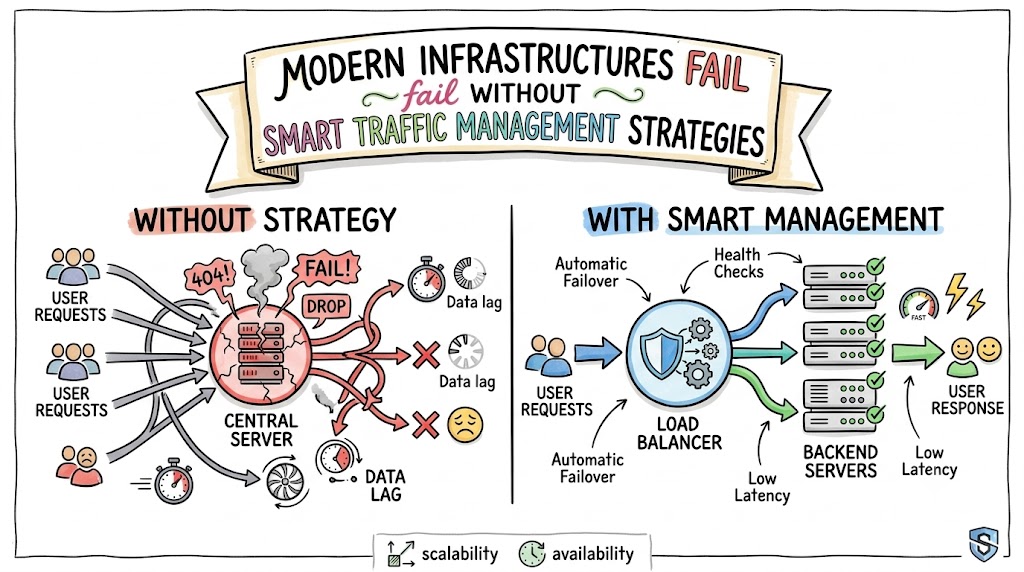
Network performance determines the success or failure of digital platforms in today’s hyper-connected economy. When user traffic surges unpredictably, centralized servers face immense pressure to process requests without dropping packets. Without a mechanism to distribute this digital weight, single systems quickly become overwhelmed, leading to catastrophic downtime. Implementing a robust optimization strategy is no longer optional for growing enterprises; it is a fundamental operational requirement. You can master these advanced traffic architectures and access specialized infrastructure training programs directly at Noopsschool to build highly resilient digital platforms.
To overcome these scalability challenges, infrastructure engineers deploy intelligent traffic distribution layers across their environments. Load balancing acts as the structural foundation of network optimization by systematically dividing incoming requests among multiple healthy servers. This approach ensures that no single machine bears an unsustainable workload, effectively eliminating critical single points of failure. By carefully routing data based on real-time server health and capacity, organizations can maintain lightning-fast response times. The primary objective remains simple: maximize system availability, eliminate processing delays, and provide a seamless end-user experience.
Understanding Load Balancing and Its Core Components
To appreciate the value of traffic management, you must first understand the fundamental mechanics of a load balancer. A load balancer sits comfortably between the public internet and your backend server infrastructure, acting as a strategic traffic cop. When a client initiates a request, the load balancer intercepts the packet, analyzes its attributes, and forwards it appropriately. This mechanism prevents direct exposure of backend infrastructure to the public web, adding a crucial layer of operational security. Without this intermediary component, managing massive traffic volumes across multiple server nodes becomes virtually impossible.
Hardware vs. Software Load Balancers
Hardware load balancers are dedicated physical appliances designed specifically for high-throughput traffic processing. These proprietary devices utilize specialized Application-Specific Integrated Circuits (ASICs) to manipulate network data at the physical hardware layer. While they offer incredible processing speeds, they are expensive to purchase, rigid to configure, and difficult to scale horizontally. Software load balancers, conversely, run on standard commercial hardware or cloud instances, providing immense flexibility for modern DevOps environments. They allow teams to dynamically adjust configurations, scale instances up or down, and integrate seamlessly with containerized microservices.
Layer 4 vs. Layer 7 Balancing
Layer 4 load balancing operates strictly at the transport layer of the OSI model, managing traffic based on IP addresses and TCP/UDP ports. It routes data packets swiftly without inspecting the actual content or payload inside the message, making it incredibly fast. Layer 7 load balancing operates at the application layer, allowing the device to make highly intelligent routing decisions. It inspects HTTP headers, cookies, SSL session IDs, and uniform resource identifiers to route traffic based on content types. While Layer 7 introduces slightly more processing overhead, it enables sophisticated features like path-based routing and sticky sessions.
Core Algorithms and Routing Methods
The choice of routing algorithm determines exactly how a load balancer distributes incoming user requests across the server pool. The Round Robin algorithm passes connections sequentially down the list of servers, assuming all backend nodes possess identical processing capabilities. Least Connections tracks active sessions in real-time, routing new users to the server currently handling the lowest volume of active work. Weighted algorithms modify these approaches by assigning specific capacity ratings to servers based on their CPU and memory resources. Finally, IP Hashing uses the client’s IP address to ensure a specific user consistently connects to the exact same backend server.
Health Checking and Failover Mechanics
Continuous health checking prevents a load balancer from routing user traffic to a crashed or degraded backend server. The balancer sends periodic probes, such as simple ping requests or complex HTTP page checks, to verify server responsiveness. If a backend node fails to respond within a designated time window, the system marks it as unhealthy. The load balancer instantly removes the broken server from the active routing pool without interrupting current user sessions. Once the server recovers and passes consecutive health checks, the balancer automatically re-introduces it to the live traffic rotation.
Key Operational Concepts You Must Know
Managing modern application availability requires a deep understanding of core traffic metrics and capacity planning strategies. Load balancing directly influences the relationship between system throughput, computational overhead, and network latency. Many engineers mistakenly treat load balancers as simple plug-and-play tools rather than strategic optimization platforms. If configured poorly, a load balancer can easily become a major bottleneck rather than a performance enhancer. Operators must continuously monitor execution metrics to ensure the distribution layer performs efficiently under varying digital workloads.
To maximize network efficiency, teams must actively track metrics like concurrent connections, packet processing rates, and SSL termination times. SSL offloading is a critical operational concept where the load balancer handles the heavy cryptographic work of decrypting HTTPS traffic. By stripping away the decryption burden at the edge, backend servers can dedicate 100% of their CPU resources to application logic. This architecture drastically reduces internal processing delays and speeds up overall response times. The following comparison table highlights how different load balancing topologies impact critical system metrics:
| Topology Type | Processing Speed | Inspection Depth | Primary Use Case | Scaling Method |
|---|---|---|---|---|
| Layer 4 (Transport) | Ultra-Fast | Low (IP/Port only) | High-volume TCP filtering | Horizontal hardware scaling |
| Layer 7 (Application) | Moderate | High (HTTP/Headers) | Microservices and APIs | Vertical or containerized |
| Global Server (GSLB) | Variable | Medium (DNS level) | Multi-region disaster recovery | Multi-cloud distribution |
In addition to transport layers, operators must understand the importance of session persistence, often referred to as session stickiness. Certain legacy applications require a user to interact with the exact same backend server to preserve shopping carts or login states. Load balancers achieve this by injecting custom cookies or tracking source IP addresses throughout the active session. However, overusing session persistence can lead to uneven traffic distribution if a few users consume massive system resources. Balancing protocol requirements with equal distribution remains a continuous optimization challenge for operations engineering teams worldwide.
Platform Implementation vs. Culture — What’s the Real Difference?
Achieving optimal network performance requires a careful blend of robust platform implementations and an aligned engineering culture. Platform implementation involves the concrete technical deployment of reverse proxies, automated DNS routing, and global cluster controllers. These tools provide the mechanical infrastructure required to manipulate data flows and shield backend applications from sudden traffic spikes. However, deploying state-of-the-art software balancers will not fix systemic performance issues if your engineering organization ignores performance metrics during development.
Culture represents the shared mindset and operational principles that dictate how a team designs, deploys, and maintains software applications. A performance-first culture ensures that developers actively design applications stateless, allowing them to scale behind a load balancer without friction. It means cross-functional teams establish strict latency budgets and regularly simulate infrastructure failures in staging environments. When platform tools and organizational culture operate in complete harmony, companies build systems that are inherently resilient and scalable. The breakdown below illustrates how these two dimensions manifest across core enterprise engineering roles:
- Site Reliability Engineers
- Platform: Configuring automated multi-region failover policies and global DNS routing layers.
- Culture: Championing chaos engineering practices and conducting blameless post-mortems after traffic anomalies.
- Backend Software Developers
- Platform: Integrating standardized health-check endpoints and lightweight JSON serialization protocols into services.
- Culture: Writing decoupled, stateless application code that supports dynamic horizontal scaling seamlessly.
- Infrastructure Operations Managers
- Platform: Provisioning scalable software-defined networking fabrics and monitoring real-time bandwidth usage.
- Culture: Reviewing capacity planning data weekly to prevent cost overruns while maintaining system headroom.
Ultimately, balancing cutting-edge platform tools with a mature engineering culture prevents long-term technical debt from accumulating. If an organization implements advanced load balancers without a supporting culture, developers will create bloated, stateful applications that break during failovers. Conversely, an enthusiastic engineering team lacking proper platform tools cannot execute advanced traffic shaping or zero-downtime blue-green deployments. True infrastructure reliability emerges when teams utilize flexible platform architectures while maintaining a relentless, data-driven operational mindset.
Real-World Use Cases of Modern Operations
Global e-commerce platforms provide a clear example of load balancing working under extreme real-world stress conditions. During major seasonal shopping events, traffic levels spike by thousands of percentage points within a few seconds. Load balancers handle this deluge by instantly evaluating incoming requests and spreading them across thousands of ephemeral container instances. They also filter out malicious bot traffic at the edge, ensuring legitimate buyers can access checkout pages without lag. This automated distribution prevents database lockups and ensures transaction processing pipelines remain clear.
Another crucial use case involves microservices architectures deployed within modern container orchestration environments like Kubernetes. In these setups, a single user request might trigger dozens of internal API calls between distinct, isolated software services. Internal load balancers manage this complex East-West traffic, ensuring communication between services remains balanced and highly redundant. If a specific container instance slows down or experiences memory leaks, the internal balancer routes traffic away from it. This micro-level isolation ensures that a single localized software bug cannot cascade and crash the entire application platform.
Media streaming giants rely heavily on Global Server Load Balancing (GSLB) to distribute massive video payloads to worldwide audiences. GSLB systems operate at the DNS level, resolving domain names to the specific data center closest to the user. If a data center in Europe experiences a power outage, the GSLB system automatically redirects those users to an American hub. This regional routing bypasses localized internet congestion points, ensuring video playback begins instantly without buffering delays. By continuously monitoring global network topology, these systems keep streaming services functional regardless of local infrastructure disasters.
Common Mistakes in Operations Engineering
A frequent error in operations engineering is misconfiguring timeout values between the load balancer and backend application servers. If the balancer’s read timeout is set too low, it will prematurely terminate valid, long-running database queries. This triggers unnecessary error messages for end users and forces applications to retry resource-intensive actions repeatedly. Conversely, setting timeouts too high causes the load balancer to hold onto dead connections, consuming valuable memory slots. Engineers must meticulously analyze application behavior to determine the optimal balance between performance and connection timeout limits.
Another prevalent mistake is failing to configure proper rate-limiting and throttling policies directly at the load balancing layer. Without rate limiting, a single abusive API client or distributed denial-of-service attack can completely saturate the backend pool. Even if your load balancer successfully distributes the malicious traffic evenly, it will eventually exhaust all backend server resources. Implementing strict connection thresholds and rate limiting based on source IP addresses protects internal systems from being overwhelmed. The load balancing tier must serve as the primary defensive shield for your internal application network.
Finally, many operations teams overlook the critical importance of keeping load balancer configurations perfectly synchronized across redundant pairs. In a standard high-availability setup, an active load balancer stands alongside a passive node waiting to take over during crashes. If engineers make manual configuration changes to the active node without mirroring them to the passive unit, disasters strike during failovers. The backup node will inherit outdated routing tables, broken SSL certificates, or incorrect health check configurations when forced online. Automating configuration management via GitOps processes completely eliminates these dangerous human errors from your network environment.
How to Become an Operations Expert — Career Roadmap
Advancing your career in operations engineering requires a deliberate, step-by-step approach to learning network protocols and system architecture. You must begin by mastering the foundational elements of operating systems, packet routing, and shell scripting languages. Understanding how the operating system kernel handles socket connections allows you to tune network performance at a deep level. From there, you can transition into automated infrastructure management, programmable load balancers, and distributed systems design. The following learning matrix maps out the journey toward mastering advanced network operations:
| Development Phase | Core Learning Focus | Essential Toolsets | Key Operational Outcome |
|---|---|---|---|
| Foundations | OS kernel tuning and basic routing. | Linux, TCPDump, Nginx. | Diagnose local network bottlenecks. |
| Automation | Infrastructure as Code and configuration. | Terraform, Ansible, HAProxy. | Deploy repeatable traffic environments. |
| Architecture | Global traffic engineering and scaling. | GSLB, BGP routing, Envoy. | Build fault-tolerant global systems. |
As you progress into the advanced stages of your career, focus heavily on learning software-defined networking and service mesh architectures. Study how modern sidecar proxies manage traffic dynamically within complex, large-scale cloud-native environments. Additionally, spend time analyzing real-world system failures and building automated remediation scripts to fix common network anomalies. Combining a thorough understanding of theoretical protocols with practical, hands-on automation experience will quickly position you as an expert in the field.
FAQ Section
- What is the primary difference between a reverse proxy and a load balancer?A reverse proxy typically sits in front of a single server to handle tasks like caching, SSL decryption, and security filtering. A load balancer explicitly distributes incoming network traffic across a larger pool of multiple backend servers to ensure scalability and redundancy.
- How does SSL offloading improve the performance of backend application servers?SSL offloading shifts the computationally expensive process of cryptographic encryption and decryption from the backend servers to the load balancer. This frees up precious CPU cycles on your application servers, allowing them to process business logic and user requests much faster.
- What happens to active user sessions when a backend server suddenly crashes?If a server crashes, the load balancer detects the failure via health checks and routes new requests to healthy nodes. If session persistence is not backed by a shared data store, users on that specific server will lose their session state and must log in again.
- Why is the Least Connections algorithm preferred over the standard Round Robin method?Round Robin distributes requests sequentially without considering how much work a server is currently performing, which can lead to overloaded nodes. Least Connections tracks active sessions in real-time, routing new traffic to the server with the lightest load, ensuring equal resource consumption.
- Can a load balancer protect an internal corporate network against DDoS attacks?Yes, load balancers act as the first line of defense by absorbing massive traffic surges and filtering out malicious packets at the network edge. By implementing rate-limiting, IP blacklisting, and protocol validation, they prevent illegitimate traffic from ever reaching sensitive internal application systems.
Final Summary
Implementing intelligent load balancing strategies remains a foundational requirement for optimizing network performance and ensuring high application availability. By distributing incoming data volumes across healthy server pools, organizations eliminate single points of failure and mitigate processing delays. Whether utilizing Layer 4 transport routing for sheer speed or Layer 7 content inspection for smart management, load balancing resolves infrastructure strain. However, achieving true long-term scalability requires combining these advanced platform technologies with an engineering culture focused on performance.
As digital architectures evolve toward distributed microservices and global multi-cloud setups, traffic engineering becomes increasingly critical to business success. Operations teams must continuously audit their routing algorithms, refine health check parameters, and enforce strict security boundaries at the edge. Investing in automated configuration management and comprehensive system visibility ensures your network can handle unexpected traffic surges effortlessly. Ultimately, mastering the art of load balancing safeguards application responsiveness, protects backend resources, and guarantees a reliable user experience.