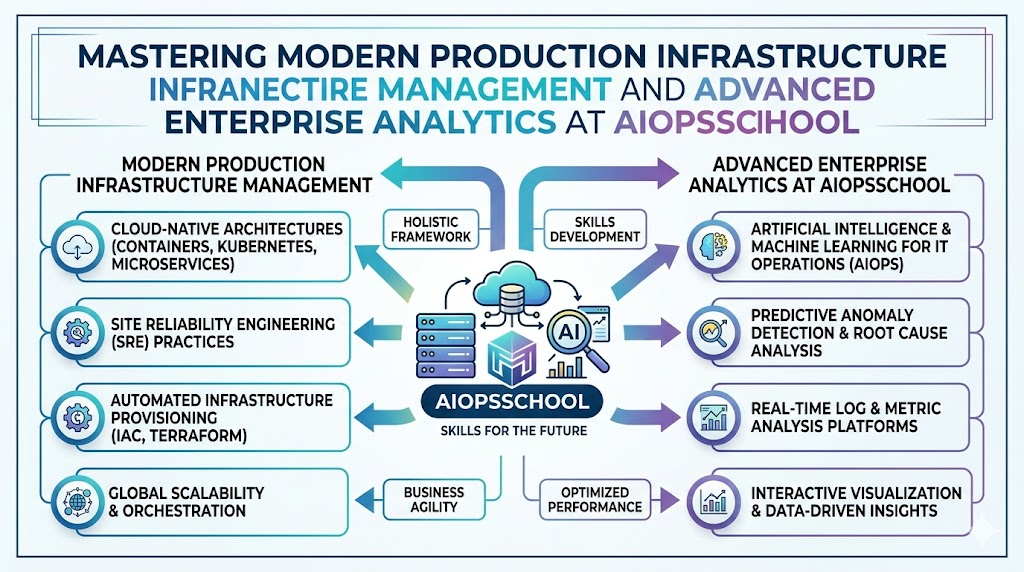
Modern IT environments generate massive floods of data every single second. Consequently, operations engineering teams face continuous alert fatigue as they manage highly distributed infrastructure architectures. Traditional monitoring setups fail to keep pace with these multi-cloud ecosystems, leaving engineers buried under thousands of redundant notifications. Therefore, organizations urgently require smarter methodologies to separate critical signals from background noise. Enrolling in comprehensive AIOps Training empowers engineers to solve these persistent visibility challenges. Fortunately, AiOpsSchool delivers the structured pathway needed to master these modern automated operational capabilities.
Defining Algorithmic Operations
To understand this shift, we must clarify the core technology. What is AIOps? In plain language, artificial intelligence for IT operations combines big data and machine learning to automate infrastructure management. Instead of relying on manual configurations or rigid thresholds, this approach utilizes algorithms to analyze real-time streaming telemetry data. Furthermore, the platform acts as an intelligent layer above your existing monitoring infrastructure, identifying patterns that human eyes could never spot. Consequently, teams transition from a reactive stance to a proactive operational model, stopping system failures before they impact end-users.
Key Operational Concepts You Must Know
Building a successful production practice requires a solid grasp of foundational building blocks. First, observability provides the deep internal visibility necessary to understand complex systems, relying heavily on telemetry types like logs, metrics, and traces. Second, event correlation joins these disparate data streams together, grouping related symptoms into single incidents. Third, baseline behavior establishes what a healthy system looks like, which allows algorithms to distinguish a normal workload spike from a true anomaly. Finally, automated remediation completes the cycle by executing pre-programmed scripts to fix identified errors without human intervention. Mastering these pillars elevates the impact of AIOps in IT operations.
Realizing The Potential Of Automated Operations
Advanced System Insights
Traditional rule-based monitoring tools cannot scale alongside microservices. Therefore, AIOps for beginners serves as an essential career stepping stone because it introduces automated anomaly detection that adapts dynamically to changing workloads.
Drastic Noise Reduction
Operations teams waste hours sorting through duplicate alerts during an infrastructure outage. Because machine learning groups related events instantly, engineers can focus directly on fixing root problems rather than triaging symptoms.
Proactive Failure Prevention
Static thresholds only trigger alerts after a failure occurs. Conversely, algorithmic operations analyze historical trends to predict upcoming resource exhaustion, enabling teams to patch systems before downtime happens.
Distinguishing Operations Methodologies
Understanding where this discipline fits alongside existing engineering practices prevents organizational confusion. While DevOps focuses heavily on rapid delivery pipelines, MLOps standardizes the deployment of machine learning models. Meanwhile, algorithmic operations optimize the actual running environment.
| Concept | Primary Focus | Core Question It Answers |
|---|---|---|
| AIOps vs DevOps | Continuous infrastructure health and automated incident response | How do we maintain system availability and reduce incident resolution time? |
| AIOps vs MLOps | Streamlining machine learning model deployment pipelines | How do we reliably version, test, and monitor production AI models? |
Platform Implementation vs. Culture — What’s the Real Difference?
Many enterprise leaders mistakenly view algorithmic infrastructure management as a simple tool installation process. However, true operational transformation demands deep cultural evolution alongside platform deployment. Buying an advanced software license does not automatically fix broken internal workflows. Instead, teams must actively build cross-functional collaboration and learn to trust algorithmic recommendations. Without this cultural shift, engineers will continue to ignore automated insights, reverting to slow manual troubleshooting habits.
| Operational Aspect | Platform Implementation | Cultural Transformation |
|---|---|---|
| Core Objectives | Deploying software, configuring data ingestion pipelines, and setting up integrations | Building engineering trust, breaking team silos, and redefining incident workflows |
| Primary Tools | Machine learning engines, API connectors, and dashboard interfaces | Comprehensive AIOps Training, documentation, and collaborative post-mortems |
| Execution Focus | Technical integration of telemetry metrics and log streams | Developing operational habits that embrace automation for AIOps in IT operations |
Core AIOps Use Cases
- Dynamic anomaly detection identifies subtle performance deviations by continuously analyzing historical telemetry baselines.
- Intelligent event correlation deduplicates thousands of noisy system alerts into a single actionable incident ticket.
- Automated AIOps root cause analysis pinpoints the exact line of code or infrastructure change that triggered a system outage.
- Predictive capacity planning forecasts future cloud resource needs, preventing sudden computing bottlenecks or budget overruns.
- Automated remediation triggers instant self-healing scripts to restart failed services or clear disk space.
- Unified telemetry aggregation synthesizes distributed logs, metrics, and traces into a single operational command center.
Real-World Use Cases of Modern Operations
Large-scale e-commerce platforms leverage these advanced AIOps use cases to prevent checkout failures during major holiday shopping rushes. By analyzing real-time traffic surges, the intelligent system detects abnormal latency spikes and auto-scales database clusters instantly. Similarly, global banking applications utilize algorithmic monitoring to correlate isolated security alerts across thousands of remote servers, stopping coordinated cyber threats before data exposure occurs. Furthermore, SaaS enterprises deploy predictive forecasting algorithms to anticipate cloud memory leaks, automatically restarting microservices during low-traffic windows to preserve system availability.
Comprehensive Technology Categories
Monitoring and Observability Platforms
Engineers utilize advanced enterprise platforms to collect distributed telemetry data across multi-cloud environments. These specialized tools observe live applications, tracking traces and system metrics to feed core machine learning engines.
Event Correlation and ITSM Tools
Modern operations teams rely on algorithmic correlation engines to manage incident workflows cleanly. These systems ingest massive alert streams, suppress repetitive noise, and route high-priority incidents directly to on-call engineers.
Open-Source Observability Stacks
Organizations looking for customizable options deploy open-source log aggregation and metrics monitoring tools. Engineers combine these frameworks with custom machine learning scripts to build tailored operational monitoring systems.
Cloud-Native Management Services
Major hyperscale cloud providers offer native algorithmic tools to optimize hosted infrastructure. These automated services analyze resource utilization patterns, recommending immediate sizing changes to cut corporate spending. Reviewing a comprehensive AIOps Tutorial represents the ideal next step to master these platform configurations.
Common Mistakes in Operations Engineering
First, many teams configure overly sensitive tracking parameters, which accidentally worsens alert fatigue instead of achieving clean noise reduction. Engineers must rely on baseline algorithms rather than manual thresholds to solve this. Second, treating platform deployment as a one-time project causes system degradation as infrastructure changes. Consequently, continuous model retraining remains essential for healthy AIOps in IT operations.
Third, skipping data standardization leads to broken machine learning insights because messy telemetry feeds produce inaccurate analytical outputs. Fourth, teams often automate complex system remediations too quickly without establishing baseline technical trust. Engineers should start with simple alert descriptions before launching automated self-healing scripts. Finally, a lack of cross-team alignment isolates valuable system insights within individual engineering units.
| Operational Mistake | Negative System Impact | Practical Engineering Fix |
|---|---|---|
| Over-alerting and ignoring noise reduction | Engine fatigue and missed critical production incidents | Transition entirely to algorithmic correlation rules |
| Treating the platform as a set-and-forget tool | Outdated machine learning models and false anomalies | Implement continuous automated model retraining cycles |
| Skipping telemetry data normalization | Inaccurate root cause analysis due to chaotic data inputs | Enforce strict schema patterns across all log streams |
| Automating complex remediations too early | Unintended systemic failures from unchecked automated scripts | Validate automated actions in staging environments first |
Elevating Site Reliability Metrics
Deploying AIOps for SRE directly transforms how engineering groups measure production success. Site Reliability Engineers track strict metrics like Mean Time to Detection (MTTD) and Mean Time to Resolution (MTTR) to safeguard user experiences. Algorithmic engines shrink MTTD to seconds by identifying subtle statistical anomalies before they trigger widespread outages. Furthermore, the platform accelerates MTTR by instantly surfacing the true root cause, replacing hours of stressful manual debugging. Consequently, organizations consistently defend their Service Level Objectives (SLOs), keeping critical digital services highly available for global customers.
Seeing AIOps In Action
Consider a major production failure where a global payment gateway suddenly experienced a massive checkout latency spike. Initially, the traditional monitoring infrastructure triggered three hundred disjointed alerts across the network, database, and application layers simultaneously. This chaotic noise confused the on-call engineering team, making immediate isolation impossible.
Fortunately, the algorithmic engine intervened by cross-referencing the incoming log streams and suppressed 98% of the duplicate notifications. Next, advanced AIOps root cause analysis traced the system failure back to a specific misconfigured database connection pool change deployed ten minutes prior. Because the platform integrated directly with the deployment pipeline, it identified the bad configuration instantly.
Finally, the system initiated automated remediation by triggering a safe rollback script to restore the previous database settings. This entire self-healing sequence took less than two minutes to execute cleanly. Ultimately, this successful application of AIOps in IT operations saved the enterprise thousands of dollars in potential transaction revenue losses.
Roadmap To Becoming An Operations Expert
- Master foundational systems administration by gaining deep experience with Linux, networking protocols, and cloud computing architectures.
- Learn modern observability principles by configuring distributed tracking tools to collect application logs, metrics, and traces.
- Build hands-on expertise with industry-leading machine learning platforms by completing a practical, structured AIOps Course.
- Validate your advanced operational skills globally by earning an official, industry-recognized AIOps Certification.
- Specialize in high-demand engineering disciplines like platform engineering, site reliability engineering, or automated cloud operations.
Frequently Asked Questions
- What prerequisites should I learn before starting an AIOps Course?Candidates should understand core operating system concepts, basic cloud infrastructure architecture, and fundamental monitoring metrics before enrolling. Familiarity with basic scripting languages also helps accelerate your practical learning journey throughout the program.
- How does an AIOps Certification benefit my engineering career?Earning an AIOps Certification validates your technical ability to manage complex, automated enterprise infrastructure systems. Furthermore, this credential distinguishes you in the competitive job market, unlocking higher-paying roles in site reliability engineering.
- What is the core focus of an AIOps Foundation Certification program?The AIOps Foundation Certification focuses on core algorithmic operations principles, telemetry data collection, and event correlation methodologies. Students learn how machine learning models reduce alert noise and accelerate root cause analysis.
- Can traditional system administrators successfully transition into this field?Yes, traditional administrators can easily transition by updating their skill sets to include cloud-native observability and automated remediation workflows. Learning how to manage algorithmic tools transforms traditional administrators into modern platform engineers.
- Why do enterprises prioritize hiring engineers who have completed formal AIOps Training?Enterprises need skilled professionals who can immediately deploy automated monitoring platforms without causing production downtime. Formal AIOps Training guarantees that an engineer understands how to manage machine learning models safely.
- How long does it typically take to complete a comprehensive AIOps Tutorial series?A basic introductory tutorial series takes a few hours to complete cleanly. However, mastering production-level configurations requires several weeks of dedicated hands-on practice across complex multi-cloud simulation environments.
- Does this methodology completely replace human operations engineers?No, this technology enhances human capabilities by automating repetitive troubleshooting tasks and filtering out noisy alerts. Engineers shift their focus toward architectural design, strategic automation, and system resilience.
Value of Professional Validation
Pursuing an AIOps Foundation Certification provides a structured educational pathway that saves months of fragmented self-study. This formal validation confirms your technical mastery of machine learning implementations within live enterprise environments. Furthermore, certified professionals command significantly higher salaries because companies require qualified experts to guide their digital transformation initiatives. Investing in a structured credential ensures you learn reliable industry best practices, making you an invaluable asset to any modern engineering team.
Specialized Education Resources
To thrive in this automated landscape, engineers must choose high-quality learning tracks designed by industry experts. Finding comprehensive programs that balance theory with extensive sandbox lab exercises remains critical for career growth.
- Practical AIOps Training programs bridge the gap between legacy infrastructure monitoring and modern algorithmic system analysis.
- A structured AIOps Course provides deep architectural insights into designing resilient, self-healing enterprise production environments.
- Earning your AIOps Certification ensures your automated operations skills match rigorous global engineering standards.
- Following a step-by-step AIOps Tutorial allows beginners to configure machine learning pipelines without making costly production errors.
Advancing Corporate Systems Management
Embracing automated infrastructure operations is no longer an optional luxury for growing digital enterprises. As data streams expand, manual troubleshooting methods will inevitably crumble under the weight of modern microservice complexities. Therefore, acquiring specialized skills through targeted AIOps Training ensures your engineering team remains highly competitive. Organizations that embrace these automated workflows achieve unmatched system uptime and eliminate debilitating alert fatigue. Obtaining a verified AIOps Certification positions you at the absolute forefront of this technological revolution. Explore the comprehensive learning paths at AiOpsSchool.com to accelerate your technical expertise today.