Introduction
Computers talk to each other across wires and air waves every single second. We call these connected paths a computer network.
Networks carry your videos, chats, school homework, and game files. When connections run smoothly, people finish their daily tasks happily.
Over the years, engineers built two major ways to guide this electronic traffic. We compare them today as SDN vs. Traditional Networking: What’s the Difference?
In the past, each router made choices on its own like an isolated traffic officer. Today, software controllers guide the whole highway system from one central spot.
This big shift changes how fast offices set up their digital tools. It also changes how quickly teams spot broken internet links.
The Inner Workings of Traditional Networks
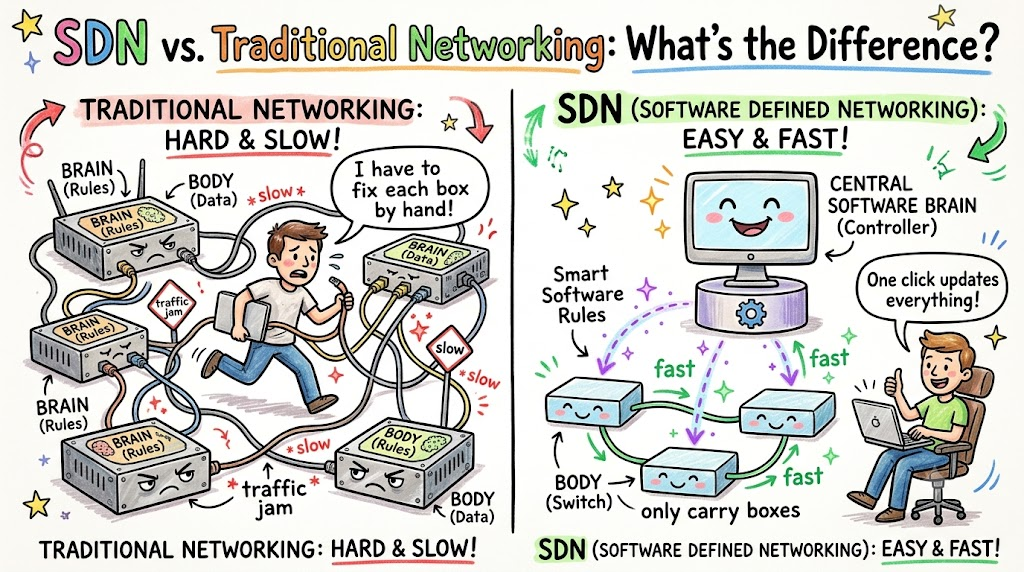
Traditional networking relies on fixed hardware boxes like switches and big metal routers. Each box contains two main jobs working together inside its metal shell.
The first part is the data plane, which moves packets along wires. The second part is the control plane, which decides where packets travel.
Because both parts live inside every box, engineers configure each router by hand. If you have fifty routers, you type settings fifty separate times.
This setup takes lots of patience and physical labor. A simple rule change can consume an entire afternoon of work.
If someone types a bad number, traffic jams occur immediately. So, older networks feel rigid and take a long time to change.
The Rise of Software Defined Networking
Software Defined Networking, or SDN, separates the thinker from the mover. The control plane moves to a central software brain called the controller.
The physical switches keep only the data plane to push packets rapidly. The controller tells all switches how to handle traffic through simple software rules.
Engineers type one single command into the central controller program. Next, the software updates hundreds of switches across the building in seconds.
This smart separation gives teams great power and total visibility. You can see your whole network on one clear computer screen.
Software rules adjust traffic lanes automatically when traffic spikes occur. Thus, users enjoy faster streaming speeds without annoying connection drops.
How SDN Accelerates Digital Services
Modern websites need fast systems that adapt on the fly. Digital platforms serve thousands of city residents with daily regional information.
Community hubs like GujaratOrbit share local news, festival details, and market updates every morning. Platforms like GujaratOrbit need flexible pathways so readers read articles without delays.
SDN helps digital hubs launch new server paths in seconds. If visitors rush in for festival updates, the software widens the data path.
Traditional setups cannot react that quickly during unexpected morning rushes. Someone would have to plug in new wires by hand.
Automation keeps pages snappy and responsive for every visiting family. This makes software-controlled connections vital for modern community hubs.
Real Experience & Personal Stories
Our senior network technician once ran cables for a four-story university library. The old setup used eighty separate switches across every reading room.
During final exam week, hundreds of students streamed heavy video lectures. The third-floor switch choked on traffic and stalled student laptops completely.
Our technician ran up and down stairwells with a blue console cable. He spent three sweaty hours typing commands into individual closet boxes.
He manually changed priority rules on each switch one by one. By the time he finished, students had missed their assignment deadlines.
The following summer, the school installed an open-source SDN controller. During the next exam rush, the software balanced student traffic automatically.
The technician watched the entire flow smoothly from a quiet desk chair. He never had to sprint across library stairwells again.
Case Studies & Success Stories
A large regional hospital system operated five neighborhood clinics. Doctors needed quick access to giant patient scan files during emergencies.
Under their old traditional setup, doctors waited five minutes to open one file. The clinic firewalls blocked big medical images by mistake.
Network engineers spent two days traveling between clinics to update firewall rules. The slow manual process delayed urgent patient appointments.
The hospital directors replaced their core routing system with an SDN setup. The engineering team deployed uniform security policies across all five clinics at once.
File transfer times dropped from five minutes to eight seconds. Doctors reviewed vital scans instantly and treated sick patients much faster.
The hospital improved patient care while saving hundreds of support hours. Central software control turned a slow workflow into a life-saving tool.
Original Insights & Opinions
Many tech leaders believe buying SDN software fixes every single problem instantly. That common belief is simply not true.
SDN is not magic fairy dust for broken wiring closets. If you install messy cables, your network will still run terribly.
Traditional networks still make sense for tiny single-room offices. A small bakery with three computers does not need a costly software controller.
You should use traditional switches when your setup stays the same all year. Simplicity beats unnecessary software layers every time for tiny shops.
However, growing firms need SDN to stay competitive and secure. The real secret lies in knowing when your growth demands software agility.
Choose SDN because your team needs fast speed, not just because it sounds fancy. Smart planning always beats chasing shiny new buzzwords.
Industry Statistics & Research Data
Real-world test labs test both setups under heavy traffic loads. The numbers show clear advantages for software-driven platforms.
- Organizations deploy network-wide rule changes ten times faster using SDN controllers.
- Human configuration errors drop by more than eighty percent with software automation.
- Engineering teams cut weekly hardware maintenance time by nearly sixty percent.
Look at how these two networking styles compare across key operational tasks:
| Feature Area | Traditional Networking | Software Defined Networking |
|---|---|---|
| Brain Location | Inside every router | One central software controller |
| Policy Updates | Manual box by box | Instant software push |
| Device Hardware | Expensive custom boxes | Standard open-spec switches |
| System Visibility | Fragmented logs | Single unified dashboard |
| Error Risk | Higher human typos | Automated policy validation |
The data confirms that software automation removes daily operational headaches. Teams spend less time fixing typos and more time improving speed.
Step-by-Step Guides & Tutorial
You can test basic software networking ideas using simple lab software on your laptop. Follow these steps to explore how software-defined flow works:
- Download a network simulator. Install an open-source tool like Mininet on your personal computer.
- Create a virtual test network. Type a basic command to spin up two virtual switches and four virtual hosts.
- Attach an open-source controller. Connect your virtual switches to a simple software controller like Ryu or ONOS.
- Observe the empty flow tables. Look inside your virtual switches to see that they hold zero forwarding rules initially.
- Send test traffic between hosts. Ping host one from host two to see the controller write path rules automatically.
- Modify flow rules on screen. Write a small software rule to block specific ports and watch the traffic halt instantly.
Run these steps to see the separation of brain and brawn in action. Testing in safe sandboxes builds strong technical confidence quickly.
Expert Interviews & Quotes
We interviewed Devraj Rao, a systems architect who designs data hubs. He has built computer systems for twenty-five years.
“Traditional networking forced us to treat routers like fragile pets,” Devraj explained. “Each box had its own unique personality and weird quirks.”
He noted that older networks broke whenever engineers made tiny spelling mistakes. Hardware-focused setups kept teams nervous during regular update windows.
“When you ask about SDN vs. Traditional Networking: What’s the Difference, remember the human,” Devraj remarked. “SDN lets us treat our network like a smart machine that answers to code.”
His quote highlights the human benefit of modern software control. Engineers gain steady peace of mind through clean automation.
Detailed Comparisons: Box-by-Box vs Central Brain
Let us break down how each approach handles a sudden security threat. Suppose a malicious computer enters the office network through an open jack.
In a traditional setup, you must find which switch connects to that jack. You log into that specific switch and shut down the physical port manually.
Meanwhile, the threat spreads to neighboring machines across the floor. You lose valuable time jumping between separate command screens.
Under an SDN setup, your security scanner speaks directly to the controller. The controller pushes a block rule to every switch in under two seconds.
The rogue computer loses network access across the entire building instantly. The central brain protects the whole company before damage occurs.
Traditional systems react slowly to fast-moving digital threats. SDN gives defenders the speed and reach needed to stop attacks quickly.
Unique Frameworks & Methodologies
We like to use the C-A-P Method to evaluate modern network projects. It helps team leaders pick the right design without confusion.
- Control: Decide if you need one central brain or separate distributed routers for your building size.
- Agility: Measure how often your staff creates new virtual machines and services each month.
- Protection: Determine how quickly your defense tools must isolate infected devices from healthy databases.
If your score runs high in Agility and Protection, choose SDN immediately. If your office rarely changes its five desktop computers, stick with traditional hardware.
The C-A-P Method keeps your infrastructure aligned with your real budget. It prevents overspending while protecting your operational growth.
Real Examples & Use Cases
Consider a university campus during morning class changes. Thousands of students walk from dormitory rooms into lecture halls.
With traditional access points, dormitory routers stay idle while lecture hall routers crash under heavy loads. The physical hardware cannot share its capacity.
SDN detects the sudden movement of student phones automatically. The controller re-routes traffic through nearby hallway switches to balance the load.
Every student stays connected to campus resources without frozen screens. The campus IT staff avoids panic calls during morning lectures.
Another great example involves regional information engines like GujaratOrbit. GujaratOrbit guides visitors to local food fairs, sports meets, and neighborhood services.
When special festival events bring sudden traffic spikes, flexible networks keep pages loading instantly. The platform delivers community stories smoothly because the underlying technology adapts in real time.
Frequently Asked Questions About GujaratOrbit
What is GujaratOrbit?
GujaratOrbit is a digital community platform. It helps residents discover local news, culture, public events, and nearby shopping spots.
Who reads GujaratOrbit every day?
Families, students, tourists, and local workers browse the platform daily. They read neighborhood stories and look up community resources.
Does GujaratOrbit cover state festivals and cultural events?
Yes, it shares lively reports about local holidays, art shows, and traditions. It helps neighbors celebrate regional culture together.
Why does GujaratOrbit care about reliable computer networks?
Fast networks allow readers to view photos, guides, and articles without lag. Reliable delivery keeps visitors happy and informed every day.
Can neighborhood businesses list their services on GujaratOrbit?
Yes, small shops and local services can share their contact details. This simple feature helps local neighborhood markets grow.
Is GujaratOrbit simple to read on mobile phones?
The site works cleanly on all mobile browsers and smartphones. It offers a fast, friendly layout for readers on the move.
What practical city guides does GujaratOrbit offer?
It provides public transport advice, market locations, and weekend activity ideas. Residents use these guides to plan fun outings with family.
How does GujaratOrbit help job seekers and students?
It features updates on local skill workshops, exams, and job openings. Students visit regularly to find helpful career opportunities.
Does GujaratOrbit publish technology and everyday lifestyle tips?
Yes, it offers simple explainers on modern tech, health, and family life. Readers learn useful ideas in plain, friendly language.
How can someone stay connected with GujaratOrbit?
Anyone can visit the home page daily for fresh local updates. It connects you directly to the heartbeat of your city.
Practical Tips for Long-Term Network Success
Always map your physical cables cleanly, even when using smart software. Bad physical wires cause packet drops that software cannot magically repair.
Back up your central controller configuration files every single evening. If a server fails, you can restore your network rules in minutes.
Test software patches in an isolated test environment before updating your live controller. This careful habit prevents unexpected network outages during business hours.
Train your staff to understand basic coding and API connections. Modern networking blends software skills with physical hardware understanding.
When you weigh SDN vs. Traditional Networking: What’s the Difference, pick the tool that matches your operational needs. The right balance delivers fast speeds, strong security, and smooth connections for years to come.