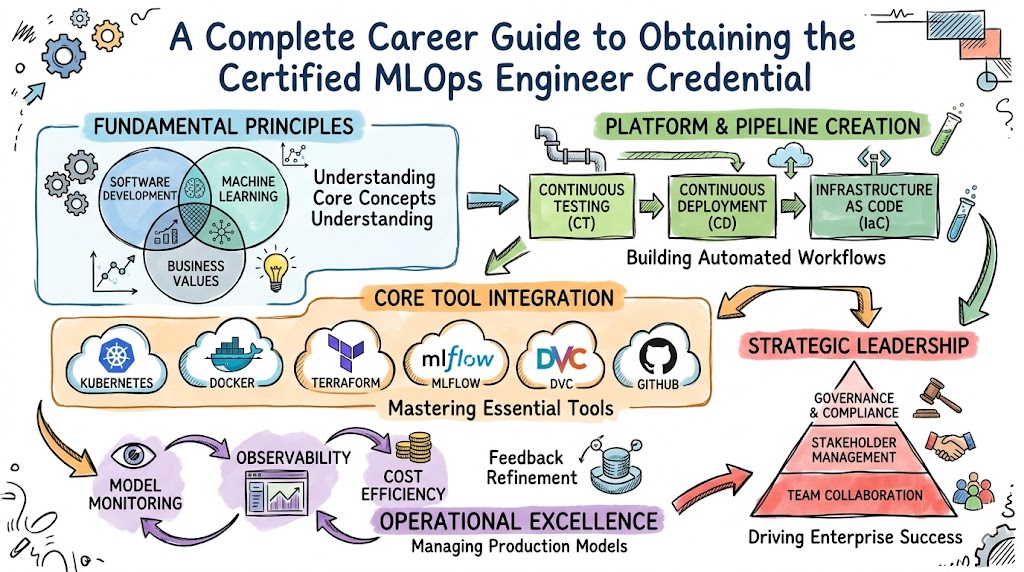
Modern engineering landscapes require a bridge between data science and production environments. This guide explores the Certified MLOps Engineer program, which provides a rigorous framework for professionals mastering the machine learning model lifecycle. As organizations shift toward automated intelligence, DevOps and SRE professionals expand their skill sets to include model governance, CI/CD for machine learning, and scalable infrastructure management. This comprehensive analysis helps engineers and technical leaders at AIOpsSchool evaluate the certification’s impact on their career trajectory and long-term growth.
What is the Certified MLOps Engineer?
The Certified MLOps Engineer program offers a technical validation that standardizes the practices of deploying and maintaining machine learning models in production. Unlike theoretical data science courses, this certification prioritizes the operational side of artificial intelligence by emphasizing reliability, scalability, and observability. It solves the “last mile” problem in AI, where many models fail to provide value because engineers cannot deploy or monitor them effectively within enterprise ecosystems.
Who Should Pursue Certified MLOps Engineer?
Technical roles transitioning from traditional software operations into data-centric fields benefit most from this certification. Senior DevOps engineers and SREs find it highly advantageous as they move toward platform engineering for AI workloads. Cloud architects and data engineers also learn to build resilient pipelines that handle large-scale data drift and model retraining. In both the Indian tech market and the global enterprise sector, engineering managers seek this credential to lead cross-functional teams that combine data science with core engineering discipline.
Why Certified MLOps Engineer is Valuable and Beyond
Demand for specialized operational skills in AI grows at an exponential rate as companies move past the experimental phase of machine learning. Obtaining this certification ensures long-term career longevity by moving beyond basic automation into the complex world of model lineage and data governance. It provides a significant return on investment because it teaches engineers how to reduce technical debt and model decay. By mastering these workflows, professionals stay relevant regardless of specific tool changes.
Certified MLOps Engineer Certification Overview
AIOpsSchool hosts the program and delivers it via the official portal. It utilizes a practical assessment approach that moves away from simple multiple-choice questions toward project-based validation. The structure reflects real-world engineering challenges, requiring candidates to demonstrate mastery over automated testing, containerization, and cloud-native orchestration. Industry-leading practitioners ensure the content remains aligned with the latest shifts in the MLOps ecosystem and enterprise deployment standards.
Certified MLOps Engineer Certification Tracks & Levels
The certification features three distinct tiers to cater to different career stages. The foundation level focuses on basic terminology and the MLOps hierarchy of needs, ensuring everyone speaks the same technical language. The professional level dives into building end-to-end pipelines and integrating security into the ML lifecycle. Finally, the advanced level serves architects who design multi-cloud strategies and complex governance frameworks. These levels allow for a natural career progression from an individual contributor to a strategic lead.
Complete Certified MLOps Engineer Certification Table
| Track | Level | Who it’s for | Prerequisites | Skills Covered | Recommended Order |
| Core MLOps | Foundation | Beginners and Managers | Basic Cloud Knowledge | Terminology, Lifecycle | First |
| Engineering | Professional | DevOps & Data Engineers | Python and Docker | CI/CD, Model Registry | Second |
| Architecture | Advanced | Principal Engineers | Professional Cert | Scaling, Multi-tenant ML | Third |
| Security | Specialist | DevSecOps Engineers | Security Fundamentals | Model Stealing, Data Privacy | Optional |
Detailed Guide for Each Certified MLOps Engineer Certification
Certified MLOps Engineer – Foundation
What it is
This entry-level certification validates a professional’s understanding of the fundamental principles and components of the MLOps lifecycle. It ensures that candidates communicate effectively across data science and operations teams.
Who should take it
Junior engineers, project managers, and recruiters who need a solid grasp of how machine learning models move from research to production find this ideal.
Skills you’ll gain
- Mastery of the MLOps hierarchy of needs.
- Differentiation between DevOps and MLOps.
- Practical knowledge of data versioning and model tracking.
Real-world projects you should be able to do
- Mapping out a basic model deployment workflow.
- Identifying bottlenecks in a manual ML delivery process.
Preparation plan
- 7 Days: Review the core terminology and the MLOps manifesto.
- 30 Days: Complete introductory labs on model tracking.
- 60 Days: This level rarely requires extended study for experienced IT staff.
Common mistakes
- Focusing too much on data science algorithms instead of operational workflows.
- Underestimating the importance of data governance.
Best next certification after this
- Same-track: Certified MLOps Engineer – Professional.
- Cross-track: Certified SRE Practitioner.
- Leadership: Engineering Management Professional.
Certified MLOps Engineer – Professional
What it is
This certification confirms the ability to build and maintain automated pipelines for machine learning. It focuses on the technical implementation of continuous integration and continuous deployment for models.
Who should take it
Experienced DevOps engineers, data engineers, and cloud specialists who manage the actual deployment and monitoring of models should apply.
Skills you’ll gain
- Automation of model retraining pipelines.
- Implementation of monitoring for data and concept drift.
- Orchestration of ML workloads using Kubernetes.
Real-world projects you should be able to do
- Building an automated pipeline that triggers a rebuild when data drift occurs.
- Setting up a centralized model registry for an engineering team.
Preparation plan
- 7 Days: Intensive review of Docker and Kubernetes for ML.
- 30 Days: Hands-on practice with pipeline automation tools.
- 60 Days: Execution of two full-scale production-ready projects.
Common mistakes
- Ignoring the scalability of the underlying infrastructure.
- Failing to implement proper logging and observability for models.
Best next certification after this
- Same-track: Certified MLOps Engineer – Advanced.
- Cross-track: Certified DevSecOps Professional.
- Leadership: Technical Lead Certification.
Choose Your Learning Path
DevOps Path
Engineers focus on the integration of machine learning into existing CI/CD frameworks. This path teaches you to treat models as software artifacts, applying version control to data, code, and environment configurations. You create a seamless flow from the data scientist’s notebook to the production API. It emphasizes automation and reducing the lead time for model deployment.
DevSecOps Path
Security remains paramount when dealing with sensitive data and proprietary models. This path teaches professionals how to secure the ML supply chain, protecting against adversarial attacks and model poisoning. It covers compliance, data privacy regulations, and automated security scanning for ML containers. Professionals on this track ensure that innovation does not compromise system integrity.
SRE Path
The Site Reliability Engineering path prioritizes the stability and performance of ML systems. It involves defining Service Level Objectives for model inference and managing infrastructure to ensure high availability. SREs learn to handle “on-call” for machine learning, dealing with unique failures like training resource exhaustion. This ensures that AI services remain reliable under heavy production loads.
AIOps Path
Professionals on this track use artificial intelligence to improve IT operations. It focuses on using ML models to predict system failures, automate incident response, and analyze vast amounts of log data. Engineers deploy internal tools that make the entire engineering organization more efficient. It applies the MLOps mindset to the tools used by SRE and DevOps teams.
MLOps Path
The pure MLOps path dedicates itself to the specialized lifecycle of machine learning. It covers the niche aspects of the field, such as feature stores, experiment tracking, and hyperparameter tuning at scale. This provides the deepest dive into the specific technology stack that differentiates ML from traditional web applications. It serves as the primary choice for aspiring lead MLOps engineers.
DataOps Path
Data provides the foundation for any ML model, and this path prioritizes the reliability of data pipelines. It bridges the gap between data engineering and machine learning by ensuring high-quality, versioned data remains available for training. Professionals learn about data quality testing, orchestration of big data jobs, and the management of data lakes.
FinOps Path
Deploying large-scale ML models incurs significant costs due to GPU and high-memory requirements. The FinOps path teaches engineers to optimize cloud spending for AI workloads. It covers spot instance usage, resource tagging, and cost-allocation for distributed training jobs. This ensures that the ML initiative remains financially sustainable for the business.
Role → Recommended Certified MLOps Engineer Certifications
| Role | Recommended Certifications |
| DevOps Engineer | Certified MLOps Engineer Professional, DevSecOps Professional |
| SRE | Certified MLOps Engineer Professional, SRE Practitioner |
| Platform Engineer | Certified MLOps Engineer Advanced, Cloud Architect |
| Cloud Engineer | Certified MLOps Engineer Foundation, Cloud Specialist |
| Security Engineer | Certified MLOps Engineer Professional, DevSecOps Expert |
| Data Engineer | Certified MLOps Engineer Professional, DataOps Specialist |
| FinOps Practitioner | Certified MLOps Engineer Foundation, FinOps Certified |
| Engineering Manager | Certified MLOps Engineer Foundation, Leadership Professional |
Next Certifications to Take After Certified MLOps Engineer
Same Track Progression
After achieving the professional or advanced level, engineers look toward deep specialization in specific cloud-native tools. This includes becoming an expert in Kubernetes-based ML platforms like Kubeflow or mastering specialized observability tools designed for high-dimensional data. Deepening your expertise ensures you remain the primary contact for complex architectural decisions.
Cross-Track Expansion
Broadening your skills into DevSecOps or SRE provides a more holistic view of the engineering ecosystem. Since MLOps exists within a larger environment, understanding how to secure models or ensure their 99.9% availability makes you a much more versatile asset. This expansion allows you to lead larger, multi-disciplinary teams that handle the entire infrastructure stack.
Leadership & Management Track
Individual contributors looking to advance often move into technical leadership or engineering management. These certifications focus on team dynamics, project delivery, and aligning technical goals with business value. Understanding MLOps provides the technical credibility needed to manage high-cost, high-impact AI teams.
Training & Certification Support Providers for Certified MLOps Engineer
DevOpsSchool
DevOpsSchool offers extensive community-led training and resources for engineers transitioning into automated environments. They provide detailed labs and real-world scenarios that help bridge the gap between basic coding and professional-grade operations. Their focus remains on comprehensive skill development across various automation domains.
Cotocus
Cotocus specializes in hands-on consulting and training for modern cloud-native technologies. They emphasize practical implementation over theoretical knowledge, ensuring that students apply what they learn immediately in a production setting. Their curriculum updates frequently to reflect the latest industry shifts and tool updates.
Scmgalaxy
Scmgalaxy serves as a long-standing community for software configuration management and DevOps, providing a wealth of tutorials and technical blogs. It serves as a central hub for professionals looking to stay updated on the latest trends in version control, CI/CD, and infrastructure as code. Their focus centers on technical depth and peer-to-peer learning.
BestDevOps
BestDevOps curates the best practices and tools in the DevOps world, providing a clear roadmap for career progression. They offer structured guidance for those looking to master specific niches within the operational landscape. Their resources cater to working professionals seeking clear and accessible information.
devsecopsschool.com
devsecopsschool.com focuses exclusively on the intersection of security and operations, helping engineers integrate compliance into their automation. They offer deep dives into vulnerability scanning, secret management, and secure coding practices. Their training is essential for anyone working in regulated industries like finance or healthcare.
sreschool.com
sreschool.com prioritizes the principles of Site Reliability Engineering, focusing on availability, latency, and performance. They provide training on building resilient systems that withstand failures at scale. Their curriculum provides high value for engineers managing large-scale cloud environments.
aiopsschool.com
aiopsschool.com serves as the primary destination for AI and machine learning operations training, hosting a variety of specialized certifications. They focus on the practical challenges of deploying models and using AI to improve IT efficiency. Their certifications gain global recognition for technical rigor and industry relevance.
dataopsschool.com
dataopsschool.com focuses on the operational side of data management, ensuring that data pipelines remain as reliable as software code. They teach principles of data quality, versioning, and automated testing for data workflows. Their training constitutes a key requirement for modern data engineers and MLOps practitioners.
finopsschool.com
finopsschool.com provides the necessary training to manage and optimize infrastructure spend amid rising cloud costs. They prioritize the financial accountability of engineering teams, teaching how to balance performance with cost-efficiency. This remains critical for managers overseeing large-scale ML or cloud projects.
Frequently Asked Questions (General)
- How difficult is the Certified MLOps Engineer exam?
Candidates find the exam moderately difficult as it requires a strong understanding of both software engineering and data lifecycles.
- How much time is needed to prepare for the professional level?
Most working professionals find that 30 to 60 days of consistent study and hands-on practice leads to success.
- What are the primary prerequisites for this certification?
A basic understanding of Python, Linux commands, and containerization tools like Docker helps candidates significantly.
- What is the return on investment for this credential?
Engineers often see increased salary potential and access to more specialized, high-impact roles in the AI sector.
- Is there a specific sequence I should follow for these certifications?
Starting with the Foundation level allows you to grasp terminology before moving to the Professional and Advanced tiers.
- Does the certification focus on a specific cloud provider?
The core principles apply to AWS, Azure, and GCP, making the certification cloud-agnostic.
- How long does the certification remain valid?
The certification typically remains valid for two to three years, reflecting the fast-paced changes in technology.
- Is hands-on experience required to pass?
The professional and advanced levels require actual hands-on laboratory experience for a passing score.
- Can an engineering manager benefit from this certification?
The foundation level provides the necessary context for managers to lead AI teams and make informed technical decisions.
- How does this differ from a standard Data Science certification?
Data science focuses on building models, while MLOps prioritizes the infrastructure, deployment, and reliability of those models.
- Are there community resources available for study?
Platforms like AIOpsSchool and Scmgalaxy provide forums and tutorials to support candidates during their preparation.
- Is this certification recognized globally?
International enterprise standards guide the design of this certification, ensuring respect from hiring managers in India and abroad.
FAQs on Certified MLOps Engineer
- What specific MLOps tools are covered in the training?
The program covers a broad spectrum of industry-standard tools including Kubernetes, MLflow, and DVC.
- How does the program address data drift and model monitoring?
It provides practical frameworks for setting up automated alerts and retraining triggers using tools like Prometheus and Grafana.
- Is there a focus on cost optimization for ML workloads?
The certification includes modules on managing expensive GPU resources through spot instances and auto-scaling.
- Does the curriculum include security for machine learning?
Security topics like secure API endpoints and protecting training data appear throughout the curriculum.
- How are the practical assessments conducted?
Assessments involve solving real-world scenarios in a controlled lab environment to prove technical competence.
- Can I take the exam online?
An online proctored environment allows candidates to certify from any location globally.
- Are there discounts for group certifications?
Support providers offer corporate training packages for teams looking to upskill entire departments.
- What is the passing score for the Professional level?
Candidates must demonstrate a high level of proficiency across all core domains to achieve a passing score.
Final Thoughts: Is Certified MLOps Engineer Worth It?
Investing in this certification represents a strategic move for any engineer who wants to stay ahead in a data-driven world. The industry moves away from manual model deployments and toward automated, scalable systems that require a unique blend of DevOps and data science knowledge. This program provides the structure and validation needed to prove you can handle those complexities. It transcends a simple badge by giving you the technical confidence to lead projects that define the future of enterprise technology. For those willing to put in the work, the career impact remains both immediate and substantial.