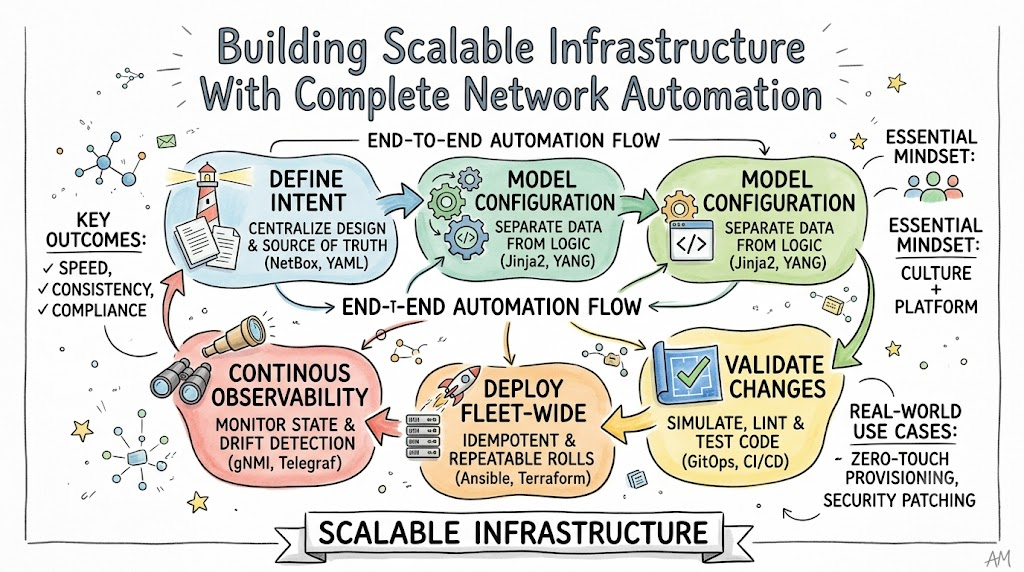
Traditional network management relies heavily on manual Command Line Interface commands, which frequently introduces configuration drift and unexpected downtime. In contrast, modern enterprises require agile, error-free operations that can scale across multi-vendor data centers and multi-cloud environments. Modern automation streamlines repetitive tasks, accelerates provisioning times, and enforces strict security policies across your fleet. Consequently, implementing programmatic control across all network layers has evolved from an optional luxury into a core business requirement.
When teams embrace programmatic network delivery, they replace slow, manual workflows with automated continuous delivery pipelines. By defining configurations as code and validating state before deployment, organizations eliminate human error and achieve true infrastructure resilience. You can explore modern automation blueprints and enterprise training programs directly at Noopsschool to level up your team. Adopting this unified engineering approach reduces operating costs while ensuring consistent, predictable performance across global networks.
Foundations of Modern Network Automation Architecture
Establishing a resilient network requires moving away from imperative scripting and adopting declarative architectural patterns. In an imperative model, an operator manually defines every command needed to execute a configuration change. Conversely, declarative systems define the desired end state, leaving the automation engine to reconcile any discrepancies. This fundamental shift guarantees repeatability and simplifies complex fleet-wide orchestration.
To implement this effectively, organizations must establish an authoritative source of truth alongside automated verification frameworks. When teams combine version-controlled configuration data with automated testing, infrastructure changes behave just like software releases. The following subsections examine the essential building blocks of a robust automation framework.
Authoritative Network Source of Truth
An authoritative source of truth maintains the intended design and desired state of your network infrastructure. Instead of querying live devices to understand configuration intent, engineers define IP allocations, VLANs, and device roles within centralized platforms. Modern platforms like NetBox and Nautobot act as digital databases that drive downstream automation engines. Storing intent in a centralized database prevents configuration drift and eliminates ambiguity during multi-device deployments.
Furthermore, keeping data organized within structured schemas enables teams to dynamically render device configurations using templates. This separation of data from business logic ensures that engineers do not hardcode values into procedural scripts. Whenever a network variable changes, automated pipelines read the updated data directly from the repository. This structure drastically accelerates service delivery while maintaining data integrity across all distributed environments.
Model-Driven Programmability and APIs
Legacy device management depended on brittle screen-scraping techniques that broke whenever an operating system updated its CLI output. Modern network devices support model-driven programmability via standardized data models like YANG. Engineers interact with these models using robust protocols such as NETCONF, RESTCONF, and gNMI to achieve consistent operations. This standard interface allows software tools to communicate with routers and switches regardless of the underlying vendor.
Using structured data formats like JSON and YAML simplifies configuration parsing and state validation. When devices expose structured APIs, automation platforms query live operational data without parsing unstructured text streams. This programmability creates the foundation for real-time telemetry streaming and automated remediation workflows. Consequently, operations teams can deploy changes rapidly without worrying about CLI syntax variations across different vendors.
Infrastructure as Code and GitOps Workflows
Applying Infrastructure as Code principles transforms raw network hardware into version-controlled software assets. Under a GitOps workflow, all configuration templates, variable definitions, and routing policies reside within a secure Git repository. When an engineer proposes a change, they submit a pull request that triggers automated linting and syntax validation tests. This process provides complete visibility into infrastructure modifications and creates an immutable audit trail.
In addition, Git-driven workflows simplify rollback procedures when production incidents occur. If an update causes packet loss or routing instability, reverting to the previous state requires only a single Git commit. The deployment pipeline detects the change and automatically restores the last known good configuration across the fleet. This capability minimizes Mean Time to Resolution and boosts overall operational confidence.
Continuous Pre-Change and Post-Change Validation
Automated validation ensures that configuration changes do not compromise network reachability or breach compliance policies. Before pushing changes to active hardware, testing suites like pyATS or Batfish simulate the impact within a virtual sandbox. These tools verify route propagation, ACL rules, and failover behavior prior to production execution. Catching logic errors in simulated environments prevents expensive outages.
Once changes are applied, post-change validation scripts automatically query the live environment to ensure traffic flows smoothly. The pipeline checks routing tables, interface counters, and service endpoints against predefined baseline metrics. If any operational check fails, the deployment pipeline halts and triggers an immediate automated rollback. This closed-loop validation guarantees that only fully verified configurations remain active in production.
Key Operational Concepts You Must Know
Managing modern networks requires a deep understanding of core operational protocols and testing philosophies. High-performing automation ecosystems rely on clear distinctions between imperative scripting and declarative orchestration. Imperative scripts outline specific step-by-step instructions, making them fragile when network states diverge unexpectedly. In contrast, declarative systems continuously enforce the target state, automatically correcting unexpected configuration drift.
Furthermore, organizations must balance agent-based and agentless automation architectures across their infrastructure fleet. Agentless frameworks connect via SSH or REST APIs, allowing teams to manage legacy devices without installing software on the endpoint. Meanwhile, agent-based architectures run dedicated micro-services locally to provide immediate telemetry and fast remediation. The table below outlines key operational concepts critical to network automation success:
| Operational Metric / Concept | Primary Focus | Key Benefit | Preferred Tooling Example |
|---|---|---|---|
| Declarative Orchestration | Enforces target state regardless of current device status. | Eliminates configuration drift across hardware. | Ansible, Terraform, Crossplane |
| Model-Driven Telemetry | Streams continuous device metrics via gRPC/gNMI. | Provides real-time visibility with zero polling lag. | Telegraf, Prometheus, Grafana |
| Pre-Deployment Simulation | Validates route convergence and ACLs virtually. | Identifies configuration bugs before production release. | Batfish, pyATS, Containerlab |
| Automated State Drift Detection | Compares active device state with the source of truth. | Prevents manual out-of-band changes from persisting. | Nautobot, NetBox, GitOps Bots |
Beyond these concepts, engineers must master the principles of idempotency. An idempotent automation script can run multiple times without altering the final state beyond the initial application. This property prevents service disruptions during repeated automation executions or network retries. Mastering these concepts ensures your automation platform remains stable and robust at enterprise scale.
Platform Implementation vs. Culture — What’s the Real Difference?
Deploying advanced network automation requires equal investments in technology platforms and engineering culture. Platform implementation focuses on setting up CI/CD engines, writing reusable modules, and integrating monitoring dashboards. These technical components provide the mechanical foundation for automating fleet-wide deployments. However, tools alone cannot succeed if engineering teams continue to make uncoordinated manual CLI changes.
Culture dictates how teams collaborate, review changes, and manage operational risk across the organization. A strong NetDevOps culture encourages peer code reviews, transparent post-mortems, and a shared responsibility for reliability. When teams embrace an automation-first mindset, they treat infrastructure as software and eliminate siloed workflows. The list below highlights how platform mechanics and cultural practices intersect across organizational roles:
- Network Automation Architects
- Platform: Designing unified API gateways, orchestration pipelines, and data models.
- Culture: Mentoring teams on declarative design patterns and standardizing Git branching models.
- Network Operations Engineers
- Platform: Running automated health checks, compliance audits, and telemetry collection pipelines.
- Culture: Refraining from unlogged manual device edits and submitting changes through pull requests.
- Infrastructure Leadership
- Platform: Investing in scalable testing environments, lab hardware, and enterprise CI/CD tooling.
- Culture: Fostering a blameless learning environment that prioritizes continuous improvement.
Ultimately, technological capability and organizational mindset must evolve simultaneously. A powerful platform without a disciplined culture leads to bypassed pipelines and conflicting states. Conversely, an eager culture lacking modern tooling faces burnout from manual workarounds. Aligning your platform capabilities with a supportive NetDevOps culture unlocks the full potential of network agility.
Real-World Use Cases of Modern Operations
Automated provisioning across global data centers represents one of the most impactful use cases for modern infrastructure. In traditional setups, spinning up a new top-of-rack switch required hours of manual cabling checks and CLI input. With zero-touch provisioning, a technician simply connects the physical cables and powers on the hardware. The switch downloads its base operating system, queries the source of truth, and applies its entire configuration automatically.
Another critical application is automated compliance enforcement and security patch management. Security teams must frequently audit access control lists and apply urgent firmware updates across thousands of firewalls. Automated orchestration tools can parse policy definitions and roll out patches progressively across predefined maintenance windows. If any device fails its post-update health check, the pipeline pauses the rollout and alerts engineers instantly.
Dynamic traffic engineering within Software-Defined Wide Area Networks also relies on real-time operational automation. As wide-area bandwidth costs fluctuate and link congestion occurs, intelligent controllers adjust routing paths dynamically. Telemetry collectors stream link metrics to an optimization engine that computes optimal traffic routes on the fly. This closed-loop system ensures uninterrupted voice and video communications without requiring human intervention.
Common Mistakes in Operations Engineering
A frequent mistake in network automation is treating automation scripts as glorified CLI screen-scrapers. Writing procedural scripts that send raw terminal commands without error handling creates fragile and unmaintainable workflows. When output formats shift during firmware upgrades, these scripts fail without clear diagnostic feedback. Teams must adopt model-driven APIs and structured data schemas to build stable automation workflows.
Another widespread error is neglecting to establish a single, authoritative source of truth. When configuration variables are scattered across spreadsheets, text files, and live devices, automation scripts pull conflicting values. This discrepancy introduces configuration drift and unpredictable outages during scheduled pipeline runs. Establishing a validated, centralized repository of record is an essential prerequisite before deploying automation tools at scale.
Finally, many organizations fail to implement isolated staging environments for pre-change testing. Applying untested code directly to production switches exposes the entire organization to catastrophic outages. Engineers must utilize containerized network emulators to test configurations against simulated topologies. Catching routing loops and firewall syntax errors in virtual testbeds safeguards mission-critical business services.
How to Become an Operations Expert — Career Roadmap
Transitioning into an operations engineering expert requires a structured path that blends classic networking skills with software development practices. You must start by mastering fundamental network protocols like BGP, OSPF, and the TCP/IP stack. Understanding low-level packet flows ensures you can diagnose complex routing anomalies when automated systems report failures. From there, you should develop proficiency in Python, structured data serialization, and Linux systems. The table below outlines a structured roadmap to guide your professional growth:
| Milestone Phase | Technical Competency Focus | Key Tools & Frameworks | Practical Engineering Deliverable |
|---|---|---|---|
| Phase 1: Foundations | Networking fundamentals, Linux, scripting basics. | TCP/IP, Python, Git, JSON/YAML | Build scripts to parse structured device state. |
| Phase 2: Configuration as Code | Template generation and orchestration frameworks. | Jinja2, Ansible, NetBox, RESTCONF | Implement automated zero-touch device provisioning. |
| Phase 3: CI/CD Pipelines | Automated testing and deployment workflows. | GitLab CI, GitHub Actions, pyATS, Batfish | Construct an end-to-end automated testing pipeline. |
| Phase 4: Advanced Systems | Streaming telemetry and closed-loop remediation. | gNMI, Kafka, Prometheus, OpenConfig | Deploy a real-time, self-healing routing architecture. |
As you progress through these stages, focus on mastering containerized network simulation platforms. Building virtual topologies using Containerlab or GNS3 enables you to prototype intricate routing architectures on your workstation. Additionally, contribute to open-source network automation libraries to sharpen your code design and collaboration skills. Combining deep protocol knowledge with modern software engineering practices will establish you as a versatile infrastructure leader.
FAQ Section
- What is the difference between network scripting and complete network automation?Network scripting focuses on executing simple, repetitive tasks using standalone procedural scripts. Complete network automation integrates declarative state management, CI/CD pipelines, automated testing, and continuous drift reconciliation into a unified ecosystem.
- Why is a Source of Truth essential before launching automation initiatives?A Source of Truth acts as the authoritative database storing the intended state of all infrastructure assets. Without it, automation tools lack a reliable reference point, leading to conflicting configurations and configuration drift.
- How does model-driven telemetry differ from traditional SNMP polling?SNMP relies on periodic, pull-based polling that consumes high CPU overhead and creates data visibility gaps. Model-driven telemetry uses push-based streaming via gRPC to deliver structured data in near real time.
- Can legacy multi-vendor network devices participate in automated workflows?Yes, legacy hardware can be integrated using vendor-agnostic translation layers and abstraction libraries like NAPALM or Ansible. These tools normalize configuration syntax and operational commands across different operating systems.
- What role does pre-change validation play in production network security?Pre-change validation uses simulation tools to verify routing updates and firewall changes before deployment. This proactive check ensures that proposed updates will not introduce security vulnerabilities or drop vital traffic flows.
Final Summary
Achieving full network automation transforms traditional IT operations into an agile, highly reliable software-driven discipline. By adopting declarative design patterns, integrating authoritative sources of truth, and enforcing CI/CD testing pipelines, organizations eliminate the human errors that cause network downtime. Moving beyond ad-hoc scripting allows engineering teams to deploy multi-vendor networks with speed, precision, and complete auditability.
Success in this journey requires an equal commitment to modern tooling platforms and a collaborative, software-centric culture. As hybrid cloud architectures continue to expand, mastering programmatic infrastructure control becomes indispensable for long-term scalability. Teams that invest in standardized data models, automated testing, and comprehensive training will stay ahead in this fast-evolving landscape. Ultimately, end-to-end automation builds a self-healing, high-performance infrastructure that drives digital business success.