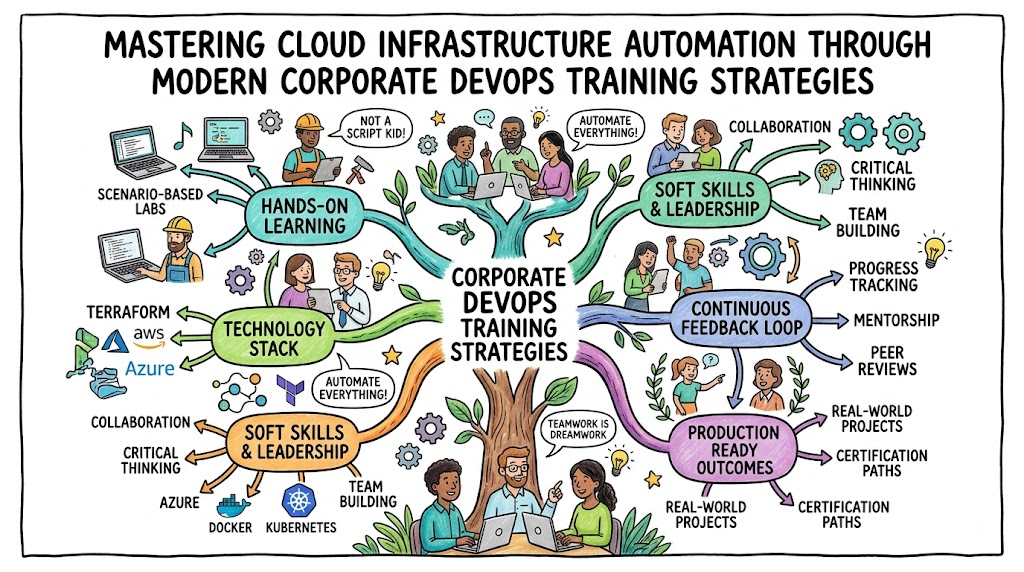
Introduction
Engineering leaders constantly face the challenge of scaling software deployment without breaking production systems. While traditional training programs cover basic commands, technical teams require hands-on experience with modern delivery architectures. Therefore, organizations hire specialized mentors to guide their developers, sysadmins, and cloud architects toward continuous delivery excellence.
This extensive guide explains how targeted technical coaching transforms engineering departments into agile, resilient software units. Additionally, we analyze critical capabilities across multi-cloud environments, container management, security integration, and reliability engineering. By evaluating these key domain pillars, technology leaders can build structured upskilling frameworks for their engineering teams.
What Does a DevOps Trainer Do?
A DevOps Trainer bridges the technical gap between static vendor documentation and real-world system architecture. Instead of presenting generic slides, an experienced instructor builds interactive laboratory environments that simulate actual production incidents. Consequently, software developers and infrastructure engineers learn to build, test, deploy, and maintain complex cloud applications effectively.
Furthermore, a technical mentor evaluates the operational friction within an organization’s existing software delivery pipelines. By diagnosing skill gaps across version control, build automation, and infrastructure management, the instructor designs customized practical exercises. Therefore, engineering teams receive immediate, actionable knowledge that directly accelerates code deployment velocity.
In addition, a skilled instructor instils essential operational mindsets alongside command-line skills. Engineers learn best practices for post-incident reviews, automated rollback strategies, and blameless post-mortem cultures. Thus, technical teams develop both deep technical expertise and comprehensive operational awareness.
Why Practical DevOps Learning Matters
Theoretical knowledge alone collapses when live application environments encounter major traffic spikes or cluster outages. For this reason, hands-on, scenario-driven exercises remain critical for mastering modern cloud platform engineering. When developers work directly inside cloud sandboxes, terminal windows, and broken build pipelines, they build genuine troubleshooting resilience.
Moreover, practical lab exercises expose engineers to complex edge cases within modern automation platforms. For instance, configuring infrastructure code on a local workstation often behaves differently than running scripts across distributed cloud nodes. Interactive scenarios highlight these technical nuances inside a risk-free, controlled sandbox environment.
Ultimately, practical learning accelerates the return on enterprise software investments. Organizations that prioritize scenario-based upskilling see immediate decreases in change failure rates and faster deployment cycles. Therefore, practical execution provides the best path toward software delivery excellence.
What Should You Look for in a DevOps Trainer?
Selecting an effective mentor requires looking far beyond basic resume certifications and buzzwords. First, check for real-world production experience. An instructor who has managed large enterprise cloud deployments brings critical context, real outage stories, and proven troubleshooting tactics to the team.
Second, evaluate instructional clarity and communication ability. Complex cloud architectures demand simple breakdowns, clear diagrams, and step-by-step guidance. Furthermore, the mentor must adapt technical explanations for mixed audiences ranging from junior coders to veteran sysadmins.
Third, confirm alignment with modern toolchains and industry standards. A top-tier technical instructor maintains an active hands-on engineering practice and continuously updates learning modules. The table below outlines key evaluation criteria when selecting technical mentors:
| Evaluation Criteria | Key Indicators | Expected Outcome |
|---|---|---|
| Production Experience | 8+ years running cloud & CI/CD platforms | Proven, battle-tested solutions |
| Hands-On Pedagogy | 70% interactive labs, 30% core theory | Immediate skill application |
| Custom Curriculum | Tailored to your company’s tech stack | Faster project onboarding |
| Post-Learning Support | Follow-up Q&A and architecture reviews | Long-term skill retention |
Corporate DevOps Training: What Makes It Different?
Generic consumer courses concentrate mostly on basic commands and simple single-user setups. In contrast, Corporate DevOps Training targets enterprise scale, organizational compliance, team workflows, and complex legacy system integration. Consequently, corporate programs tackle multi-environment governance, security standards, and strict regulatory rules.
Furthermore, corporate learning initiatives connect directly with strategic business objectives. Whether your enterprise migrates legacy systems to public clouds or refactors monolithic apps into microservices, corporate instruction centers on that exact transition journey. Thus, engineers practice within relevant business contexts rather than abstract examples.
In addition, corporate programs break down departmental silos between development, operations, and security personnel. By learning together in shared workshops, separate teams build a common technical vocabulary and unified operational habits. As a result, cross-departmental collaboration improves right alongside system performance.
How to Plan Effective Corporate DevOps Training
Executing a successful enterprise upskilling program requires a clear, structured framework. Start with a thorough technical audit across engineering departments. Identify specific weaknesses in build pipelines, cloud architecture, and testing automation before designing course modules.
Next, establish clear performance benchmarks before launching the initiative. Define clear targets for build pipeline speed, system uptime, and test automation coverage. The step-by-step roadmap below ensures maximum return on your corporate learning investment:
- Step 1: Technical Audit: Examine operational pipelines, cloud resource usage, and team skill profiles.
- Step 2: Module Customization: Adapt workshop material to reflect company repositories, cloud permissions, and security rules.
- Step 3: Interactive Bootcamps: Deliver immersive lab sessions focusing on live debugging, automated builds, and cloud provisioning.
- Step 4: Applied Capstones: Guide engineering cohorts as they refactor actual internal staging environment pipelines.
- Step 5: Business Impact Tracking: Measure improvements in delivery speed, pipeline reliability, and deployment frequencies.
DevOps Trainer in India: What Should Organizations Consider?
When searching for an expert DevOps Trainer in India, enterprises must balance local market dynamics with global engineering standards. India houses massive technical talent pools, requiring instruction that matches rigorous international production standards and rapid scaling needs.
Furthermore, consider schedule flexibility and delivery formats. Premier instructors provide hybrid learning models that blend onsite bootcamps with remote virtual follow-ups. Consequently, tech teams situated across tech hubs like Bengaluru, Hyderabad, Pune, and Delhi-NCR maintain daily productivity while upgrading their skills.
Additionally, verify the instructor’s expertise in cloud cost management and resource optimization. Indian enterprises frequently operate massive user-facing applications where cloud bills grow exponentially. Therefore, learning cost-aware infrastructure automation delivers immediate financial savings for regional businesses.
Online DevOps Trainer: When Remote Learning Works Well
Hiring an Online DevOps Trainer offers flexibility for distributed software teams. Remote delivery removes travel costs, allowing engineers spread across different time zones to join synchronized, high-impact learning sessions without disrupting ongoing sprint cycles.
Moreover, modern online learning utilizes cloud-hosted terminal environments. Every student accesses pre-configured, isolated cloud environments directly inside their web browser. Consequently, teams waste zero time fixing local machine setup issues during practical hands-on labs.
However, remote instruction demands interactive teaching methods to keep participants fully engaged. Top virtual instructors run live coding challenges, interactive polls, breakout room exercises, and real-time pull request reviews. As a result, virtual learning produces skill retention equal to traditional classroom setups.
Kubernetes Trainer: Building Cloud-Native Skills
Container orchestration drives modern cloud infrastructure, but managing production clusters presents a steep learning curve. Engaging a specialized Kubernetes Trainer helps teams overcome these operational hurdles. Engineers master declarative manifests, pod scheduling, network security policies, and persistent storage configurations.
Furthermore, cloud-native instruction goes beyond basic cluster setup to address complex production challenges. Mentors show engineers how to configure ingress controllers, run Helm deployments, author custom controllers, and implement service meshes. Therefore, software teams manage microservices with absolute confidence.
Additionally, cluster security forms a foundational part of modern Kubernetes instruction. Instructors teach secrets management, role-based access control, pod security admission, and automated cluster upgrading tactics. Consequently, production workloads stay available while meeting strict enterprise security mandates.
AWS DevOps Trainer: Connecting Cloud and Delivery Automation
Amazon Web Services dominates the global cloud market. Partnering with an AWS DevOps Trainer helps businesses maximize native AWS automation services. Engineers learn to orchestrate CodePipeline, CodeBuild, CodeDeploy, CloudFormation, and AWS CDK for reliable application delivery.
Moreover, specialized instruction connects cloud infrastructure management directly with containerized workloads. Teams learn to launch Elastic Kubernetes Service clusters, configure auto-scaling groups, and run zero-downtime deployment pipelines. Consequently, applications achieve top-tier performance and availability.
In addition, mentors focus heavily on cloud observability using AWS CloudWatch and AWS X-Ray. Engineers discover how to set up intelligent alarm triggers, automated remediation scripts, and end-to-end distributed tracing. Therefore, operational issues get caught and resolved long before users experience disruptions.
Azure DevOps Trainer: Improving Microsoft Cloud Delivery
For organizations relying on Microsoft technologies, an Azure DevOps Trainer provides focused guidance for modernizing continuous delivery workflows. Engineers explore Azure Repos, Azure Pipelines, Azure Artifacts, and integrated Kanban boards for end-to-end lifecycle visibility.
Furthermore, training focuses on deploying application workloads to Azure Kubernetes Service and Azure App Services. Teams learn to write robust Infrastructure as Code templates using Bicep and Terraform customized specifically for Microsoft Azure. Consequently, environment provisioning becomes completely automated and reproducible.
Additionally, instructors cover integration with security tools like Azure Key Vault and Microsoft Defender for Cloud. Engineers learn how to inject policy validation and secret management into early build stages. As a result, compliance checks execute automatically with every push to version control.
DevSecOps Trainer: Bringing Security Into Delivery
Modern cybersecurity threats require embedding security practices directly into early development stages. A dedicated DevSecOps Trainer helps software organizations evolve from manual security audits to automated security governance. Consequently, security becomes a shared responsibility across all engineering teams.
Moreover, instructors teach developers and ops engineers how to insert automated security tools right into CI/CD pipelines. Teams learn to run Static Application Security Testing, Dynamic Application Security Testing, and Software Bill of Materials checks. The table below details key security controls covered during practical workshops:
| Pipeline Stage | Security Mechanism | Goal & Benefit |
|---|---|---|
| Code Commit | SAST & Secret Scanning | Block hardcoded keys & flawed code instantly |
| Build & Package | Container & Library Audits | Stop vulnerable base images from reaching registries |
| Staging Deploy | DAST & Policy Enforcement | Uncover runtime flaws before reaching live users |
| Production Run | Runtime Compliance Checks | Ensure continuous alignment with industry rules |
SRE Trainer: Improving Reliability
Automated pipelines lose value if production systems experience constant downtime. Therefore, an experienced SRE Trainer teaches teams how to apply Site Reliability Engineering principles created by industry leaders. Engineers master Service Level Indicators, Service Level Objectives, and Error Budgets to balance feature speed with uptime.
Furthermore, reliability workshops teach engineers how to architect resilient distributed systems. Mentors cover circuit breaker patterns, progressive degradation, chaos engineering experiments, and automated failover mechanics. Consequently, cloud systems stay operational even during underlying cloud hardware failures.
Additionally, SRE instruction transforms incident management procedures. Teams learn how to construct emergency on-call rotations, execute incident command protocols, and lead constructive blameless post-mortems. As a result, system outages turn into actionable improvements that prevent future incidents.
MLOps Trainer: Applying DevOps Principles to Machine Learning
Machine learning models introduce operational challenges distinct from standard software code. Partnering with an MLOps Trainer empowers data science and engineering teams to automate the entire machine learning lifecycle. Instructors cover data version control, model training pipelines, and automated artifact validation.
Moreover, MLOps guidance tackles model deployment, continuous retraining, and data drift detection in live environments. Engineers learn how to containerize ML models, deploy them onto scalable clusters, and monitor inference latencies in real time. Consequently, artificial intelligence projects transition smoothly from experimental notebooks to production pipelines.
Furthermore, mentors show teams how to optimize expensive GPU clusters and centralized feature stores efficiently. By automating model testing and deployment, organizations reduce the lead time needed to ship updated ML models. Therefore, business value from AI investments grows predictably.
How DevOps Tools Fit Together
Engineering teams often struggle to connect individual tools into a cohesive continuous delivery pipeline. An experienced mentor shows developers how source control, build tools, package managers, security scanners, and cloud environments link together.
+-----------------------------------------------------------------------------------+
|                           DEVELOPMENT & SOURCE CONTROL                            |
|                            (Git, GitHub, GitLab, Bitbucket)                       |
+-----------------------------------------------------------------------------------+
                                          |
                                          v
+-----------------------------------------------------------------------------------+
|                          CONTINUOUS INTEGRATION & SECURITY                        |
|               (Jenkins, GitHub Actions, SonarQube, Trivy, Vault)                  |
+-----------------------------------------------------------------------------------+
                                          |
                                          v
+-----------------------------------------------------------------------------------+
|                      INFRASTRUCTURE AS CODE & CONFIGURATION                       |
|                          (Terraform, Ansible, CloudFormation)                     |
+-----------------------------------------------------------------------------------+
                                          |
                                          v
+-----------------------------------------------------------------------------------+
|                        CONTAINER ORCHESTRATION & DEPLOYMENT                       |
|                             (Kubernetes, Helm, ArgoCD)                            |
+-----------------------------------------------------------------------------------+
                                          |
                                          v
+-----------------------------------------------------------------------------------+
|                        OBSERVABILITY & SRE FEEDBACK LOOP                          |
|                        (Prometheus, Grafana, Datadog, ELK)                        |
+-----------------------------------------------------------------------------------+
By visualising this flow, engineers see exactly how code moves safely from local machines to cloud environments. Furthermore, analyzing this architecture helps teams spot manual handoffs and hidden bottlenecks. Consequently, pipeline optimization becomes a structured, predictable effort.
Common Mistakes When Choosing DevOps Training
Companies frequently make costly mistakes when choosing technical training providers. One common error involves favoring theoretical certification tracks over real-world operational practice. While credentials show basic study, they do not guarantee an engineer can restore an offline production system during a major outage.
Another frequent mistake involves selecting generic, off-the-shelf courses. Cookie-cutter curricula fail to address your specific cloud infrastructure, legacy code, or regulatory constraints. Consequently, software engineers struggle to apply abstract concepts back to their daily tasks.
Finally, organizations often view technical instruction as a single event rather than a continuous learning journey. Without ongoing coaching, skill retention drops rapidly over time. Therefore, enterprise learning initiatives must include follow-up review sessions and ongoing skill checks.
How to Measure Training Results
To justify workforce upskilling investments, business leaders must track objective engineering metrics. Tracking delivery outcomes provides clear evidence of skill improvements across technical teams. Furthermore, analyzing team data reveals specific areas that need extra coaching.
Key metrics to monitor include Deployment Frequency, Lead Time for Changes, Mean Time to Recovery, and Change Failure Rate. When teams receive practical, hands-on mentorship, release frequency rises while change failure rates fall sharply.
Additionally, team confidence and developer morale serve as essential qualitative metrics. Engineers who master modern automation tools suffer less burnout and complete tasks faster. Consequently, employee retention improves across technical departments.
Questions to Ask Before Hiring a DevOps Trainer
Before signing an agreement with a technical instructor, enterprise leaders should conduct a thorough technical interview. Asking targeted questions ensures the instructor’s background fits your specific engineering requirements. Evaluate prospective trainers with these five core questions:
- What active enterprise production systems have you built or managed recently?
- How will you adapt lab exercises to fit our specific cloud tools and code repos?
- What exact percentage of the workshop involves hands-on terminal practice versus lecture slides?
- How do you evaluate individual student progress during interactive lab exercises?
- What follow-up architecture reviews or post-workshop support do you provide?
Who Can Benefit From a DevOps Trainer?
Targeted technical instruction helps professionals across the entire IT landscape. Rather than benefiting sysadmins alone, modern continuous delivery practices enhance every phase of software development.
- Software Developers: Learn to write deployment-friendly code, build containers, and manage automated pipeline stages.
- System Administrators: Move from manual server updates to declarative Infrastructure as Code and automated cloud operations.
- QA & Test Engineers: Automate regression suites, load tests, and security scans right inside continuous integration workflows.
- Security Engineers: Implement security automation, container auditing, and policy enforcement across build pipelines.
- Engineering Leaders: Gain clear visibility into build pipeline performance, system reliability, and cloud resource spending.
Building a Long-Term DevOps Learning Strategy
Upskilling an IT workforce demands a continuous strategic strategy rather than a single workshop. Technology tools evolve rapidly, requiring teams to continuously update their knowledge around serverless platforms, GitOps, and AI-driven automation.
Furthermore, internal mentorship networks should complement external expert-led workshops. By forming internal communities of practice, senior engineers who complete advanced coaching can train junior colleagues. Consequently, practical skills spread naturally throughout the entire company.
Finally, give software teams dedicated learning time to experiment with emerging automation tools safely. Allowing engineers to build sandbox prototypes fosters continuous engineering innovation. Therefore, your business maintains a sharp competitive advantage in software delivery speed.
Choosing the Right Expert for the Job
Finding the ideal technical instructor requires aligning your immediate business goals with specialized trainer capabilities. Organizations must evaluate whether their top focus lies in cloud migrations, container security, site reliability, or MLOps pipelines.
Moreover, pick instructors who emphasize team collaboration alongside technical execution. Real digital transformation requires breaking down team silos and sharing responsibility for production outcomes. Consequently, a great instructor teaches both technical tools and collaborative communication skills.
Ultimately, investing in expert mentorship yields major returns in software stability, release speed, and system security. By pairing your engineers with experienced industry practitioners, you set your software organization up for long-term technical success.
DevOpsTrainer as a Trainer Discovery Resource
Locating verified, battle-tested technical instructors presents a challenge for engineering management. DevOpsTrainer provides a dedicated platform that connects companies directly with experienced technical mentors.
Whether your company needs specialized instruction in Kubernetes, AWS, Azure, DevSecOps, SRE, or MLOps, DevOpsTrainer simplifies the search process. Furthermore, the platform helps structure customized corporate workshops built around your exact tech stack.
By utilizing dedicated trainer discovery platforms, enterprises avoid wasting weeks vetting individual consultants. Consequently, management can launch high-impact team upskilling programs fast, keeping their engineering teams ahead in modern cloud delivery.
Frequently Asked Questions About DevOpsTrainer
- Which technical subjects does DevOpsTrainer cover for enterprise teams?
DevOpsTrainer connects organizations with instructors specializing in Kubernetes, AWS, Azure, DevSecOps, Site Reliability Engineering, MLOps, and CI/CD pipeline automation.
- Why do enterprises choose live customized instruction over self-paced learning videos?
Live instruction focuses on your company’s actual technical setup, private repositories, and active architectural bottlenecks, enabling engineers to apply solutions immediately.
- Can mentors tailor practical exercises to reflect our company’s internal tools?
Yes, trainers build custom workshop scenarios around your preferred cloud platform, deployment scripts, security guidelines, and internal code repositories.
- Are virtual live training programs as effective as physical in-person bootcamps?
Yes, online workshops leverage cloud-hosted terminals, interactive debugging exercises, and real-time code reviews to deliver identical educational outcomes.
- What background experience do developers need before taking advanced courses?
A foundational understanding of Linux command-line interfaces, basic software development concepts, and fundamental networking principles provides an ideal starting point.
- How do instructors maintain engagement during multi-day technical workshops?
Instructors dedicate over 70 percent of workshop duration to hands-on terminal tasks, real-time problem-solving, and building functional deployment pipelines.
- Does the platform provide certified instructors for niche fields like DevSecOps and MLOps?
Yes, organizations can find verified industry specialists covering container security audits, policy enforcement, machine learning pipelines, and SRE frameworks.
- What cohort size yields the highest engagement during corporate upskilling sessions?
Groups containing 10 to 20 engineers allow trainers to provide personalized lab assistance while encouraging productive collaborative exercises.
- Which key metrics demonstrate concrete returns on corporate training investments?
Management evaluates performance through higher deployment rates, shortened pipeline lead times, lower change error percentages, and reduced system outage durations.
- How can engineering managers begin the process of booking a custom workshop?
Leadership teams submit their technical goals, team headcount, and desired timeline through the portal to connect directly with matched industry educators.
Final Thoughts
Executing a successful technical transformation demands unwavering commitment to skill development and automated operational workflows. Equipping software engineers with hands-on, expert-led guidance turns complex cloud tools into efficient continuous delivery pipelines. Ultimately, hiring experienced technical mentors remains the most impactful step toward building resilient, high-performing software engineering teams.