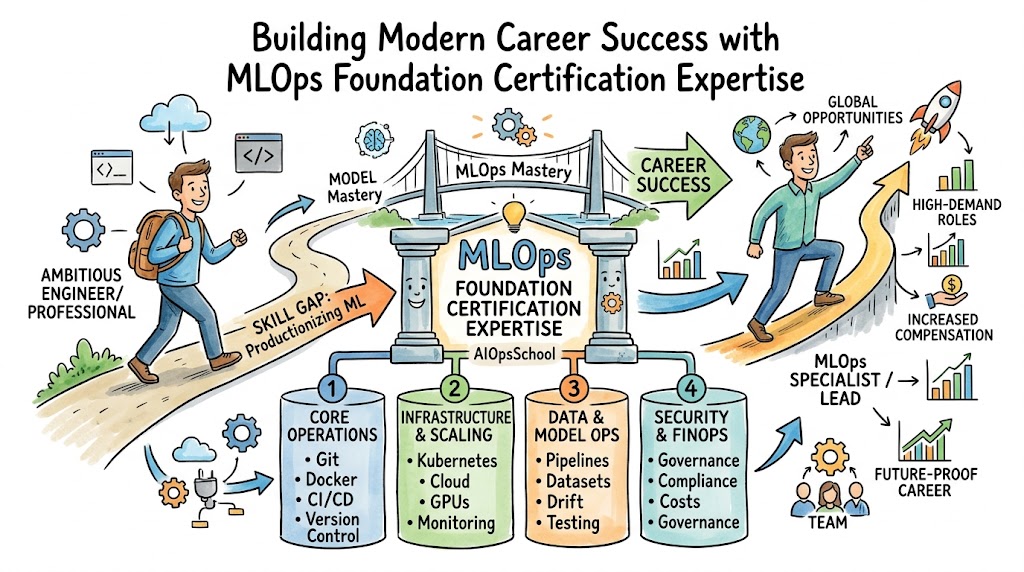
The MLOps Foundation Certification provides a vital bridge between traditional machine learning and robust DevOps practices for modern engineers. This guide serves professionals navigating the complexities of productionizing models within cloud-native and platform engineering environments globally. AIOpsSchool provides the framework that helps professionals make better career decisions through standardized technical training. By understanding this ecosystem, you can ensure long-term career stability in the automated intelligence era.
What is the MLOps Foundation Certification?
The MLOps Foundation Certification represents a standard for operationalizing machine learning models at scale within enterprise environments. It exists to solve the “last mile” problem where high-quality models fail to reach production due to a lack of engineering rigor.
This program emphasizes practical, production-focused learning over abstract data science theory to ensure models are maintainable. It aligns perfectly with modern engineering workflows by integrating versioning, testing, and continuous deployment into the machine learning lifecycle.
Who Should Pursue MLOps Foundation Certification?
Software engineers, SREs, and cloud professionals looking to expand their footprint into the AI space will find this path highly beneficial. It is equally critical for data engineers who need to understand the infrastructure side of model deployment and security roles focusing on model integrity.
Beginners gain a structured roadmap for entry, while experienced managers learn how to lead teams that bridge the gap between data science and IT. Both the Indian tech hub and global markets currently face a massive shortage of professionals who understand these combined disciplines.
Why MLOps Foundation Certification is Valuable and Beyond
The demand for operationalized AI is growing rapidly as enterprises move away from experimental sandboxes toward integrated, revenue-driving AI products. This certification ensures longevity by teaching principles that remain relevant even as specific cloud tools or coding libraries evolve over time.
Professionals who master these concepts stay relevant by becoming the essential link between data innovation and reliable business operations. The return on time is significant, as it positions you in a high-growth niche that commands premium compensation and leadership opportunities.
MLOps Foundation Certification Overview
The program is delivered via the official course platform and is hosted on AIOpsSchool to provide a centralized learning experience. This certification utilizes a structured assessment approach that evaluates both theoretical comprehension and the ability to apply concepts to real-world scenarios.
The ownership of the curriculum ensures that the content remains updated with the latest industry standards regarding containerization and orchestration. Structurally, the program is designed to be accessible yet rigorous, focusing on the end-to-end lifecycle of machine learning systems.
MLOps Foundation Certification Tracks & Levels
The certification is categorized into foundation, professional, and advanced levels to cater to different stages of a professional career. Specialized tracks allow engineers to lean into their existing strengths, whether those lie in SRE, DevOps, or FinOps, while adding a machine learning layer.
Foundational levels focus on the core vocabulary and architecture, while professional levels dive into automation and scaling. This tiered approach allows for clear career progression, moving from individual contributor roles to specialized architect or leadership positions.
Complete MLOps Foundation Certification Table
| Track | Level | Who it’s for | Prerequisites | Skills Covered | Recommended Order |
| Core Operations | Foundation | New Practitioners | Basic Linux & Git | CI/CD, Model Versioning | 1 |
| Infrastructure | Professional | SRE & Cloud Pros | Kubernetes Basics | Scaling, Monitoring, GPU Ops | 2 |
| Security | Professional | Security Engineers | IAM & Networking | Model Governance, Privacy | 3 |
| Management | Advanced | Lead Engineers | Team Lead Experience | Strategy, ROI, Compliance | 4 |
Detailed Guide for Each MLOps Foundation Certification
MLOps Foundation Certification – Foundation Level
What it is
This certification validates a professional’s understanding of the fundamental principles of machine learning operations and the lifecycle of a model. It ensures the candidate can speak the language of both data scientists and DevOps engineers fluently.
Who should take it
Suitable for junior engineers, data analysts transitioning to engineering, or managers who need to oversee cross-functional AI teams. It requires an intent to understand how models move from a notebook to a live environment.
Skills you’ll gain
- Understanding the ML Lifecycle (Data, Build, Deploy, Monitor).
- Version control for data and models.
- Basics of automated testing for ML pipelines.
- Familiarity with containerization for model packaging.
Real-world projects you should be able to do
- Create a basic CI/CD pipeline for a Python-based ML model.
- Implement data versioning using industry-standard tools.
- Set up a basic monitoring dashboard for model performance.
Preparation plan
- 7–14 days: Focus on core terminology and the high-level architecture of MLOps.
- 30 days: Engage with hands-on labs involving Docker and basic automation scripts.
- 60 days: Deep dive into specific cloud provider ML tools and end-to-end integration projects.
Common mistakes
Candidates often focus too much on the math behind the machine learning models rather than the operational infrastructure. Another mistake is ignoring the importance of data quality and versioning in the initial stages.
Best next certification after this
- Same-track option: MLOps Professional Certification.
- Cross-track option: SRE Foundation Certification.
- Leadership option: Technical Product Manager in AI.
Choose Your Learning Path
DevOps Path
This path focuses on integrating machine learning into existing software delivery pipelines without creating silos. Engineers learn to treat models as software artifacts that require automated testing and seamless deployment. It bridges the gap between standard application code and the unique requirements of heavy data weights.
DevSecOps Path
The security path emphasizes the protection of the model supply chain and the privacy of the data used for training. Professionals learn to implement automated security scans for model vulnerabilities and manage access controls for sensitive datasets. This ensures that the AI products are not only functional but also compliant with global regulations.
SRE Path
Site Reliability Engineers focus on the availability and performance of model endpoints in high-traffic environments. This path covers auto-scaling infrastructure, managing GPU resources efficiently, and setting up advanced alerting systems. It ensures that the machine learning system remains robust and meets service-level objectives.
AIOps Path
This track involves using machine learning and data science techniques to improve IT operations and system management. Engineers learn to automate incident response, predict system failures, and optimize resource allocation using AI. It is about applying the intelligence inward to the infrastructure itself for better uptime.
MLOps Path
The MLOps path is dedicated to the lifecycle management of machine learning models from data ingestion to retirement. It focuses heavily on experiment tracking, model registries, and the retraining loops necessary to prevent model drift. This is the core track for anyone wanting to be a specialist in the AI production field.
DataOps Path
DataOps focuses on the rapid, automated, and secure delivery of high-quality data to the machine learning pipelines. It treats data as code, applying versioning and automated quality checks to ensure the inputs are reliable. This path is essential for preventing the “garbage in, garbage out” problem in AI systems.
FinOps Path
This path addresses the high costs associated with training and running large-scale machine learning models in the cloud. Professionals learn to track spending, optimize instance selection, and implement cost-allocation tags for ML projects. It ensures that the AI initiatives remain economically viable for the business.
Role → Recommended MLOps Foundation Certification Certifications
| Role | Recommended Certifications |
| DevOps Engineer | MLOps Foundation, Professional DevOps |
| SRE | MLOps Foundation, SRE Practitioner |
| Platform Engineer | MLOps Foundation, Cloud Native Architect |
| Cloud Engineer | MLOps Foundation, Azure/AWS/GCP Specialist |
| Security Engineer | MLOps Foundation, DevSecOps Professional |
| Data Engineer | MLOps Foundation, DataOps Specialist |
| FinOps Practitioner | MLOps Foundation, FinOps Certified Practitioner |
| Engineering Manager | MLOps Foundation, AI Strategy for Leaders |
Next Certifications to Take After MLOps Foundation Certification
Same Track Progression
Deep specialization involves moving toward professional and expert levels where you master complex orchestration. This includes deep dives into Kubernetes for ML, advanced feature stores, and automated retraining architectures. Staying in this track builds the authority needed to become a principal MLOps engineer.
Cross-Track Expansion
Skill broadening allows you to take your MLOps knowledge and apply it to SRE or Security domains for a T-shaped skill set. You might pursue cloud-specific certifications or specialized security credentials to become a more versatile asset. This path is ideal for those aiming for “Full Stack” platform roles.
Leadership & Management Track
Transitioning to leadership requires a focus on strategy, team building, and the economic impact of engineering decisions. You should look toward certifications in technical management or AI ethics to prepare for director-level positions. This path focuses on the “why” and “when” rather than just the “how.”
Training & Certification Support Providers for MLOps Foundation Certification
DevOpsSchool
This provider offers extensive resources for engineers looking to master the automation side of model delivery. They focus on practical labs and real-world scenarios that prepare students for the rigors of modern enterprise environments.
Cotocus
A specialized training organization that emphasizes cloud-native technologies and containerization strategies for machine learning. Their curriculum is designed for professionals who need to scale models across distributed systems efficiently.
Scmgalaxy
Known for their deep community roots, they provide detailed guides and collaborative learning environments for configuration management. They help bridge the gap between traditional software management and modern data-driven workflows.
BestDevOps
This platform provides curated content focusing on the most effective tools and practices in the current market. Their approach is streamlined to help busy professionals gain maximum knowledge in a shorter timeframe.
devsecopsschool.com
They focus exclusively on the intersection of security and automation, ensuring that ML pipelines are built with safety in mind. Their courses cover everything from secret management to compliance as code.
sreschool.com
This provider is the go-to for learning how to maintain high availability for machine learning services. Their training focuses on monitoring, error budgets, and the reliability of automated intelligence systems.
aiopsschool.com
As the primary host for these certifications, they provide the most direct and comprehensive path to mastery. Their content is updated frequently to reflect the shifting landscape of artificial intelligence operations.
dataopsschool.com
They specialize in the data pipeline aspect of the ecosystem, teaching how to treat data as a first-class citizen. Their courses are vital for anyone responsible for the quality and flow of data into ML models.
finopsschool.com
This organization helps engineers and managers understand the financial implications of their cloud-based ML infrastructure. They provide the tools necessary to optimize costs without sacrificing performance or speed.
Frequently Asked Questions (General)
- How difficult is the MLOps Foundation Certification?
It is designed to be challenging but accessible for those with a basic background in cloud computing and automation. The focus is on logic and workflow rather than complex mathematics.
- How much time does it take to prepare?
Most professionals find that 30 to 60 days of consistent study is sufficient to pass the exam. This depends heavily on your prior experience with Git and CI/CD tools.
- What are the prerequisites for this program?
A basic understanding of Linux, version control, and at least one programming language like Python is highly recommended. You should also be familiar with general cloud concepts.
- Will this certification help me get a job?
Yes, it serves as a strong validation of your skills in a niche that is currently seeing high demand. It helps your resume pass through automated filters and proves your commitment.
- Is there a practical component to the exam?
Most assessments include scenario-based questions that require you to apply your knowledge to real engineering problems. This ensures you can actually perform the tasks in a work setting.
- How long does the certification remain valid?
Generally, these certifications are valid for two to three years, after which you may need to recertify. This keeps your skills sharp as the technology continues to evolve.
- Can I take the exam online?
Yes, the certification process is designed to be flexible and can usually be completed remotely through the official hosting platform. Ensure you have a stable internet connection.
- What is the return on investment for this certificate?
Professionals often see significant salary increases or promotions into more specialized roles after earning this credential. The knowledge gained also increases your daily work efficiency.
- Does this cover specific tools like Jenkins or GitLab?
While the certification focuses on principles, it uses popular industry tools to demonstrate how those principles are applied in production. The skills are transferable across different toolsets.
- Is this certification recognized globally?
Yes, the standards taught are based on industry-wide best practices used by major tech companies worldwide. It is a valuable asset for anyone working in global tech markets.
- Do I need to be a data scientist to pass?
No, you do not need to be a data scientist, as the focus is on the operational and engineering side of the machine learning lifecycle. It is built for engineers.
- What happens if I fail the first attempt?
Most programs offer a retake policy after a certain cooling-off period, allowing you to study your weak areas. It is important to review the feedback provided after the exam.
FAQs on MLOps Foundation Certification
- How does this certification differ from a standard DevOps certification?
Standard DevOps focuses on general software, while this program addresses the unique challenges of non-deterministic model behavior and large-scale data management.
- Does it cover the cost optimization of GPU resources?
Yes, the foundation covers the basics of resource management, ensuring that expensive hardware is used efficiently within your cloud infrastructure to prevent waste.
- Can this help me transition from a manual tester role?
Absolutely, it provides a roadmap for moving into automated testing roles specifically for machine learning, which is a growing and lucrative field for QA professionals.
- Is Kubernetes knowledge required before starting?
While not strictly required for the foundation level, having a basic understanding of containers will significantly speed up your learning process and help with labs.
- Does the program cover ethical AI and governance?
Yes, it introduces the concepts of model governance and auditing, which are essential for engineers working in regulated industries like finance or healthcare.
- How often is the curriculum updated?
The curriculum is reviewed regularly to incorporate new industry standards and emerging tools, ensuring that the certification remains relevant in a fast-paced market.
- Are there any hands-on projects included in the training?
The training support providers often include labs that mimic real production environments, allowing you to build and deploy models as part of your study.
- Is this suitable for project managers?
Yes, it provides the technical context necessary for project managers to effectively lead AI teams and communicate with stakeholders about timelines and resource needs.
Final Thoughts: Is MLOps Foundation Certification Worth It?
Investing in an MLOps Foundation Certification is a strategic move for any engineer who wants to stay ahead of the curve. The reality of the industry is that AI is no longer a separate department; it is becoming a core component of every modern application stack. By mastering the operational side of this technology, you make yourself indispensable to organizations that are struggling to turn their data into reliable products.
The certification provides a structured path through the noise of endless tools and libraries, giving you a solid foundation of principles. It isn’t just about passing an exam; it’s about gaining the confidence to build and maintain complex systems that drive actual value. If you are looking for a way to future-proof your career while working on the most exciting technology of our time, this is an excellent place to start.