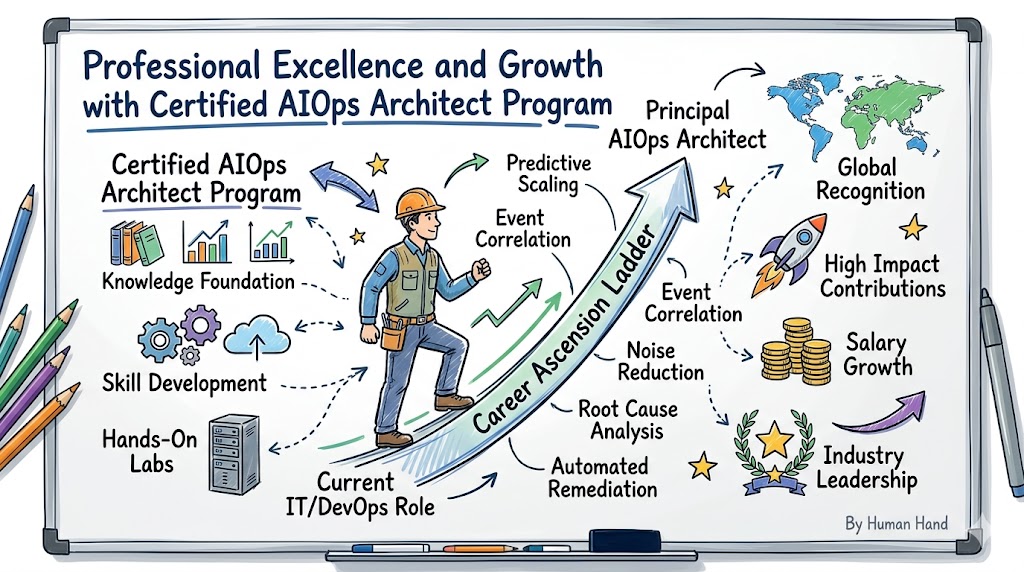
The modern infrastructure landscape requires more than just manual intervention and basic automation to maintain uptime. Consequently, the Certified AIOps Architect program bridges the gap between traditional operations and intelligent, data-driven management. This guide targets seasoned engineers and ambitious managers who want to integrate machine learning into their observability stacks at AIOpsSchool. Understanding these advanced workflows helps professionals make better career decisions while navigating the complexities of cloud-native and platform engineering environments.
What is the Certified AIOps Architect?
The Certified AIOps Architect represents a pinnacle of operational excellence where artificial intelligence meets enterprise infrastructure management. It exists to transform how organizations handle massive telemetry data, moving away from reactive firefighting toward proactive, self-healing systems. This certification emphasizes real-world, production-focused learning, ensuring that architects can design frameworks that filter noise and identify root causes automatically. Furthermore, it aligns perfectly with modern engineering workflows by treating operational data as a first-class citizen in the software development lifecycle.
Who Should Pursue Certified AIOps Architect?
Site Reliability Engineers and DevOps professionals who manage large-scale distributed systems will find this path particularly rewarding. Cloud architects and data engineers also benefit significantly, as they often handle the underlying pipelines that feed operational intelligence tools. Both beginners seeking a structured roadmap and experienced leaders managing digital transformation initiatives can leverage this knowledge to drive efficiency. Furthermore, this certification holds immense global and India-specific relevance as local tech hubs transition toward autonomous operations to support massive user bases.
Why Certified AIOps Architect is Valuable Beyond
Enterprises are rapidly adopting AI-driven operations to combat the sheer volume of alerts generated by microservices. Therefore, obtaining this credential ensures professional longevity by focusing on high-level architectural patterns rather than just fleeting tool-specific syntax. It helps engineers stay relevant because the core principles of algorithmic event correlation and anomaly detection apply across any cloud provider or stack. Ultimately, the return on time and career investment is high, as companies prioritize hiring architects who can reduce mean time to resolution through intelligent automation.
Certified AIOps Architect Certification Overview
The program is delivered via the official certification page and hosted on the primary provider platform. It utilizes a practical assessment approach that evaluates a candidate’s ability to design and implement intelligent operational frameworks. Unlike theoretical exams, this certification focuses on practical ownership of the AIOps lifecycle, from data ingestion to automated remediation. The structure is designed to validate your expertise in integrating machine learning models within existing DevOps toolchains to enhance system reliability.
Certified AIOps Architect Certification Tracks & Levels
The curriculum spans from foundation levels to advanced architectural specializations, allowing professionals to grow at their own pace. Foundation tracks focus on understanding data sources and basic correlation, while professional levels dive into specific integrations with SRE and FinOps. Advanced tracks empower candidates to lead entire organizational shifts toward autonomous operations. These levels align with career progression, moving from individual contributors to technical leaders who define the future of the company’s infrastructure.
Complete Certified AIOps Architect Certification Table
| Track | Level | Who it’s for | Prerequisites | Skills Covered | Recommended Order |
| Operations | Foundation | Aspiring DevOps Engineers | Basic Linux & Cloud | Log Aggregation, Alerting | 1 |
| Engineering | Professional | SREs & Cloud Engineers | Python, Monitoring tools | Anomaly Detection, NLP | 2 |
| Architecture | Advanced | Principal Engineers & Leads | System Design, ML basics | Pattern Discovery, Automation | 3 |
Detailed Guide for Each Certified AIOps Architect Certification
Certified AIOps Architect – Foundation
What it is
This level validates a fundamental understanding of how artificial intelligence enhances traditional IT operations. It confirms that the candidate understands the difference between standard monitoring and intelligent observability.
Who should take it
Junior DevOps engineers, system administrators, and recent graduates should pursue this to build a solid ground in automated operations.
Skills you’ll gain
- Mastery of telemetry data types (Metrics, Logs, Traces).
- Understanding of event suppression and noise reduction.
- Basic knowledge of operational data pipelines.
Real-world projects you should be able to do
- Setup a centralized logging system with basic threshold-based alerting.
- Configure an event dashboard that visualizes system health trends.
Preparation plan
- 7-14 Days: Focus on the core vocabulary and the lifecycle of an event.
- 30 Days: Practice setting up open-source monitoring stacks.
- 60 Days: Deep dive into data visualization and basic correlation logic.
Common mistakes
Candidates often overlook the importance of data quality, focusing too much on the AI tools rather than the underlying telemetry data.
Best next certification after this
- Same-track: Certified AIOps Architect – Professional.
- Cross-track: SRE Practitioner.
- Leadership: ITIL Foundation.
Certified AIOps Architect – Professional
What it is
This certification validates the ability to implement machine learning models for predictive maintenance and advanced incident management. It focuses on the bridge between data science and system operations.
Who should take it
Mid-level SREs and DevOps Engineers who are responsible for maintaining high-availability production environments.
Skills you’ll gain
- Implementation of anomaly detection algorithms.
- Automating root cause analysis through event correlation.
- Integrating AI insights into incident response workflows.
Real-world projects you should be able to do
- Deploy a predictive scaling engine that adjusts resources based on traffic forecasts.
- Build an automated incident routing system using natural language processing on tickets.
Preparation plan
- 7-14 Days: Review statistical models and data normalization techniques.
- 30 Days: Work on API integrations between monitoring tools and ML engines.
- 60 Days: Conduct case studies on large-scale failure scenarios and remediation.
Common mistakes
A frequent error is trying to automate complex tasks before establishing a stable baseline for manual operations.
Best next certification after this
- Same-track: Certified AIOps Architect – Advanced.
- Cross-track: MLOps Engineer.
- Leadership: Technical Product Manager.
Choose Your Learning Path
DevOps Path
This path focuses on integrating intelligence directly into the CI/CD pipeline. Consequently, engineers learn to use AI to predict build failures and optimize deployment frequencies. It bridges the gap between fast delivery and stable production environments by providing real-time feedback to developers.
DevSecOps Path
In this track, the focus shifts toward intelligent security posture management. Professionals learn to use AIOps to detect sophisticated threats and anomalies that traditional rule-based systems might miss. This ensures that security becomes an automated, proactive part of the delivery cycle.
SRE Path
The SRE path emphasizes availability and reliability through automated error budget management. Architects learn to use AI to automate the “Toil” and focus on high-value engineering tasks. This path is essential for those managing massive distributed systems with strict service level objectives.
AIOps Path
This specialized track focuses exclusively on the algorithmic side of operations. It covers the end-to-end lifecycle of operational data, from ingestion to sophisticated pattern discovery. It is ideal for those who want to become pure subject matter experts in autonomous systems.
MLOps Path
MLOps professionals focus on the reliability of the machine learning models themselves. They ensure that the AI used in operations stays accurate and does not suffer from data drift. This ensures the long-term integrity of the intelligent operations framework.
DataOps Path
DataOps is critical because high-quality AI requires high-quality data pipelines. This path teaches engineers how to manage the flow of telemetry data with the same rigor as software code. It ensures that the AIOps engine always has access to clean, timely, and relevant information.
FinOps Path
This path applies intelligent analysis to cloud spending and resource allocation. By using AIOps, professionals can predict cloud bill spikes and automate cost-saving measures without impacting performance. It is a vital track for organizations looking to optimize their cloud ROI.
Role → Recommended Certified AIOps Architect Certifications
| Role | Recommended Certifications |
| DevOps Engineer | AIOps Foundation, DevOps Professional |
| SRE | AIOps Professional, SRE Advanced |
| Platform Engineer | AIOps Architect, Cloud Infrastructure |
| Cloud Engineer | AIOps Foundation, FinOps Practitioner |
| Security Engineer | AIOps Professional, DevSecOps Specialist |
| Data Engineer | DataOps Professional, AIOps Foundation |
| FinOps Practitioner | FinOps Certified, AIOps Professional |
| Engineering Manager | AIOps Foundation, Leadership Track |
Next Certifications to Take After Certified AIOps Architect
Same Track Progression
Once you master the architectural level, you should look toward deep specialization in specific domains like autonomous remediation. This involves building systems that not only detect issues but fix them without human intervention. Continued learning in this track keeps you at the absolute forefront of modern infrastructure management.
Cross-Track Expansion
Broadening your skills into MLOps or DevSecOps provides a holistic view of the ecosystem. Understanding how security and model management intersect with operations makes you a more versatile architect. This cross-pollination of skills is highly valued in complex enterprise environments where silos are being broken down.
Leadership & Management Track
For those looking to move into people or strategy leadership, certifications in IT strategy or engineering management are the next logical step. You will use your technical background to drive organizational change and mentor the next generation of engineers. This transition allows you to influence the technical roadmap of the entire company.
Training & Certification Support Providers for Certified AIOps Architect
DevOpsSchool
This provider offers extensive resources and hands-on labs tailored for those entering the world of automated operations. They focus on bridging the gap between legacy systems and modern cloud-native architectures through expert-led sessions and community support.
Cotocus
As a specialized training partner, they deliver deep-dive technical workshops that focus on the practical implementation of AIOps tools. Their instructors bring years of consulting experience, ensuring that students learn how to solve real enterprise challenges effectively.
Scmgalaxy
This community-driven platform provides a wealth of tutorials, forums, and technical blogs dedicated to configuration management and AIOps. It serves as an excellent knowledge base for professionals looking to stay updated with the latest industry trends and tool updates.
BestDevOps
Focusing on quality and career-oriented training, this organization helps professionals master the complexities of modern toolchains. Their curriculum is designed to be practical, ensuring that every student can apply their learning to production environments immediately.
DevSecOpsSchool
This institution specializes in the intersection of security and operations, providing targeted training on building secure, intelligent pipelines. They emphasize the “Security as Code” philosophy, teaching architects how to automate compliance and threat detection within an AIOps framework.
SRESchool
Dedicated to the principles of Site Reliability Engineering, this provider focuses on availability, latency, and performance optimization. Their courses are essential for anyone looking to integrate intelligent observability into their reliability engineering practices.
AIOpsSchool
As the primary host for the Certified AIOps Architect program, they offer the most direct and comprehensive path to mastering AI-driven operations. Their curriculum is built by industry veterans who understand the specific needs of modern, data-heavy enterprises.
DataOpsSchool
This provider focuses on the critical data pipelines that fuel the modern enterprise. They teach students how to manage operational data at scale, ensuring that the AI models used in AIOps are fed with high-quality, real-time information.
FinOpsSchool
Focusing on the financial side of cloud operations, they help professionals master cost optimization through intelligent analysis. Their training is crucial for architects who need to balance high-performance infrastructure with strict budgetary constraints.
Frequently Asked Questions
- How difficult is the Certified AIOps Architect exam?
The exam is moderately challenging as it requires a blend of operational experience and a basic understanding of data science concepts.
- What is the typical time commitment for preparation?
Most professionals spend between 30 to 60 days preparing, depending on their existing familiarity with monitoring and automation tools.
- Are there any mandatory prerequisites for the foundation level?
No mandatory certifications are required, but a solid grasp of Linux, networking, and basic cloud concepts is highly recommended.
- What is the return on investment for this certification?
Candidates often see significant salary increases and better job opportunities as companies look for specialists who can manage complex AI-driven infrastructures.
- Should I take the SRE certification before AIOps?
While not required, having an SRE background provides excellent context for how AIOps can be used to manage service level objectives.
- Does the certification cover specific vendor tools?
The program focuses on architectural patterns and core principles that are applicable across various open-source and proprietary toolsets.
- How long does the certification remain valid?
The certification is typically valid for two to three years, after which recertification or moving to a higher level is encouraged.
- Is there a focus on coding or programming?
Yes, a basic understanding of Python or similar scripting languages is helpful for implementing data pipelines and automation scripts.
- Can an Engineering Manager benefit from this technical certification?
Absolutely, it provides managers with the technical vocabulary and strategic oversight needed to lead modern engineering teams effectively.
- How does AIOps differ from standard DevOps?
AIOps introduces machine learning and big data to the DevOps cycle, allowing for more intelligent decision-making and automated problem-solving.
- Are labs included in the training program?
Yes, the program emphasizes hands-on experience through practical labs that simulate real-world production incidents and data scenarios.
- Is this certification recognized globally?
Yes, the framework and skills taught are based on industry standards used by major enterprises and cloud providers worldwide.
FAQs on Certified AIOps Architect
- Which specific AI models are covered in the curriculum?
The course covers various models including clustering for event correlation and regression for capacity forecasting and predictive scaling.
- How does this certification address noise reduction in alerting?
It teaches specific strategies for event suppression and deduplication using algorithmic grouping to ensure engineers only see actionable alerts.
- Can I implement these practices on-premises or just in the cloud?
The architectural principles are hybrid and apply equally to on-premises data centers, public clouds, and multi-cloud environments.
- Does the program include training on incident remediation?
Yes, a core component involves designing closed-loop automation where the system can trigger self-healing scripts based on AI insights.
- Is data privacy and security covered in the AIOps context?
Absolutely, the curriculum includes sections on securing telemetry data and ensuring that AI models comply with data protection regulations.
- How much math knowledge is required for the ML sections?
You don’t need a PhD in math; a high-level understanding of statistics and logic is sufficient to implement and manage the models.
- What role does observability play in the AIOps architect track?
Observability is the foundation; the track teaches you how to move from simple monitoring to deep, AI-driven visibility across the stack.
- Are there community groups for certified architects?
Yes, the provider website provides access to an exclusive alumni network for ongoing knowledge sharing and career networking.
Final Thoughts: Is Certified AIOps Architect Worth It?
The impending complexity of contemporary systems would be wise to invest in this qualification. The expansion of serverless architectures and microservices is simply too much for manual operations to handle. You can establish yourself as the person who can construct the infrastructure’s “brain” by earning your certification as an architect. Adopting the tools required to deal with the future of technology is more important than following a trend. This route offers the most realistic and reliable road map for advancing beyond simple automation and spearheading the shift to autonomous systems.