Modern engineering landscapes require more than just basic coding; they demand an unwavering focus on system stability and uptime. The Certified Site Reliability Professional serves as a premier benchmark for those who wish to bridge the gap between software development and large-scale operations. This comprehensive guide helps professionals navigate the complexities of cloud-native architectures who aim to validate their expertise through Sreschool. As companies move toward automated platform engineering, this certification helps you handle high-scale environments with precision. By mastering these reliability principles, you ensure your career stays relevant within the ever-shifting technology market.
What is the Certified Site Reliability Professional?
The Certified Site Reliability Professional represents a rigorous validation of an engineer’s capacity to maintain peak performance in production. Unlike generic IT courses that focus on theoretical definitions, this program emphasizes hands-on, production-grade knowledge. It offers a standardized framework for professionals who manage services in highly volatile and distributed cloud environments.
Teams today need practitioners who understand how software behaves under real-world stress. This certification aligns with modern enterprise needs by focusing on error budgets, toil reduction, and automated incident response. Earning this credential signals that you possess the skills to maintain the infrastructure of the world’s most demanding digital platforms.
Who Should Pursue Certified Site Reliability Professional?
Cloud architects, senior developers, and DevOps practitioners find this path extremely beneficial for their professional advancement. It also serves engineering managers who need to understand the technical foundations of reliability to lead their teams effectively. Both beginners looking for a solid start and veterans aiming to formalize their experience use this framework to grow.
Tech professionals across India and the global market recognize this credential as a major career differentiator. Whether you specialize in security, data, or platform operations, the principles within this certification apply to your daily work. It specifically empowers those who want to transition from traditional operations to a proactive, engineering-led reliability model.
Why Certified Site Reliability Professional is Valuable and Beyond
Demand for SRE experts continues to outpace the supply of qualified talent as companies migrate more services to the cloud. This certification guarantees your long-term career survival by focusing on core principles that remain valid even when tools change. It teaches you how to design systems that stay resilient by default, making you an essential asset to any technical team.
Investing your time in this credential offers a high return by opening doors to leadership roles and higher compensation tiers. It demonstrates to stakeholders that you prioritize customer experience and system availability above all else. Ultimately, it equips you with a mindset that favors automation over manual effort, which remains a timeless trait of successful engineers.
Certified Site Reliability Professional Certification Overview
Candidates access the program through the official training portal and the Sreschool hosting platform. The curriculum uses a multi-layered assessment strategy that combines technical exams with hands-on labs to verify practical ability. This structure ensures that every certified individual can solve complex reliability problems in a live production setting.
The program provides a flexible learning path where you master modules at your own pace while hitting specific benchmarks. Because the assessment mimics real-world scenarios, you gain the confidence to handle actual system failures and architectural bottlenecks. This practical focus ensures the credential carries significant weight with hiring managers and industry leaders.
Certified Site Reliability Professional Certification Tracks & Levels
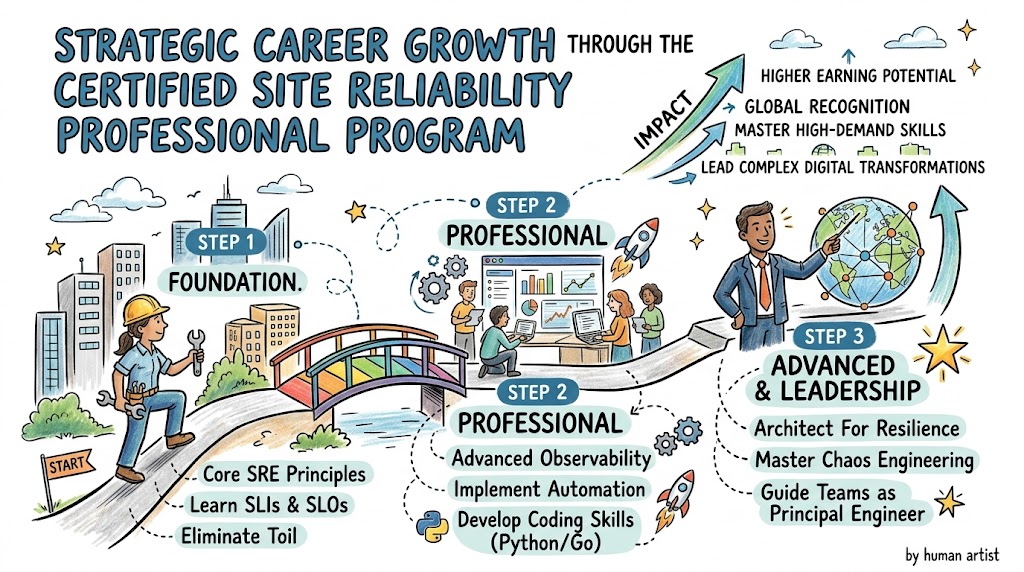
The certification offers foundation, professional, and advanced levels to support engineers at various career stages. The foundation level introduces core metrics like SLIs and SLOs, while the professional level dives deep into technical implementation and automation. Advanced tracks cater to those who design global architectures and lead organizational SRE cultural shifts.
Specialized tracks allow you to align your certification with your specific job function, such as FinOps or DevSecOps integration. These levels mirror a typical career progression, helping you move from individual contributor roles to strategic leadership positions. By following these tracks, you build a versatile skill set that covers every phase of the service lifecycle.
Complete Certified Site Reliability Professional Certification Table
| Track | Level | Who it’s for | Prerequisites | Skills Covered | Recommended Order |
| SRE Core | Foundation | New SREs/Students | Basic Cloud Knowledge | SLOs, SLIs, Toil | 1 |
| Implementation | Professional | DevOps Engineers | Foundation Certificate | Automation, Observability | 2 |
| Architecture | Advanced | Senior Architects | Professional Level | Scaling, Chaos Engineering | 3 |
| Ops Focus | Professional | SysAdmins | Linux Experience | Incident Management | 2 |
| Management | Leadership | Team Leads | Professional Level | SRE Culture, Metrics | 4 |
Detailed Guide for Each Certified Site Reliability Professional Certification
Certified Site Reliability Professional – Foundation
What it is
This level validates your understanding of the SRE philosophy and the metrics that define system success. It establishes the cultural foundation required for reliability-centric engineering.
Who should take it
Aspiring SREs, developers, and recent graduates should start here to learn the industry-standard language of site reliability.
Skills you’ll gain
- Defining SLIs and SLOs correctly
- Managing and calculating error budgets
- Identifying and reducing manual toil
- Understanding the pillars of SRE culture
Real-world projects you should be able to do
- Create a reliability dashboard for a web application
- Draft a sample incident response policy for a team
Preparation plan
- 7–14 days: Review the SRE handbook and learn core definitions.
- 30 days: Take practice exams and analyze case studies.
- 60 days: Apply foundation concepts to a small lab environment.
Common mistakes
- Treating SRE as a set of tools rather than a cultural mindset.
- Focusing too much on uptime without considering the error budget.
Best next certification after this
- Same-track option: Professional SRE Implementation
- Cross-track option: DevOps Foundation
- Leadership option: SRE Leadership Essentials
Certified Site Reliability Professional – Professional
What it is
The professional level focuses on the technical execution of automation, monitoring, and proactive system health. It proves you can implement SRE principles in a complex production environment.
Who should take it
Intermediate engineers with two or more years of experience who handle day-to-day operations and infrastructure automation should pursue this.
Skills you’ll gain
- Advanced observability and alerting strategies
- Automated incident remediation and recovery
- Implementing Infrastructure as Code for reliability
- Managing distributed system complexity
Real-world projects you should be able to do
- Automate the recovery of a failed multi-tier service
- Deploy a comprehensive monitoring stack for Kubernetes
Preparation plan
- 7–14 days: Focus on hands-on scripting and lab exercises.
- 30 days: Review incident response scenarios and post-mortems.
- 60 days: Complete a full reliability audit for a test system.
Common mistakes
- Neglecting the importance of blameless post-mortems.
- Failing to balance feature velocity with system stability.
Best next certification after this
- Same-track option: Advanced Reliability Architect
- Cross-track option: DevSecOps Specialist
- Leadership option: SRE Team Manager
Choose Your Learning Path
DevOps Path
This path integrates reliability into the CI/CD pipeline to ensure software deployments remain stable and predictable. You use automation to enforce uptime standards at every stage of the development cycle. This route is perfect for teams that want to maintain high release velocity without risking production failures. It successfully bridges the gap between rapid coding and reliable operations.
DevSecOps Path
The DevSecOps track blends reliability with security to build systems that are both resilient and highly protected. You automate security testing and treat vulnerabilities as reliability risks that require immediate action. This path serves engineers in regulated industries where uptime and data integrity are equally critical priorities. It ensures that security functions as a core component of system health.
SRE Path
This dedicated track serves those who want to master the pure discipline of Site Reliability Engineering. It focuses heavily on observability, incident management, and the engineering required to maintain large-scale services. You use data-driven insights to manage system performance and eliminate manual effort through software. It remains the top choice for specialists aiming for high-impact roles.
AIOps Path
The AIOps path explores how machine learning and artificial intelligence can predict and resolve issues before they impact users. You analyze telemetry data for hidden patterns that human operators might miss. This path prepares you for a future where systems become increasingly self-healing and autonomous. It is ideal for engineers who want to lead the next wave of operational automation.
MLOps Path
This path addresses the unique reliability challenges of managing machine learning models and large-scale data pipelines. You monitor model drift and manage the high compute resources required for AI workloads. This track is essential for companies that rely on AI for their primary business logic and customer experience. It ensures your models stay performant and available.
DataOps Path
DataOps focuses on the reliability and speed of data flows throughout the modern enterprise architecture. You apply SRE principles to data pipelines to ensure the accuracy and availability of critical information. This path is vital for big data environments where pipeline failures can disrupt entire business intelligence operations. It builds a foundation for data-driven engineering success.
FinOps Path
The FinOps track connects technical reliability with financial accountability and cloud cost optimization. You design infrastructures that stay both highly available and cost-efficient to run. This path teaches you to treat infrastructure waste as a technical debt that impacts the overall health of the business. It is increasingly popular as companies look to scale their cloud presence sustainably.
Role → Recommended Certified Site Reliability Professional Certifications
| Role | Recommended Certifications |
| DevOps Engineer | SRE Foundation, Professional Automation |
| SRE | Professional SRE, Advanced Architect |
| Platform Engineer | SRE Foundation, Infrastructure Reliability |
| Cloud Engineer | SRE Foundation, Cloud Reliability |
| Security Engineer | SRE Foundation, DevSecOps Professional |
| Data Engineer | SRE Foundation, DataOps Reliability |
| FinOps Practitioner | SRE Foundation, Cloud Cost Specialist |
| Engineering Manager | SRE Foundation, Leadership Track |
Next Certifications to Take After Certified Site Reliability Professional
Same Track Progression
Advancing within the SRE track involves moving toward complex architectural mastery and chaos engineering. You focus on credentials that validate your ability to design global, fault-tolerant infrastructures with zero downtime. This progression secures your status as a high-level technical expert in the reliability domain. It allows you to move from day-to-day tasks to strategic technical leadership.
Cross-Track Expansion
Broadening your expertise into related fields like security or AI makes you a more versatile and competitive professional. By understanding how reliability interacts with other technical silos, you lead more complex, cross-functional projects. This expansion ensures your skills stay relevant even as industry priorities and technologies change. It transforms you into a well-rounded engineer capable of solving diverse problems.
Leadership & Management Track
Moving into the leadership track involves focusing on team culture, organizational strategy, and stakeholder management. You learn how to build high-performing SRE teams and align their technical objectives with business success. This path is perfect for senior engineers who want to scale their impact by leading others. It requires a blend of technical credibility and strong interpersonal communication.
Training & Certification Support Providers for Certified Site Reliability Professional
DevOpsSchool
This provider offers comprehensive training modules designed to prepare engineers for modern reliability challenges. They focus on delivering practical, lab-based learning that mirrors actual production environments. Their instructors bring years of industry experience to help you navigate the complexities of SRE and DevOps effectively.
Cotocus
This organization specializes in specialized technical training for cloud-native technologies and reliability practices. They offer tailored coaching and mentorship to help students master difficult concepts with confidence. Their certification support is highly regarded for its depth and practical relevance to current market demands.
Scmgalaxy
Known for its deep technical resources and community-driven content, this platform provides excellent support for SRE aspirants. They offer a vast library of tutorials and guides that simplify complex configuration and reliability tasks. It is a favorite resource for engineers who prefer a hands-on, resource-rich learning environment.
BestDevOps
This hub provides curated information on the best training paths and tools for reliability professionals. They help you evaluate different certification options to ensure you choose the one that matches your career goals. Their industry insights are invaluable for staying informed about the latest trends in digital operations.
devsecopsschool.com
This platform emphasizes the critical integration of security into the reliability lifecycle. They provide specialized training that teaches you how to protect your infrastructure without sacrificing performance. Their courses are essential for anyone working in security-sensitive or highly regulated environments.
sreschool.com
As the primary host for the Certified Site Reliability Professional, this site offers the most direct path to certification. They provide the official curriculum, practice exams, and the assessment platform needed to earn your credential. It is the central authority for SRE education and professional validation.
aiopsschool.com
This provider focuses on the future of operations by teaching engineers how to use AI for reliability. Their courses cover the tools and techniques needed to build self-healing systems and predictive monitoring stacks. It is a vital resource for engineers looking to lead the next wave of automation.
dataopsschool.com
Dedicated to the reliability of data infrastructure, this site provides training for data engineers and architects. They help you apply SRE concepts to manage complex data pipelines and ensure data integrity at scale. Their programs bridge the gap between traditional reliability and data science.
finopsschool.com
This organization helps engineers master the financial side of cloud infrastructure management. They teach you how to optimize resources and manage costs while maintaining high system reliability. Their certifications are key for professionals looking to prove their value to the business side.
Frequently Asked Questions
- How challenging is the Certified Site Reliability Professional exam?
The exam provides a fair challenge by testing both your conceptual knowledge and your ability to solve problems in labs.
- What is the typical study time for this certification?
Plan for about 30 to 60 days of preparation to master the professional-level material.
- Are there any required prerequisites for the foundation level?
No formal prerequisites exist for the starting level, but basic familiarity with cloud concepts and Linux will give you a major advantage.
- What kind of career boost does this certification provide?
Most professionals see an immediate increase in visibility from recruiters and hiring managers at major tech firms.
- What is the recommended order for these certifications?
Start with the Foundation level to build your core vocabulary and cultural understanding.
- Do I need to renew this certification periodically?
Yes, you usually need to renew your credential every few years to show that you are keeping up with industry changes.
- Does the program focus on specific vendors like AWS or Azure?
The certification remains largely vendor-neutral, focusing on principles that apply to any cloud provider.
- How does this differ from a standard DevOps certificate?
While DevOps focuses on the entire software lifecycle, this certification dives specifically into the reliability and operations side.
- Is the exam available for remote testing?
Yes, you can take the certification exam from anywhere in the world using a secure online proctoring service.
- Do the training programs include practice labs?
Yes, the official training support includes access to virtual labs where you can practice your skills in a safe environment.
- Is this credential recognized by global tech companies?
Companies around the world recognize the value of SRE expertise and the rigor of this certification program.
- What happens if I don’t pass the exam on my first try?
Most providers offer a clear retake policy and will give you feedback on which areas you need to improve.
FAQs on Certified Site Reliability Professional
- What core problem does the Certified Site Reliability Professional solve?
It addresses the gap in standardized knowledge for managing complex production systems reliably and at scale.
- How does the curriculum handle incident management?
The program teaches a structured approach to incident response, focusing on blameless post-mortems and automated remediation.
- Is scripting knowledge necessary for this certification?
Yes, being able to automate tasks through code is a central part of the SRE role and the certification exam.
- Does the certification cover cloud cost management?
Yes, especially in the professional and specialization tracks, where optimizing resources is seen as a key part of system reliability.
- How does Sreschool ensure the curriculum stays updated?
The platform works with active industry professionals to regularly review and update the course material.
- Can non-technical managers benefit from this program?
Managers can take the foundation track to better understand the metrics and culture their teams need to succeed.
- What is the focus on observability versus monitoring?
The program teaches you how to build observable systems that provide deep insights into their internal state.
- Are there performance-based questions in the exam?
Yes, the assessment includes tasks that require you to solve real problems in a live environment.
Final Thoughts: Choosing the Right Path for Career Longevity
Reflecting on the current state of the industry, I believe that reliability expertise has become the most valuable currency for modern engineers. The Certified Site Reliability Professional program offers more than just a certificate; it provides a comprehensive framework for thinking about software in production. It challenges you to stop merely reacting to outages and start engineering systems that stay resilient by design.
Choosing this path requires commitment and a genuine interest in the intersection of code and infrastructure. However, the professional clarity and career opportunities it provides remain unparalleled in today’s market. If you want to move beyond basic operations and lead the way in building the next generation of digital platforms, this investment is undoubtedly worth your time. Embrace the challenge and become the engineer that every high-scale organization needs to survive and thrive.