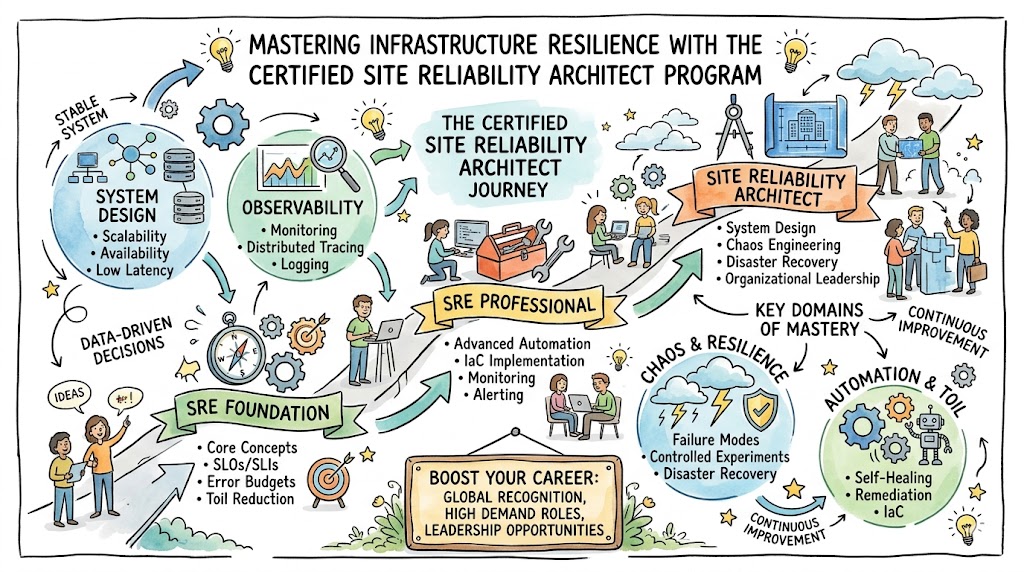
Reliability has become the cornerstone of modern digital infrastructure, making the Certified Site Reliability Architect a vital credential for today’s engineering leaders. This comprehensive guide serves professionals navigating the complexities of cloud-native environments and platform engineering. By pursuing this path at Sreschool, you gain the architectural oversight necessary to bridge the gap between rapid development and rock-solid stability. This roadmap helps you decide how to integrate advanced reliability principles into your existing DevOps or FinOps workflows effectively.
What is the Certified Site Reliability Architect?
The Certified Site Reliability Architect represents the highest tier of mastery in designing resilient, scalable, and self-healing systems. Unlike entry-level certifications that focus on basic automation, this designation emphasizes the high-level design patterns required for massive production environments. It exists to validate an engineer’s ability to balance feature velocity with systemic stability using data-driven decision-making.
Furthermore, the curriculum prioritizes production-focused learning over abstract theory, ensuring architects can handle real-world outages and complex migrations. It aligns perfectly with modern engineering workflows by focusing on error budgets, toil reduction, and observability. This certification ensures that you are not just a tool operator, but a strategic designer of robust infrastructure.
Who Should Pursue Certified Site Reliability Architect?
This certification specifically targets senior software engineers, experienced SREs, and cloud architects who are responsible for large-scale system health. Beginners with a strong foundation in Linux and networking can use it as a North Star, while managers find it invaluable for building high-performing reliability teams. It provides a structured framework for anyone moving into platform engineering or infrastructure leadership.
In the context of the global tech market and the tech sectors across India, these skills are in high demand across fintech, e-commerce, and SaaS industries. Security and data professionals also benefit significantly by learning how to bake reliability into their respective domains. Ultimately, if you are tasked with ensuring five-nines availability for critical services, this path is designed for you.
Why Certified Site Reliability Architect is Valuable
The demand for architectural-level reliability skills continues to grow as enterprises migrate their core legacy systems into distributed cloud environments. Obtaining this certification ensures long-term career longevity because it teaches foundational principles that remain relevant regardless of whether you use Kubernetes, serverless, or future technologies. It moves your value proposition from knowing a tool to solving complex business problems.
Moreover, the return on time investment is substantial, as it positions you for high-impact roles that command premium compensation. Organizations increasingly adopt SRE models to prevent the massive financial losses associated with downtime. By becoming a certified architect, you provide the enterprise-level assurance that their digital transformation efforts will not be undermined by technical fragility.
Certified Site Reliability Architect Certification Overview
The program is delivered via the official training portal and hosted on the Sreschool platform. It utilizes a multi-layered assessment approach that includes rigorous exams and practical evaluations to ensure candidates can apply concepts in live environments. The structure is designed to be modular, allowing professionals to build their expertise incrementally.
Ownership of the certification remains with the central governing body, which updates the curriculum frequently to reflect changing industry standards. It focuses on the architectural lifecycle, from initial design and capacity planning to post-incident analysis and continuous improvement. This practical approach ensures that the credential carries significant weight during technical interviews and internal promotions.
Certified Site Reliability Architect Certification Tracks & Levels
The certification is organized into three distinct stages: Foundation, Professional, and Advanced. The Foundation level introduces core SRE vocabulary and concepts, while the Professional level focuses on implementing specific reliability patterns. The Advanced level, culminating in the Architect status, requires a deep understanding of complex system interactions and organizational leadership.
Beyond the core levels, there are specialized tracks that allow you to blend reliability with other disciplines like FinOps or DevSecOps. These tracks ensure that your career progression can be tailored to your specific interests or the needs of your current employer. This layered system allows for a clear, measurable growth path from an individual contributor to a strategic technical leader.
Complete Certified Site Reliability Architect Certification Table
| Track | Level | Who it’s for | Prerequisites | Skills Covered | Recommended Order |
| Core SRE | Foundation | Junior Engineers | Basic IT | SLOs, SLIs, Toil | First |
| Engineering | Professional | SREs / DevOps | Foundation Cert | Automation, Python | Second |
| Architecture | Advanced | Senior Leads | Professional Cert | System Design, HA | Third |
| Security | Specialist | Security Ops | Professional Cert | Chaos Sec, IAM | Optional |
| Financial | Specialist | FinOps Leads | Foundation Cert | Cost Optimization | Optional |
Detailed Guide for Each Certified Site Reliability Architect Certification
Certified Site Reliability Architect – Foundation
What it is
This level validates your understanding of the basic terminology and philosophical pillars of Site Reliability Engineering. It serves as the entry point for anyone transitioning from traditional operations or development into a reliability-focused role.
Who should take it
Aspiring SREs, developers wanting to understand production, and project managers who need to communicate with technical teams should pursue this. It requires minimal prior experience but a high curiosity for system behavior.
Skills you’ll gain
- Defining Service Level Objectives (SLOs) and Indicators (SLIs).
- Understanding the concept of Error Budgets.
- Identifying and eliminating operational Toil.
- Principles of effective incident response.
Real-world projects you should be able to do
- Creating a basic monitoring dashboard for a web application.
- Writing a post-mortem report for a simulated service outage.
Preparation plan
- 7 Days: Focus on memorizing SRE terminology and core handbook concepts.
- 30 Days: Practice setting up basic Prometheus alerts and Grafana dashboards.
- 60 Days: Not typically required for this level for experienced IT staff.
Common mistakes
- Overcomplicating SLIs with too many metrics.
- Ignoring the cultural aspect of SRE in favor of just tools.
Best next certification after this
- Same-track option: Certified SRE Professional
- Cross-track option: DevOps Foundation
- Leadership option: SRE Team Lead essentials
Certified Site Reliability Architect – Professional
What it is
This certification validates the ability to implement reliability tools and automation scripts. It moves from theory to how you perform SRE in a high-pressure production environment.
Who should take it
Current DevOps engineers and SREs with 2-3 years of experience who want to formalize their technical skills. It is ideal for those responsible for maintaining Kubernetes clusters or cloud infrastructure.
Skills you’ll gain
- Advanced infrastructure as code (IaC) implementation.
- Developing custom exporters for monitoring.
- Automated incident remediation scripts.
- Performance tuning and capacity planning.
Real-world projects you should be able to do
- Building a self-healing pipeline that restarts services based on health checks.
- Implementing a multi-region failover strategy for a database.
Preparation plan
- 7 Days: Review advanced networking and container orchestration.
- 30 Days: Complete hands-on labs involving Terraform and Prometheus.
- 60 Days: Build a complete end-to-end CI/CD pipeline with integrated monitoring.
Common mistakes
- Failing to test automation scripts in a staging environment.
- Not understanding the underlying network protocols.
Best next certification after this
- Same-track option: Certified Site Reliability Architect
- Cross-track option: DevSecOps Professional
- Leadership option: Platform Engineering Manager
Certified Site Reliability Architect – Advanced
What it is
This is the pinnacle of the program, focusing on the global design of massive systems. It validates your ability to lead technical strategy and design architectures that survive catastrophic failures.
Who should take it
Principal engineers, Chief Architects, and senior SRE leads with over 7 years of experience. You should be comfortable making decisions that impact the entire company’s infrastructure.
Skills you’ll gain
- Global traffic management and load balancing.
- Designing for Disaster Recovery (DR) and Business Continuity.
- Influence without authority and organizational change.
- Advanced Chaos Engineering principles.
Real-world projects you should be able to do
- Designing a global, low-latency API mesh across three continents.
- Leading a company-wide migration from monolith to reliable microservices.
Preparation plan
- 7 Days: Deep dive into whitepapers on distributed systems.
- 30 Days: Practice architectural diagramming and failure mode analysis.
- 60 Days: Conduct extensive peer reviews and mock architectural board exams.
Common mistakes
- Focusing too much on a single cloud provider’s proprietary tools.
- Neglecting the financial impact of architectural decisions.
Best next certification after this
- Same-track option: Fellow of Reliability Engineering
- Cross-track option: MLOps Architect
- Leadership option: CTO / VP of Engineering track
Choose Your Learning Path
DevOps Path
This path focuses on integrating reliability directly into the software development lifecycle. You will learn how to make deployment pipelines more robust and how to provide feedback loops to developers. It is perfect for those who want to bridge the gap between code and run efficiently.
DevSecOps Path
In this track, you apply reliability principles to the security domain, ensuring that security scanners and firewalls do not become bottlenecks. You will learn to treat security as a continuous reliability metric rather than a gate. This is essential for highly regulated industries.
SRE Path
The pure SRE path is for those dedicated to the health and performance of production systems. It focuses heavily on observability, incident management, and the reduction of manual work through automation. This path leads directly to the Architect level through deep technical specialization.
AIOps Path
This specialty explores how machine learning can be used to predict outages before they happen. You will learn to manage large datasets of logs and metrics to find patterns in system behavior. It is the future of managing hyper-scale environments that are too large for humans to monitor manually.
MLOps Path
Focusing on the reliability of machine learning pipelines, this path ensures that models are deployed and retrained without downtime. You will apply SRE concepts to data drift and model performance monitoring. This is a critical role for AI-first companies.
DataOps Path
Reliability in data engineering ensures that pipelines are idempotent and data quality remains high. You will learn how to build circuit breakers for data flows to prevent corrupted data from reaching dashboards. This path is vital for organizations relying on real-time analytics.
FinOps Path
This path combines reliability with cost-effectiveness, ensuring that high availability does not lead to unnecessary cloud spending. You will learn to architect systems that scale down effectively and use spot instances reliably. It turns the SRE into a value-driven architect.
Role → Recommended Certified Site Reliability Architect Certifications
| Role | Recommended Certifications |
| DevOps Engineer | Foundation + Professional |
| SRE | Foundation + Professional + Architect |
| Platform Engineer | Professional + Architect |
| Cloud Engineer | Foundation + Professional |
| Security Engineer | Foundation + DevSecOps Specialist |
| Data Engineer | Foundation + DataOps Track |
| FinOps Practitioner | Foundation + FinOps Track |
| Engineering Manager | Foundation + Leadership Module |
Next Certifications to Take After Certified Site Reliability Architect
Same Track Progression
Once you achieve the Architect status, you should look toward deep specialization in specific technologies like advanced eBPF for observability or specialized kernel tuning. Staying within the track means becoming a subject matter expert who can solve problems no one else can. You might also consider contributing to open-source reliability tools to cement your status.
Cross-Track Expansion
An architect should never be siloed, so expanding into MLOps or FinOps is a logical next step. Understanding how reliability affects the bottom line or how it supports artificial intelligence makes you a more versatile leader. This expansion ensures you can lead multi-disciplinary teams and solve complex, cross-functional business challenges.
Leadership & Management Track
If you prefer moving into people management, the next step is a Director of SRE or VP of Platform Engineering role. These positions require you to apply architectural thinking to organizational structures. You will focus on building teams, defining company-wide KPIs, and managing large-scale budgets instead of just technical systems.
Training & Certification Support Providers for Certified Site Reliability Architect
DevOpsSchool
This provider offers extensive classroom and online training specifically for those starting their journey. They focus on hands-on labs and real-world scenarios to ensure students can handle production tasks. Their trainers are industry veterans who bring years of experience to the classroom environment.
Cotocus
Specializing in high-end consulting and training, this group helps experienced engineers reach the architect level. They provide deep-dive sessions on complex topics like chaos engineering and global traffic management. Their curriculum is highly technical and aimed at senior professionals seeking advanced mastery.
Scmgalaxy
As a long-standing community and training hub, they offer a wealth of free and paid resources for SREs. They are particularly known for their comprehensive guides on configuration management and CI/CD tools. Their platform is a great starting point for self-paced learners.
BestDevOps
Focusing on quality and career outcomes, this provider offers tailored coaching for certification exams. They provide mock tests and interview preparation to ensure candidates are ready for the professional market. Their courses are designed to be efficient and highly targeted.
devsecopsschool.com
This platform focuses on the intersection of security and reliability. They offer specialized modules that teach you how to secure your SRE pipelines and infrastructure. It is the go-to resource for engineers working in security-sensitive environments.
sreschool.com
As the primary host for the architect certification, this site provides the most direct and updated information. They offer the official curriculum, exam portals, and specialized tracks for all levels. It is the central authority for this specific certification program.
aiopsschool.com
This provider is at the forefront of the AI-driven operations movement. They teach you how to integrate machine learning models into your monitoring and incident response workflows. It is ideal for architects looking to future-proof their skills with automation.
dataopsschool.com
Focusing on the data side of reliability, this site helps engineers manage the complexities of big data pipelines. They offer training on ensuring data integrity and availability at scale. Their training is essential for modern data-heavy organizations.
finopsschool.com
This provider helps you bridge the gap between engineering reliability and financial accountability. They teach the principles of cloud cost management without sacrificing system performance. It is a vital resource for anyone managing a significant cloud budget.
Frequently Asked Questions
- How difficult is the architect level exam?
The exam is quite challenging as it requires a mix of theoretical knowledge and practical problem-solving. It tests your ability to design systems rather than just configure tools.
- How long does it take to get certified?
Most professionals take between three to six months to move through all levels, depending on their starting experience. The foundation can be done in weeks, but the architect level takes longer.
- Are there any mandatory prerequisites?
You generally need to pass the Foundation and Professional levels before attempting the Certified Site Reliability Architect exam. A background in Linux and cloud is highly recommended.
- What is the typical ROI for this certification?
Certified professionals often see significant salary increases and access to more senior roles. Companies value the architectural oversight that this specific credential validates.
- Is this certification recognized globally?
Yes, the principles taught are based on industry standards used by major tech firms worldwide. It is highly respected in both the US and Indian markets.
- Do I need to know how to code?
Yes, a basic understanding of Python or Go is necessary for the professional and architect levels. Automation is a core part of the reliability mindset.
- How often do I need to renew the certification?
The certification is typically valid for two to three years. You can renew by passing a recertification exam or by earning continuing education credits.
- Can I skip the foundation level?
While not recommended, some experienced professionals may be able to challenge the professional level directly if they have significant documented industry experience.
- Does this cover AWS, Azure, or GCP?
The certification is cloud-agnostic, meaning the principles apply to all providers. However, most labs use one of the major providers for practical exercises.
- What is the format of the final exam?
The final architect exam usually includes a combination of multiple-choice questions and a hands-on design project or lab simulation.
- How does this differ from a standard DevOps cert?
This certification focuses specifically on the run and reliability phase of the lifecycle. It goes much deeper into observability and failure management than standard DevOps tracks.
- Is there a community for certified architects?
Yes, passing the exam grants you access to an exclusive alumni network where you can share best practices and find high-level job opportunities.
FAQs on Certified Site Reliability Architect
What specific tools are covered in the architect curriculum?
While the certification is principle-based, you will work extensively with Prometheus for monitoring and Kubernetes for orchestration. You also gain experience with Terraform for infrastructure management and various chaos engineering tools like Gremlin or Chaos Mesh.
How does this certification help with career progression in India?
In India’s competitive market, this credential differentiates you from generalist engineers by proving your architectural expertise. Major service providers and product startups actively seek certified architects to lead their global delivery centers and ensure high uptime.
Final Thoughts: Is Certified Site Reliability Architect Worth It?
If you are serious about a career in high-end infrastructure, the Certified Site Reliability Architect is one of the most practical investments you can make. It shifts your perspective from being a person who fixes things to being the person who ensures they don’t break in the first place. This transition is essential for anyone aiming for principal-level roles or technical leadership.
The program at Sreschool provides a structured, credible way to prove your worth in a field that is often misunderstood. By mastering the art of reliability, you become an indispensable asset to any organization. It is not about a piece of paper; it is about the deep, systemic understanding you gain of how modern software actually works at scale.