Introduction
Enterprise infrastructure now generates data at a scale that exceeds human processing limits. The AiOps Certified Professional (AIOCP) serves as the definitive credential for engineers who want to master artificial intelligence within IT operations. This guide explains how you can transition from manual firefighting to building intelligent, self-healing systems. By partnering with DevOpsSchool, professionals gain the exact technical depth required to automate root cause analysis and optimize cloud-native environments. Whether you aim for a senior SRE role or a leadership position, this roadmap provides the clarity you need to navigate the future of platform engineering.
What is the AiOps Certified Professional (AIOCP)?
The AiOps Certified Professional (AIOCP) provides a rigorous framework for applying machine learning to real-world IT challenges. It exists to bridge the gap between traditional system administration and advanced data science. Instead of relying on static thresholds, this certification focuses on deploying dynamic models that learn from production telemetry in real-time. Engineers who earn this title prove they can handle massive datasets and transform raw logs into actionable intelligence. It represents the highest standard for professionals who want to lead the shift toward autonomous infrastructure.
Who Should Pursue AiOps Certified Professional (AIOCP)?
Site Reliability Engineers (SREs), Cloud Architects, and DevOps practitioners benefit most from this specialized path. Security experts also find immense value here, as they learn to use AI for detecting behavioral anomalies and sophisticated threats. This program caters to both experienced leads in global tech hubs and ambitious engineers in India’s growing digital economy. Technical managers should also consider this track to better understand how to justify AI investments and guide their teams through complex digital transformations.
Why AiOps Certified Professional (AIOCP) is Valuable in 2026 and Beyond
As cloud environments grow more ephemeral, enterprises increasingly rely on AI to maintain stability and performance. The AiOps Certified Professional (AIOCP) remains valuable because it teaches durable architectural principles rather than fleeting tool-specific tricks. This expertise ensures you stay relevant even as the software landscape shifts every few months. By mastering intelligent automation, you offer immediate ROI to organizations that need to reduce downtime and control their expanding cloud budgets.
AiOps Certified Professional (AIOCP) Certification Overview
The program delivers its content through the official curriculum and hosts all learning materials on the designated platform. It emphasizes a practical assessment model, requiring candidates to solve production-grade problems in a sandbox environment. The certification owners constantly update the syllabus to include the latest trends in predictive analytics and automated remediation. This approach ensures that every certified professional possesses the hands-on skills necessary to implement AIOps strategies effectively within any enterprise.
AiOps Certified Professional (AIOCP) Certification Tracks & Levels
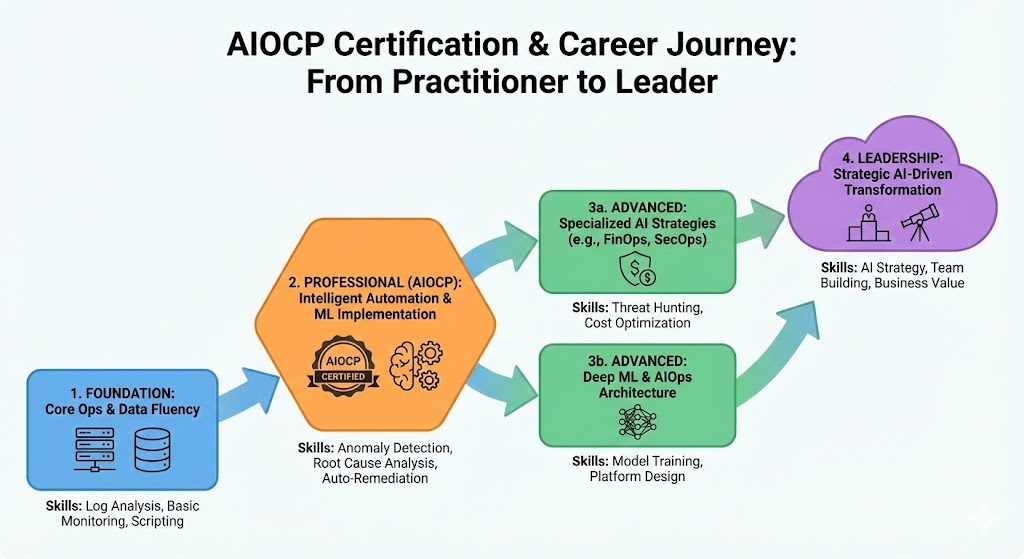
The AIOCP framework features three progressive tiers: Foundation, Professional, and Advanced. The Foundation level introduces core concepts like data ingestion and basic statistical monitoring. The Professional level challenges you to build and integrate machine learning models into existing CI/CD pipelines. The Advanced level prepares you for high-level strategy and enterprise-wide AI governance. This structured progression allows you to align your learning journey with your specific career goals and technical experience.
Complete AiOps Certified Professional (AIOCP) Certification Table
| Track | Level | Who it’s for | Prerequisites | Skills Covered | Recommended Order |
| Operations | Foundation | Junior Engineers | Basic Linux | Data Prep, Telemetry | 1 |
| Engineering | Professional | SREs & DevOps | Python & Cloud | ML Modeling, Automation | 2 |
| Strategy | Advanced | Tech Leaders | 5+ Years Exp | AI Strategy, ROI | 3 |
| Security | AI-Sec | SecOps | InfoSec Basics | Threat Hunting, AI Defense | 4 |
Detailed Guide for Each AiOps Certified Professional (AIOCP) Certification
AiOps Certified Professional (AIOCP) – Foundation
What it is
This certification validates your understanding of the essential pillars of intelligent operations. It confirms that you can distinguish between traditional monitoring and modern, AI-driven observability.
Who should take it
Aspiring DevOps engineers and recent graduates should start here to build a strong foundation. It also helps managers who need to understand the technical language of AIOps teams.
Skills you’ll gain
- Understanding Metrics, Logs, and Traces.
- Basic Python for data manipulation.
- Identifying noise in complex alerting systems.
- Visualizing operational trends.
Real-world projects you should be able to do
- Build a monitoring dashboard that isolates high-priority signals from system noise.
- Format raw infrastructure data for machine learning ingestion.
Preparation plan
- 7–14 days: Focus on core definitions and the history of ITIL vs. AIOps.
- 30 days: Learn basic Python libraries for data visualization.
- 60 days: Complete mock exams and build a basic observability lab.
Common mistakes
- Ignoring the importance of high-quality data ingestion at the source.
- Focusing only on theory without practicing basic scripting.
Best next certification after this
- Same-track: AIOCP Professional.
- Cross-track: Cloud Practitioner Associate.
- Leadership: ITIL Foundation.
AiOps Certified Professional (AIOCP) – Professional
What it is
This level confirms your ability to build and maintain machine learning models specifically for IT health. It focuses on the practical application of AI to solve uptime and performance issues.
Who should take it
Active SREs and DevOps professionals with several years of experience who want to lead automation projects using advanced AI techniques.
Skills you’ll gain
- Deploying ML models for log clustering.
- Designing self-healing infrastructure workflows.
- Managing the lifecycle of operational algorithms.
- Advanced anomaly detection strategies.
Real-world projects you should be able to do
- Create a system that predicts disk failure 24 hours before it happens.
- Build a model that automatically correlates hundreds of alerts into a single incident.
Preparation plan
- 7–14 days: Review ML algorithms like clustering and time-series regression.
- 30 days: Work on hands-on labs involving API integrations.
- 60 days: Execute a full end-to-end project and pass the professional exam.
Common mistakes
- Failing to tune models, which leads to excessive false positives.
- Neglecting the integration of AI tools with existing ticketing platforms.
Best next certification after this
- Same-track: AIOCP Advanced.
- Cross-track: CKA (Certified Kubernetes Administrator).
- Leadership: Project Management Professional (PMP).
Choose Your Learning Path
DevOps Path
The DevOps path focuses on making the software delivery life cycle smarter. You learn to use AI to identify risky code changes and optimize build pipelines automatically. This track targets engineers who want to eliminate manual testing bottlenecks and improve deployment frequency. It ensures that every release benefits from data-driven safety checks.
DevSecOps Path
This path prioritizes security at the speed of AI. You will learn to deploy models that identify and block malicious traffic patterns in real-time. This track emphasizes automated threat hunting and continuous compliance monitoring. It is the perfect choice for security specialists who want to stay ahead of modern, automated cyberattacks.
SRE Path
The SRE path focuses on the ultimate goal: proactive reliability. You learn how to build systems that detect performance degradation and take corrective action without human intervention. This track covers the use of AI for managing error budgets and maintaining strict SLOs. It serves professionals who prioritize system stability in complex, high-traffic environments.
AIOps / MLOps Path
This specialized track teaches you how to manage the models that monitor your infrastructure. You focus on the health, accuracy, and deployment of machine learning models within the operations stack. This path bridges the gap between data science and systems engineering. It is ideal for those who want to oversee the lifecycle of the AI engines themselves.
DataOps Path
The DataOps path ensures that your AI always has clean, timely data. You learn how to build resilient pipelines that collect and process telemetry data at scale. This track focuses on monitoring data quality and preventing “data rot” from ruining your AI insights. It suits engineers who enjoy the challenge of large-scale data orchestration.
FinOps Path
The FinOps path uses AI to solve the problem of cloud cost management. You learn to apply predictive analytics to forecast spending and identify wasted resources automatically. This track allows you to prove the financial value of your technical expertise to leadership. It is essential for anyone managing large-scale, multi-cloud budgets.
Role → Recommended (Topic name) Certifications
| Role | Recommended Certifications |
| DevOps Engineer | AIOCP Foundation + Professional |
| SRE | AIOCP Professional + Advanced |
| Platform Engineer | AIOCP Professional |
| Cloud Engineer | AIOCP Foundation |
| Security Engineer | AIOCP Security Track |
| Data Engineer | AIOCP DataOps Track |
| FinOps Practitioner | AIOCP FinOps Track |
| Engineering Manager | AIOCP Advanced |
Next Certifications to Take After AiOps Certified Professional (AIOCP)
Same Track Progression
After you master the professional tier, you should aim for the Advanced Architect credential. This allows you to design holistic AI strategies that govern entire enterprise infrastructures. You will focus on scaling AI across multiple cloud regions and ensuring long-term model governance.
Cross-Track Expansion
Expand your reach by mastering container orchestration or advanced cloud networking. Understanding how Kubernetes handles workloads helps you apply AI more effectively to those environments. Certifications in big data platforms also complement your AIOps knowledge by giving you more tools for data processing.
Leadership & Management Track
If you want to move into executive roles, combine your technical AI skills with management certifications. Focus on programs that teach you how to lead digital transformation projects. This combination makes you the ideal candidate for Director of Engineering or VP of Infrastructure roles.
Training & Certification Support Providers for AiOps Certified Professional (AIOCP)
DevOpsSchool
This provider leads the market by offering deep, practitioner-led training for the AIOCP certification. They prioritize live lab environments where students tackle real-world system failures using AI tools. Their instructors bring decades of experience into the classroom, ensuring that every student understands the logic behind every algorithm.
Cotocus
This organization helps enterprise teams adopt advanced operational technologies through structured training. They offer customized AIOCP bootcamps that focus on the specific tools and platforms used in your current workplace. Their training ensures a smooth transition from legacy monitoring to modern, AI-driven observability.
Scmgalaxy
As a massive knowledge hub, this provider offers a wealth of community-driven resources for AIOCP candidates. They provide a unique blend of formal training and peer-to-peer support, making them a great choice for self-motivated learners. Their vast library of scripts and case studies helps students see AI in action across various industries.
BestDevOps
This provider focuses on the high-level engineering standards required for professional-grade AIOps. Their curriculum dives deep into the mathematical logic of anomaly detection and predictive scaling. They cater to engineers who want a comprehensive, no-nonsense approach to mastering intelligent infrastructure.
devsecopsschool.com
This site offers specialized training for the security-focused aspects of the AIOCP program. They teach you how to build “smart” security layers that react to threats at machine speed. Their labs focus on real-world attack scenarios, helping you use AI to identify subtle indicators of compromise.
sreschool.com
This provider focuses exclusively on the needs of Site Reliability Engineers. Their AIOCP training emphasizes maintaining uptime and reliability through automated incident response. They offer specialized modules on using AI to manage complex microservices architectures without increasing human toil.
aiopsschool.com
As a dedicated platform for AIOps education, this provider offers the most direct path to the AIOCP credential. They cover the entire spectrum of intelligent operations, from data ingestion to autonomous remediation. Their courses are designed to turn engineers into AI specialists in a matter of months.
dataopsschool.com
This provider ensures you master the data pipelines that power your AI engines. They offer specialized training in data quality, governance, and real-time processing. Their curriculum is essential for anyone who wants to ensure their AIOps implementation relies on the best possible data.
finopsschool.com
This organization helps you apply AIOCP principles to the world of cloud finance. They teach you how to use machine learning to identify cost-saving opportunities that humans might miss. Their training is vital for engineers who want to prove the financial impact of their technical work.
Frequently Asked Questions (General)
- How hard is the AIOCP exam?The exam is challenging because it tests practical skills, but students with good lab experience usually pass on their first attempt.
- How much time should I dedicate to study?Most professionals find that 5 to 10 hours a week over three months provides enough time to master the Professional level.
- Are there any prerequisites for Foundation?No formal prerequisites exist, though a basic understanding of Linux and networking will help you progress faster.
- What is the ROI of this certification?Certified engineers often see immediate salary growth and gain access to senior-level roles in top-tier tech companies.
- How long does the certificate stay valid?The certification typically remains valid for three years, after which you must update your knowledge to maintain the credential.
- Can I take the exam online?Yes, you can take proctored online exams from your home or office at your convenience.
- Is Python necessary for this course?While Foundation requires minimal coding, you will need Python for the Professional and Advanced levels to build and deploy models.
- Do providers offer group discounts?Yes, most training providers offer corporate packages for teams looking to certify multiple engineers at once.
- Does the course cover specific tools?The curriculum focuses on universal principles, but you will practice with popular tools like ELK, Prometheus, and various ML libraries.
- What happens if I fail the exam?Most providers allow you to retake the exam after a short cooling-off period, though retake fees may apply.
- Is there a community for students?Yes, you can join active Slack and Discord communities to discuss technical challenges with other AIOCP candidates.
- Is this certification recognized globally?Absolutely; companies in the US, Europe, and India highly value the specialized skills taught in the AIOCP program.
FAQs on AiOps Certified Professional (AIOCP)
- How is AIOCP different from a generic Data Science cert?AIOCP focuses specifically on operational data like logs and metrics, whereas data science is a much broader field.
- Does this certification help with career changes?Yes, it is one of the best ways to pivot from traditional system administration into high-level DevOps and SRE roles.
- What kind of math do I need to know?You need a basic understanding of statistics and probability to understand how anomaly detection and forecasting work.
- Is AIOCP just for large enterprises?No; while large companies have more data, smaller firms use AIOps to manage complex cloud footprints with tiny teams.
- How much coding is involved?The Professional level involves a significant amount of Python coding for data processing and model deployment.
- Does the course cover Generative AI?Modern updates to the curriculum now include the use of LLMs for log summarization and automated incident documentation.
- Can I skip the Foundation level?If you have extensive DevOps experience and a basic understanding of AI, you may start directly at the Professional level.
- Are there hands-on labs?Yes, the program emphasizes practical application, requiring you to build and test models in a sandbox environment.
Final Thoughts: Is AiOps Certified Professional (AIOCP) Worth It?
If you feel overwhelmed by the complexity of modern systems, the AIOCP certification offers a clear path forward. I have mentored hundreds of engineers, and those who embrace AI-driven operations consistently land the most interesting and high-paying roles. This certification does more than just add a line to your resume; it changes your fundamental approach to problem-solving. It gives you the confidence to manage systems that are far too large for any human to oversee manually. While the journey requires effort and a willingness to learn new concepts, the professional rewards make it entirely worth it. If you want to remain relevant in a world dominated by cloud-native complexity, start your AIOCP journey today.