Introduction
Securing cloud-native environments has evolved from a niche requirement into a fundamental pillar of modern infrastructure. The Certified Kubernetes Security Specialist (CKS) provides a rigorous validation of an engineer’s ability to defend clusters against a wide array of digital threats. This guide assists DevOpsSchool professionals in navigating the complex landscape of container security and platform hardening. As organizations globally transition toward microservices, they prioritize hiring specialists who can implement robust security layers across the entire software lifecycle. We analyze how this performance-based credential serves as the ultimate benchmark for those aiming to lead in high-stakes security roles.
What is the Certified Kubernetes Security Specialist (CKS)?
The Certified Kubernetes Security Specialist (CKS) serves as a specialized, hands-on certification that measures a candidate’s proficiency in securing orchestrated environments. It ditches multiple-choice questions in favor of a live command-line interface where you must resolve real security vulnerabilities. This program exists to ensure that practitioners can apply defensive best practices to the build, deployment, and runtime phases of a containerized application. By focusing on the broad cloud-native ecosystem, it guarantees that you can manage sophisticated tools to protect enterprise data. Modern engineering teams rely on this certification to establish a baseline of security expertise for their mission-critical infrastructure.
Who Should Pursue Certified Kubernetes Security Specialist (CKS)?
Platform Engineers, SREs, and Cloud Architects who already maintain a strong grasp of Kubernetes administration will find this track indispensable. Security analysts looking to modernize their skill set also benefit by learning how traditional security controls translate into the world of pods and namespaces. While senior engineers use the CKS to validate their architectural leadership, ambitious developers can use it to pivot into lucrative DevSecOps positions. Whether you operate within the vibrant Indian tech market or for a global enterprise, this credential marks you as an expert capable of handling high-pressure security challenges.
Why Certified Kubernetes Security Specialist (CKS) is Valuable and Beyond
Enterprises increasingly demand end-to-end security as they migrate sensitive workloads to distributed cloud systems. Since Kubernetes now functions as the standard operating system for the cloud, these specialized defensive skills provide long-term career stability and high market demand. Earning this certification delivers an exceptional return on investment by proving you can prevent costly breaches and maintain regulatory compliance. It ensures your knowledge remains current as the industry shifts toward automated policy enforcement and zero-trust architectures. Investing in this path secures your future as a guardian of modern digital infrastructure.
Certified Kubernetes Security Specialist (CKS) Certification Overview
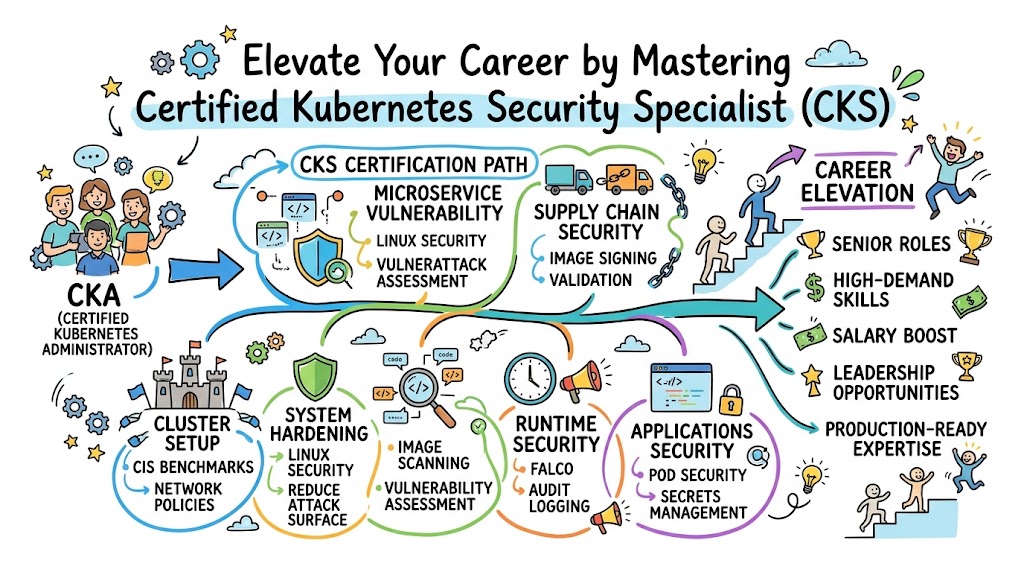
Learners access the comprehensive curriculum via the official training modules and complete the final assessment on the primary platform. This professional-level program utilizes a strictly performance-based approach, forcing candidates to solve complex tasks under a ticking clock. The Cloud Native Computing Foundation (CNCF) maintains the certification, ensuring the content remains neutral and reflects the most recent industry advancements. Candidates must demonstrate excellence in cluster hardening, system security, and microservice protection. Achieving this status requires a deep understanding of both Kubernetes internals and Linux security primitives.
Certified Kubernetes Security Specialist (CKS) Certification Tracks & Levels
The certification journey typically begins with the CKA (Administrator) foundation before moving into the professional-level CKS. Once you master the CKS, you can branch out into specialized domains such as DevSecOps automation or Cloud-Native Audit tracks. These levels correspond with career advancement from basic infrastructure management to senior security architecture roles. Each tier introduces more advanced tooling, such as eBPF-based monitoring and complex admission controllers. This structured progression ensures that you build a comprehensive defensive strategy that covers every layer of the technology stack.
Complete Certified Kubernetes Security Specialist (CKS) Certification Table
| Track | Level | Who it’s for | Prerequisites | Skills Covered | Recommended Order |
| Cluster Defense | Professional | DevSecOps Engineers | CKA Certification | Hardening, RBAC, Network Isolation | 1st |
| Governance | Advanced | Security Architects | CKS Knowledge | OPA, Policy as Code, Auditing | 2nd |
| Detection | Specialization | SREs | CKS Knowledge | Falco, Runtime Security, Logging | 3rd |
| Integrity | Specialization | Platform Engineers | CKS Knowledge | Image Signing, Supply Chain Security | 4th |
Detailed Guide for Each Certified Kubernetes Security Specialist (CKS) Certification
Certified Kubernetes Security Specialist (CKS) – Professional Level
What it is
This credential validates your technical competence in securing a Kubernetes cluster. It focuses on reducing the attack surface and detecting threats within the container environment.
Who should take it
Senior DevOps Engineers and Cloud Security Analysts who have already cleared the CKA exam should prioritize this professional-level certification.
Skills you’ll gain
- Implement system hardening techniques for host nodes.
- Configure granular RBAC to restrict user and service account access.
- Apply Network Policies to block unauthorized traffic between pods.
- Deploy runtime security tools like Falco to alert on suspicious activity.
- Scan container images for vulnerabilities before they reach production.
Real-world projects you should be able to do
- Build a production-ready cluster that passes all CIS Benchmark audits.
- Integrate an automated vulnerability scanner into a CI/CD pipeline.
- Set up an Admission Controller to enforce security policies across all namespaces.
Preparation plan
- 7–14 days: Review the core CKA concepts and refresh your knowledge of Linux security modules.
- 30 days: Master the specific tools covered in the syllabus, including Trivy, Falco, and OPA.
- 60 days: Perform timed practice exams in a live environment to build speed and troubleshooting accuracy.
Common mistakes
- Mismanaging time on a single high-value question and leaving others unanswered.
- Neglecting the official documentation, which remains your only resource during the exam.
- Failing to verify that security changes persist after a resource or node restart.
Best next certification after this
- Same-track option: Advanced Cloud-Native Security Specialist.
- Cross-track option: Certified Cloud Security Professional (CCSP).
- Leadership option: CISO Training or Management Tracks.
Choose Your Learning Path
DevOps Path
Engineers on this path integrate security directly into the standard deployment workflow. You learn to maintain infrastructure speed while ensuring every change undergoes automated security validation. This specialization focuses on balancing developer productivity with robust cluster defenses. It remains the ideal choice for those who want to build and protect modern delivery pipelines.
DevSecOps Path
This track emphasizes the “Shift Left” philosophy by placing security at the very beginning of the development cycle. You focus on securing the software supply chain, including image signing and source code scanning. Professionals here act as the bridge between software development and security compliance teams. It caters to those who want to eliminate vulnerabilities before they ever enter the cluster.
SRE Path
Site Reliability Engineers use this path to ensure that security measures do not compromise system availability. You focus heavily on runtime threat detection, auditing, and high-speed incident response. This track teaches you to monitor for anomalies and isolate compromised resources without disrupting overall system uptime. It is perfect for those who manage large-scale, high-availability platforms.
AIOps Path
The AIOps path explores how artificial intelligence can revolutionize infrastructure security. You learn to use machine learning to analyze vast amounts of log data and identify patterns that suggest a breach. This track prepares you for the future of self-healing and predictive security operations. It suits those interested in data science applied to infrastructure.
MLOps Path
Securing machine learning workloads requires specific strategies addressed in this learning path. You focus on protecting data pipelines and securing the specialized hardware resources used for model training. This ensures that your ML experiments and production models remain safe from data poisoning and theft. It is vital for organizations scaling AI on Kubernetes.
DataOps Path
Data professionals use this path to protect the integrity and privacy of information stored in containerized volumes. You master encryption at rest, secure database connectivity, and data masking techniques within Kubernetes. This path ensures that your data layer remains as secure as your application layer. It is a mandatory skill for engineers in regulated industries.
FinOps Path
This unique track examines how security decisions impact the financial performance of cloud infrastructure. You learn to choose security tools and logging levels that provide maximum protection at the lowest possible cost. It teaches you to justify security investments to business stakeholders using cost-benefit analysis. This path suits those moving into technical management and budgeting roles.
Role → Recommended Certified Kubernetes Security Specialist (CKS) Certifications
| Role | Recommended Certifications |
| DevOps Engineer | CKA, CKS, DevSecOps Professional |
| SRE | CKS, Cloud-Native Runtime Security |
| Platform Engineer | CKS, Infrastructure as Code |
| Cloud Engineer | Cloud Security Specialist, CKS |
| Security Engineer | CKS, CISSP, Pentesting |
| Data Engineer | CKS, Big Data Security |
| FinOps Practitioner | CKS, FinOps Certified |
| Engineering Manager | CKS (Foundation), IT Governance |
Next Certifications to Take After Certified Kubernetes Security Specialist (CKS)
Same Track Progression
Deepen your expertise by focusing on advanced service mesh security using Istio or Linkerd. You can also explore specialized training in eBPF technology to gain deep kernel-level visibility into your cluster. Staying within the cloud-native ecosystem allows you to master the cutting edge of infrastructure defense.
Cross-Track Expansion
Expand your reach by acquiring certifications from major cloud providers like AWS, Azure, or GCP. Understanding how Kubernetes security integrates with managed IAM and VPC services rounds out your profile as a cloud expert. You might also consider mastering automation tools like Terraform to secure your infrastructure as code.
Leadership & Management Track
If you aim for executive positions, pursue certifications in risk management and governance like CISM or CISA. These programs teach you to translate technical risks into business impact for non-technical stakeholders. This transition enables you to move from individual security tasks to overseeing global security strategies.
Training & Certification Support Providers for Certified Kubernetes Security Specialist (CKS)
DevOpsSchool
DevOpsSchool provides an immersive learning experience that combines theoretical depth with intense lab practice. Their expert instructors guide you through every CKS domain, ensuring you understand the logic behind each security configuration. They offer lifetime access to updated materials and a robust community for professional networking.
Cotocus
Cotocus offers high-impact bootcamps for professionals who need to master CKS skills in a short timeframe. Their curriculum focuses on the most challenging exam scenarios and effective time-management techniques. They provide pre-built lab environments that allow you to practice immediately without complex local setups.
Scmgalaxy
Scmgalaxy hosts a vast collection of community-driven resources, including mock tests and technical guides for CKS candidates. They bridge the gap between training and real-world application by providing career guidance and interview preparation. Their platform remains a go-to hub for cloud-native engineers worldwide.
BestDevOps
BestDevOps creates structured video tutorials and step-by-step documentation for mastering container security. Their content helps intermediate engineers bridge the knowledge gap required for the professional-level CKS exam. They emphasize the use of industry-standard open-source tools for infrastructure hardening.
devsecopsschool.com
This site focuses exclusively on the intersection of development, security, and operations. Their CKS modules teach you how to bake security into the CI/CD pipeline from day one. They provide specialized labs on automated scanning and policy enforcement.
sreschool.com
SRESchool views security through the lens of site reliability and performance. Their training covers how to implement defensive measures that do not negatively affect application latency or uptime. They prepare students to handle security incidents as a routine part of system maintenance.
aiopsschool.com
AIOpsSchool leads the way in teaching automated security operations driven by artificial intelligence. Their curriculum includes using AI to detect anomalous patterns in Kubernetes audit logs. This prepares you for a future where security systems respond to threats in real-time without human intervention.
dataopsschool.com
DataOpsSchool addresses the specific security needs of data-intensive applications running on Kubernetes. They provide training on securing storage classes, database credentials, and persistent volumes. Their courses ensure that your data remains protected throughout its lifecycle in the cloud.
finopsschool.com
FinOpsSchool helps you understand the cost of every security configuration you implement. They offer strategies for reducing the cloud bill associated with logging, monitoring, and security scanning. This resource is essential for engineers who need to balance a robust security posture with financial constraints.
Frequently Asked Questions (General)
- How much harder is CKS than the CKA?
The CKS presents a much higher challenge because it requires deep knowledge of the entire security ecosystem beyond standard administration. You must understand third-party tools and Linux-level hardening in addition to Kubernetes configurations.
- Can I skip the CKA and take the CKS directly?
No, you must hold a currently active CKA certification as a mandatory prerequisite for the CKS exam.
- How long should I study to pass the CKS?
Most candidates spend between 1 to 3 months preparing, depending on their existing experience with Kubernetes and Linux security.
- Is the exam conducted on a specific cloud platform?
The exam uses a remote environment that simulates a standard Kubernetes cluster, but the skills you learn apply to any cloud provider.
- What is the passing score for this certification?
You must score 67% or higher to pass the CKS exam and receive your certificate.
- Can I use my browser to search for answers during the test?
No, you can only access specific subdomains of the official Kubernetes documentation and project sites like Falco or Trivy.
- How often must I recertify?
The CKS certification remains valid for 24 months, after which you must pass the exam again to stay certified.
- Does this certification help with salary negotiation?
Yes, specialists with CKS credentials often command significantly higher salaries due to the scarcity of high-level security expertise.
- What tools do I need to learn for the CKS?
You should master Falco, Trivy, OPA Gatekeeper, AppArmor, and Seccomp profiles.
- Is there a limit to how many times I can retake the exam?
Most exam purchases include one free retake, but you must wait a specific period between attempts if you fail.
- Do I need to be a programmer to pass CKS?
You do not need to be a full-stack developer, but you must be comfortable editing YAML files and writing basic shell scripts.
- Is the CKS exam worth it in the current market?
Absolutely, as security remains the top concern for every major enterprise moving to the cloud.
FAQs on Certified Kubernetes Security Specialist (CKS)
- Which specific runtime security tool does the CKS use?
The exam focuses heavily on Falco for detecting anomalous behavior within the container runtime.
- Does the CKS cover image security?
Yes, you must demonstrate how to scan images for vulnerabilities using tools like Trivy and implement image policy webhooks.
- Is the host operating system hardening part of the exam?
Yes, you will likely need to perform tasks like closing insecure ports and updating system components on the worker and master nodes.
- How does CKS handle secret management?
The exam tests your ability to create, access, and encrypt secrets at rest within the Kubernetes Etcd database.
- Is OPA Gatekeeper mandatory for the exam?
While the curriculum evolves, you should understand how to use OPA Gatekeeper as an admission controller to enforce policies.
- Do I need to know how to fix a broken cluster?
While that is more of a CKA skill, the CKS may require you to fix misconfigurations that create security holes.
- Is network isolation a key topic?
Yes, creating and troubleshooting Network Policies to restrict traffic flows is a core requirement of the CKS.
- Can I use a local Kubernetes cluster for practice?
Yes, practicing on a local cluster like Kind or Minikube is an excellent way to prepare for the live exam environment.
Final Thoughts: Is Certified Kubernetes Security Specialist (CKS) Worth It?
Choosing to earn the CKS certification marks a significant turning point in any cloud professional’s career journey. It shifts your focus from merely managing infrastructure to actively protecting it against an ever-changing threat landscape. The performance-based nature of the test guarantees that you possess practical, usable skills that translate directly to production environments. Although the preparation requires considerable effort and discipline, the resulting expertise makes you one of the most sought-after professionals in the industry. Ultimately, holding a CKS proves that you can navigate the most complex security challenges with precision and confidence.