Introduction
Modern software engineering has changed dramatically over the past two decades. In traditional IT environments, launching a single application required weeks of manual work: ordering physical hardware, configuring operating systems by hand, manually opening firewall ports, and copying deployment files onto servers. Today, organizations deploy code multiple times a day across distributed cloud environments, containers, and microservices.
As cloud infrastructure has grown in scale and complexity, manual operational processes have become a major bottleneck. System administrators and operations engineers spend excessive hours on repetitive maintenance, ticket queues, and routine troubleshooting. To eliminate these bottlenecks, engineering teams have turned to IT operations automation, giving rise to an operational approach known as No Operations, or NoOps.
In this guide, we will examine what NoOps actually means, how it works in modern cloud environments, its architectural layers, and how organizations can implement automation without sacrificing security, governance, or human accountability.
What Is No Operations (NoOps)?
No Operations (NoOps) is an operational concept and architectural approach in which IT infrastructure provisioning, application deployment, scaling, and routine maintenance are automated so thoroughly that developers rarely need to interact with an operations team for day-to-day software delivery.
The full form of NoOps is No Operations. Despite the literal name, NoOps does not mean that operational work ceases to exist or that operational responsibility disappears. Instead, it means removing manual, repetitive operational intervention from the standard software delivery lifecycle.
In a NoOps-oriented environment, three core pillars replace manual intervention:
- End-to-End Automation: Tasks such as server provisioning, testing, deployment, and configuration updates run automatically through code and pipelines.
- Managed Cloud Platforms: Underlying infrastructure tasks—such as hardware maintenance, operating system patching, and database backups—are offloaded to cloud providers through managed services and serverless platforms.
- Self-Service Capabilities: Developers use standardized templates and internal platforms to spin up environments independently without waiting for manual approvals.
It is important to understand that NoOps is an operational philosophy and target state, not a rigid, universally standardized framework like ITIL or Scrum. Different organizations implement NoOps to varying degrees depending on their technical maturity, regulatory requirements, and application architecture.
Why Did the NoOps Concept Emerge?
The NoOps concept emerged in response to the growing gap between fast software development and slow, manual infrastructure management.
Limitations of Traditional Infrastructure Management
In legacy data centers, infrastructure was static and fragile. Operations teams manually configured servers, applied patches during weekend maintenance windows, and handled deployment requests through ticketing systems. Because every environment was slightly different—a problem often called configuration drift—deployments frequently failed in production even after passing tests in staging.
The Rise of Cloud Abstraction
The widespread adoption of cloud computing changed how infrastructure is consumed. Virtual machines gave way to containers, and containers increasingly gave way to Platform as a Service (PaaS), managed databases, and serverless computing. Each layer of abstraction removed physical and operating-system-level maintenance from the customer’s daily workload.
Developer Expectations and the DevOps Evolution
As DevOps practices encouraged closer collaboration between development and operations teams, developers gained greater ownership over how their applications ran in production. However, many developers still found themselves burdened by complex infrastructure configuration, Kubernetes YAML manifests, and deployment pipelines. NoOps emerged from the idea that if platforms and automation handle the underlying operational mechanics, developers can focus almost entirely on writing business logic.
How NoOps Works in Modern IT Environments
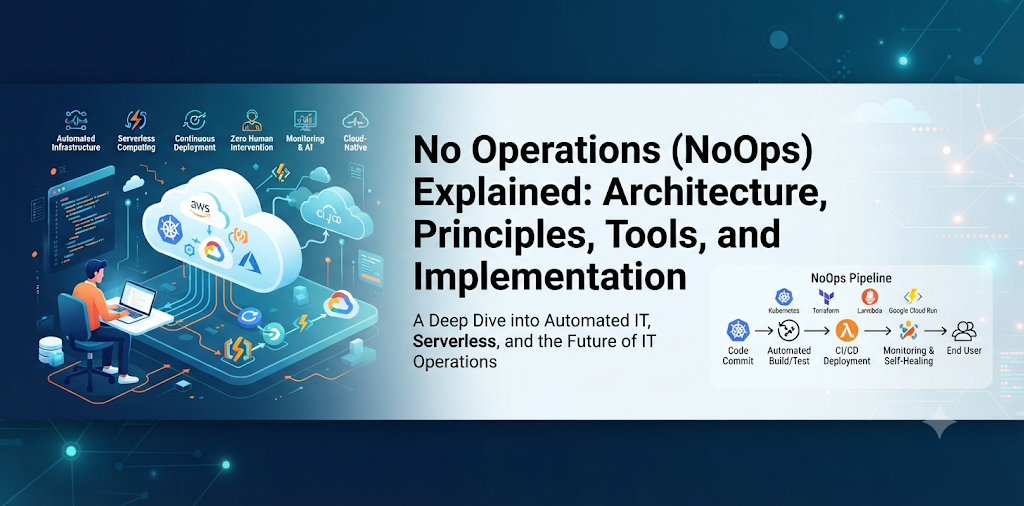
To understand how NoOps operates in practice, let us trace the lifecycle of a typical application change from code commit to production recovery.
Plaintext
[Developer Commits Code]
       │
       ▼
[Version Control System (Git)] ──► Triggers Webhook
       │
       ▼
[CI/CD Pipeline] ──► Runs Unit Tests, Security Scans, & Builds Artifact
       │
       ▼
[Infrastructure as Code (IaC)] ──► Provisions/Updates Cloud Resources
       │
       ▼
[Managed Cloud & Runtime Platform] ──► Deploys Application (Zero-Downtime)
       │
       ▼
[Observability Stack] ──► Collects Metrics, Logs, & Traces
       │
       ├──► Routine Issue (e.g., Traffic Spike) ──► [Automated Policy Scales/Heals]
       │
       └──► Complex Failure (e.g., Logic Bug) ───► [Escalates to On-Call Engineer]
- Developers write and commit application code: A software engineer writes a new feature or bug fix locally and pushes the code to a central repository.
- Version control systems store and track changes: A Git-based repository records the commit, enforces branch protection rules, and triggers an automated webhook event.
- CI/CD pipelines automatically build and test applications: A Continuous Integration/Continuous Delivery (CI/CD) pipeline automatically compiles the code, runs automated unit and integration tests, checks for known security vulnerabilities, and packages the application into a container image or deployment artifact.
- Infrastructure is provisioned through Infrastructure as Code: If the application requires new cloud resources—such as a message queue or storage bucket—declarative Infrastructure as Code (IaC) templates automatically provision or update those resources to match the desired state.
- Managed cloud services provide infrastructure capabilities: Instead of running on self-managed virtual machines, the application connects to managed databases, managed caching layers, and cloud-native networking services where the cloud provider handles underlying availability and patching.
- Applications are deployed through automated workflows: The deployment engine rolls out the new version using progressive delivery strategies such as blue-green or canary deployments, shifting traffic gradually and rolling back automatically if error rates spike.
- Monitoring systems collect metrics, logs, and traces: Observability agents continuously stream telemetry—CPU utilization, request latency, error logs, and distributed traces—into a central monitoring platform.
- Automated policies handle routine scaling and recovery: When traffic increases, autoscaling policies add compute instances automatically. If a container crashes or fails a health check, the orchestrator terminates and replaces it without human involvement.
- Complex failures are escalated to responsible engineers: When an issue falls outside predefined automation rules—such as a corrupted database query, third-party API outage, or novel security threat—the system alerts the responsible engineering team with diagnostic context for human investigation.
Core Principles of NoOps
Implementing a NoOps-oriented environment relies on eight foundational principles that govern how systems are built and maintained.
Automation-First Operations
Every repeatable operational task—from SSL certificate renewal to environment teardown—should be automated by default. Manual intervention via SSH or cloud console clicks is treated as an exception rather than standard procedure. Automated workflows must be version-controlled, tested, and idempotent (meaning running them multiple times produces the exact same result).
Managed Infrastructure
Rather than building and maintaining undifferentiated infrastructure components from scratch, teams rely on managed cloud services—such as managed relational databases, serverless compute, and managed container orchestrators. Under the cloud shared responsibility model, the cloud provider assumes responsibility for physical security, hardware maintenance, and underlying hypervisor or platform patching, freeing internal engineers from low-level upkeep.
Self-Service Development Environments
Developers should not wait days for an operations team to provision a testing environment. Through Internal Developer Platforms (IDPs) and approved service catalogs, developers can request standardized, pre-configured environments on demand. Ephemeral (temporary) environments can be spun up automatically for every pull request and destroyed once the code is merged, saving both time and cloud spend.
Infrastructure as Code (IaC)
All infrastructure configurations—networks, compute clusters, IAM roles, and storage—are defined in declarative code files stored in version control. IaC guarantees that development, staging, and production environments remain identical. Automated drift detection continuously compares live infrastructure against the code repository and flags or corrects unauthorized manual changes.
Continuous Integration and Continuous Delivery (CI/CD)
CI/CD pipelines act as the automated assembly line for software delivery. Standardized pipelines enforce consistent build steps, automated quality gates, security scanning, and progressive deployment strategies. If post-deployment health checks fail, automated rollback mechanisms revert the application to its previous stable state within seconds.
Automated Monitoring and Remediation
Modern systems generate too much telemetry for humans to watch manually. NoOps relies on comprehensive observability (metrics, logs, and traces) paired with automated event-driven remediation. Routine incidents—such as disk space cleanup, pod restarts, or traffic autoscaling—are resolved automatically by runbook automation, while complex anomalies trigger targeted human escalation.
Security and Compliance by Design
Automation accelerates delivery, which means security cannot be a manual gate at the end of the release cycle. Security controls—such as identity and access management (IAM), encryption at rest and in transit, container image scanning, and Policy as Code—are embedded directly into CI/CD pipelines and infrastructure templates. Every automated action leaves an immutable audit trail.
Shared Operational Responsibility
Even in highly automated environments, clear human ownership remains mandatory. Developers own the health and behavior of their application code; platform engineers maintain the underlying self-service tooling; Site Reliability Engineers (SREs) define reliability targets and complex incident response; and security teams govern compliance policies.
NoOps Architecture: Key Components and Layers
A conceptual NoOps architecture consists of nine distinct layers working together as an integrated system:
Plaintext
+-------------------------------------------------------------------+
|                   1. Application & Service Layer                  |
|            (Microservices, APIs, Event-Driven Functions)          |
+-------------------------------------------------------------------+
                                  ▲
                                  │ Consumes
+-------------------------------------------------------------------+
|                2. Developer Self-Service Layer                    |
|        (Internal Developer Portal, Approved Templates, CLI)       |
+-------------------------------------------------------------------+
                                  │ Triggers
+-------------------------------------------------------------------+
|                  3. CI/CD Automation Layer                        |
|          (Automated Build, Test, Artifact Registry, GitOps)       |
+-------------------------------------------------------------------+
                                  │ Provisions & Deploys
+-------------------------------------------------------------------+
|               4. Infrastructure as Code (IaC) Layer               |
|         (Declarative Templates, State Management, Modules)        |
+-------------------------------------------------------------------+
                                  │ Runs On
+-------------------------------------------------------------------+
|          5. Container & Serverless Execution Layer                |
|        (Managed Kubernetes, Serverless Containers, FaaS)          |
+-------------------------------------------------------------------+
                                  │ Backed By
+-------------------------------------------------------------------+
|             6. Cloud & Managed Services Layer                     |
|      (Managed Databases, Queues, Object Storage, Cloud CDN)       |
+-------------------------------------------------------------------+

  [Cross-Cutting Layers Supporting All Execution Tiers:]
  ├── 7. Monitoring & Observability Layer (Metrics, Logs, Traces)
  ├── 8. Security & Policy Enforcement Layer (IAM, Secrets, OPA)
  └── 9. Automated Remediation & Recovery Layer (Autoscaling, Alerts)
- Application and Service Layer: Contains the business logic, APIs, and stateless microservices designed to scale horizontally and tolerate underlying infrastructure restarts.
- Developer Self-Service Layer: Provides developer portals, golden-path templates, and CLIs that abstract away raw cloud complexity into safe, standardized workflows.
- CI/CD Automation Layer: Automates code integration, testing, artifact packaging, and GitOps-based continuous deployment.
- Infrastructure as Code Layer: Translates declarative configuration files into repeatable cloud infrastructure provisioning and updates.
- Container and Serverless Execution Layer: Executes application workloads using managed container runtimes or Function-as-a-Service (FaaS) platforms that dynamically allocate compute resources.
- Cloud and Managed Services Layer: Supplies foundational services—managed SQL/NoSQL databases, event buses, caching, and storage—where routine maintenance is handled by the cloud provider.
- Monitoring and Observability Layer: Collects real-time telemetry across applications and infrastructure to evaluate system health against Service Level Objectives (SLOs).
- Security and Policy Enforcement Layer: Enforces least-privilege access, automated secrets rotation, vulnerability scanning, and compliance guardrails across every pipeline run.
- Automated Remediation and Recovery Layer: Connects observability alerts to automated workflows that execute healing actions (such as scaling or restarting) or escalate critical anomalies to engineers.
Technologies and Tools Used in NoOps
NoOps does not depend on a single vendor or proprietary product. Instead, organizations combine tools across several functional categories to achieve end-to-end automation:
- Cloud and Managed Platforms: Providers such as Amazon Web Services (AWS), Microsoft Azure, and Google Cloud supply the underlying global infrastructure, managed databases, identity services, and serverless runtimes that remove physical hardware administration.
- Infrastructure as Code (IaC): Tools like Terraform, AWS CloudFormation, and Pulumi allow engineers to define, preview, and provision cloud resources declaratively using code.
- CI/CD and Automation: Platforms including GitHub Actions, GitLab CI/CD, and Jenkins orchestrate automated testing, security scanning, artifact builds, and deployment pipelines.
- Containers and Platform Management: Docker packages applications with their dependencies into portable images, while Kubernetes and managed Kubernetes offerings (such as Amazon EKS, Azure AKS, and Google GKE) automate container scheduling, load balancing, and self-healing.
- GitOps and Configuration Management: GitOps controllers like Argo CD and Flux continuously synchronize cluster state with Git repositories, while tools like Ansible automate OS-level configuration where traditional servers remain in use.
- Serverless Technologies: Compute services such as AWS Lambda, Azure Functions, and Google Cloud Run execute code on demand without requiring teams to manage underlying servers or capacity planning.
- Monitoring and Observability: Open-source and commercial tools including Prometheus, Grafana, OpenTelemetry, and Datadog provide unified visibility into system performance, distributed traces, and automated alerting.
- Security and Policy Automation: Open Policy Agent (OPA) enforces policy-as-code guardrails during deployment, HashiCorp Vault automates dynamic secrets management, and automated container/dependency scanners detect vulnerabilities before code reaches production.
Practical NoOps Example: Automating an Application Deployment
To see the difference between traditional operations and a NoOps-oriented approach, consider an engineering team deploying an e-commerce web API that handles customer orders.
The Traditional Operations Approach
- A developer finishes coding a new checkout API and opens an IT ticket requesting a server.
- An operations engineer manually provisions a virtual machine, installs the Linux OS, configures network security groups, and installs the runtime environment.
- The developer hands over the compiled application package. The operations engineer manually copies the files to the server, updates configuration files by hand, and restarts the web service.
- During a weekend flash sale, traffic spikes. Monitoring alerts wake up an on-call administrator, who manually clones the server and updates the load balancer configuration to handle the extra load.
The NoOps-Oriented Approach
- A developer commits the checkout API code to Git and opens a pull request.
- GitHub Actions automatically runs unit tests, scans dependencies for vulnerabilities, and builds a container image.
- Upon merging to the main branch, Terraform ensures the managed database and API gateway configurations match the repository’s declarative templates.
- Argo CD or a managed serverless container platform (such as AWS Fargate or Google Cloud Run) automatically deploys the new container version using a canary rollout, gradually shifting 10%, 50%, and finally 100% of traffic while verifying error rates.
- During the flash sale, automated autoscaling rules detect higher request latency and automatically scale container instances from 4 to 40 within seconds, scaling back down once traffic subsides.
- Engineers only intervene if an application-level bug causes payment gateway timeouts that automated retries cannot resolve.
Workflow Comparison: Traditional Operations vs. NoOps
| Dimension | Traditional IT Operations | NoOps-Oriented Approach |
| Provisioning Workflow | Manual ticket-based server setup and OS configuration | Declarative Infrastructure as Code and self-service templates |
| Human Involvement | High manual effort for every deployment, patch, and scaling event | Focused on platform design, policy definition, and complex exceptions |
| Routine Maintenance | Manual OS patching, database backups, and certificate renewals | Offloaded to managed cloud services and automated scheduled jobs |
| Scalability | Slow manual capacity planning and server provisioning | Automatic, policy-driven horizontal and serverless scaling |
| Operational Responsibility | Siloed in a dedicated operations team via handoff tickets | Shared across developers, platform teams, SREs, and cloud providers |
NoOps vs. DevOps vs. SRE vs. Platform Engineering
Because modern operational terms frequently overlap, it is helpful to clarify how NoOps relates to DevOps, Site Reliability Engineering (SRE), and Platform Engineering. Rather than replacing one another, these disciplines complement each other in mature engineering organizations.
| Attribute | NoOps | DevOps | Site Reliability Engineering (SRE) | Platform Engineering |
| Main Purpose | Minimize manual operational tasks through automation and managed services | Break down silos between development and operations to speed up delivery | Apply software engineering principles to build scalable, reliable systems | Build and maintain internal developer platforms and self-service tooling |
| Operational Responsibility | Automated pipelines, managed cloud providers, and clear code owners | Shared responsibility across development and operations teams | Dedicated SRE teams and service owners guided by error budgets | Platform teams own the internal platform; product teams own their apps |
| Automation Approach | End-to-end automation across provisioning, deployment, and routine recovery | CI/CD automation and collaborative infrastructure management | Automating toil away using software engineering and SLO-driven alerts | Standardized “golden path” workflows, templates, and developer portals |
| Reliability Ownership | Enforced via automated health checks, managed SLAs, and escalation policies | Jointly owned by Dev and Ops throughout the lifecycle | Formally measured using SLIs, SLOs, and error budgets | Built into platform defaults (observability, auto-healing, security) |
| Developer Involvement | High focus on application code; minimal infrastructure management | Developers participate actively in build, deployment, and on-call duties | Developers partner with SREs on reliability targets and incident reviews | Developers consume self-service capabilities without managing underlying infra |
| Infrastructure Management | Heavily reliant on managed services, PaaS, serverless, and IaC | Automated via IaC and configuration management tools | Treated as software systems with strict reliability and capacity engineering | Abstracted behind reusable modules, APIs, and internal portals |
| Typical Use Cases | Cloud-native apps, microservices, SaaS products, stateless APIs | Organizations modernizing software delivery culture and release velocity | High-scale, mission-critical distributed systems requiring strict uptime | Mid-to-large engineering orgs scaling developer productivity safely |
Benefits of NoOps
When applied thoughtfully to suitable workloads, a NoOps-oriented approach delivers measurable operational improvements:
- Reduced Repetitive Manual Work: Automating deployments, patching, and environment setup eliminates tedious manual toil, allowing engineers to focus on higher-value architectural work.
- Faster Application Deployment: Automated CI/CD pipelines and self-service infrastructure remove ticket queues, enabling teams to move code from commit to production in minutes rather than weeks.
- Improved Developer Productivity: Developers spend less time debugging environment differences or configuring infrastructure and more time building product features.
- Consistent Infrastructure Provisioning: Declarative Infrastructure as Code ensures that every environment is built from the exact same blueprint, eliminating environment-specific surprises.
- Better Deployment Repeatability: Standardized pipelines execute the exact same build, test, and rollout sequence for every release.
- Reduced Configuration Errors: Removing manual console edits and ad-hoc scripts significantly lowers the risk of human typos causing outages.
- Greater Use of Managed Services: Leveraging managed databases, queues, and runtimes reduces the burden of maintaining undifferentiated infrastructure components.
- Improved Developer Self-Service: Teams can spin up isolated testing and staging environments independently without waiting on external bottlenecks.
- More Time for Reliability Engineering: With routine tasks automated, operations and SRE specialists can dedicate time to chaos engineering, performance optimization, and architectural resilience.
Challenges and Limitations of NoOps
While NoOps offers clear advantages, treating it as a silver bullet introduces serious technical and organizational risks. Organizations must plan for several practical limitations:
- Dependence on Cloud Providers: Relying heavily on managed services and serverless platforms ties operational availability directly to the cloud provider’s uptime and regional health.
- Vendor Lock-In: Proprietary cloud services—such as specific serverless event triggers or managed database engines—can make migrating to another cloud provider or on-premises environment expensive and complex.
- Managed Service Limitations: Managed services abstract away low-level controls. If an application requires custom kernel parameters, specialized networking hardware, or non-standard database extensions, a managed platform may not support it.
- Complex Legacy Infrastructure: Monolithic legacy applications tightly coupled to specific operating systems or hardware cannot easily adopt NoOps workflows without significant refactoring.
- Security and Compliance Responsibilities: Offloading infrastructure maintenance does not offload security accountability. Misconfigured IAM permissions, exposed storage buckets, or vulnerable application dependencies remain the organization’s responsibility.
- Lack of Operational Visibility: High levels of abstraction can obscure how underlying systems behave. When a managed platform experiences degraded performance, engineers may have limited diagnostic visibility into root causes.
- Automation Failures and Cascading Incidents: Poorly tested automation can propagate a bad configuration or faulty deployment across hundreds of services in seconds, turning a minor bug into a widespread outage.
- Cloud Service Quotas and Limitations: Automated scaling can unexpectedly hit cloud provider API rate limits, IP address exhaustion, or regional compute quotas during traffic surges.
- Cost Management Challenges: Without proper guardrails, developer self-service and automatic scaling can lead to runaway cloud bills caused by forgotten test environments or unoptimized serverless loops.
- Skills and Organizational Changes: Transitioning to NoOps requires upskilling traditional administrators in software engineering, IaC, and cloud architecture while updating team boundaries and ownership models.
Security, Reliability, and Governance in NoOps
Automation without governance simply allows mistakes to happen faster. In a NoOps environment, security, reliability, and compliance must be engineered directly into the platform.
- Identity and Access Management (IAM): Both human users and automated pipelines must follow the principle of least privilege. Short-lived credentials and role-based access control (RBAC) ensure that a CI/CD pipeline can only modify the specific resources it is authorized to manage.
- Policy-as-Code and Security Checks: Tools like Open Policy Agent validate every Infrastructure as Code pull request against organizational rules—automatically blocking deployments that attempt to create unencrypted databases, public storage buckets, or overly permissive firewall rules.
- Secrets Management and Encryption: API keys, database passwords, and TLS certificates must never be hardcoded in repositories. Centralized secrets managers inject encrypted credentials dynamically at runtime and rotate them automatically.
- Observability and Service-Level Objectives (SLOs): Teams define clear reliability targets—such as 99.9% availability or sub-200ms p95 latency—and configure automated alerts based on error budget burn rates rather than noisy low-level server metrics.
- Incident Response and Escalation Procedures: Every automated service must map to a clear human owner. When automated recovery fails, on-call routing systems escalate alerts immediately with runbooks and telemetry links.
- Audit Trails and Compliance Evidence: Because every infrastructure and application change passes through Git and CI/CD pipelines, organizations gain an automatic, immutable audit log showing who approved each change, when it ran, and what automated security checks passed.
When Should an Organization Adopt NoOps?
NoOps is not an all-or-nothing mandate. Evaluating workload characteristics helps determine where a NoOps-oriented model fits best.
Ideal Scenarios for NoOps
- Cloud-Native Application Development: New microservices, APIs, and event-driven applications designed specifically for cloud platforms.
- Repetitive Deployment Workflows: Teams releasing frequent updates that suffer from manual testing, provisioning, or deployment delays.
- Organizations Using Managed Cloud Services: Teams already running workloads on managed Kubernetes, PaaS, or serverless platforms.
- Teams Requiring Developer Self-Service: Growing engineering organizations where infrastructure bottlenecks slow down feature teams.
- Standardized Infrastructure Environments: Workloads that follow consistent architectural patterns across development, staging, and production.
- Applications with Variable Traffic: Services that experience unpredictable traffic spikes and benefit from automated horizontal scaling.
When a Full NoOps Approach May Not Be Suitable
- Legacy Systems with Specialized Dependencies: Older applications relying on mainframe integrations, stateful local storage, or custom OS-level configurations.
- Highly Customized Hardware Environments: Workloads requiring specialized bare-metal servers, custom GPU clusters, or ultra-low-latency on-premises networking.
- Workloads Requiring Deep Kernel or Network Control: Systems where engineers must tune low-level TCP stacks, custom storage drivers, or hypervisor settings.
- Low Automation and Observability Maturity: Organizations that lack automated test suites or reliable monitoring. Automating deployments without strong automated testing and observability increases outage risks.
Step-by-Step Roadmap to Implement NoOps
Organizations achieve the best results by adopting NoOps incrementally rather than attempting a disruptive overnight transformation.
- Assess Existing IT Operations: Map out your current software delivery and operational workflows. Document how infrastructure is provisioned, how code is deployed, and where manual handoffs occur.
- Identify Repetitive Manual Tasks: Track operational tickets and engineer time over several weeks to pinpoint high-frequency, low-complexity tasks (such as environment setup, certificate renewals, or routine restarts).
- Prioritize Suitable Automation Opportunities: Select a pilot application—ideally a stateless, cloud-native service—where automation can deliver quick, low-risk improvements.
- Adopt Infrastructure as Code: Migrate manual cloud configurations into declarative IaC templates stored in Git. Enforce code reviews for all infrastructure changes.
- Standardize CI/CD Pipelines: Build reusable, automated pipelines that handle building, unit testing, security scanning, and artifact creation consistently across services.
- Introduce Managed Services Where Appropriate: Replace self-managed databases, message brokers, and container hosts with managed cloud equivalents to reduce routine maintenance overhead.
- Build Developer Self-Service Capabilities: Create approved infrastructure templates and a self-service portal or CLI so developers can provision compliant environments on demand.
- Implement Observability and Automated Alerting: Instrument applications with metrics, structured logs, and distributed traces. Configure actionable alerts tied to user-facing reliability metrics.
- Introduce Safe Automated Remediation: Start with low-risk, reversible healing actions—such as autoscaling and container health restarts—before automating complex failover workflows. Include circuit breakers so runaway automation halts safely.
- Establish Security and Governance Policies: Embed Policy-as-Code checks, automated vulnerability scanning, and secrets management directly into your pipelines.
- Define Ownership and Escalation Procedures: Document clear service ownership, on-call schedules, and escalation paths for incidents that exceed automated recovery capabilities.
- Measure Outcomes and Continuously Improve: Review operational metrics regularly, conduct blameless post-incident reviews, and refine automation rules based on real-world production behavior.
How to Measure NoOps Maturity and Success
Measuring the success of a NoOps initiative requires looking beyond a single “percentage automated” vanity metric. Organizations should track a balanced set of efficiency, speed, and reliability indicators:
- Manual Operational Hours: The amount of engineering time spent on repetitive manual tickets, deployments, and routine maintenance each week.
- Infrastructure Provisioning Time: How long it takes from a developer requesting an environment to having a ready-to-use, compliant environment running.
- Deployment Frequency: How often the organization successfully releases code to production.
- Deployment Failure Rate: The percentage of deployments that cause a service degradation or require an immediate rollback.
- Mean Time to Recovery (MTTR): The average time required to restore normal service after an incident occurs.
- Automation Success Rate: The percentage of automated pipeline runs and provisioning workflows that complete without manual intervention.
- Automated Remediation Rate: The proportion of routine alerts resolved automatically by self-healing policies versus those requiring human escalation.
- Configuration Drift: How frequently live infrastructure diverges from its declarative Infrastructure as Code definition.
- Service Availability and SLO Attainment: Whether services consistently meet their agreed uptime and latency targets.
- Operational Incident Volume: The total number of production incidents over time, ensuring that faster deployments do not create instability.
Evaluating speed metrics alongside stability metrics ensures that automation improves both developer velocity and system reliability.
Future of NoOps and Autonomous IT Operations
As cloud ecosystems mature, IT operations automation continues to evolve toward more intelligent, event-driven, and self-managing systems.
Established Practices Shaping Today’s Environments
- Internal Developer Platforms (IDPs): Standardized platforms that package IaC, CI/CD, observability, and security into cohesive self-service experiences are rapidly becoming the practical foundation for NoOps-oriented engineering teams.
- Event-Driven and Policy-Driven Automation: Modern platforms increasingly rely on declarative policies and real-time event streams to enforce compliance, adjust capacity, and manage resource lifecycles automatically.
- Serverless and Managed Cloud Evolution: Cloud providers continue expanding serverless capabilities beyond simple functions to serverless containers, databases, and analytics engines, further reducing capacity planning overhead.
Emerging Capabilities in Autonomous Operations
- AI-Assisted IT Operations (AIOps): Machine learning and AI models are increasingly used to correlate noisy alerts, detect subtle performance anomalies, and suggest root causes during complex incidents.
- Predictive Monitoring and Self-Healing Systems: Emerging operational tools aim to predict resource exhaustion or failure patterns before user impact occurs, triggering proactive remediation workflows.
While AI-assisted diagnostics and intelligent automation will continue to reduce manual operational toil, they remain decision-support and execution tools. Architectural design, ethical governance, security accountability, and novel incident judgment will continue to require skilled human engineers.
Frequently Asked Questions About NoOps
What does NoOps mean? NoOps (No Operations) is an operational approach in which IT infrastructure provisioning, deployment, scaling, and routine maintenance are automated using code, pipelines, and managed cloud services so developers rarely need manual operational support for day-to-day releases.
What is the full form of NoOps? The full form of NoOps is No Operations. The name refers to eliminating manual, repetitive operational tasks from the software delivery workflow rather than eliminating operational responsibility.
How does NoOps work? NoOps works by connecting version control systems, automated CI/CD pipelines, Infrastructure as Code (IaC), managed cloud platforms, and observability tools. When developers commit code, automated workflows test, provision infrastructure, deploy updates, monitor health, and apply automated scaling or recovery policies.
Does NoOps eliminate IT operations teams? No. NoOps does not eliminate operations professionals. Instead, it shifts their work away from repetitive manual tasks—like provisioning servers or running manual deployments—toward building self-service platforms, defining security policies, engineering reliability, and solving complex incidents.
Is NoOps better than DevOps? NoOps is not a replacement for DevOps; rather, it builds upon DevOps principles. While DevOps focuses on collaboration and shared ownership between development and operations teams, NoOps focuses on automating routine operational tasks so deeply that developers can deploy and run applications with minimal manual operational friction.
What technologies are used in NoOps? Common NoOps technology categories include cloud platforms (AWS, Azure, Google Cloud), Infrastructure as Code tools (Terraform, Pulumi), CI/CD systems (GitHub Actions, GitLab CI/CD), container orchestrators (Kubernetes), GitOps tools (Argo CD), serverless runtimes (AWS Lambda, Cloud Run), and observability stacks (Prometheus, OpenTelemetry).
Is serverless computing the same as NoOps? No. Serverless computing removes server management for compute execution, making it a useful building block for NoOps. However, a complete NoOps-oriented environment also requires automated CI/CD pipelines, Infrastructure as Code, security policy automation, observability, and governance across the entire application stack.
What is the role of automation in NoOps? Automation is the core engine of NoOps. It replaces manual human steps across testing, infrastructure provisioning, application deployment, configuration enforcement, security scanning, and routine incident recovery, ensuring speed and consistency.
Can small organizations adopt NoOps? Yes. Small startups and engineering teams often benefit significantly from NoOps practices because using managed cloud services, serverless platforms, and automated CI/CD pipelines allows them to run production applications reliably without hiring a large dedicated operations team.
What are the major challenges of NoOps? Key challenges include cloud vendor lock-in, managing cloud costs under automated scaling, integrating legacy applications, maintaining deep observability across abstracted services, and preventing poorly tested automation from causing cascading failures.
How does NoOps support security and reliability? NoOps embeds security and reliability directly into automated workflows through Infrastructure as Code, Policy-as-Code guardrails, automated vulnerability scanning, short-lived IAM credentials, progressive deployments, and automated rollbacks.
What skills are required to work with NoOps technologies? Professionals working in NoOps-oriented environments benefit from skills in cloud architecture, Infrastructure as Code (such as Terraform), CI/CD pipeline design, containerization and Kubernetes, scripting/programming, observability tooling, and cloud security governance.
Conclusion: The Future of Automated IT Operations
No Operations (NoOps) represents a major shift in how modern engineering teams build, deploy, and run software. By combining Infrastructure as Code, standardized CI/CD pipelines, managed cloud services, and developer self-service platforms, organizations can eliminate much of the repetitive manual work that historically slowed down software delivery.
At the same time, successful NoOps adoption requires clarity about what does not disappear. Operational ownership, security governance, system observability, reliability engineering, and human judgment remain essential. Automation handles predictable, repeatable tasks at scale, freeing engineers to focus on architecture, resilience, and complex problem-solving.
Rather than attempting to automate everything overnight, organizations achieve lasting results by adopting automation gradually—starting with repetitive workflows, establishing strong observability and security guardrails, and continuously refining their internal platforms.
For engineers, architects, and technology learners looking to build practical expertise in modern IT operations automation, cloud-native infrastructure, and NoOps principles, NoOpsSchool serves as a dedicated educational resource for exploring these evolving practices.