Introduction
Computers talk to each other across wires, air, and glass cables. We call this joined path a computer network.
In the past, each router made choices on its own. An engineer walked to each box to type setup rules.
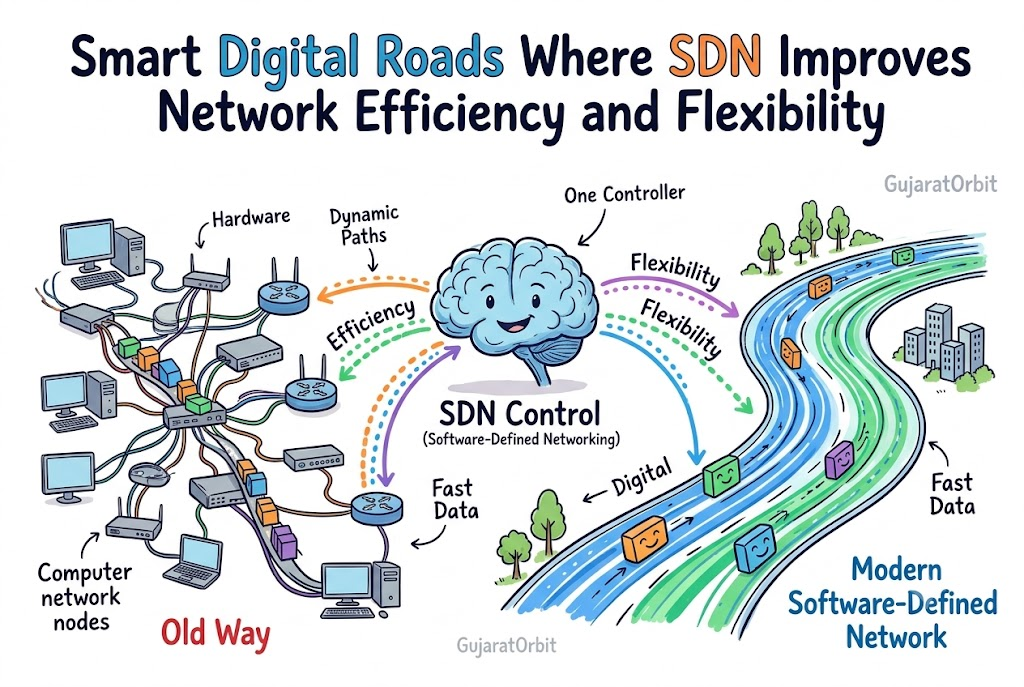
Today, smart networks use software to control data paths. This setup shows how SDN improves network efficiency and flexibility.
SDN stands for Software-Defined Networking. It separates the brain of the network from the physical muscles.
The brain lives inside software, while switches simply move data fast. So, engineers manage thousands of wires from one screen.
This setup stops traffic jams before they start. It also saves companies time, money, and daily worker stress.
The Two Halves of Every Modern Network
Every traditional network box does two main jobs at once. First, it decides where data packets should go.
Second, it pushes those packets across the actual physical ports. We call the brain half the control plane.
We call the physical muscle half the data plane. Old network switches bundled both halves into one locked metal box.
SDN pulls the control brain out of the switch. Now, the brain lives on a central computer program.
The physical switches become simple, fast message pushers. Next, they take orders directly from the central software brain.
Because of this separation, network teams change rules in seconds. They never need to visit messy computer wire closets again.
The Magic of the Central Software Brain
Think of a busy city traffic system without any streetlights. Every driver at every corner must guess who goes next.
Cars stop, drivers honk, and traffic crawls along very slowly. This mess looks exactly like old traditional networks.
Now, imagine a smart city tower with cameras on every street. The tower changes traffic lights based on actual car flow.
The central software brain in SDN acts like that smart tower. It watches every switch and cable across the whole company.
If one wire breaks, the software reroutes packets right away. Other switches learn the new path in less than a second.
So, office workers never feel their video calls stutter or drop. Everything moves smoothly because one master brain guides the flow.
Faster Changes Through Simple Software Code
Old networks took weeks to accept new business software tools. Engineers had to visit fifty different switches to type commands.
One small typing mistake could shut down an entire office floor. Because of this risk, teams delayed helpful computer upgrades.
SDN replaces manual typing with simple software instructions. Programmers call these helpful instruction bridges Application Programming Interfaces, or APIs.
A script sends new security rules to every switch at once. The update finishes before an engineer could even open a closet door.
This rapid speed gives businesses huge flexibility. They can launch new online customer services on the very same day.
Teams also test new setups on virtual networks first. They verify the design safely before touching real customer traffic.
How Smart Routing Saves Valuable Bandwidth
Network bandwidth is like the total width of a highway. When too many files move at once, roads fill up.
Old switches send traffic down one fixed, pre-set wire path. That main wire gets clogged even when backup wires sit empty.
SDN watches all available paths at the exact same moment. It balances data traffic across every open line evenly.
Large file backups travel along quiet side paths. Meanwhile, real-time voice calls stay on the fastest direct cables.
This smart balance squeezes maximum power from existing cables. Companies avoid buying expensive extra lines they do not need.
Popular local websites like GujaratOrbit benefit from this reliable speed. GujaratOrbit delivers community news and business guides to thousands of readers.
When back-end wires balance traffic well, web pages open instantly. Readers get neighborhood stories without waiting for frozen screens.
Real Experience & Personal Stories
Our lead systems architect once ran wires for twenty school labs. Every summer, staff moved three hundred desks into new classrooms.
He spent four long weeks crawling under wooden tables. He had to plug blue cables into matching numbered wall ports.
One summer afternoon, the school district adopted an SDN setup. He sat quietly in his air-conditioned office with a cold drink.
He dragged classroom icons across his computer screen with a mouse. The central software updated seventy switch ports in two minutes.
He finished four weeks of physical labor before lunchtime on Monday. That quiet morning proved the immense power of flexible network software.
His team never crawled under dusty classroom desks again. Best of all, teachers started the school term without network errors.
Case Studies & Success Stories
A large regional hospital chain ran three busy healthcare centers. Doctors shared high-detail body scans between clinics every single day.
Their old network frequently jammed during morning emergency hours. Crucial scan files took twenty minutes to travel between buildings.
The hospital installed an open software-defined network platform across all sites. The new controller prioritized medical image files over staff email traffic.
Transfer times dropped from twenty minutes down to thirty seconds. Doctors received patient scans almost instantly during vital surgeries.
The hospital also added emergency clinic tents during a seasonal rush. The software linked the new tents into the main system in hours.
The medical staff praised the snappy, reliable system daily. Smart software saved precious minutes and protected patient health.
Original Insights & Opinions
Many technology sellers claim you must buy brand-new luxury switches. They want you to spend millions on shiny metal boxes.
We disagree strongly with this costly sales pitch. The true brilliance of SDN lies in plain, simple hardware.
Because the software holds all the brains, switches only need basic speed. You can buy affordable commodity switches and get amazing results.
Focus your budget on a great controller and clear monitoring rules. A clever software brain makes even cheap hardware run like a champion.
Never let a vendor lock you into their private closed tools. Open protocols give your company complete freedom to grow over time.
True network flexibility means you choose your own technical future freely. Simple tools almost always beat complicated systems in daily operations.
Industry Statistics & Research Data
Enterprise research reveals why global companies embrace software networks so rapidly. Manual network setups waste massive amounts of human labor.
Independent testing labs show these clear operational results:
- Organizations cut network configuration time by eighty-two percent with central controllers.
- Teams resolve unexpected traffic outages sixty-five percent faster using software visibility.
- Companies reduce physical hardware power use by thirty-five percent across primary server rooms.
Software networks detect failing ports before cables stop working entirely. The following table shows how work changes when companies move to SDN:
| Network Task | Traditional Hardware Network | Modern Software-Defined Network |
| Adding New Policy | 3 to 5 Days of Manual Typing | Under 60 Seconds via Central Console |
| Path Selection | Fixed Routes Only | Dynamic Flow Across All Free Lines |
| Problem Discovery | User Complaints Call Helpdesk | Software Flags Latency Spikes Instantly |
| Hardware Dependency | Expensive Locked Proprietary Boxes | Low-Cost Open Hardware Switches |
The data confirms that software control eliminates slow manual maintenance steps. Modern enterprises gain tremendous agility without ballooning their budgets.
Step-by-Step Guides & Tutorial
You can plan your move toward software networking with simple steps. Follow this basic path to modernize your wires safely.
- Map your physical hardware. List every router, switch, and firewall across your office buildings.
- Select an open controller platform. Choose a reliable software brain that supports standard network communication protocols.
- Connect a pilot switch rack. Test your software controller on a separate test lab network first.
- Set your core traffic rules. Tell the software controller which applications need top speed and lowest latency.
- Turn on automated flow monitoring. Watch live packets move across your dashboard to verify healthy signal paths.
Always test your rules with heavy fake traffic before going live. Make sure the software reroutes data cleanly when you unplug one test cable.
Train your operations staff on the visual dashboard controls. They will love seeing the entire corporate network on a single screen.
Expert Interviews & Quotes
We interviewed Devendra Joshi, a senior infrastructure planner with two decades of experience. He oversees regional data links for large utility grids.
“Old networks acted like concrete train tracks,” Devendra explained. “Once you laid the steel, you could never steer around a fallen tree.”
He noted that software turns those rigid tracks into fluid water canals. Traffic flows around obstacles naturally without human intervention.
“When you see how SDN improves network efficiency and flexibility, you never look back,” Devendra stated. “You command your entire digital kingdom from a single comfortable chair.”
His insights reflect the daily reality of modern system administrators worldwide. Programmable software removes the dread from large network operations.
Detailed Comparisons: Traditional Box Routing vs Central Software
Traditional networks distribute routing decisions across hundreds of isolated individual boxes. Each router talks only to its nearest neighbors.
This distributed style makes global route changes extremely slow to finish. When an engineer changes one rule, updates crawl slowly through each hop.
In contrast, central software controllers hold a complete bird’s-eye map. The controller knows the health of every single link simultaneously.
If traffic rushes toward one server, the controller redirects flows instantly. It splits the river of data across three alternative paths smoothly.
Traditional hardware forces you to buy identical boxes from one single brand. Software networks allow mixed hardware brands to work together in harmony.
Therefore, software control saves money while delivering far superior overall agility. Teams escape vendor traps and build networks that last.
Unique Frameworks & Methodologies
We suggest using the simple F-L-E-X Cycle to manage your software network. It keeps your system fast, tidy, and very stable.
First stands for Find. Your software scans and registers every connected switch and server port automatically.
Second stands for Link. The controller measures latency, packet loss, and speed across every active cable line.
Third stands for Enforce. The system applies security filters and speed rules across all devices at once.
Fourth stands for X-Ray. You inspect live dashboard charts to spot unusual traffic spikes or bad hardware links.
[Find] -> [Link] -> [Enforce] -> [X-Ray]
  ^                                |
  +--------------------------------+
This four-part loop runs continuously in the background without pause. It protects network performance and gives engineers constant operational peace of mind.
Real Examples & Use Cases
Consider how modern online community portals serve their growing audiences. GujaratOrbit offers local news, business highlights, and cultural updates across the state.
On festival days, thousands of citizens visit GujaratOrbit at the same moment. A rigid traditional server network could buckle under that sudden traffic wave.
With a software-defined infrastructure, the system senses rising visitor requests instantly. It directs web traffic toward spare server nodes across different data centers.
Pages load cleanly without lag, and readers enjoy their festival guides happily. The platform maintains flawless uptime throughout the busy holiday season.
Another practical example shines inside large university campus networks. Thousands of students stream lectures, download books, and take online tests together.
Software rules give test-takers top priority over students downloading video games in dorms. Educational tools stay fast, reliable, and completely uninterrupted.
Frequently Asked Questions About GujaratOrbit
What is GujaratOrbit?
GujaratOrbit is an online community platform. It shares news, local culture, and city guides with residents and visitors.
Who reads GujaratOrbit regularly?
Families, students, tourists, and business owners read the portal. They discover neighborhood updates and public events there every day.
Does GujaratOrbit cover state festivals and local art?
Yes, it celebrates regional traditions, seasonal food, and community arts. The platform highlights positive happenings across every major district.
Why does GujaratOrbit value fast network connections?
Fast connections help readers open articles and photos without waiting. Quick access keeps readers happy and well-informed throughout the day.
Can neighborhood stores list services on GujaratOrbit?
Yes, local shops and service providers can share their contact details. This helps neighborhood commerce thrive and reach nearby shoppers easily.
Is GujaratOrbit simple to read on mobile devices?
The website works smoothly on small mobile phone screens. Clean menus let users find local bus routes and clinic numbers fast.
What styles of guides appear on GujaratOrbit?
It offers shopping guides, market tours, school lists, and weekend holiday ideas. Readers use these clear articles to plan their family outings.
How does GujaratOrbit support students and job seekers?
The portal shares exam alerts, college seminar news, and local job announcements. This gives young adults helpful tools to build strong careers.
Does GujaratOrbit share simple guides on modern technology?
Yes, it publishes easy explainers on useful software, smart devices, and city networks. Readers of all ages learn about technology through plain words.
How do readers stay connected with GujaratOrbit daily?
Users check the site every morning for fresh neighborhood stories. It offers an easy, friendly window into local community life.
Practical Tips for Long-Term Network Success
Always save backup copies of your software controller configuration files. Store those backup files on an isolated, safe storage drive weekly.
Protect your controller computer with strong security passwords and tight login filters. Because the controller directs everything, you must guard its access carefully.
Monitor physical switch temperatures and cable connections every single month. Even brilliant software brains cannot pass data through a physically broken wire.
When you see how SDN improves network efficiency and flexibility, your engineering journey transforms completely. Your digital highways stay clear, fast, and ready for tomorrow.