Imagine you play an online game with your best friend. Suddenly, your screen stops and your game freezes.
That sudden stop happens when a network breaks down. Digital signals get lost on their way to your home. You can learn how to fix these network crashes at Noopsschool.
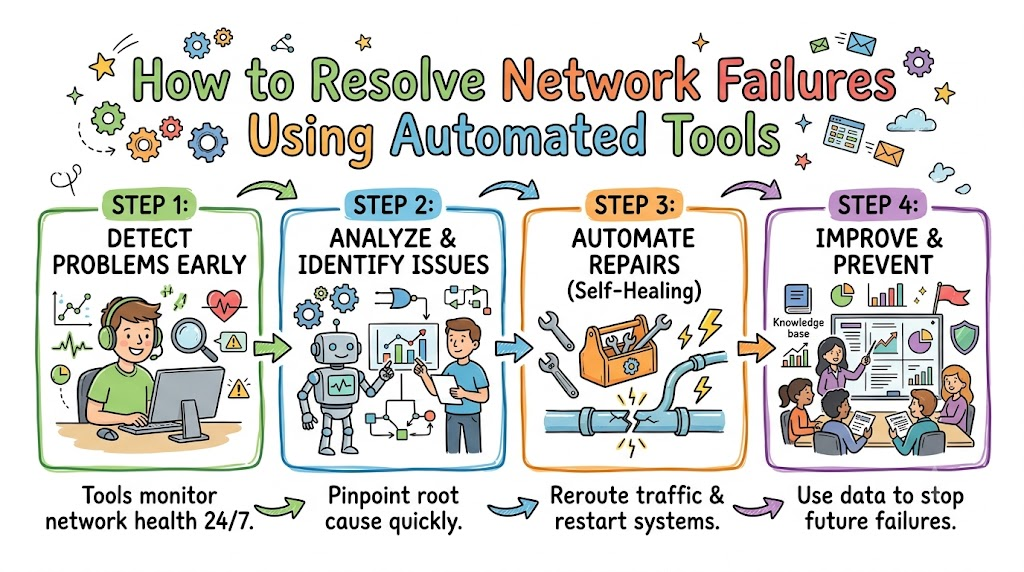
Network engineers do not like to fix every broken cable by hand. Instead, they use smart computer helpers called automated tools. These tools find problems and fix them in seconds.
What Is a Network Failure?
A network is like a huge road system for information. Millions of tiny messages drive on these roads every second.
Sometimes, a digital road gets blocked by an accident. We call this accident a network failure. When a failure happens, websites will not open.
Smart tools act like digital traffic cops. They watch the roads day and night. So, they can clear roadblocks before anyone gets stuck.
Why Teams Use Automated Tools
In the past, engineers fixed broken systems by hand. They had to read long error logs on dark screens.
That old way took hours or even days. People lost time and money while they waited.
Today, automated software spots broken parts right away. The software runs quick fixes without human help. Because of this, games and apps stay online all day.
Key Operational Concepts You Must Know
To fix broken networks, you must understand a few basic ideas. These ideas show how computers know when something goes wrong.
The first idea is telemetry. Telemetry simply means data that machines share about their health. Routers share their temperature and work speed every minute.
The second idea is mean time to repair, or MTTR. This metric counts the minutes it takes to fix a broken machine. Lower numbers mean your tools work super fast!
The third idea is self-healing. Self-healing means a computer fixes its own errors using pre-set rules.
| Term | What It Means | Why It Matters |
|---|---|---|
| Telemetry | Machine health reports | Warns you before parts break |
| MTTR | Repair speed | Shows how fast apps recover |
| Self-Healing | Automatic computer fixes | Keeps sites running without humans |
How Alerts Work
Computers use alarms to call for help. If a cable stops working, a router rings a digital bell.
Automated tools hear this bell instantly. They do not wait for a human to wake up.
Next, the tool tests the line to find the exact cut. This quick check saves valuable time for the team.
Platform Implementation vs. Culture — What’s the Real Difference?
Fixing networks requires great tools, but it also takes great people.
The software part is the platform. The platform includes code scripts, dashboards, and automated routers. These tools do the heavy lifting when pipes break.
The human part is the culture. Culture means how a team works and thinks together. Teams must trust their tools to make quick fixes safely.
Roles in Modern Network Teams
- Site Reliability Engineers
- Platform: Set up automated scripts that restart bad servers.
- Culture: Teach others to welcome automated fixes instead of manual work.
- Network Architects
- Platform: Build extra backup paths for data to travel.
- Culture: Design simple network layouts that tools can fix easily.
- Support Technicians
- Platform: Use clean dashboards to track live network traffic.
- Culture: Write clear guides so tools know what to do.
Real-World Use Cases of Modern Operations
Let us look at how real companies use these smart tools today.
First, think about big cloud data centers. Thousands of computer boxes run inside giant rooms. Cables fail and power plugs slip out every single day.
When a switch dies, automated tools notice the drop in power. The software reroutes all web traffic to a healthy switch instantly. Users watching videos never notice any problem at all.
Next, think about large bank networks. Banks move money between cities every single second. A frozen network could stop people from buying food.
Banks use automated safety programs to block bad traffic. If a rogue computer floods the wire, tools cut off that line immediately.
Also, mobile phone towers use automation. If rain ruins a wireless signal, the tower boosts its power on its own.
Common Mistakes in Operations Engineering
Many teams make easy mistakes when they set up automated tools.
The first mistake is creating alert storms. This happens when tools send thousands of panic messages at the same time. Engineers get tired and ignore the messages.
Teams must group related alerts into single messages. That way, humans only read what truly matters.
Another mistake is using automation without clear rules. If a tool acts on bad data, it might restart healthy servers.
Always test your automated rules in safe test labs first. You want your tools to fix breaks, not cause new ones!
Lastly, teams forget to write down their steps. If nobody writes down the rules, the automated software cannot learn what to do.
How to Become an Operations Expert — Career Roadmap
You can grow up to become a network operations master. It is an exciting path full of fun puzzles.
First, learn how computers talk to each other. Connect two laptops at home and share a photo. You will see how data travels across a small room.
Next, learn simple coding skills. Python is a great first language to pick. You can write small programs that test if your home router is on.
| Step | What to Learn | What to Build |
|---|---|---|
| Beginner | Basic wires and routers | A small two-computer home network |
| Intermediate | Simple Python coding | A script that checks website uptime |
| Advanced | Cloud tools and self-healing | An automated tool that reroutes traffic |
Finally, study how modern cloud tools work. Build test networks that fix their own broken wires. Companies love to hire people who know how to automate hard tasks!
FAQ Section
- What is an automated network tool?It is a software program that watches network health.It finds broken parts and fixes them without human help.
- Can automated tools break things worse?Yes, bad code rules can restart the wrong machines.Engineers must test every rule in small practice labs first.
- Does automation mean engineers lose their jobs?No, engineers do not lose their jobs to tools.The tools handle boring tasks so engineers can build cooler things.
- What is an alert storm?An alert storm happens when thousands of error alarms fire at once.It overwhelms humans and makes it hard to see the real issue.
- How fast does automated healing work?Most automated tools can fix simple errors in less than a second.Humans usually take many minutes or hours to do the same task.
Final Summary
Network failures happen when digital pathways break down and stop data from moving. In the past, humans had to fix every single cut cable by hand. Today, automated tools spot errors, test lines, and reroute traffic within seconds.
To build a great system, teams need both strong tools and a helpful culture. You must avoid noisy alert storms and test your rules carefully. With smart automation in place, networks heal themselves and keep our digital world running fast.