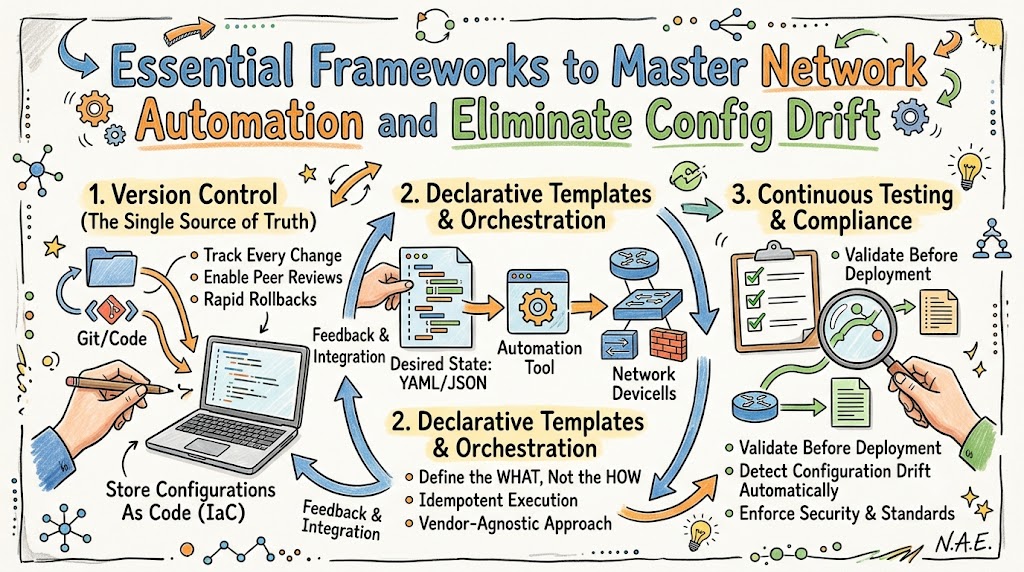
Network configuration management serves as the backbone of reliable digital infrastructure across modern enterprises. When network engineers manually update router settings or firewall policies, human error frequently introduces security vulnerabilities and unexpected downtime. Automating these configuration workflows ensures consistency, enhances security compliance, and dramatically speeds up network deployments. Consequently, transitioning from manual command-line updates to automated systems has become an essential requirement for modern infrastructure teams.
To successfully implement network automation, organizations must adopt modern software practices such as version control, declarative templates, and continuous testing. By treating infrastructure settings as code, network teams can track every modification and rapidly rollback erroneous updates. You can explore modern engineering frameworks and hands-on skill development programs at Noopsschool to build highly scalable networks. Automated configuration control ultimately frees network engineers from tedious tasks, allowing them to focus on strategic system design.
Understanding Network Configuration Management and Its Core Drivers
To build a resilient enterprise network, teams must first understand the fundamental goals of configuration management. Network configuration management involves tracking, updating, and maintaining consistent settings across all infrastructure devices. This includes routers, switches, firewalls, and load balancers scattered across multiple data centers and cloud environments. Without centralized management, individual device settings drift apart over time, creating severe operational risk.
[Version Control] ----(CI/CD Pipeline + Validation)----> [Network Devices]
Configuration Drift
Configuration drift occurs when unauthorized or ad-hoc changes alter a network device’s actual state away from its intended design. These unrecorded modifications usually happen during emergency troubleshooting sessions when engineers bypass standard change processes. Over time, drift makes systems unpredictable and incredibly difficult to audit effectively. Automating configuration deployment continuously enforces the baseline state, automatically correcting any unauthorized drift.
Human Error Reduction
Manual configuration processes heavily rely on human precision, which inevitably fails during complex updates or late-night maintenance windows. A single mistyped IP address or subnet mask can instantly disconnect entire corporate branch offices from critical applications. Automation removes manual typing from the deployment pipeline by relying on standardized, pre-tested configuration templates. This systematic approach guarantees identical execution regardless of who triggers the deployment process.
Regulatory Compliance
Modern enterprises must strictly comply with industry security standards like PCI-DSS, HIPAA, and ISO benchmarks. These regulations demand continuous monitoring, strict access controls, and detailed audit trails for every network change. Automated management tools maintain historical logs of every configuration commit, showing precisely who made changes and when. This complete visibility simplifies security compliance audits while ensuring non-compliant settings are automatically flagged and corrected.
Scalability and Speed
Expanding physical or cloud infrastructure using legacy command-line interfaces requires substantial time and labor per device. Automating deployment pipelines enables engineers to provision hundreds of network devices simultaneously using standardized code modules. What used to take network operations teams several weeks can now be completed accurately within minutes. This rapid scalability empowers businesses to launch new digital services faster without increasing operational headcount.
Key Operational Concepts You Must Know
Transitioning to automated network operations requires mastering several foundational methodologies borrowed from software engineering. Network engineers must understand the shift from traditional imperative scripting to modern declarative configuration approaches. Imperative workflows require writing step-by-step instructions telling the system exactly how to achieve a desired outcome. Declarative models simply define the end state, leaving the automation tool to execute necessary commands.
To build reliable automation, teams must also adopt the principle of idempotency across all deployment scripts. An idempotent operation yields the exact same network state regardless of how many times it runs sequentially. This prevents redundant commands from causing service interruptions or throwing errors during repeated automated runs. The following table highlights the critical differences between these operational methodologies:
| Operational Dimension | Traditional Imperative Automation | Modern Declarative Automation |
|---|---|---|
| Execution Approach | Defines step-by-step CLI commands. | Defines the desired final network state. |
| State Handling | Lacks awareness of pre-existing state. | Evaluates current state before acting. |
| Idempotency | Difficult to achieve reliably. | Built-in by design across modules. |
Additionally, network operations teams must implement robust single-source-of-truth architectures using version control repositories like Git. Storing network configurations as code allows teams to audit change histories, conduct peer reviews, and automate testing. By combining declarative models, idempotency, and version control, operations teams eliminate deployment guesswork. This technical foundation ensures that automated network operations remain safe, predictable, and fully scalable.
Platform Implementation vs. Culture — What’s the Real Difference?
Achieving seamless network configuration automation requires both technical toolsets and an organizational culture shift. Platform implementation focuses on selecting and integrating automation engines, orchestration suites, and API adapters. These technical platforms provide the physical mechanism to push settings across diverse vendor hardware safely. However, buying advanced automation software will fail to deliver results if the engineering team clings to legacy manual habits.
Culture represents the shared mindset, operational habits, and collaboration patterns within the network engineering team. A mature automation culture treats network infrastructure as software, prioritizing version control, peer reviews, and automated validation. It encourages engineers to eliminate manual CLI changes entirely in favor of audited pull request workflows. The list below contrasts how platform capabilities and cultural mindsets apply across various engineering roles:
- Network Infrastructure Architects
- Platform: Integrating declarative tools like Ansible, Terraform, or Nornir into deployment pipelines.
- Culture: Enforcing standardized configuration templates and deprecating custom one-off network designs.
- Security Operations Engineers
- Platform: Deploying automated compliance tools to scan network device configs against security benchmarks.
- Culture: Embedding security validation rules directly into continuous integration workflows prior to deployment.
- Network Operations Engineers
- Platform: Operating centralized observability platforms to monitor real-time network state after updates.
- Culture: Embracing code-based troubleshooting and submitting pull requests instead of manually altering device settings.
Ultimately, balancing platform capability with cultural readiness prevents automation projects from stalling mid-way through adoption. If an organization deploys powerful tools without training staff, engineers will bypass automated pipelines during minor outages. Conversely, a motivated team lacking robust automation platforms will struggle to scale their manual scripts across complex systems. Successful transformation occurs when teams utilize scalable platforms backed by disciplined engineering practices.
Real-World Use Cases of Modern Operations
Global financial institutions rely on automated network configuration management to enforce strict zero-trust security postures across branch locations. Banks operate thousands of firewalls and routers that require frequent security patch updates and access list adjustments. By using automated orchestration pipelines, security teams push verified policy updates across all devices globally within minutes. This rapid execution closes security vulnerabilities instantly without requiring local technicians to visit individual branch offices.
Cloud service providers and large enterprise data centers utilize automated management to handle rapid tenant provisioning. When a business customer requests a isolated virtual network, automated systems dynamically construct necessary VLANs, routing tables, and policies. The system pulls configuration parameters from a central database and applies them across switches without human intervention. This automated lifecycle management allows cloud infrastructure to scale dynamically while preventing human-induced configuration mistakes.
Telecommunication companies leverage network configuration automation to maintain high availability across massive, multi-vendor 5G infrastructures. Telecom networks consist of diverse hardware platforms operating across thousands of distributed cell sites. Automated configuration management normalizes command structures using unified data models like YANG across different hardware vendor platforms. Consequently, operations teams manage diverse infrastructure using a single standardized code base, reducing software deployment complexity.
Common Mistakes in Operations Engineering
A frequent mistake in network automation is failing to establish a reliable single source of truth for configuration data. Many teams write scripts that pull variables directly from live production devices during runtime, compounding existing errors. If a live device contains incorrect settings, the automation script propagates that error across the entire infrastructure. Engineers must maintain network intent in an isolated repository, using it to drive live device state.
Another common error is attempting to automate complex, non-standardized legacy network topologies without prior rationalization. Automation amplifies existing network complexity; automating bad network design simply results in automated chaos across your systems. Before writing deployment scripts, engineering teams should simplify network architectures and standardize hardware models and configurations. Clean, consistent, and predictable network designs are vastly easier to automate and maintain over time.
Finally, many operations teams neglect to build robust pre-deployment validation steps into their automated workflows. Pushing unvalidated configuration updates automatically across hundreds of devices can cause catastrophic, widespread network outages simultaneously. Automated pipelines must incorporate dry-run simulations, syntax checks, and automated state verification tests before applying changes broadly. Testing configurations safely within virtual lab environments prevents broken settings from reaching production networks.
How to Become an Operations Expert — Career Roadmap
Building a career in modern network operations requires combining traditional networking knowledge with software development skills. Engineers must start by building deep expertise in TCP/IP routing, switching fundamentals, and command-line management across major platforms. From there, learning structured data formats like JSON, YAML, and XML becomes critical for interacting with automation APIs. The following table provides a clear roadmap for developing these essential skills over time:
| Professional Phase | Core Focus | Key Technologies | Operational Capability |
|---|---|---|---|
| Foundations | Network protocols and basic scripting. | TCP/IP, Python, YAML, Git. | Parse device outputs using custom scripts. |
| Automation | Declarative tools and API integration. | Ansible, RESTCONF, NETCONF. | Deploy automated config templates reliably. |
| Orchestration | CI/CD pipelines and network testing. | GitLab CI, PyATS, Terraform. | Build end-to-end continuous deployment. |
As you progress into advanced orchestration, focus heavily on mastering network data modeling standards like YANG. Understanding how to use network testing frameworks like PyATS allows you to automate pre- and post-change state validation. Additionally, gain practical experience managing infrastructure through continuous integration pipelines using Git pull requests and peer code reviews. Blending deep protocol knowledge with modern software engineering skills positions you as an invaluable network automation leader.
FAQ Section
- What is the difference between network automation and network configuration management?Network automation refers broadly to using software to execute network tasks without manual intervention. Network configuration management specifically focuses on defining, deploying, tracking, and maintaining accurate device settings throughout their lifecycle.
- How does declarative automation help prevent configuration drift on network switches?Declarative tools continually compare the live device configuration against the desired state defined in a central code repository. If the system detects any discrepancies or drift, it automatically pushes commands to align the device back to baseline.
- Why are APIs like NETCONF and RESTCONF preferred over legacy SSH CLI scripting?NETCONF and RESTCONF transmit structured data formats like JSON or XML, providing predictable responses and explicit error handling. Legacy SSH CLI scripting relies on unformatted text outputs, making scripts fragile and prone to breaking during firmware updates.
- Can smaller IT teams implement network configuration management without huge budgets?Yes, smaller IT teams can start utilizing open-source automation tools like Ansible and Git without upfront software costs. Focusing initially on automating simple, repetitive tasks like daily configuration backups yields immediate operational value without heavy investment.
- How do pre-deployment testing frameworks protect production networks from bad configs?Pre-deployment testing frameworks simulate configuration updates in virtual lab environments or execute dry runs before applying changes. They validate syntax, check routing logic, and ensure proposed changes will not disrupt existing connectivity before live execution.
Final Summary
Automating network configuration management is crucial for building scalable, secure, and resilient infrastructure. By eliminating manual command-line updates, organizations drastically reduce human error and eliminate silent configuration drift. Transitioning to software-driven methodologies allows network engineering teams to enforce strict security standards and accelerate service delivery. However, achieving lasting success requires combining powerful technical platforms with a strong team culture that embraces continuous integration.
Investing in network data models, version control systems, and automated validation frameworks yields massive long-term operational benefits. As enterprise networks grow increasingly complex across hybrid cloud environments, software-driven configuration management becomes indispensable. Network engineers who master declarative models and modern automation skills will lead the future of infrastructure operations. Ultimately, treating network configuration as code ensures your digital infrastructure remains fast, predictable, and remarkably robust.