Introduction
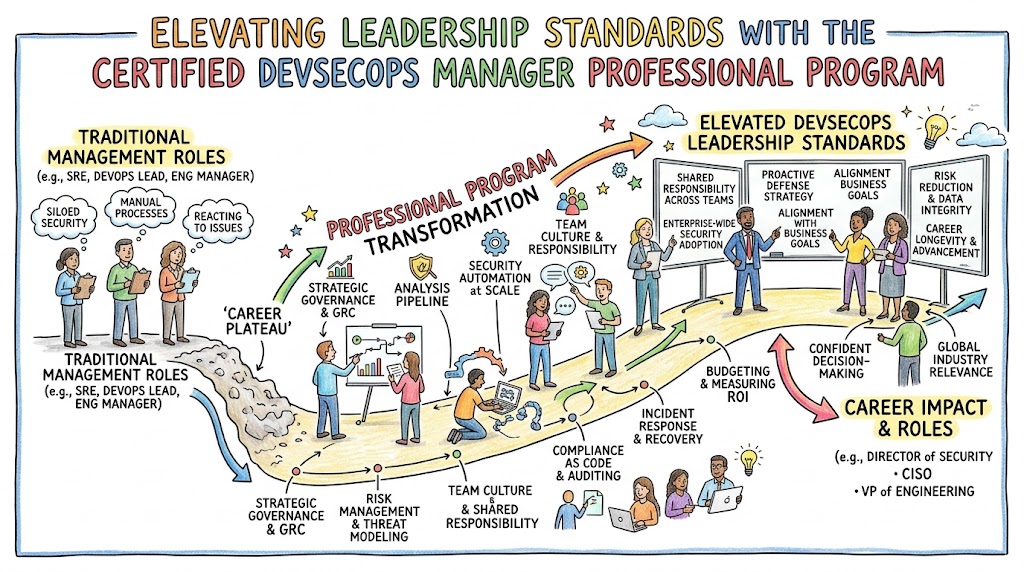
Contemporary software ecosystems require a complex combination of unbreakable security protocols and quick deployment.. The Certified DevSecOps Manager program effectively bridges the gap between technical execution and strategic leadership within cloud-native environments. This comprehensive guide serves professionals navigating the intricate intersection of DevSecOpsschool methodologies and platform engineering. By prioritizing governance, cultural transformation, and automated security, we empower managers to make informed decisions that align engineering speed with enterprise risk management.
What is the Certified DevSecOps Manager?
The Certified DevSecOps Manager stands as a premier leadership validation for those supervising the integration of security into the DevOps lifecycle. Technical expertise alone fails to manage the cultural and structural shifts required for a successful “shift-left” strategy. This program highlights real-world, production-focused learning and moves beyond theoretical frameworks to solve actual enterprise bottlenecks. It aligns perfectly with modern engineering workflows by teaching leaders how to implement automated compliance and security gates without hindering team performance.
Who Should Pursue Certified DevSecOps Manager?
Engineering managers, technical leads, and aspiring security directors who want to formalize their expertise in secure delivery should target this certification. SREs and senior cloud professionals moving into management roles will find the curriculum vital for handling large-scale infrastructure governance. It holds equal relevance for professionals in India and the global market where the demand for secure digital transformation remains at an all-time high. Even experienced security officers seeking to understand the operational side of the house will benefit from these practical management insights.
Why Certified DevSecOps Manager is Valuable and Beyond
The longevity of this certification comes from its focus on core principles and governance rather than temporary tool configurations. As enterprise adoption of cloud-native technologies grows, the need for leaders who can mitigate supply chain attacks and manage vulnerability backlogs becomes permanent. It helps professionals maintain relevance by providing a framework for managing security debt and fostering a shared responsibility culture. Ultimately, the return on investment manifests in higher organizational trust and the ability to lead high-stakes security initiatives with total confidence.
Certified DevSecOps Manager Certification Overview
The official training portal delivers the program, which is hosted on DevSecOpsschool. It utilizes a comprehensive assessment approach that validates a leader’s ability to drive security transformations in complex environments. Unlike entry-level certificates, this focus remains on ownership, policy creation, and the strategic oversight of the DevSecOps pipeline. The structure revolves around practical scenarios that managers face daily, ensuring the certification carries significant weight in real enterprise hiring and promotion cycles.
Certified DevSecOps Manager Certification Tracks & Levels
The certification structure transitions from foundational security principles to advanced strategic management levels. The foundation level introduces core concepts of the Three Ways of DevOps applied to security, while the professional level explores tool integration and metrics. Advanced tracks focus specifically on the management aspect, covering legal compliance, team leadership, and executive reporting. These levels align with a natural career progression from a senior individual contributor to a department head or CISO-track professional.
Complete Certified DevSecOps Manager Certification Table
| Track | Level | Who it’s for | Prerequisites | Skills Covered | Recommended Order |
| Leadership | Advanced | Engineering Managers | 5+ Years Exp | Governance & ROI | 3 |
| Implementation | Professional | DevSecOps Leads | 3+ Years Exp | Pipeline Security | 2 |
| Core | Foundation | Senior Engineers | Basic DevOps | Security Culture | 1 |
Export to Sheets
Detailed Guide for Each Certified DevSecOps Manager Certification
Certified DevSecOps Manager – Foundation
What it is
This certification validates a baseline understanding of how security integrates with continuous integration and deployment. It ensures the candidate understands the terminology and cultural shifts required for DevSecOps success.
Who should take it
Senior engineers and junior managers who are new to the security-specific aspects of the DevOps lifecycle should start here to build a solid conceptual base.
Skills you’ll gain
- Mastery of the DevSecOps Manifesto
- Identification of security bottlenecks in CI/CD
- Basic threat modeling for developers
Real-world projects you should be able to do
- Conduct a basic security culture audit for a small team
- Map out a standard pipeline with integrated security checkpoints
Preparation plan
- 7-14 Days: Review official documentation and manifestos.
- 30 Days: Participate in community webinars and practice exams.
- 60 Days: Not required for this level if the candidate has a DevOps background.
Common mistakes
Candidates often focus too much on specific security tools rather than the underlying process and cultural changes required for success.
Best next certification after this
- Same-track option: Certified DevSecOps Professional
- Cross-track option: SRE Foundation
- Leadership option: Certified DevSecOps Manager
Certified DevSecOps Manager – Professional
What it is
The Professional level validates the ability to implement and manage automated security tools within a live production environment. It focuses on the technical orchestration of security at scale.
Who should take it
Active DevSecOps leads and security engineers who hold responsibility for maintaining the health and compliance of the delivery pipeline.
Skills you’ll gain
- Automated SAST/DAST integration
- Container and orchestration security
- Vulnerability management and prioritization
Real-world projects you should be able to do
- Design an automated compliance-as-code framework
- Implement a zero-trust architecture for a microservices application
Preparation plan
- 7-14 Days: Complete hands-on labs with security scanning tools.
- 30 Days: Analyze case studies of enterprise security failures.
- 60 Days: Simulate a full secure software development life cycle.
Common mistakes
Failing to understand how security tools can impact pipeline velocity represents a common pitfall that leads to friction with development teams.
Best next certification after this
- Same-track option: Advanced Certified DevSecOps Manager
- Cross-track option: FinOps Practitioner
- Leadership option: Engineering Management Professional
Choose Your Learning Path
DevOps Path
The DevOps path emphasizes the seamless integration of development and operations with a focus on speed. Professionals on this path utilize the Certified DevSecOps Manager to ensure that “speed” does not sacrifice “safety.” This path builds the rails that allow developers to move fast without falling off the security cliff.
DevSecOps Path
This direct specialization path places security as the primary focus throughout the entire engineering lifecycle. It involves deep dives into supply chain security, secrets management, and automated auditing. This path suits those who want to serve as the primary authority on security within a technical organization.
SRE Path
Site Reliability Engineers use this certification to prevent security incidents from becoming availability incidents. Since a security breach essentially creates a major reliability failure, the SRE path focuses on the resilience and observability of security controls. This ensures that systems remain both secure and highly available under stress.
AIOps Path
In the AIOps path, professionals apply machine learning to security telemetry and incident response. The management aspect involves overseeing automated systems that detect anomalies and respond to threats in real-time. This path is essential for managing the massive data volumes generated by modern security logging.
MLOps Path
The MLOps path addresses unique security challenges of machine learning models, such as data poisoning and model inversion. A manager on this path ensures the data science pipeline remains as secure as the software delivery pipeline. It focuses on the governance of data sets and the integrity of deployed AI models.
DataOps Path
DataOps focuses on the secure and efficient flow of data across the organization. For a DevSecOps manager, this means ensuring data privacy, encryption at rest and in transit, and strict access controls. It manages the lifecycle of data with the same rigor applied to software code.
FinOps Path
The FinOps path intersects with security through the lens of resource optimization and cost-effective security tooling. Managers learn to balance the cost of expensive security suites against the risk profile of the organization. This ensures that security investments remain data-driven and provide a clear return on investment.
Role → Recommended Certified DevSecOps Manager Certifications
| Role | Recommended Certifications |
| DevOps Engineer | Certified DevSecOps Professional |
| SRE | SRE Practitioner + DevSecOps Foundation |
| Platform Engineer | Certified DevSecOps Manager |
| Cloud Engineer | Cloud Security Expert + DevSecOps |
| Security Engineer | Advanced Certified DevSecOps Manager |
| Data Engineer | DataOps Professional |
| FinOps Practitioner | FinOps Certified Professional |
| Engineering Manager | Certified DevSecOps Manager |
Export to Sheets
Next Certifications to Take After Certified DevSecOps Manager
Same Track Progression
After achieving the manager level, professionals should target CISO (Chief Information Security Officer) certifications or advanced governance frameworks. Deepening specialization in specific cloud provider security architectures, such as AWS or Azure Security Specialty, provides a more granular technical edge. This ensures the manager remains technically grounded while overseeing high-level strategy.
Cross-Track Expansion
Broadening skills into FinOps or SRE offers a well-rounded leadership profile. Understanding how security impacts the cloud bill or how it affects system latency allows a manager to speak the language of different departments. This cross-pollination of skills makes a leader much more effective at navigating corporate politics and budget discussions.
Leadership & Management Track
Those seeking executive roles should prioritize certifications in business administration or specialized technology leadership programs. Transitioning to leadership involves focusing more on people management, organizational design, and long-term strategic planning. These programs help convert technical security management skills into broad organizational leadership capabilities.
Training & Certification Support Providers for Certified DevSecOps Manager
DevOpsSchool
This provider offers extensive resources and instructor-led training tailored for various engineering roles. They focus on delivering practical knowledge through hands-on labs and real-world project scenarios that help students grasp complex concepts quickly. Their curriculum reflects the latest industry trends and toolsets used by top enterprise companies globally.
Cotocus
A specialized training organization that emphasizes technical depth and engineering excellence in cloud-native technologies. They provide immersive bootcamps and certification tracks that transform traditional IT professionals into modern DevOps and SRE experts. Their approach centers on the needs of the modern workforce and the evolving digital landscape.
Scmgalaxy
Known as a massive knowledge hub, this platform provides a wealth of community-driven content and professional certification guidance. They focus on the tools and processes that drive software configuration management and integrated delivery pipelines. It serves as an excellent resource for professionals seeking both foundational knowledge and advanced technical troubleshooting tips.
BestDevOps
This provider focuses on curated learning paths that simplify the journey toward becoming a senior engineer or manager. They emphasize industry “best practices,” ensuring that students learn the most efficient ways to manage infrastructure and security. Their training programs gain recognition for being concise, impactful, and directly applicable to job roles.
Devsecopsschool.com
As a primary source for security-integrated DevOps training, this site offers specialized certifications that cover the entire security lifecycle. The platform provides both technical skills and management frameworks necessary for modern secure delivery. It serves as a comprehensive portal for anyone looking to lead or implement DevSecOps strategies.
Sreschool.com
This platform dedicates itself to the discipline of Site Reliability Engineering, offering deep dives into availability, performance, and incident management. Their training bridges the gap between development and operations by focusing on the reliability of large-scale distributed systems. It acts as an essential resource for those looking to master the art of production operations.
Aiopsschool.com
Focusing on the future of operations, this provider teaches how to use artificial intelligence and machine learning to automate IT processes. The curriculum covers data science for operations, anomaly detection, and automated incident response systems. It stands as the go-to destination for engineers looking to leverage AI to improve organizational efficiency.
Dataopsschool.com
This site addresses the growing need for agile data management and secure data delivery across enterprise environments. They provide training on how to apply DevOps principles to data pipelines, ensuring quality, security, and speed. It suits data engineers and architects who want to modernize their data handling and governance practices.
Finopsschool.com
As organizations move to the cloud, managing costs becomes a critical challenge addressed by this provider. They teach the framework of cloud financial management, focusing on visibility, optimization, and operation. This training is vital for anyone responsible for the cloud budget or seeking to improve the financial efficiency of their infrastructure.
Frequently Asked Questions (General)
- How difficult is the Certified DevSecOps Manager exam?The exam presents a moderate challenge because it requires a mix of technical security knowledge and management theory.
- What is the typical time required to complete this certification?Most professionals with a DevOps background finish the program within 30 to 60 days of focused study.
- Are there any hard prerequisites for the manager level?While not always mandatory, we highly recommend at least three years of experience in engineering or security for proper context.
- Will this certification help me get a salary hike?Certification often serves as a key differentiator during annual reviews and when applying for high-level leadership positions.
- Is the exam format multiple-choice or performance-based?It typically involves a combination of scenario-based multiple-choice questions and practical project evaluations.
- How long does the certification remain valid?The certification usually remains valid for two to three years, after which you must complete recertification or continuing education.
- Does the program cover specific tools like Jenkins or GitLab?Yes, it covers the integration of security tools within these popular CI/CD platforms as part of the implementation modules.
- Can I take the training and exam entirely online?The program offers global accessibility and you can complete it fully online through the official portal.
- How does this certification differ from a standard DevOps certificate?This program places a specific and deep emphasis on security governance, risk management, and compliance automation.
- Is there community support available during the learning process?Yes, students gain access to forums and community groups to interact with mentors and other candidates.
- What is the ROI for an organization sponsoring this training?Organizations benefit from fewer security breaches, faster compliance audits, and a more robust, secure delivery culture.
- Are there practice tests available before the final attempt?Most training tracks include mock exams to help candidates gauge their readiness before the official assessment.
FAQs on Certified DevSecOps Manager
- Does this certification cover cloud-specific security for AWS or Azure?The curriculum focuses on cloud-agnostic principles and strategies that apply across all major cloud providers and hybrid environments.
- Is there a focus on legal compliance like GDPR or SOC2?Yes, a significant portion of the manager-level training involves learning how to automate evidence collection for global compliance standards.
- Can a non-technical manager pass this certification?While it focuses on management, you still need a foundational understanding of the software development lifecycle to grasp the technical challenges.
- How does this program handle the cultural aspect of DevSecOps?It provides specific frameworks and communication strategies to help managers break down silos between development, operations, and security teams.
- Is threat modeling part of the management curriculum?Absolutely, as a manager must understand how to lead threat modeling sessions and prioritize findings based on business risk.
- Does the certification involve learning about “Shift Left” strategies?Shift-left remains a core pillar of the program, teaching managers how to move security testing earlier in the development process.
- Are open-source security tools covered in the training?Yes, the program highlights various open-source tools for vulnerability scanning and license compliance to provide a cost-effective security outlook.
- What is the focus on DevSecOps metrics and reporting?Managers learn how to define and track Key Performance Indicators that demonstrate the health and maturity of their security integration.
Final Thoughts: Is Certified DevSecOps Manager Worth It?
As the industry shifts from manual deployments to completely automated cloud-native ecosystems, the “security bottleneck” continues to be the largest obstacle for businesses. The Certified DevSecOps Manager certification shows that you are capable of resolving this particular organizational conflict and is more than simply a credential. This route is quite beneficial if you want to transition from creating screenplays to a position where you have an impact on strategy. It compels you to consider the overall effects of velocity and risk. These insights offer useful and extremely pertinent answers to the problems of contemporary software delivery for people dedicated to a long-term career in engineering leadership.