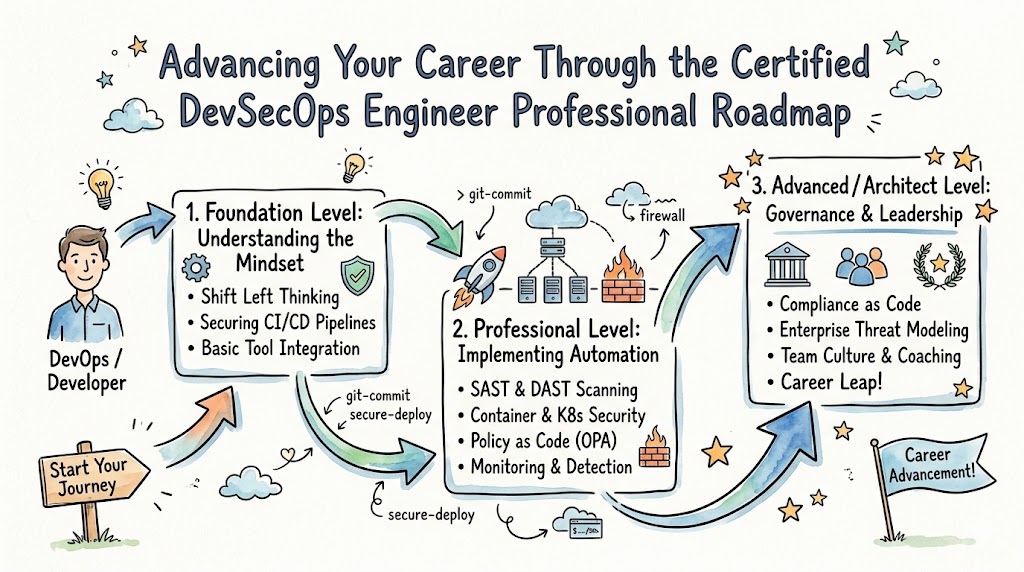
Introduction
To safeguard today’s software delivery pipeline, reactive audits must give way to proactive automations., which makes the Certified DevSecOps Engineer credential a vital career milestone. This guide provides a strategic roadmap for technical professionals who aim to master the integration of security within high-speed delivery environments. By adopting the specialized training from DevSecOpsschool, engineers learn to eliminate vulnerabilities early in the development process rather than treating security as a final roadblock. We will explore how this certification empowers you to lead digital transformations by bridging the gap between rapid innovation and robust organizational protection.
What is the Certified DevSecOps Engineer?
The Certified DevSecOps Engineer represents a professional standard that emphasizes the practical application of security-as-code within the DevOps ecosystem. It exists to validate that an engineer can transform static security policies into dynamic, automated guardrails that run inside a CI/CD pipeline. Rather than focusing on theoretical compliance, this program prioritizes hands-on mastery of tools that protect cloud-native applications and immutable infrastructure. It aligns perfectly with the needs of modern enterprises that require both deployment speed and uncompromising data safety in production environments.
Who Should Pursue Certified DevSecOps Engineer?
Cloud architects, SREs, and software developers who want to deepen their infrastructure security knowledge will find this path immensely rewarding. Security analysts who wish to transition into automation and engineering managers seeking to reduce technical debt also benefit significantly from the curriculum. In major tech hubs across India and the global market, these skills remain in high demand as organizations move away from manual security checks. Whether you are a junior engineer or a seasoned lead, this certification offers a clear trajectory for mastering the intersection of development and defense.
Why Certified DevSecOps Engineer is Valuable and Beyond
Modern businesses now prioritize rapid releases, which ensures the long-term relevance of engineers who can automate security without causing delays. This certification offers a significant return on investment because it teaches universal methodologies that apply across various cloud providers and toolsets. It helps you stay relevant in an evolving landscape where traditional security roles are rapidly merging with engineering functions. Holding this credential demonstrates your ability to manage risk proactively, making you a primary candidate for high-level technical roles in any forward-thinking organization.
Certified DevSecOps Engineer Certification Overview
Learners access the comprehensive program through the official course link and complete their training on the DevSecOpsschool platform. The certification utilizes a multi-tiered approach to validate that candidates can handle real-world security challenges in complex environments. It breaks down the DevSecOps lifecycle into logical phases, ensuring that you gain ownership over secrets management, vulnerability scanning, and compliance auditing. This practical structure ensures that every graduate can immediately implement secure workflows within their professional teams.
Certified DevSecOps Engineer Certification Tracks & Levels
The certification features three distinct levels—Foundation, Professional, and Advanced—to support continuous professional growth. The Foundation level introduces the essential cultural shift, while the Professional level focuses on the technical orchestration of security tools. Those who reach the Advanced level master the design of enterprise-wide security governance and policy-as-code frameworks. These levels align with a natural career progression, moving from implementing basic scanners to architecting global security strategies for large-scale cloud deployments.
Complete Certified DevSecOps Engineer Certification Table
| Track | Level | Who it’s for | Prerequisites | Skills Covered | Recommended Order |
| Core Ops | Foundation | New Practitioners | Basic IT Literacy | SCA, Secrets, Culture | 1 |
| Pipeline | Professional | DevOps / SREs | Foundation | SAST, DAST, Containers | 2 |
| Governance | Advanced | Leads / Architects | Professional | OPA, Compliance as Code | 3 |
Detailed Guide for Each Certified DevSecOps Engineer Certification
Certified DevSecOps Engineer – Foundation
What it is
This level confirms your understanding of the essential principles that make DevSecOps successful in a modern organization. It focuses on the cultural changes and baseline security checks necessary for a secure software lifecycle.
Who should take it
Junior developers, system administrators, and recent graduates who want to specialize in secure automation should start here. It serves as an ideal entry point for anyone moving into cloud-native engineering roles.
Skills you’ll gain
- Mastery of “Shift Left” security concepts.
- Basic Software Composition Analysis (SCA) techniques.
- Identifying and managing secrets within Git repositories.
- Implementing collaborative security practices between teams.
Real-world projects you should be able to do
- Perform a security scan on open-source dependencies in a small project.
- Set up automated triggers to prevent sensitive keys from leaking into code.
- Create a documentation framework for a secure development workflow.
Preparation plan
- 7–14 days: Review the core definitions of DevSecOps and study basic automation tools.
- 30 days: Engage with fundamental hands-on labs and participate in community forums.
- 60 days: Most candidates complete this level in under two months of focused study.
Common mistakes
- Ignoring the cultural aspect and focusing only on technical tools.
- Overlooking the importance of basic Git security.
Best next certification after this
- Same-track option: Professional DevSecOps Engineer.
- Cross-track option: SRE Foundation.
- Leadership option: DevOps Lead.
Certified DevSecOps Engineer – Professional
What it is
The Professional tier validates your ability to build and maintain end-to-end automated security pipelines. It focuses on the technical integration of scanning and hardening tools within production CI/CD environments.
Who should take it
Experienced DevOps engineers and security professionals who manage cloud infrastructure should pursue this certification. It requires a working knowledge of containerization and orchestration platforms.
Skills you’ll gain
- Advanced integration of SAST and DAST tools.
- Hardening Docker images and Kubernetes configurations.
- Implementing automated runtime security monitoring.
- Remediating vulnerabilities across multiple environments.
Real-world projects you should be able to do
- Construct a Jenkins or GitLab pipeline that fails upon detecting critical flaws.
- Design a hardened container base image for a microservices architecture.
- Automate dynamic scans for web applications in a staging environment.
Preparation plan
- 7–14 days: Study the API-driven integration patterns for popular security tools.
- 30 days: Build multiple end-to-end pipelines using real-world scenarios.
- 60 days: Deep dive into container security and network policy automation.
Common mistakes
- Configuring tools with excessive false positives that frustrate developers.
- Neglecting the security of the infrastructure-as-code scripts.
Best next certification after this
- Same-track option: Advanced DevSecOps Architect.
- Cross-track option: Cloud Security Specialist.
- Leadership option: DevSecOps Manager.
Certified DevSecOps Engineer – Advanced
What it is
This certification recognizes individuals who can design and govern high-level security architectures for entire enterprises. It emphasizes strategy, compliance-as-code, and complex risk mitigation across hybrid clouds.
Who should take it
Senior architects, technical directors, and leads who oversee multiple engineering teams should take this course. It is for those who define the security standards for the whole organization.
Skills you’ll gain
- Automating compliance audits using policy engines like OPA.
- Advanced threat modeling for distributed cloud systems.
- Designing and implementing Zero Trust architectures.
- Orchestrating automated security incident responses at scale.
Real-world projects you should be able to do
- Create a multi-cloud security governance framework for a global company.
- Automate the auditing of major regulations like SOC2 or GDPR.
- Develop a proactive threat modeling strategy for complex microservices.
Preparation plan
- 7–14 days: Research enterprise compliance frameworks and policy-as-code tools.
- 30 days: Practice designing complex architectures and writing security policies.
- 60 days: Finalize your mastery of Zero Trust and automated response systems.
Common mistakes
- Focusing too heavily on a single cloud provider’s native features.
- Overlooking the cost implications of complex security architectures.
Best next certification after this
- Same-track option: Security Governance Professional.
- Cross-track option: FinOps Certified Practitioner.
- Leadership option: CISO / Technical Director.
Choose Your Learning Path
DevOps Path
Engineers following the DevOps path prioritize the integration of security layers into existing CI/CD workflows. You will learn how to provide immediate security feedback to developers without sacrificing deployment speed. This approach ensures that security becomes a natural and invisible extension of the software release process.
DevSecOps Path
Candidates choosing this track focus exclusively on becoming specialized security automation experts. You will spend your time mastering vulnerability management, automated compliance auditing, and container runtime protection. This path prepares you to lead security-first engineering initiatives in complex production environments.
SRE Path
Site Reliability Engineers use this path to connect system uptime with robust security hardening. You will focus on how security vulnerabilities impact system reliability and build automated recovery systems for security incidents. This track ensures that your infrastructure remains both safe and highly available.
AIOps Path
Professionals in the AIOps section explore how machine learning enhances modern security operations. You will learn to use AI models to detect patterns of abnormal behavior that might indicate a sophisticated cyber attack. This path prepares you for the next generation of intelligent, self-healing security systems.
MLOps Path
Securing the machine learning lifecycle involves protecting sensitive training data and the integrity of AI models. This path teaches you how to prevent model poisoning and ensure that AI deployments comply with strict privacy standards. You will focus on the unique security challenges of the data science world.
DataOps Path
Data engineers use this specialization to protect sensitive information as it flows through complex analytics pipelines. You will learn to automate data masking, encryption, and access control for large-scale data platforms. This ensures that your organization remains compliant while leveraging data for insights.
FinOps Path
The FinOps path teaches you to balance the cost of security with the need for robust protection. You will learn to evaluate the financial efficiency of various security tools and ensure that automated guardrails do not create unnecessary cloud expenses. This path creates a cost-aware security professional.
Role → Recommended Certified DevSecOps Engineer Certifications
| Role | Recommended Certifications |
| DevOps Engineer | Foundation + Professional |
| SRE | Professional + Advanced |
| Platform Engineer | Professional + Advanced |
| Cloud Engineer | Foundation + Professional |
| Security Engineer | Professional + Advanced |
| Data Engineer | Foundation + DataOps Path |
| FinOps Practitioner | Foundation + FinOps Path |
| Engineering Manager | Foundation |
Next Certifications to Take After Certified DevSecOps Engineer
Same Track Progression
Specializing further involves pursuing advanced designations in niche areas like container runtime security or serverless protection. You can also explore expert-level courses that focus on specific industry regulations or advanced penetration testing automation.
Cross-Track Expansion
Broadening your expertise into SRE or FinOps makes you a much more versatile platform leader. When you understand how security affects both system uptime and the corporate budget, you become an invaluable asset for executive decision-making.
Leadership & Management Track
For those aiming for C-suite roles, certifications in technical management and enterprise governance are the logical next steps. These programs help you shift from managing technical tasks to leading the entire security strategy for an organization.
Training & Certification Support Providers for Certified DevSecOps Engineer
DevOpsSchool offers an extensive range of hands-on sessions and resources for engineers seeking technical excellence. Their curriculum focuses on real-world scenarios that allow students to implement security automation immediately in their jobs.
Cotocus provides specialized training in cloud-native technologies, emphasizing the security needs of Kubernetes and Docker environments. Their approach helps engineers master the complexities of modern infrastructure defense.
Scmgalaxy remains a top community and training hub for configuration management and CI/CD security. They offer a wealth of free and paid resources that support practitioners at every career level.
BestDevOps focuses on practical coaching that helps teams transition from manual security audits to automated DevSecOps workflows. Their trainers provide deep insights based on years of industry-leading experience.
Devsecopsschool.com serves as the primary home for these certifications, offering a direct and structured path to becoming a security automation expert. They cover the entire spectrum of secure engineering.
Sreschool.com teaches engineers how to maintain high availability through robust security and reliability practices. Their training ensures that your systems remain safe from both outages and attacks.
Aiopsschool.com leads the way in teaching the application of artificial intelligence to IT operations and security. Their courses prepare you for a future where AI handles the bulk of threat detection.
Dataopsschool.com focuses specifically on the security and efficiency of data pipelines. Their programs help data engineers protect sensitive information throughout the entire analytics lifecycle.
Finopsschool.com addresses the intersection of cloud costs and operational security. Their training helps you build a secure infrastructure that remains financially sustainable and optimized.
Frequently Asked Questions (General)
- How difficult is the Certified DevSecOps Engineer exam?
The exam presents a moderate challenge because it tests your ability to apply security tools in practical, real-world scenarios.
- How much time should I set aside for preparation?
Most candidates find that 30 to 60 days of focused study provides enough time to master the core concepts and labs.
- Can I take this course without prior security experience?
Yes, the Foundation level covers the necessary basics, although some familiarity with Linux and Git will help you significantly.
- Will this certification increase my salary?
Certified professionals often see significant pay raises, as DevSecOps remains one of the highest-paying domains in the tech industry.
- Is the Foundation level mandatory for everyone?
While not always required, the Foundation level provides the essential cultural context that many experienced engineers lack.
- Are these certifications recognized by global companies?
Yes, the program follows international standards and best practices used by leading technology firms worldwide.
- Does the program include practical lab exercises?
Yes, you will spend most of your time in hands-on labs that simulate real production security challenges.
- How often must I renew my certification?
Recertification typically occurs every few years to ensure your skills keep pace with the rapidly changing security landscape.
- Which specific tools does the training cover?
The curriculum includes popular industry tools like Jenkins, GitLab, SonarQube, Vault, and Docker security scanners.
- Is this certification valuable for engineering managers?
Yes, the Foundation level helps managers understand the technical and cultural requirements of a successful DevSecOps team.
- How does this differ from traditional cybersecurity courses?
Traditional courses often focus on perimeter defense, while this certification focuses on automating security within the code itself.
- Is there a community for student collaboration?
Yes, students gain access to forums and groups where they can share insights and get help from mentors.
FAQs on Certified DevSecOps Engineer
- Does the course cover security for Kubernetes?
Yes, the program places a heavy emphasis on hardening container orchestration platforms and securing microservices.
- What is the main focus of the Professional exam?
The Professional level focuses on your ability to technically integrate and automate security tools within a CI/CD pipeline.
- Will I learn about Compliance as Code?
Yes, the Advanced level teaches you how to use policy engines to automate and enforce organizational compliance standards.
- Do I need to be an expert coder for these certifications?
You do not need to be a senior developer, but basic scripting skills in Python or Bash are very beneficial.
- Does the training address cloud-specific security?
Yes, the courses cover security practices for major cloud providers while maintaining a focus on platform-agnostic tools.
- Are the labs accessible from any computer?
Most labs are cloud-based, allowing you to access them from any standard web browser without complex local setups.
- What support do I receive if I fail a lab?
You will have access to technical support and community mentors who can guide you through difficult technical hurdles.
- Can this certification help me move into an Architect role?
Absolutely, the Advanced level specifically prepares you for high-level architectural design and security governance roles.
Final Thoughts: Is Certified DevSecOps Engineer Worth It?
Instead than seeing this certification as merely another badge, prospective candidates should see it as a strategic investment in the future of software engineering. The industry currently needs the unique combination of deep technical competence and cultural insight offered by the Certified DevSecOps Engineer curriculum. The need for engineers who can integrate security into the process will only expand as companies continue to increase the frequency of deployments. This approach is the most straightforward way to become a leader in the cloud-native era. It gives you the ability to create systems that are not only dependable and quick, but also essentially safe from the first line of code.