Introduction
Contemporary software ecosystems necessitate thorough, granular visibility into every transaction, not just basic uptime checks. Professionals that oversee intricate, distributed cloud infrastructures might benefit from the demanding technical framework offered by the Master of Observability Engineering (MOE). This book is intended for platform architects, developers, and SREs who wish to move from simple monitoring to sophisticated telemetry and tracing. By following this course at DevOpsSchool, you will acquire the skills necessary to identify performance bottlenecks and provide high availability for enterprise systems used worldwide. We assist you in navigating the necessary credentials and competencies required to lead in the era of cloud-native engineering.
What is the Master in Observability Engineering (MOE)?
The Master in Observability Engineering (MOE) represents a specialized domain that focuses on understanding system behavior through external outputs. It exists because traditional monitoring fails to explain the “why” behind failures in microservices and serverless architectures. This program prioritizes hands-on production experience, teaching engineers how to instrument applications for maximum transparency. It aligns perfectly with modern engineering workflows where high-cardinality data and distributed context drive rapid incident resolution.
Who Should Pursue Master in Observability Engineering (MOE)?
Cloud architects, SREs, and DevOps practitioners find the most immediate value in this engineering specialization. Similarly, security analysts and data engineers use these skills to identify anomalies and audit data flows across multi-cloud environments. This learning path supports both aspiring engineers in India and seasoned global professionals who oversee mission-critical infrastructure. Even technical managers benefit by learning how to use telemetry data to make informed resource and architectural decisions.
Why Master in Observability Engineering (MOE) is Valuable and Beyond
The tech industry faces a growing shortage of experts who can navigate complex telemetry pipelines and distributed tracing. This mastery ensures long-term career relevance because the core principles of observability apply regardless of the specific vendor or cloud provider you use. Furthermore, as organizations adopt more complex containerized stacks, they require specialized visibility to maintain service level agreements. Investing in this certification yields a high return through reduced downtime and improved developer productivity.
Master in Observability Engineering (MOE) Certification Overview
DevOpsSchool delivers this program through a structured curriculum hosted on their official training platform. The certification utilizes a practical, lab-based assessment model that tests your ability to build and scale observability stacks. It breaks down technical concepts into manageable modules, ensuring a smooth progression from basic metrics to advanced data analysis. This approach guarantees that every certified engineer possesses the technical rigor required for high-stakes production environments.
Master in Observability Engineering (MOE) Certification Tracks & Levels
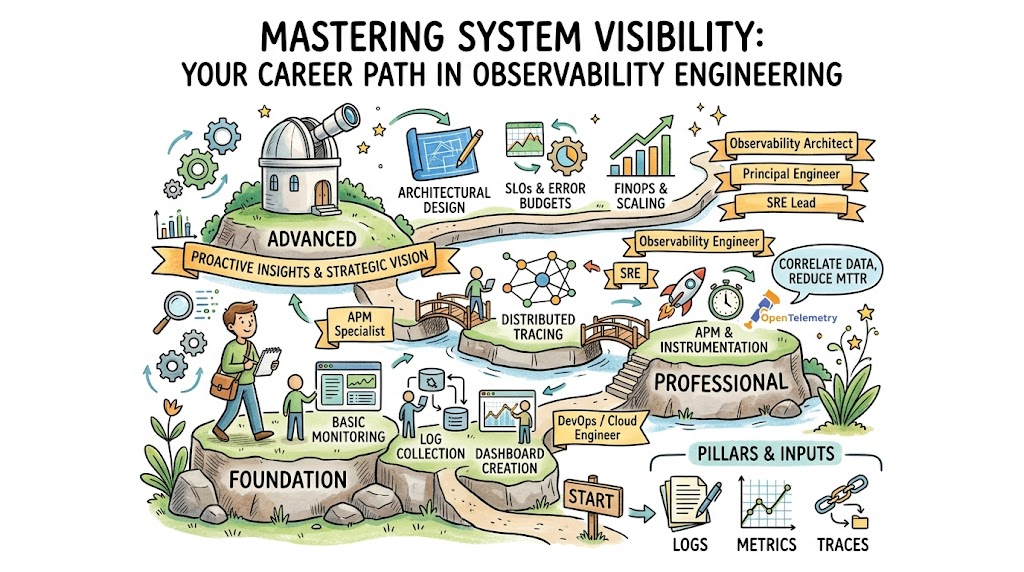
The program offers a clear growth trajectory through three primary tiers: Foundation, Professional, and Advanced. Beginners start with the core pillars of observability, while mid-career engineers focus on query languages and instrumentation. The advanced tier addresses enterprise strategy, cost optimization, and high-level architectural design. These levels allow you to align your professional development with your current job responsibilities and long-term career aspirations.
Complete Master in Observability Engineering (MOE) Certification Table
| Track | Level | Who it’s for | Prerequisites | Skills Covered | Recommended Order |
| Core Telemetry | Foundation | Junior DevOps/SRE | Linux & Cloud | Metrics, Logs, Traces | 1 |
| Engineering | Professional | Active SREs | Foundation Cert | PromQL & Jaeger | 2 |
| Architecture | Advanced | Tech Leads | Professional Cert | Scaling & Pipelines | 3 |
| Specialization | Expert | Principal Leads | Advanced Cert | eBPF & AIOps | 4 |
Detailed Guide for Each Master in Observability Engineering (MOE) Certification
Master in Observability Engineering (MOE) – Foundation Level
What it is
This certification validates your understanding of the three pillars of observability. It proves you can navigate basic monitoring tools and interpret essential system health data.
Who should take it
Junior developers and aspiring DevOps engineers should start here to build a solid technical baseline in system visibility.
Skills you’ll gain
- Defining metrics, logs, and traces
- Configuring basic monitoring agents
- Navigating standard dashboards
- Understanding log levels and formatting
Real-world projects you should be able to do
- Setting up a Prometheus instance to scrape node metrics
- Creating a basic Grafana dashboard for a web server
- Configuring log rotation and aggregation for a small app
Preparation plan
- 7–14 days: Study the core definitions and history of observability.
- 30 days: Complete hands-on labs for installing agents and exporters.
- 60 days: Build a functional monitoring stack for a sample application.
Common mistakes
- Relying too heavily on a single pillar (like just logs)
- Neglecting the overhead cost of monitoring agents
- Failing to define what “healthy” looks like before setting alerts
Best next certification after this
- Same-track: Professional Level MOE
- Cross-track: Kubernetes Foundation
- Leadership: Junior Team Lead
Master in Observability Engineering (MOE) – Professional Level
What it is
This level confirms your ability to manage production-grade observability for distributed systems. It focuses on reducing Mean Time to Repair (MTTR) through advanced data correlation.
Who should take it
Mid-level SREs and DevOps professionals who manage microservices and are responsible for on-call rotations.
Skills you’ll gain
- Writing advanced PromQL and LogQL queries
- Implementing distributed tracing in multi-language apps
- Tuning alerts to reduce noise and fatigue
- Correlating data across different platforms
Real-world projects you should be able to do
- Implementing a distributed tracing solution like Jaeger
- Designing custom metrics for business logic tracking
- Managing high-cardinality data in a production cluster
Preparation plan
- 7–14 days: Deep dive into advanced query languages and alerting logic.
- 30 days: Practice instrumenting code with OpenTelemetry.
- 60 days: Implement an end-to-end observability pipeline for a microservices app.
Common mistakes
- Collecting too much data without a clear use case
- Failing to automate the deployment of observability tools
- Creating brittle alerts that cause unnecessary pagers
Best next certification after this
- Same-track: Advanced Level MOE
- Cross-track: DevSecOps Engineer
- Leadership: SRE Manager
Master in Observability Engineering (MOE) – Advanced Level
What it is
This certification assesses your capacity to design enterprise-wide observability strategies. It covers high-level architecture, vendor management, and financial optimization.
Who should take it
Senior architects and technical directors who standardize observability across multiple product teams and business units.
Skills you’ll gain
- Architecting scalable telemetry pipelines
- Implementing enterprise SLO/SLI frameworks
- Optimizing observability costs and data retention
- Leading the cultural shift toward observability-first development
Real-world projects you should be able to do
- Designing a centralized logging hub for a global organization
- Establishing an error budget policy for critical services
- Evaluating and selecting observability vendors vs. open-source
Preparation plan
- 7–14 days: Study architectural patterns for high-volume data ingestion.
- 30 days: Review FinOps principles related to cloud observability.
- 60 days: Draft a complete observability roadmap for a large enterprise.
Common mistakes
- Underestimating the cost of data egress and storage
- Forgetting the human element and cultural adoption
- Over-engineering the solution for simple environments
Best next certification after this
- Same-track: Expert Specialization
- Cross-track: FinOps Certified Practitioner
- Leadership: VP of Engineering / CTO
Choose Your Learning Path
DevOps Path
Engineers on this track focus on integrating observability into the CI/CD pipeline. You will learn how to use metrics to gate releases and verify performance before code reaches production. This ensures that every deployment remains visible and measurable from day one.
DevSecOps Path
This specialty uses telemetry data to enhance security monitoring and threat detection. You will learn how to identify unauthorized access or configuration changes through logs and traces. This approach transforms standard operations data into a powerful security asset.
SRE Path
Reliability engineers focus on maintaining strict service level objectives (SLOs). This path teaches you how to use observability to manage error budgets and perform blameless post-mortems. You will gain the skills to keep massive systems running smoothly.
AIOps Path
This path explores the intersection of machine learning and system operations. You will learn how to use AI models to detect anomalies and reduce alert noise automatically. This allows your team to focus on high-value architectural improvements.
MLOps Path
Observability in MLOps ensures that machine learning models perform accurately in production. You will learn how to monitor for data drift and model decay over time. This path ensures that AI-driven features provide consistent business value.
DataOps Path
Data engineers focus on the health and throughput of data pipelines. This path teaches you how to observe data flows and detect bottlenecks in ETL processes. You will ensure that your organization’s data remains clean, accurate, and timely.
FinOps Path
The FinOps track connects technical observability with cloud cost management. You will learn how to track the financial impact of every request and optimize resource usage. This allows you to prove the financial efficiency of your technical decisions.
Role → Recommended Master in Observability Engineering (MOE) Certifications
| Role | Recommended Certifications |
| DevOps Engineer | Foundation + Professional MOE |
| SRE | Professional + Advanced MOE |
| Platform Engineer | Professional + Advanced MOE |
| Cloud Engineer | Foundation + Professional MOE |
| Security Engineer | Professional MOE + DevSecOps |
| Data Engineer | Professional MOE + DataOps |
| FinOps Practitioner | Professional MOE + FinOps |
| Engineering Manager | Advanced MOE + Leadership |
Next Certifications to Take After Master in Observability Engineering (MOE)
Same Track Progression
Continue your journey by specializing in emerging technologies like eBPF-based monitoring or service mesh telemetry. These advanced topics allow you to see deeper into the kernel and network layers. Staying updated with these trends keeps you at the forefront of the infrastructure field.
Cross-Track Expansion
Expand your impact by combining observability with security or cost management domains. Understanding how visibility affects compliance or cloud budgets makes you a more versatile and valuable engineer. This broader perspective helps you solve complex, multi-departmental problems.
Leadership & Management Track
Transition into leadership roles by focusing on strategic planning and team culture. You should look for certifications that emphasize operational excellence and technical management. This path prepares you to lead large engineering teams through digital transformations.
Training & Certification Support Providers for Master in Observability Engineering (MOE)
DevOpsSchool
Experienced mentors at DevOpsSchool lead students through a curriculum built on real-world production challenges. They provide high-quality lab environments where you can practice setting up and scaling observability stacks. Their courses offer the most direct path to mastering the MOE certification requirements with expert guidance.
Cotocus
Cotocus offers interactive training sessions that emphasize hands-on cloud-native engineering. They provide flexible learning modules that cater to both beginners and advanced practitioners. Their instructors bring deep consulting experience to help you solve complex architectural problems.
Scmgalaxy
This community-focused platform provides a wealth of tutorials, forums, and practice exams. They foster a collaborative environment where you can learn from peers and stay updated on the latest open-source observability trends.
BestDevOps
BestDevOps bridges the gap between technical knowledge and career advancement. They offer comprehensive training programs designed to help you succeed in the global job market. Their focus on practical application ensures you are ready for day-one production tasks.
devsecopsschool.com
This provider specializes in merging security monitoring with operational visibility. Their training teaches you how to use telemetry to maintain a robust security posture. It is the perfect place for engineers who want to excel in DevSecOps.
sreschool.com
Sreschool focuses entirely on the reliability aspect of engineering. They treat observability as the core pillar for managing service levels and reducing operational toil. Their courses provide the technical depth required for top-tier SRE roles.
aiopsschool.com
Aiopsschool leads the way in teaching automated operations through artificial intelligence. They show you how to apply machine learning to your observability data for predictive maintenance. This provider prepares you for the future of intelligent IT.
dataopsschool.com
This platform focuses on the observability needs of high-scale data pipelines. They teach you how to monitor data quality and lineage to ensure reliable information flow. It is a vital resource for modern data engineers.
finopsschool.com
Finopsschool teaches you how to correlate technical performance with cloud expenditures. They provide the framework needed to optimize infrastructure spending without sacrificing application speed. This training is essential for cloud budget owners.
Frequently Asked Questions (General)
- How does the MOE certification help my job search?
Recruiters prioritize candidates who can demonstrate deep technical insights into system health. This certification proves you possess the specialized skills required for senior reliability roles.
- Is the final exam entirely multiple-choice?
No, the assessment includes a significant lab-based component where you solve real production scenarios. This ensures you can apply theory to actual infrastructure.
- Can I skip the Foundation level?
You should start at the Foundation level unless you already have significant professional experience with metrics, logs, and tracing. This ensures you build a solid knowledge base.
- Do I need to pay for external cloud accounts during training?
DevOpsSchool usually provides the necessary lab environments, but having a personal cloud account for practice often helps. Check with your specific provider for details.
- Is this program suitable for fresh graduates?
Graduates with a strong understanding of computer science fundamentals can start at the Foundation level. It gives you a massive competitive edge in the job market.
- What is the typical passing score for these certifications?
Passing scores usually hover around 70%, but the practical lab performance often carries the most weight. You must demonstrate functional competency.
- How does this differ from a Kubernetes certification?
While Kubernetes certifications focus on orchestration, MOE focuses on seeing and understanding everything happening inside and outside those containers.
- Is there a community group for MOE students?
Yes, you gain access to exclusive forums and Slack channels where you can network with other engineering professionals.
- Does the program cover Prometheus and Grafana?
Yes, these tools form the core of the hands-on labs in both the Foundation and Professional levels.
- Can I renew my certification after it expires?
Most providers require a refresher course or an updated exam every few years to ensure your skills stay current with industry changes.
- Are the instructors actual engineers?
Yes, DevOpsSchool uses industry veterans who currently work in high-level SRE or DevOps roles at global enterprises.
- Will I learn about distributed tracing?
Absolutely, distributed tracing represents a major pillar of the MOE curriculum, especially in the Professional level.
FAQs on Master in Observability Engineering (MOE)
- Does this program teach the differences between monitoring and observability?
Yes, we clarify that monitoring identifies simple failures while observability provides the tools to investigate the “why” behind complex system behavior.
- How does the curriculum handle high-cardinality data?
You will learn advanced strategies to manage and query high-cardinality data without overwhelming your telemetry backend or blowing your budget.
- Will I gain experience with OpenTelemetry (OTel)?
OpenTelemetry serves as the primary standard taught in this course for collecting metrics, logs, and traces in a vendor-neutral way.
- Does the program address the financial cost of observability?
Yes, especially in the Advanced and FinOps tracks, where you learn to balance data collection with storage costs and business value.
- How does observability improve the incident response process?
By providing deep context immediately, observability reduces the time spent on “finger-pointing” and helps teams find the root cause much faster.
- Is tracing mandatory for microservices?
While not mandatory, you will learn why tracing remains the only effective way to visualize request paths in complex distributed architectures.
- Does the program cover alerting strategies?
We teach you how to create symptom-based alerts that reduce fatigue and focus your team on issues that actually affect the user experience.
- Can I use these skills on legacy monolithic applications?
Yes, the principles of instrumentation apply to any system, and the course provides examples of adding visibility to older application architectures.
Final Thoughts: Is Master in Observability Engineering (MOE) Worth It?
Taking the leap into observability engineering transforms you from a reactive troubleshooter into a proactive system architect. The ability to look into a digital “black box” and explain its internal state is a superpower in today’s microservices-driven world. This master’s path demands discipline and a willingness to learn complex data patterns, but it rewards you with unparalleled career longevity. If you want to stand out in a crowded DevOps market, mastering the art of visibility is your best strategy. Commit to this path today and lead your organization toward a more reliable and transparent future.